
Project Details
The Result at a Glance
01
- 300+
Monthly Sales The account reached more than 300 conversions per month as the campaign structure matured. - 10.18
ROAS Monthly return on ad spend reached 10.18, showing strong revenue efficiency at scale.
02
- £900K+
Monthly Revenue The account generated more than £900K in monthly conversion value. - £96.5K
Monthly Spend The reported monthly advertising spend was £96.5K.
About the Client
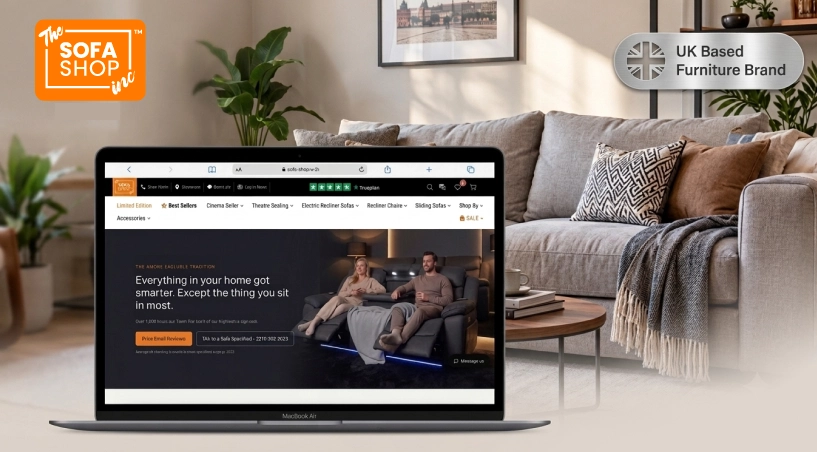
The Sofa Shop is a UK-based furniture company that has already been successful in selling its furniture through brick-and-mortar stores until it expanded its reach through the online platform in 2022. While the online expansion offered a great opportunity to reach out to many more customers, it posed a challenge of competition in the crowded search engine marketing environment. Google Ads needed to play an integral role in this online growth of The Sofa Shop, with an emphasis on sales rather than website visits.
The Challenge
The main challenge was to turn an unused Google Ads account into a scalable e-commerce sales channel while building reliable data from the ground up.
- The existing Google Ads account had not been actively utilized.
- Campaigns, ad groups, and tracking needed to be built from scratch.
- There was no meaningful performance data to guide optimization.
- The account needed to attract high-intent customers ready to purchase..
- Keywords and ads needed to be structured around relevant product searches.
- The campaigns needed to scale sales while maintaining a strong ROAS.
- A scalable Shopping campaign structure needed to be introduced as the account grew.
Goal & Objectives
The goal was to build a Google Ads operation capable of generating consistent online sales and then scale it without losing sight of return on ad spend. Because the account was effectively starting from scratch, the first priority was to establish reliable tracking and a sensible campaign foundation before expanding into broader product advertising.
- Build the Google Ads account and tracking infrastructure from the ground up.
- Capture high-intent demand through well-structured Search campaigns.
- Organize products and keywords around clear themes.
- Create relevant, product-focused ad messaging and supporting ad assets.
- Establish reliable conversion tracking so sales can be measured accurately.
- Use Search campaign data to identify opportunities for scaling.
- Introduce Shopping campaigns to place products directly in Google's Shopping feed.
- Grow online sales while maintaining a strong ROAS.
Our Strategy
We built the account in stages. Search came first because it allowed us to reach shoppers already expressing strong purchase intent and gave us useful data about the terms generating demand. Once the account had a working foundation and enough information to guide the next stage, we expanded into Standard Shopping so the product catalogue could appear directly in Shopping results.
Built the Google Ads Foundation
Objective: Create the infrastructure required to measure and manage paid traffic properly from day one.
Approach: We configured the account structure, established conversion tracking, and made sure key sales actions could be measured. The setup was planned around the client's products and commercial priorities.
Outcome: The account had a dependable foundation for launching campaigns, measuring sales, and making optimization decisions from real data.
Launched High-Intent Search Campaigns
Objective: Start capturing customers already searching for relevant furniture and sofa products.
Approach: We launched Search campaigns first, focusing on high-intent queries where users were actively looking for products. Search gave us control over targeting, ad messaging, and budget while generating useful conversion data.
Outcome: The campaigns began generating the data needed to understand demand and identify strong opportunities for growth.
Created Tightly Themed Ad Groups
Objective: Keep keywords closely related so each ad could speak directly to the search behind it.
Approach: We organized the account into tightly themed groups, generally keeping around 5–10 closely related keywords in each group. This made it easier to align search terms with relevant product messaging.
Outcome: The tighter structure improved control and made ongoing testing and optimization more practical.
Used Relevant Ad Extensions
Objective: Give shoppers additional information and useful ways to interact with the business from the search result.
Approach: We used relevant ad assets and extensions according to each campaign's needs, focusing on information that supported the product and campaign message.
Outcome: The ads became more informative and gave potential customers more context before reaching the website.
Expanded into Standard Shopping
Objective: Put the product catalogue directly in front of shoppers using Google's Shopping feed.
Approach: After the Search campaigns had been running and we had gathered useful performance data, we introduced new Standard Shopping campaigns. The product feed and campaign setup were used to make the catalogue visible in Shopping results and reach customers further along the purchase journey.
Outcome: Shopping opened a new acquisition route for the online store and gave us another way to scale product sales beyond traditional Search ads.
Scaled Around Performance
Objective: Increase sales volume while keeping efficiency under control as the account grew.
Approach: As the campaigns generated more conversion data, we used performance trends to guide budget allocation and optimization. Stronger areas received greater attention while targeting and campaign structure continued to be refined.
Outcome: The account moved from an unused Google Ads setup into a high-volume sales channel, reaching 300+ monthly conversions and a 10.18 ROAS.
The Takeaways
The Sofa Shop campaign is a good example of why e-commerce Google Ads should be built in stages. We first established tracking, built Search campaigns around high-intent demand, organized the account so it could be managed properly, and then used the data from that first phase to guide the move into Shopping.