Google Ads campaigns often struggle to reach the right customers even after selecting relevant search terms. Ads may appear for unrelated searches, attracting invalid potential customers. One such cause of this problem can be the selection of match types of the keywords.
Google Ads offers three primary keyword match types serving different purposes. Understanding them can help you connect with relevant searchers, manage your advertising budget, and make better campaign decisions.
Read this blog to learn more about how these match types work and how to choose the right one for your advertising campaigns.
Key Takeaways
- The keyword match types provided by Google Ads include Broad Match, Phrase Match, and Exact Match.
- Broad Match focuses on targeting search terms related to your selected keywords.
- Google considers factors like search intent, keyword relevance, and landing page content when determining keyword matching.
- When multiple keywords are eligible, Google follows keyword prioritization rules to determine which keyword is selected.
- Regularly reviewing the Search Terms report helps identify irrelevant searches and refine keyword targeting.
- Combining suitable match types with negative keywords and conversion tracking can help improve campaign performance.
What Are Keyword Match Types in Google Ads?
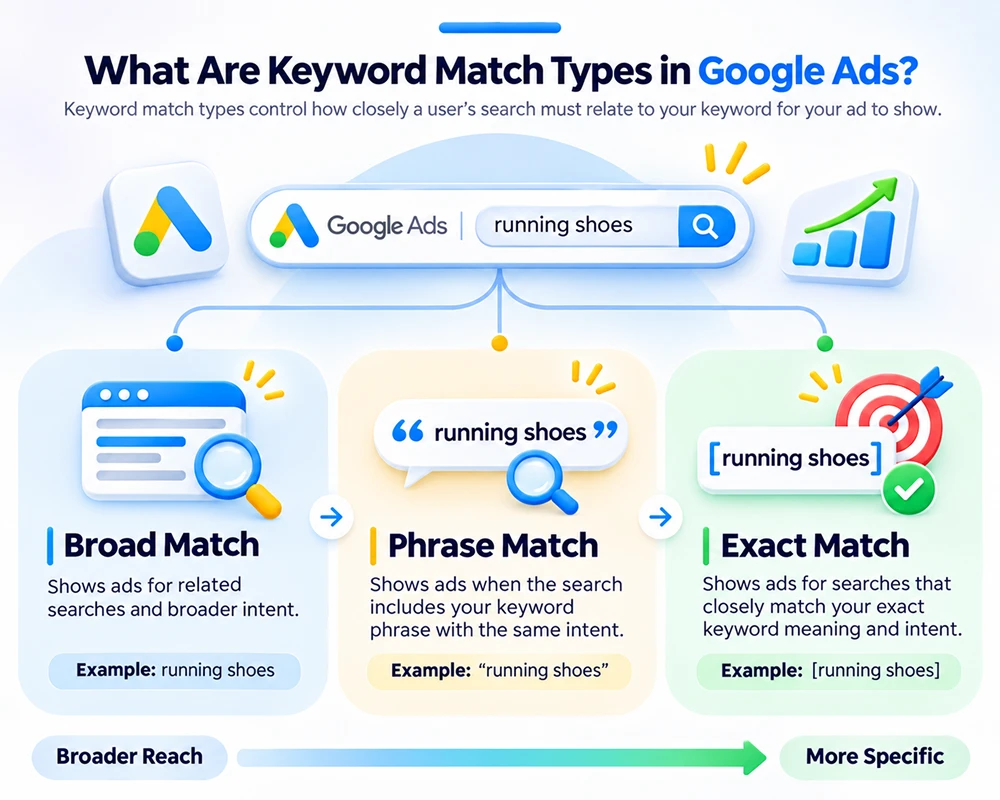
Keyword match type refers to settings that indicate how closely a user’s search query relates to your selected keywords for your ad.
When you create a Google Search campaign, you add relevant keywords that show the products or services you want to advertise. However, users never search the exact search terms you target.
For example, you run an ad for your digital marketing agency and add the target keyword “Google ad services”.
Users may search queries like “Google Ads management agency,” “Google advertising services,” or “PPC management services.”
Google uses keyword match types to determine which of these searches may be relevant to your keyword and eligible to trigger your ad.
Google Ads offers three primary keyword match types:
- Broad Match: The default match type in Google Ads that allows your ad to show on searches for your keyword.
- Phrase Match: The keyword match type that shows your ad when a user’s search includes the same keyword phrase and has the same intent.
- Exact Match: Your ad shows only when a user’s search query matches your exact keyword or shares the same meaning and intent.
I’ve briefly explained the different keyword match types. Now, let’s look at how these keywords work in Google Ads.
How Do Broad, Phrase, and Exact Match Actually Work?
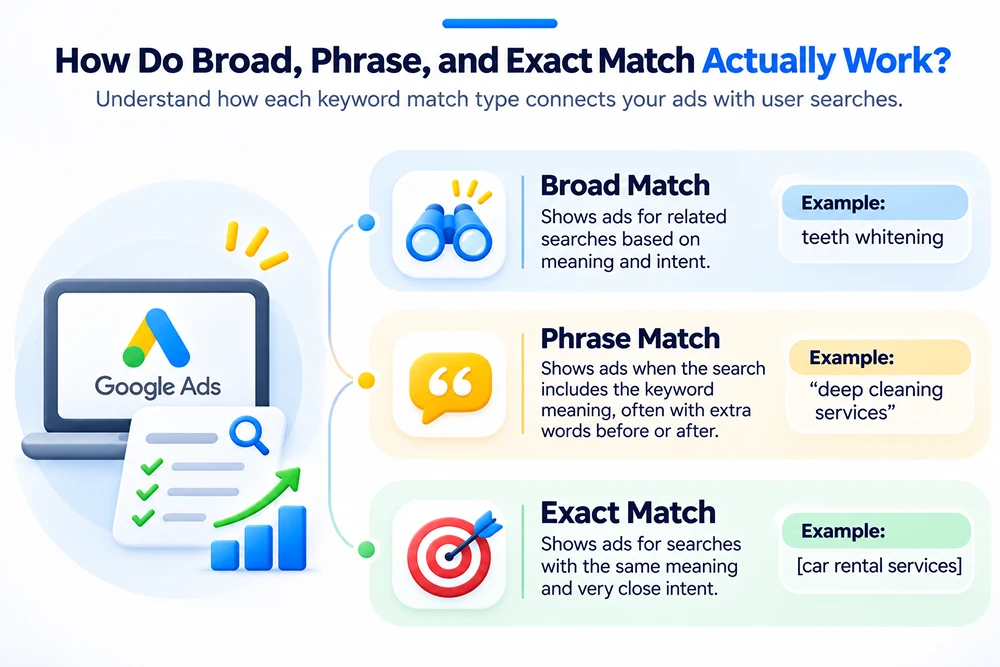
Each keyword match type determines how Google interprets your targeted keywords and connects them with users’ search queries. Let’s understand how each one works and what kind of searches it can help your ads reach.
1. Broad Match
This match type allows your ads to appear for search terms that are related to your targeted keywords.
For example, you run a dental clinic and want to attract potential patients looking for teeth treatments. For this, you may target the broad keyword “teeth whitening”.
Your ad may be visible for searches like:
- Professional teeth whitening
- Cosmetic dental treatments
- Teeth whitening dentist near me
- How to remove teeth stains
You may notice that some searches do not include the exact keyword “teeth whitening,” but they indicate that users are interested in services like improving the appearance of their teeth.
This allows your clinic to reach people searching for related dental treatments without manually adding every possible keyword variation.
Google considers various factors like:
- Meaning of the keyword
- User’s search intent
- Previous searches
- Landing page content
When is broad match useful?
Here are the following situations:
- To reach a wider audience
- To discover new keyword opportunities
- To find related search terms
- To attract potential customers using different search phrases
- To expand your campaign reach
2. Phrase Match
This match type allows your ad to show when a user’s search query includes the meaning of your keyword or additional words before or after.
For example, you want to run an ad for your deep cleaning services for your home cleaning business.
For this, you target a phrase match keyword “deep cleaning services”.
Your ad may become visible for searches like:
- Professional deep cleaning services
- Deep cleaning company near me
- Affordable home deep cleaning
- Deep cleaning services for apartments
These searches express an intent related to deep cleaning, even when users add extra words to describe their requirements.
However, a search such as “deep cleaning tips at home” may not be relevant if the user is looking for DIY cleaning advice rather than hiring a professional cleaning company.
This shows how phrase match helps you reach potential customers searching for your services while maintaining targeting control.
When is phrase match useful?
- To reach users searching for a specific product or service.
- To maintain better control over search relevance.
- To target relevant keyword variations.
- To reach potential customers with specific search intent.
- To balance audience reach and targeting control.
3. Exact Match
This match type allows your ad to show when a user’s search query has the same intent as your targeted keyword. It does not mean that the search queries must include similar words in the same order.
For example, you run a car rental business and want to attract relevant customers who are looking to rent a vehicle.
For this, you may target the keyword “car rental services”.
Your ad may become eligible for searches such as:
- Car rental service
- Rent a car
- Car hire near me
- Rental cars nearby
Searches like “car rental jobs” or “how to start a car rental business” have a different intent and are less likely to match.
This shows how exact match helps you target users whose searches closely align with the service you offer, even when they do not use the same words.
When is exact match useful?
- To target specific search queries.
- To reach users with high purchase intent.
- To focus on relevant potential customers.
- To reduce exposure to less relevant searches.
- To maintain greater control over keyword targeting.
Broad vs Phrase vs Exact Match
Once you understand the difference between match types, it becomes easier to select the right targeting approach for your campaign.
Key Points | Broad Match | Phrase Match | Exact Match |
|---|---|---|---|
| How it works | It focuses on matching search terms related to your targeted keyword, including different words and phrases. | It focuses on matching searches that include the meaning of your keyword, along with relevant additional words. | It focuses on matching searches that have the same meaning or intent as your keyword. |
| Audience reach | Wider reach, helping you connect with more potential customers. | Moderate reach, focusing on searches related to your targeted keyword. | More focused reach, targeting closely related searches. |
| Targeting Control | Provides less control over the searches that trigger your ads. | Offers a balance between reach and control. | Provides the highest level of control among the three match types. |
| Search variations | Can include a wider range of related searches, even when the wording is different. | Includes relevant searches that express the same meaning as your keyword. | Includes searches with the same meaning or intent, even if the wording differs. |
| Best For | Discovering new search opportunities and expanding campaign reach. | Reaching relevant customers while maintaining a balance between reach and relevance. | Includes searches with the same meaning or intent, even if the wording differs. |
How Google Decides Which Keyword Triggers Your Ad
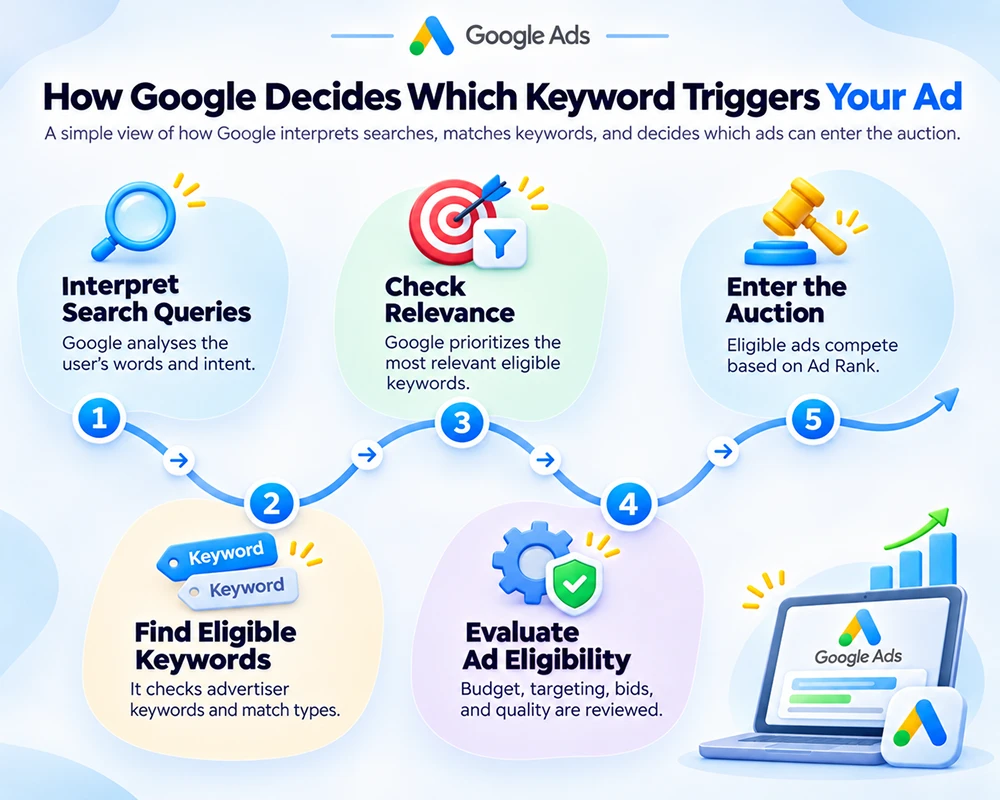
Google does not simply select the advertisement keywords that contain the most relevant words related to user queries. It follows a proper process to identify which keywords and ads are appropriate to participate in the auction.
Here is how the process generally works:
1. Interpretation of Search Queries
Firstly, Google recognizes search queries and understands exactly what users are searching for. It analyzes the terms and intent.
For instance, when you enter the query “hire an SEO agency,” you may be seeking professional SEO services.
2. Identification of Eligible Keywords
Google reviews the keywords of the advertiser and selects those that are potentially suitable to match the search query, considering their match types.
For example, when someone searches for “local PPC services for restaurants.”
In this case, potentially suitable keywords may include “PPC services,” “local PPC,” or “PPC for restaurants.”
3. Analysis of Keyword and Campaign Relevance
If there are several keywords eligible in the same account, then Google uses keyword prioritization rules.
For instance, if the exact match keyword is the same as the search keyword, then it usually gets preference over phrase match keywords or broad match keywords.
However, Google may use other eligible keywords if the preferred keyword is not eligible or cannot participate.
4. Google Evaluates Ad Eligibility
The selected keyword does not automatically guarantee that an ad will appear.
For this, Google considers factors like campaign settings, location targeting, budget, bidding strategy, ad quality, and other auction-related signals.
5. The Ad Participates in the Auction
Eligible ads enter the auction of Google Ads. The Ad Rank plays an important role in determining whether an ad can appear and where it may be positioned.
Therefore, keyword matching determines which searches may trigger your ads, while the auction determines which eligible ads actually appear.
How to Choose the Right Keyword Match Type for Your Campaign
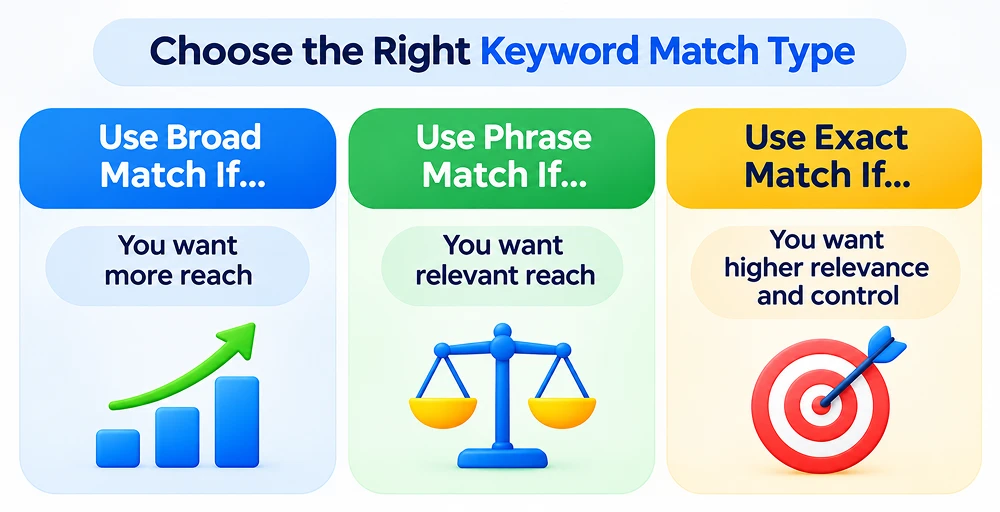
The right match type depends on various factors like advertising goals, budget, conversion history, and how much control you want over the searches triggering your ads.
Instead of using the same match type for every keyword, consider the following situations:
1. Use Broad Match
If your campaign needs more reach and you want to identify additional relevant searchers, broad match can be a useful option.
For example, a company offering commercial cleaning services may start with the keyword “commercial cleaning.”
Google may identify related search terms involving office cleaning, industrial cleaning, warehouse cleaning, and professional facility cleaning.
Review the Search Terms report regularly to identify which searches are generating qualified leads.
2. Use Phrase Match
If you want to attract users who are searching for a particular service without limiting your campaign, phrase match can be a suitable choice.
For example, a company offering PPC management services can target the keyword “PPC management” to reach searches such as:
- PPC management for small businesses
- Professional PPC campaign management
- PPC management agency
This approach provides flexibility while keeping the searches closely connected to the advertised service.
3. Use Exact Match
If you already know which searches are valuable to your business, exact match can help you focus your advertising efforts.
For example, an enterprise SEO agency may target [enterprise SEO agency] to reach businesses specifically looking for enterprise-level SEO support.
This can be useful for high-value services where attracting the right type of customer is more important than generating a large number of clicks.
Common Google Ads Keyword Match Type Mistakes
Even when advertisers understand the three match types, certain mistakes can affect campaign performance and advertising costs.
1. Using Broad Match Without Monitoring Search Intent
Broad match type focuses on reaching relevant users searching for related terms. But it can also trigger ads for searches that are not closely connected to your products or services.
Without regularly reviewing search terms, you may spend money on clicks from users who are unlikely to convert.
How to avoid it: Review your search terms report regularly, identify irrelevant queries, and add relevant negative keywords to improve targeting.
2. Restricting Campaigns Too Much With Exact Match
Targeting exact match keywords gives you control over which searches trigger your ads. Depending only on exact match keywords can limit your campaign’s exposure to potential customers who use different but relevant search phrases.
How to avoid it: Combine exact match with phrase or broad match where appropriate to discover additional relevant searches and reach a wider audience.
3. Adding Negative Keywords Without Checking Their Impact
In negative keywords, advertisers add unwanted searches. Adding them without properly understanding their effect can reduce valuable traffic.
How to avoid it: Check search query relevance before adding negative keywords and regularly review your negative keyword lists to identify accidental exclusions.
4. Using Multiple Match Types Without a Clear Strategy
Your campaign performance will be affected if you add the same keywords in broad, phrase, and exact match.
Without a clear targeting approach, it becomes harder to understand which keyword variations are attracting relevant traffic and generating conversions.
How to avoid it: Assign match types according to your campaign objectives. Use broader targeting for discovering relevant searches and more restrictive matching when you need greater control over search intent.
5. Ignoring Keyword Performance After Campaign Launch
Most of the time, advertisers ignore keyword performance. Customers’ search behaviour, needs, and campaign performance can change over time. Ignoring these changes may result in unnecessary spending and missed conversion opportunities.
How to avoid it: Monitor keyword-level performance, search terms, click-through rates, and conversions. Use these insights to adjust your match types and refine your keyword targeting as the campaign develops.
Frequently Asked Questions
1. Which keyword match type is best in Google Ads?
There is no best match type for every advertising campaign. Broad match is used for finding new search possibilities, phrase match is a balance between reach and relevance, and exact match gives you more control over targeting. You need to consider the goals of your campaign, conversion tracking, budget, and audience intent.
2. Does exact match mean my ad only appears for the exact keyword?
No, exact match can trigger ads for search terms that have similar intent to your targeted keyword. Google considers factors like close variants, misspellings, abbreviations, and reordered words.
3. Is broad match better than phrase match?
Broad match can help advertisers reach a wider audience, while phrase match offers more focused targeting. The better option depends on how much reach you need and how closely you want searches to align with your products or services.
4. Can I use broad, phrase, and exact match in the same campaign?
Yes, you can use all keyword match types in the same campaign or ad group. Google uses keyword prioritization rules to determine which eligible keyword enters the auction when multiple keywords match the same search.
5. Do keyword match types affect Google Ads costs?
Match types do not have separate fixed CPC rates. However, they can influence the searches for which your ads become eligible. Broad match may expose your campaign to a wider range of searches, while exact match can focus on more specific queries. Your actual advertising costs depend on auction competition, bids, Ad Rank, and other factors.
Conclusion
Keyword match types help advertisers control how their ads attract valid customers. Each match type has its own purpose, from expanding audience reach to targeting specific search intent.
Choosing the right match type focuses on understanding search terms and keyword performance for managing effective Google Ads campaigns.
By understanding how Google matches keywords with user searches, you can make better targeting decisions, reduce irrelevant clicks, and focus your advertising budget on more valuable opportunities.