
Imagine you launched a campaign at 9 am in the morning, and by afternoon, you started receiving inquiry calls. That’s exactly what an effective Pay Per Click (PPC) campaign can make possible. You don’t have to wait for months for your content to gain visibility. PPC puts your business in front of ready-to-buy customers the moment your ads go live.
Unlike organic marketing strategies that take months to build up, PPC lets you reach your potential audience instantly. But speed is only a part of the story. What makes a highly efficient PPC campaign is a combination of precise targeting, real-time optimization, and measurable return on investment.
In this guide, we will walk you through factors that influence PPC campaign performance, how PPC services deliver results instantly, and how businesses can get the most out of their PPC campaigns right from the start.
Key Takeaways
- PPC services deliver fast results as they put your ads in front of high-intent customers actively searching for your product or services shortly after the launch.
- PPC is a form of paid digital advertisement that helps businesses achieve online visibility and traffic.
- An effective PPC campaign with precise targeting, a high-quality landing page, and real-time data optimization lays the foundation for quick results from the ad campaign.
- Several factors influence the speed of results in PPC, such as bidding strategy, budget allocation, keyword competitiveness, ad quality, landing page experience, and industry competition.
- You can maximize the performance of your PPC campaigns from day one by following best practices such as targeting high-intent keywords, optimizing campaign structure, writing strong ad copy, aligning ads with landing pages, and tracking conversions.
What Are PPC Services?
PPC (Pay-Per-Click) is a form of paid digital advertisement that helps businesses gain online visibility. Advertisers pay only when a user clicks on their ads. They need to bid to have their ads, including Google Ads, displayed on search engines, websites, or social platforms. The more relevant and high-quality your ad is, the bigger the chances of its appearance. PPC services are a fast and measurable way to bring qualified users to your website.
- PPC vs SEO: SEO brings free organic traffic to your website by improving its authority and ranking over months. PPC can put you at the top of search results instantly.
- PPC vs Social Media Marketing: Social media helps you build brand awareness, but there are many casual scrollers on those platforms. PPC connects you to people already seeking your services, so results come quicker.
Popular PPC Platforms
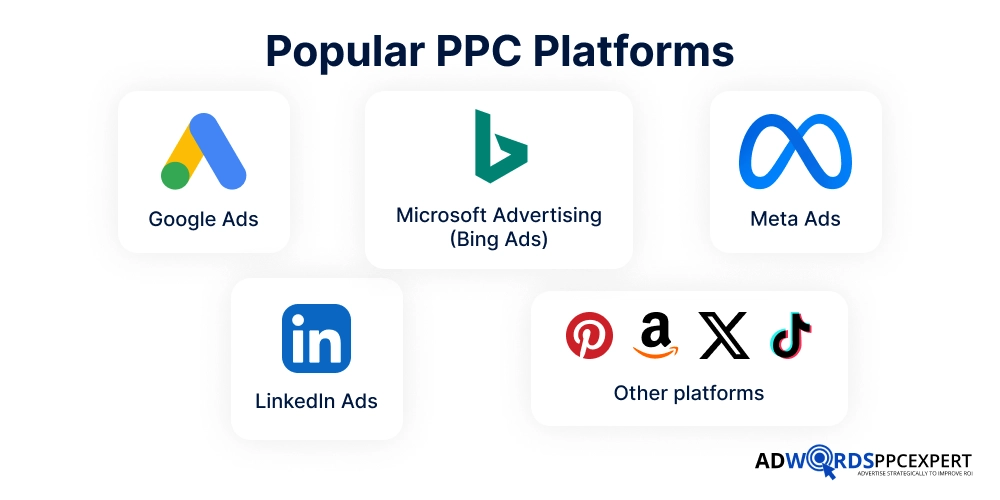
- Google Ads: It is the largest and most common PPC platform. It includes Google Search, YouTube, Display Network, and Shopping ads.
- Microsoft Advertising (Bing Ads): It is a cost-effective alternative to Google Ads, and lets you reach users across various search engines and Microsoft-owned properties.
- Meta Ads: Facebook and Instagram Ads are strong for audience targeting.
- LinkedIn Ads: Best for B2B campaigns targeting professionals.
- Other platforms: TikTok Ads, Pinterest Ads, Amazon Advertising, and Twitter/X Ads.
How PPC Works
- Auction: Advertisers bid on keywords or audiences. When someone searches, the platform runs a mini auction in seconds to check relevance, Quality Score, and bid amount. The ad that scores well appears at the top.
- Quality Score: Google and other platforms evaluate your ad relevance and landing page experience to give you a quality score. A high score helps you better position your ad at a lower cost.
- Bidding strategy: You can choose from manual CPC, automated bidding, target CPA (cost per acquisition), and target ROAS (return on ad spend).
How PPC Services Deliver Instant Results?
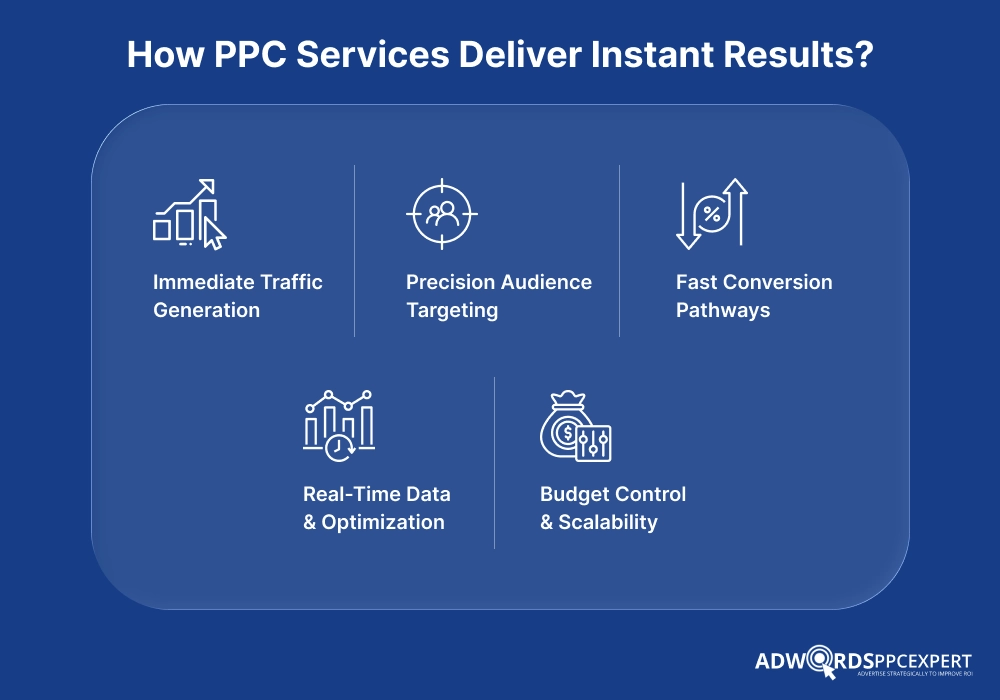
The biggest advantage of PPC is the ability to deliver fast, measurable results. But it doesn’t come by coincidence; PPC campaigns are built for speed at every layer with a strategic approach. Following are the five strategic pillars that ensure the fastest results by PPC services:
Strategy Pillar |
What It Does |
Why It Drives Speed |
|---|---|---|
| Immediate Traffic Generation | Targets high-intent keywords and expands reach via Display, Shopping & Video ads | Ads go live within hours, and traffic starts flowing the same day |
| Precision Audience Targeting | Reaches specific audiences based on demographics, location, interests, remarketing, and lookalike audiences | Zero wasted impressions, ensuring ads reach the most likely buyers |
| Fast Conversion Pathways | Uses optimized landing pages, compelling CTAs, lead forms, and direct purchase options | Reduces friction in the customer journey, helping visitors take action faster |
| Real-Time Data & Optimization | Provides live performance data, A/B testing, automated rules, and AI-powered bidding | Campaigns improve in real time instead of weeks later |
| Budget Control & Scalability | Allows businesses to start with a manageable budget and scale successful campaigns quickly | No guesswork—invest more only in campaigns that are already delivering results |
Immediate Traffic Generation
Unlike SEO, that take months to build visibility, PPC provides instant visibility that helps you generate immediate traffic. PPC can place your ad in front of high-intent users who are actively searching or browsing and are most likely to convert. The foundation of PPC speed is right keyword targeting.
- Keyword Targeting & Search Intent Matching: With smart PPC targeting, you can target users based on their search intent. By identifying high-intent keywords, you can ensure your ad reaches buyers just when they are searching.
- Display, Shopping, and Video Ads for Broader Reach: PPC works beyond search through display, shopping, and video ads. These platforms help expand reach, build visibility, and create brand awareness.
Precision Audience Targeting
PPC platforms offer advanced targeting capabilities to help businesses reach the most relevant audiences. Precise targeting implies your ad reaches interested buyers from day one, and there is less wasted budget and accelerated results.
- Demographics, Location, Interests, and Remarketing: Target users by age, gender, location, income level, or past website visitors (remarketing).
- Lookalike Audiences and Custom Intent: This feature helps advertisers find new users showing search behavior similar to your existing customers or demonstrate buying signals.
Since not all keywords carry the same intent. Here is an example table for your better understanding:
Intent Type |
Example Keyword |
What It Signals |
|---|---|---|
| Informational | "what is solar panel installation" | Research stage, not ready to buy |
| Navigational | "SunPower solar company near me" | Brand-aware, comparing options |
| Commercial | "best solar installation company" | Evaluating options, close to making a decision |
| Transactional | "solar panel installation cost quote" | Ready to buy, high conversion potential |
Fast Conversion Pathways
PPC can offer a quick path to conversion with optimized landing pages. When the message, offer, and page experience align, it is likely to convert.
- Optimized Landing Pages: Dedicated, high-converting landing pages that match the ad message and remove distractions.
- Strong CTAs and Offer-Driven Campaigns: Urgent calls-to-action like “Book Now”, “Get 30% Off Today”, or “Free Consultation” combined with limited-time offers.
- Lead Forms and Direct Purchase Options: Lead forms shorten customers’ journey, making them take instant action.
Real-Time Data & Optimization
One of the best aspects of PPC is its ability to generate real-time data. It gives you instant access to performance data such as clicks, impressions, conversions, and cost per result. It helps marketers know what’s working and which campaign is going in the wrong direction.
- Instant Performance Metrics: You can track clicks, impressions, cost-per-click, conversion rate, and ROI in real time via detailed dashboards.
- A/B Testing and Quick Adjustments: You can test multiple ad variations, headlines, and images in real time, pause underperformers, and shift budget towards the best-performing variations.
- Automated Rules and AI Bidding: You can use smart bidding strategies (like Target ROAS or Maximize Conversions) and automated rules to adjust bids or pause ads based on performance.
Budget Control & Scalability
PPC allows businesses to maintain full control over their PPC budget and spending pace. It provides flexibility to businesses to see returns quickly and scale confidently without requiring any significant upfront investment.
- Start Small and Scale Winning Campaigns Quickly: You can start with a small daily budget to test what works, then increase spending on high-performing ads, keywords, and audiences accordingly.
- ROI Visibility from Day One: PPC provides clear reporting and tells exactly how much revenue is generated for every dollar spent, making it easy to justify and expand the budget.
What are the Key Factors That Influence the Speed of Results in PPC?
While PPC is built for speed, not all the campaigns deliver instant results at the same pace. There are several factors, such as competition, quality signals, ad quality, and landing page experience, that affect the speed of PPC results. Let’s discuss them briefly below:
Budget allocation and bidding strategy
- Your daily or monthly budget directly impacts how much exposure your ad receives.
- The smarter your bidding strategy, the faster the results.
- Smart bidding strategies (such as Target CPA, Maximize Conversions, or Enhanced CPC) help platforms automatically optimize for better results.
- A higher budget may help you compete more aggressively and collect data faster.
- Start with a sufficient budget to enable quick scaling. Too low budget may delay potential outcomes.
Keyword competitiveness
- High-intent, low-competition keywords can generate results almost immediately.
- Highly competitive keywords (e.g., “insurance quotes” or “laptop deals”) require higher bids and take a longer time to generate results, as a lot of advertisers are bidding on them.
- Long-tail, niche-specific keywords may deliver faster wins as there is low competition.
- The best can be a mix of high and low competition keywords based on niche and business goals.
Ad quality and relevance
- Ad quality is a crucial factor in determining performance. Google and other platforms reward ads that match user intent with a high Quality Score.
- High-quality, relevant ads can get better placements at a low cost.
- If the ad seems irrelevant and poorly matched, it struggles for visibility even with a high budget.
Landing page experience
- Landing page experience directly affects both conversion speed and ad performance.
- When your ad gets clicked, and the user lands on a poor page that took forever to load, the message didn’t match your ad copy, the user is likely to leave, increasing the bounce rate.
- A well-optimized landing page with clear CTAs helps visitors convert quickly, and results appear faster.
Industry competition level
- Some industries like SAAS, financial services, and healthcare are crowded with advertisers. Campaign optimization takes time, and results are slow in these industries due to intense market competition.
- For less competitive niches, results can be seen within hours with an effective campaign.
- Understanding your industry’s competitive landscape can help you set realistic goals and expectations.
How to Maximize PPC Performance From Day One?
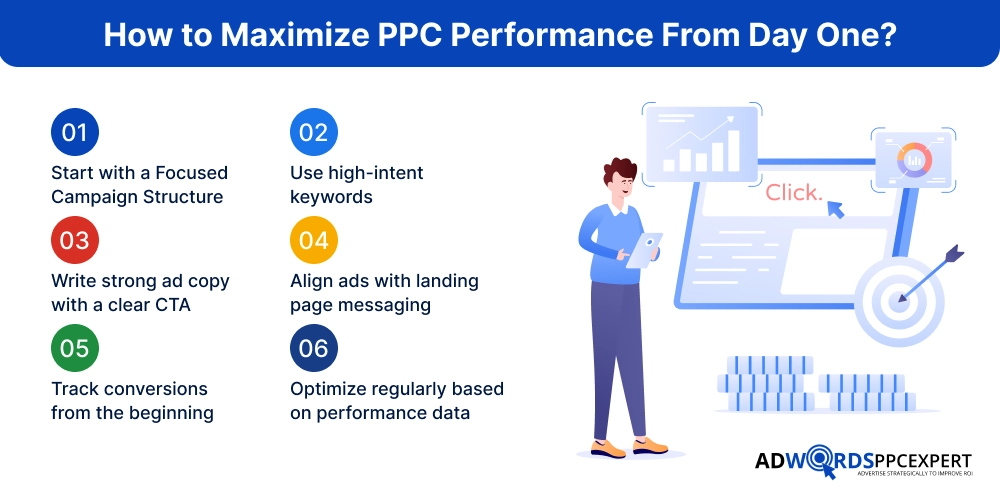
Launching a campaign is only the first step. To ensure fast results, you need a strategic approach right from the start. Following are the best practices you can follow to maximize PPC performance from day one:
Best Practice |
Why It Matters |
|---|---|
| Build a focused campaign structure | Improves relevance and budget efficiency |
| Target high-intent keywords | Attracts users who are ready to take action |
| Write compelling ad copy | Encourages more clicks and engagement |
| Align ads with landing pages | Creates a smoother user experience |
| Track conversions from day one | Measures campaign success accurately |
| Optimize based on performance data | Helps improve results over time |
Start with a Focused Campaign Structure
- Keep the campaign organized around specific goals and product categories.
- Group similar keywords and ads together to improve relevance and allow accurate performance.
Use high-intent keywords
- Target keywords that signal strong buying intention, such as “roof repair near me” or “buy running shoes online.”
- Avoid overly broad or generic keywords that attract low-intent traffic.
Write strong ad copy with a clear CTA
- Write compelling ads that grab attention and tell people exactly what to do next.
- A clear and strong call‑to‑action (CTA) like “Book a Free Quote Today” speeds up response.
Align ads with landing page messaging
- Make sure your landing page matches the promise you made in copy.
- When a visitor finds the same offer, it leaves the user with a positive impression of your page and improves conversion rates.
Track conversions from the beginning
- Setting up the tracking from day one is crucial to ensure you know in which direction your ad is moving.
- Tracking keeps you informed about ad performance, updates on which keywords are working, provides valuable insights about users’ behavior, and helps measure the overall effectiveness of PPC campaigns.
Optimize regularly based on performance data
- Don’t follow a set-and-forget format. PPC is a continuous process.
- You need to keep a check on performance data, use A/B testing, bid adjustment, and refine strategies in real time.
Conclusion
PPC isn’t just another marketing channel. It is one of the fastest ways to put your business in front of users actively searching for the services. By combining precision targeting with real-time optimization and high-intent keywords, PPC can deliver results within a few hours of campaign setup and approval.
Unlike SEO, where results take weeks to months to appear, PPC allows you to get calls and leads instantly. Businesses that monitor and optimize their campaigns on a regular basis are most likely to maximize their returns and achieve sustainable growth.
Whether you are launching a new product, promoting a limited offer, or looking to generate leads quickly, investing in professional PPC services can help you reach the right audience at the right time.
Frequently Asked Questions About PPC Services
1. How quickly can you expect results from PPC?
The results from ads start to appear within hours of setup and approval. You can see leads and inquiries coming in within days. You can maintain a consistently profitable campaign by continuous monitoring and optimization.
2. Why does PPC deliver results faster than SEO?
PPC results are quick to appear, as it makes your ad appear at the top of the page almost immediately after the launch. Contrary to this, SEO is a long-term process that focuses on building your website’s authority and organic ranking. This usually takes months to show results and produce significant traffic.
3. What factors affect how quickly a PPC campaign performs?
There are several factors that affect the speed of your PPC campaigns. These include budget allocation, bidding strategy, keyword competitiveness, relevance and quality of your ad, landing page experience, and industry competition.
4. Which PPC platform delivers the fastest results?
Google Ads is generally considered the fastest platform owing to its popularity and reach. However, other platforms like Microsoft Ads, LinkedIn Ads, and other platforms also provide effective results depending on your business requirements and goals.
5. How much budget do I need to start a PPC campaign?
Your budget depends on the size of your business, your goals, industry competition, and other requirements. Small businesses can start with a basic package ranging from $200 to $600 per month. A large company may require a monthly budget of $1500 to get started with Google Ads.

Ami Singh is a highly skilled AdWords PPC Specialist, known for creating profitable Google Ads strategies that elevate brands. With deep expertise in Google Search, Display, Shopping, YouTube Ads, and advanced bidding techniques, Ami consistently converts data into performance-driven results.
With a sharp analytical mind and a strong understanding of online consumer behavior, Ami designs campaigns that maximize ROI, boost quality scores, and reduce acquisition costs. His approach blends technical expertise with strategic thinking—making him a go-to expert for businesses aiming to dominate Google Ads.
Ami doesn’t just adapt to the fast-changing PPC industry, but he also stays ahead of the curve by testing new features, adopting automation smartly, and refining what works. Clients trust him for his transparency, insights, and ability to scale campaigns sustainably.
Looking to take your Google AdWords performance to the next level? Connect with Ami Singh at Softtrix and discover how he can help you get the maximum growth through powerful PPC strategies.