Summarized Answer
Google has a much larger and more established advertising audience. In this case, a business may choose to keep around 60–95% of its PPC budget on Google Ads, while keeping 5–40% for ChatGPT Ads to test and understand the results. This is not a fixed percentage. The percentage varies from business to business, as every business has different goals, audiences, and budgets.
Planning to run ads on ChatGPT along with Google Ads? But don’t know how to split the budget or what the process is? Then this blog is all about this.
Google has been running its advertising platform for 2000. Google Ads has become a regular part of PPC strategies for businesses.
But now, ChatGPT has also entered the advertising space. OpenAI started testing ads in ChatGPT in 2026, and advertisers can now run campaigns through its Ads Manager in supported markets.
ChatGPT Ads currently support CPC bidding, with OpenAI recommending a starting maximum bid of $3–$5 per click for CPC campaigns.
For the ultimate profit, run the ad campaigns on the platform that actually maximizes your spending. But does that mean moving more of your PPC budget to ChatGPT, or should Google Ads still get the bigger share? The answer depends on how people search, what you are selling, your campaign goals, and how each platform can bring opportunities for your business.
In this blog, we’ll compare Google Ads and ChatGPT Ads, look at how their advertising approach is different, and discuss how marketers can think about splitting their PPC budget between the two.
What are Ads?
Ads are paid promotions that businesses run for their products or services. They help businesses directly reach audiences who may be interested in what they offer. People may see these ads while searching, browsing online, or interacting with different digital platforms.
To run such ads, businesses pay different platforms to show their ads to the right audience. Some businesses run ads on Google, while others use Meta ad platforms like Instagram and Facebook. Some also run YouTube ads, and now ChatGPT is also entering the advertising space, where businesses can potentially reach users in a different way.
What is Google Ads and ChatGPT Ads? Are these identical channels
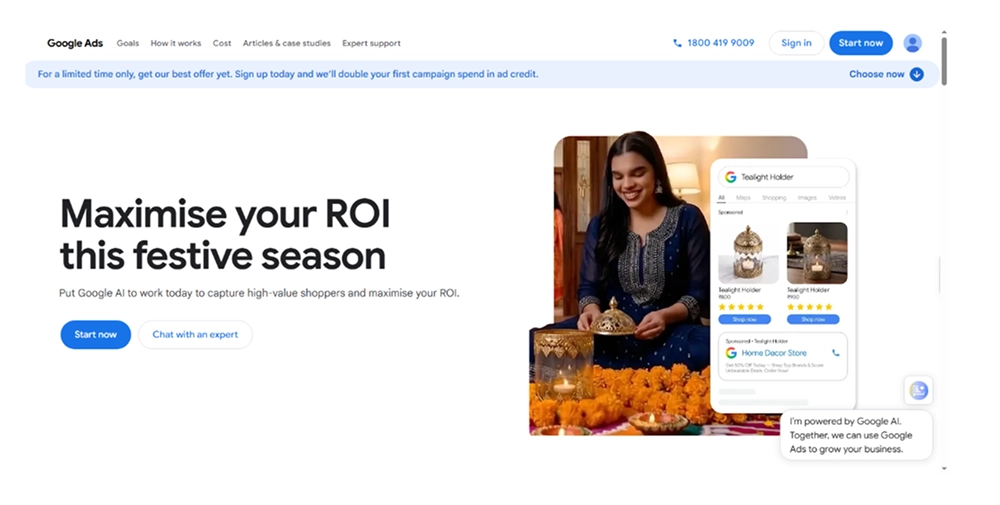
Google Ads is an online advertising platform by Google. Here, businesses can create different types of campaigns around users’ searches. These ads can appear when users search for particular products, services, or information.
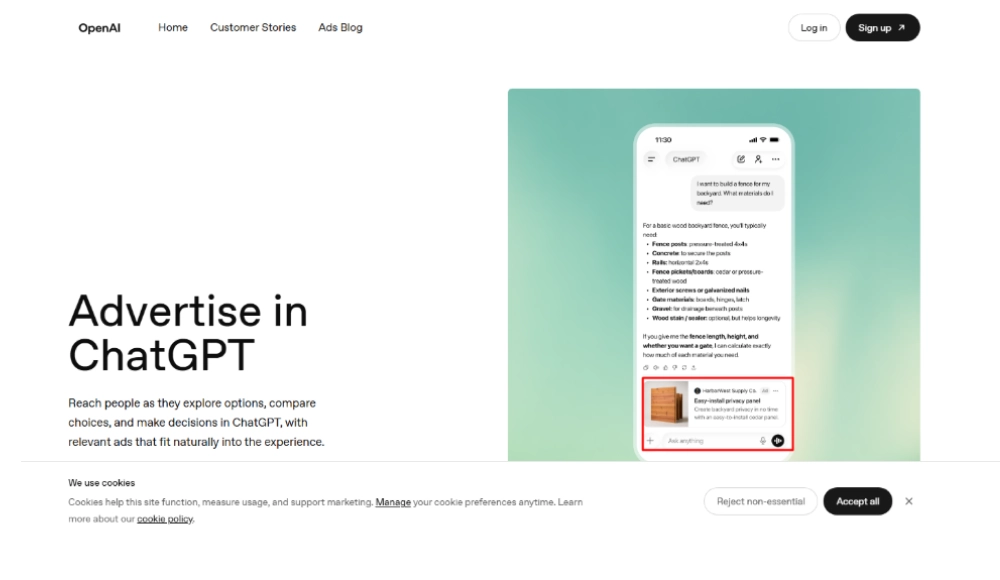
On the other hand, ChatGPT Ads are a newer advertising option from OpenAI. This allows businesses to promote their products or services within the ChatGPT experience.
The major differences marketers should evaluate
If you are planning on investing in one platform, then this comparison will definitely change your mind. These two platforms serve different purposes.
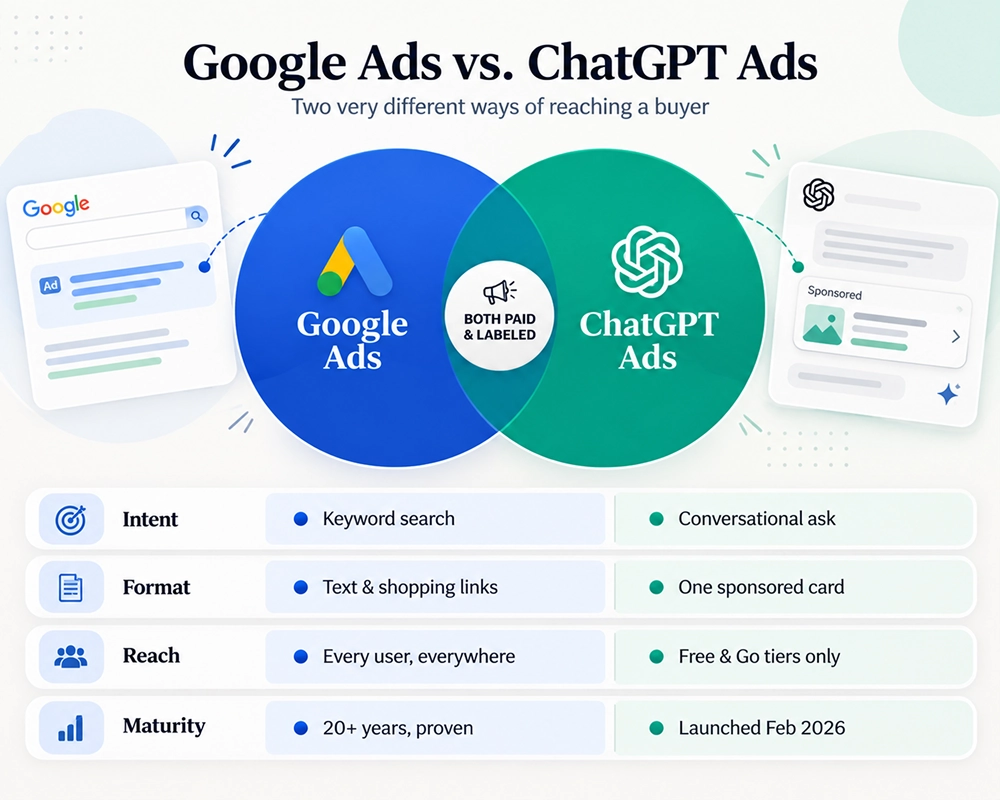
Factor | Google Ads | ChatGPT Ads |
|---|---|---|
| Main role | Capture existing demand | Influence discovery and consideration |
| Primary signal | Search query, audience, behavior, product feed | Conversation context, intent, landing page, context hints |
| Typical user mindset | “I need this now” | “Help me understand or choose” |
| Common formats | Search, Shopping, Display, YouTube, Performance Max | Sponsored cards below ChatGPT responses |
| Best for | Local services, urgent needs, branded demand, ecommerce | Product education, comparisons, planning, complex decisions |
| Measurement maturity | Mature and broad | Newer, with developing reporting |
| Creative style | Keyword and offer focused | Helpful, contextual, conversation-aware |
| Main risk | Rising CPCs and lower visibility from changing search behavior | Limited historical data and uncertain incremental scale |
How are Google ads changing because of AI Overviews?
The way searches are done now compared with before has changed drastically. AI is changing the old-school way of searching, and we are all aware of this. But it doesn’t stop here. Ads are also changing as Google adds more AI into the search experience.
AI Overviews can now appear at the top of the search results with information and resources. So, if someone wants to read more, they can explore the resources, or they can ask another question based on the answer they get. Because of this, it is crucial to build or optimize your campaigns in a way that allows Google Ads to show on AI Overviews.
Ads can appear above or below an AI Overview. But in some eligible markets, ads can also appear within the AI Overview. However, advertisers cannot directly choose or exclude the AI Overview ad placement.
With these changes, marketers also need to think differently about targeting. People are making longer and more detailed searches, so Google’s AI-powered campaign options, broad match, Performance Max, Shopping, and keywordless targeting are becoming more important.
Because of this shift, Google Ads shouldn’t be judged only by keyword-level metrics like CTR. Marketers also need to look at the bigger picture and understand whether the campaigns are actually bringing valuable leads, conversions, and business results.
You can also read our blog on Google Ads account audits and our Google Ads management pricing breakdown to understand these areas in more detail.
How ChatGPT Ads Work
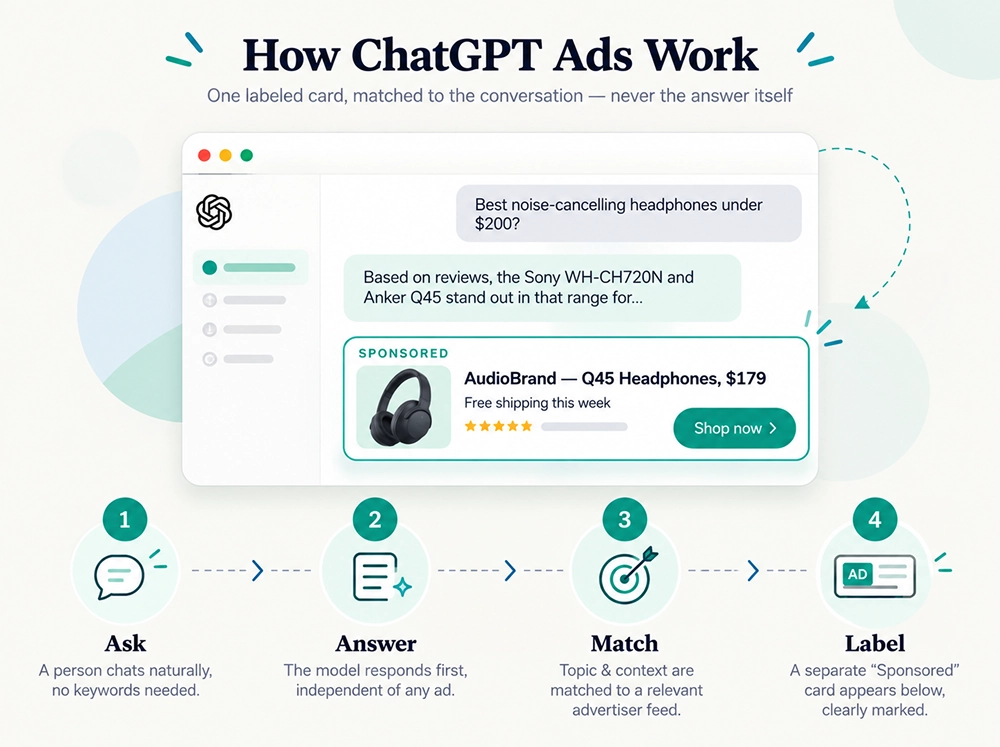
ChatGPT Ads work a little differently from traditional search ads. The ad can appear below a ChatGPT response, depending on the conversation and the advertising setup.
What is a website page, and what makes it high-converting?
Instead of targeting only exact-match keywords, ChatGPT Ads use context signals to understand whether an ad is relevant to the conversation. This means the way you target users is different from how you may target them through Google Ads.
Some of the main things marketers can work with include:
- Campaign objectives: Views, clicks, and conversions.
- Ad performance: CPC, CPM, CTR, spend, and conversions.
- Conversion tracking: UTM parameters can be used to track where the traffic and conversions come from.
- Sponsored Agents: Businesses can use conversational experiences to take users further after they interact with an ad.
There are also privacy and eligibility limitations, so ChatGPT Ads are not available or shown in the same way for every user, market, or type of conversation.
How can businesses allocate the Budget: The Complete Framework
The correct split depends on four questions:
1. How much existing high-intent demand does your business have?
2. How expensive is Google traffic in your category?
3. How long is the buying cycle?
4. Can you measure lead quality and revenue beyond the first click?
Use the following as starting ranges:
Business situation | Google Ads | ChatGPT Ads |
|---|---|---|
| Urgent local service | 85–95% | 5–15% |
| Established ecommerce brand | 70–85% | 15–30% |
| Complex B2B or SaaS offer | 65–80% | 20–35% |
| New category or educational product | 60–75% | 25–40% |
| Business with little conversion data | About 80% | About 20% |
Note: These are not permanent recommendations. This budget is only to control your risk.
Google receives the larger share when it already produces profitable demand and when customers search with strong commercial intent.
ChatGPT receives a larger test budget when the product requires research, the category is underdeveloped, or the company wants to influence users before they search for a specific brand or solution.
A business should not allocate 40% to ChatGPT simply because the audience is growing. It should earn that allocation by demonstrating qualified conversions or measurable assisted value.
Want deeper insights into PPC budget allocation? Read our detailed analysis on what you should avoid when allocating your PPC budget.
Avoid the Mistakes That Can Cost You Leads
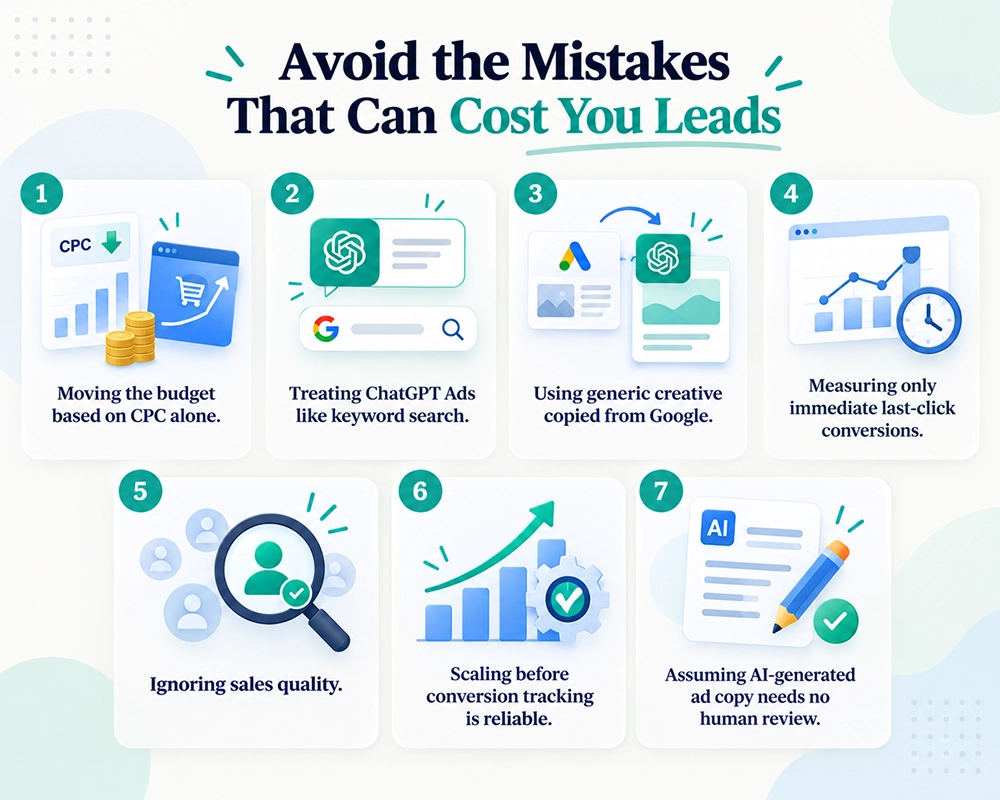
- Moving the budget based on CPC alone. A lower CPC does not always mean better results. Look at the traffic quality and conversions too.
- Treating ChatGPT Ads like keyword search. ChatGPT Ads work differently from traditional keyword-based search ads, so the same targeting approach may not work.
- Using generic creative copied from Google. What works on Google may not work the same way on a conversational platform.
- Measuring only immediate last-click conversions. Some users may need more time before they convert, so looking only at the last click can miss part of the customer journey.
- Ignoring sales quality. More conversions do not always mean more valuable customers. Check whether the leads are actually useful for your business.
- Scaling before conversion tracking is reliable. Make sure your conversion tracking is working properly before increasing the budget.
- Assuming AI-generated ad copy needs no human review. AI can help create ad copy, but you should still review it for accuracy, relevance, and brand fit.
The recommended default
For most advertisers in 2026, a sensible starting structure is:
- 70–85% of the paid-search budget in Google Ads.
- 10–25% in ChatGPT Ads for a controlled test.
- 5–10% held for creative, landing-page, measurement, or retargeting experiments.
Use a lower ChatGPT percentage for urgent local services and a higher percentage for complex B2B, education, software, and products that require research.
Most Asked Questions
1. Is this budget fixed for ChatGPT? If not, when should I increase my ChatGPT Ads investment?
No, the budget is not fixed. Start with a smaller share and increase it when ChatGPT Ads consistently bring qualified leads, conversions, and a competitive cost per customer. Remember, don’t increase the budget based on clicks alone. Check lead quality, sales, and actual customer value first. After that, plan your budget accordingly.
2. Do I run the Google ad alone?
You can run Google Ads alone, especially when your business depends on high-intent searches, local demand, or Shopping campaigns. You can also keep Google Ads running while testing ChatGPT Ads with a smaller budget. Compare the quality of leads, conversions, customer acquisition cost, and revenue before moving more budget to ChatGPT.
Final Says!
Google Ads can remain the main PPC platform for most businesses because it helps reach people who are already searching for a product or service. It also has a larger advertising network and more campaign data to work with.
ChatGPT Ads can be used as an additional channel to reach people who are exploring, comparing, or asking questions before making a decision.
So, it is not simply Google Ads vs. ChatGPT Ads. You can use Google Ads to capture existing demand and test ChatGPT Ads to see if it brings additional valuable customers.
If you still have a question about the right PPC split or want to know which industries should put more budget into Google Ads or ChatGPT Ads, you can get in touch with our PPC experts.