
A successful PPC campaign for a lot of businesses means a consistent flow of clicks. But, in reality, clicks don’t always generate revenue. An ad can attract plenty of traffic while still wasting a significant portion of your campaign budget on irrelevant searches, low-intent audiences, poor keyword targeting, or landing pages that fail to convert. Unfortunately, many marketers lose a large amount of their ad spend without even realizing it.
The real problem isn’t always how much you spend but where and how you allocate that budget. Even small mistakes can silently drain your ad spend month after month. This can reduce your return on investment and make it harder for you to increase successful campaigns.
In fact, a recent study of more than 15,000 Google Ads accounts by LocaliQ revealed that the average business wastes over $1,127 per month on clicks that generated little to no measurable returns.
The good news is that you can prevent most PPC budget leaks. By identifying common budgeting mistakes early and making adjustments based on real data, you can improve the efficiency of your campaigns, save on acquisition costs, and get more value out of every dollar you spend.
In this blog, we’ll explore the most common PPC budget mistakes that advertisers make and drain their ad spend, and how to fix them.
Key Takeaways
- The success of your PPC campaigns depends more on how you allocate your budget than on how much you spend.
- Marketers should set clear business goals before deciding their budget. This allows them to ensure every dollar spent supports lead generation, sales, or brand growth.
- Avoid spreading the ad budget across too many campaigns, as limited spending can make optimization and performance tracking difficult.
- Allocate more budget to high-intent keywords likely to generate conversions than to keywords that can only drive traffic.
- Review search term reports regularly and add negative keywords to prevent irrelevant clicks from wasting your ad spend.
- Always adjust your budget according to seasonality, market demand, and campaign performance instead of using the same budget throughout the year.
- Fix landing pages and conversion issues before increasing ad spend. That’s because traffic will not solve poor conversion rates.
- Track metrics such as CPA, ROAS, conversions, and revenue.
- Move your budget continuously toward the campaigns that perform best for maximum results (ROI).
Why PPC Budget Management Is More Important Than Bid Management?
It is a common misconception among advertisers that increasing the budget will help them get more visibility. But in reality, poor budget allocation often causes bigger losses. Better budget management results in stronger results, ensuring that money is spent on the right campaigns.
A well-planned budget ensures your ads stay active for the right audience throughout the day. Hence, reviewing where money is spent should come first.
Here’s how poor budget management can harm you more than doing any good:
- Poor budget decisions can make each lead cost more than it should, increasing your cost per acquisition (CPA).
- When money goes to clicks that don’t convert, ROAS drops. To avoid this, you should allocate more budget to keywords and ads that bring in ready-to-buy users and improve profits.
- If you spend a lot of budget on broad audiences, many of the leads may not be a good fit. Narrowing your target audience who are more likely to need your offer improves lead quality.
So, how do you detect poor budget management? There are several warning signs that indicate budget mismanagement. Some of these are:
- Campaigns running out of budget early
- Strong click numbers with few conversions
- Large budget differences between campaigns with limited profit opportunities.
Budget Management |
Bid Management |
|---|---|
| Solves the problem of where your money is spent | Solves the problem of how much you pay for a click |
| Helps prevent wasted ad spend | Helps improve ad position and visibility |
| Directly impacts CPA, ROAS, and lead quality | Primarily impacts traffic volume and competitiveness |
| Focuses on allocating funds to the right campaigns | Focuses on adjusting bids for keywords or audiences |
| Determines overall campaign profitability | Determines click costs and auction performance |
8 Most Common PPC Budget Mistakes Costing You Money
Now that you understand why budget management is essential in paid campaign success, let’s look at the most common mistakes that drain advertising budgets. Many of these issues are easy to ignore. However, fixing them can significantly improve the performance of your campaigns, lead quality, and ROI.
Mistake 1: Setting a Budget Without Clear Business Goals
Be honest – do you set your PPC budget based on what you can afford or what you want to achieve? Setting the budget with no clarity on the end goals is a common mistake. This approach often leads to inconsistent results because the connection between spending and business outcomes is missing.
Before you allocate ad budget, define your primary goal.
Are you trying to generate leads, increase sales online, drive phone calls, or just want to build brand awareness? Each objective requires a different budget strategy. For example, if your goal is to generate leads, your strategy should focus on high-intent keywords and conversion tracking. But if you aim for brand awareness, your campaign should prioritize reach and impressions.
When you have clear goals and set the budget accordingly, it helps ensure that every dollar supports a measurable outcome. Instead of asking, “How much should we spend?”, ask, “How many leads or sales do we need?” Then work backward to estimate the budget that is required.
For example, if your average cost per lead is $50 and you aim to achieve 100 leads per month, your campaign budget should be around $5,000.
When you have clear goals for your campaigns, it creates a foundation for budget decisions and measuring performance.
Mistake 2: Investing in High-Traffic Keywords Instead of High-Intent Keywords
It is easy to assume that more traffic automatically leads to more conversions. In reality, not all clicks bring you the same value.
High-traffic keywords often bring you users who are still looking or exploring options. While these keywords can generate a large number of clicks, they may not produce enough leads or sales to justify the cost.
On the other hand, high-intent keywords target users who are closer to making a decision. Searches such as “emergency plumber near me”, “buy Nike Men’s Shoes”, or “roof repair estimate” often indicate stronger buying intent.
So, instead of allocating most of your budget to broad informational keywords, choose keywords that best fit with your business goals and sales funnel.
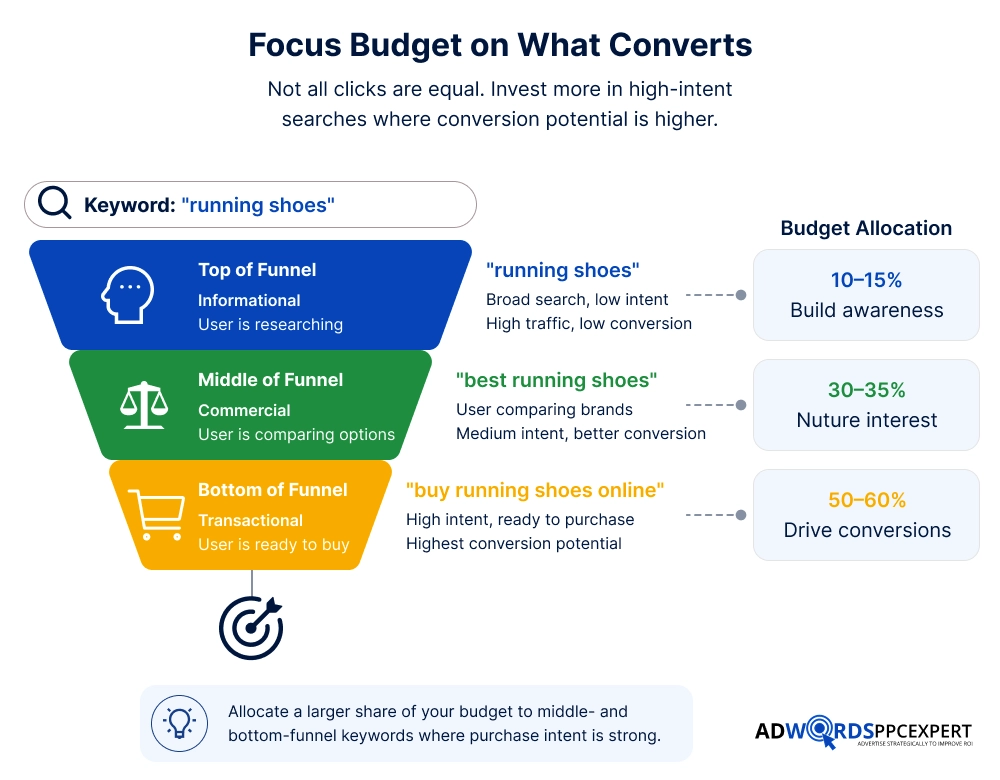
Top-of-funnel keywords can help in achieving brand awareness. But a larger part of your budget should typically be directed toward middle-and bottom-funnel searches where the potential of conversion is higher. Following this approach can help improve CPA and ROAS while reducing wasted spend.
Mistake 3: Spreading the Budget Too Thin Across Multiple Campaigns
Many advertisers create multiple campaigns, ad groups, and targeting options, etc., all at the same time. Seems like a good way to reach more people, right? Indeed, it is. But, it often spreads the budget too thin!
Wondering? Let us explain.
When you allocate only a small amount of budget to each campaign, your ads may not generate enough clicks or conversions to provide useful data. Without sufficient data, identifying the keywords, audiences, and ad creatives that generate results may be difficult.
Moreover, budget fragmentation also slows down optimization. Instead of collecting meaningful insights from a few well-funded campaigns, marketers end up managing many underperforming campaigns that generate limited results.
Here, a better approach can be to focus on the products, services, or audience segments in your highest-priority list. By consolidating similar campaigns, you can allocate more budget to areas that matter the most.
And once you have data for consistent conversions and profitable performance, you can gradually expand into additional campaigns and audience groups.
Mistake 4: Ignoring Search Term Reports and Negative Keywords
One of the fastest ways you can waste PPC budget is by paying for irrelevant clicks. Search term reports in your account show the actual queries people use before they click your ads. If you don’t review these reports regularly, your ads may appear for searches that have little or no connection to your products or services.
For example, a company that sells premium software may unintentionally pay for clicks from users searching for “free software” or “software jobs.” These clicks use up budget without contributing to business goals.
This problem can be solved by using negative keywords, as these prevent ads from showing for unwanted searches. Adding terms such as “free,” “cheap,” “jobs,” “training,” or other irrelevant phrases can improve targeting and reduce wasted spend.
However, you should not consider negative keyword management a one-time task. Since search behavior changes constantly, reviewing search term reports regularly helps maintain campaign efficiency and protects your budget from unnecessary losses.
Mistake 5: Allocating The Same Budget Year-Round
Each campaign is unique and demands different budget allocation because the digital landscape is constantly changing.
Customer demand does not remain the same throughout the year, yet many businesses keep the same PPC budget every month. That’s a mistake!
This approach can cause missed opportunities during peak seasons and overspending during slower periods.
Many industries experience seasonal fluctuations as well. Retail businesses often see increased demand during holiday shopping periods, while tax services generate more demand during the tax season. Other industries, including healthcare, home improvement, B2B, and travel, also undergo seasonal trends.
Competitor activity can change year-round as well. When the competition is high, advertising costs may increase. This requires you to spend additional budget to maintain visibility.
To manage your budget well, you should follow a better strategy of adjusting budgets based on historical performance, seasonal demand, and market conditions. The idea is simple:
Increase spending during peak conversion periods and reduce it during slower months. This helps maximize overall return on investment.
Mistake 6: Increasing Spend Before Fixing Conversion Issues
A common mistake that most marketers make is to increase the budget when the campaign performance slows down or drops. Sadly, spending more money rarely fixes the basic conversion problems.
For example, if landing pages are poorly designed, forms are difficult to complete, or your offers aren’t attractive, additional traffic will simply increase wasted spend.
To prevent this waste, you should review your conversion process before increasing the budget. Analyze the performance of landing pages and form completion rates. Also, check page speed, mobile experience, and whether the call-to-action is correctly placed. This allows you to spot the issue that may be stopping visitors from converting.
This is where Conversion Rate Optimization (CRO) becomes important. Instead of spending more to get the same weak results, CRO helps you improve what already exists. Even a small increase in conversion rate can lower acquisition costs and raise revenue.
Once you are sure that your ads can consistently generate profitable conversions, you can consider scaling your PPC campaign. Increasing budget becomes much more effective once the foundation becomes strong.
Mistake 7: Failing to Shift Budget Toward Top-performing Campaigns
Are you among those marketers who set campaign budgets and rarely adjust them? If yes, you aren’t alone!
Doing this causes strong-performing campaigns to remain underfunded while weaker campaigns continue utilizing valuable resources.
The performance of PPC campaigns changes over time; Some keywords, audiences, devices, and ads consistently generate better results than others. That is why conducting regular performance reviews is critical. It helps identify winners and losers.
Campaigns that produce high-quality leads at a lower CPA often deserve additional investment. On the other hand, campaigns with poor conversion rates or high acquisition costs may need reduced budgets, optimization, or even pausing.
A simple budget reallocation framework can help:
- Campaigns running out of budget early
- Strong click numbers with few conversions
- Large budget differences between campaigns with limited profit opportunities.
Following this process ensures that your budget depends on performance rather than assumptions.
Mistake 8: Measuring Success By Clicks Instead of Revenue
Clicks are easy to track, which is why advertisers often focus heavily on them. However, clicks alone do not determine business success. A campaign that generates thousands of clicks may still lose money if those visitors do not become customers.
The reality is, high click-through rates can look impressive in reports, but they don’t always show that you are making profits.
Instead of focusing on vanity metrics, focus on metrics that directly affect business growth. Key performance indicators (KPIs) such as CPA, ROAS, conversion rate, customer lifetime value, and total revenue generated help you determine how effective your campaigns are.
Revenue-focused reporting helps you identify which campaigns are truly adding to business growth. It also supports better budget decisions; you can direct ad spends toward activities that generate measurable financial returns.
How To Audit Your PPC Budget in 30 Minutes?
Once you identify the most common PPC budget mistakes, the next step is to determine whether any of them are affecting your campaigns. The good news is that you don’t need a full account audit to uncover major budget issues.
In just 30 minutes, you can review a few key areas and quickly identify opportunities to improve performance.
Step 1: Review Campaign-Level Spend
Start by checking how much money each campaign is consuming and comparing it to the results it generates. Look for campaigns that consume a large portion of the budget but deliver few conversions.
At the same time, identify campaigns producing stronger results that may be limited by budget. This review helps you know where money is being wasted and where additional investment may be worth it.
Step 2: Analyze Keyword Profitability
In the next step, review your keyword performance. Focus on metrics like conversions, CPA, and revenue rather than clicks alone. Keywords that generate traffic without producing leads or sales may need lower bids. It can also mean tighter targeting or removal. Prioritize keywords that consistently drive profitable actions.
Step 3: Check Impression Share Lost Due To Budget
Review the “Search Impression Share Lost (Budget)” metric in Google Ads. A high percentage is a sign that your ads are missing opportunities because of a lower campaign budget. If the campaign is already performing well, increasing its budget may help drive more conversions.
Step 4: Evaluate Conversion Performance
Analyze conversion rates across campaigns, ad groups, and landing pages. If certain campaigns are getting a lot of traffic but generating few conversions, it may be due to poor targeting, messaging, or landing page rather than the budget size.
Step 5: Evaluate Conversion Performance
At last, move the budget from underperforming campaigns to those generating the best results. Let performance data guide your decisions rather than assumptions. Reallocating budget regularly ensures more of your advertising spend supports campaigns that contribute to business growth and profitability.
How To Allocate PPC Budget for Maximum ROI?
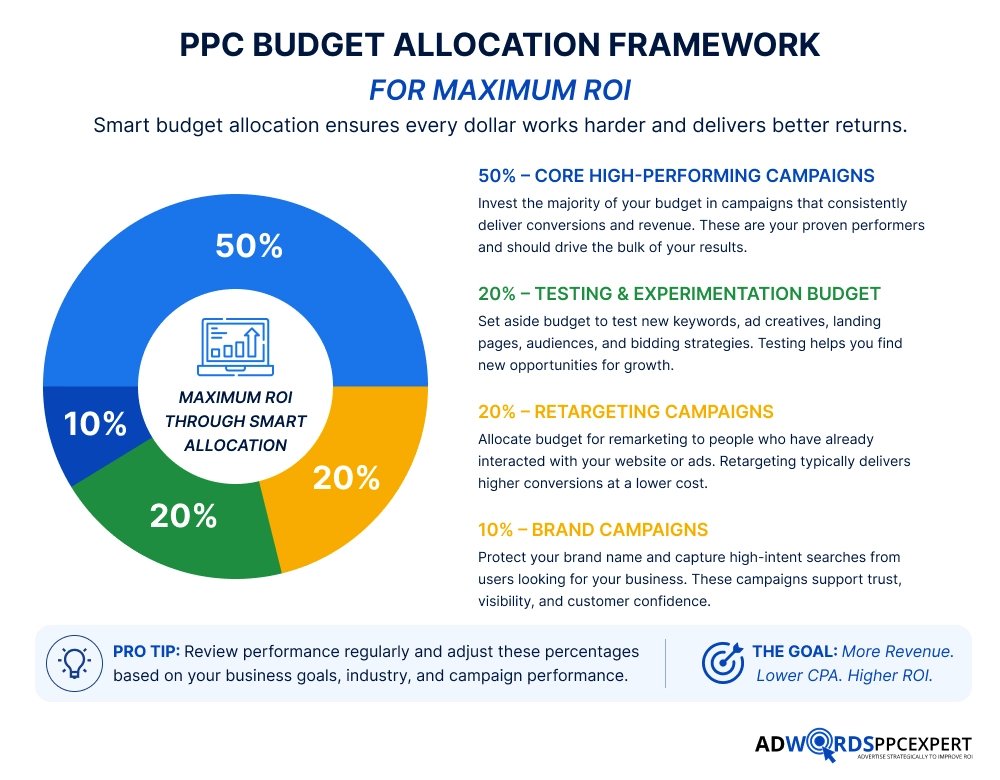
Having a practical budget allocation framework can help you generate higher ROI. It enables you to focus on spending where it delivers the best results. Allocate nearly 50% of your budget to campaigns that consistently generate leads or sales. Set aside 20% for testing new keywords, ads, and audiences to discover growth opportunities.
Further, dedicate 20% to retargeting campaigns, which often convert at a lower cost. The remaining 10% allocate to brand campaigns to protect brand visibility and capture high-intent searches. Make sure to review and adjust budget allocations regularly based on campaign performances.
The Final Say
The success of any PPC campaign, including professional PPC services, doesn’t depend on how much you spend but on how smartly you budget. Even a well-funded campaign can perform poorly if money is directed towards the wrong keywords, audiences, or campaigns.
By avoiding common budget mistakes and regularly reviewing performance data, you can reduce wasted spend and improve lead quality, conversions, and overall profitability.
Besides, make it a habit to audit your PPC budget regularly. Monitor key metrics such as CPA and ROAS, and adjust the budget based on actual results rather than assumptions. Small budget changes can often produce significant performance improvements.
The goal is not simply to spend more on PPC, but to make every advertising dollar work harder. When budget decisions are guided by data, achieving maximized ROI becomes easier.

Ami Singh is a highly skilled AdWords PPC Specialist, known for creating profitable Google Ads strategies that elevate brands. With deep expertise in Google Search, Display, Shopping, YouTube Ads, and advanced bidding techniques, Ami consistently converts data into performance-driven results.
With a sharp analytical mind and a strong understanding of online consumer behavior, Ami designs campaigns that maximize ROI, boost quality scores, and reduce acquisition costs. His approach blends technical expertise with strategic thinking—making him a go-to expert for businesses aiming to dominate Google Ads.
Ami doesn’t just adapt to the fast-changing PPC industry, but he also stays ahead of the curve by testing new features, adopting automation smartly, and refining what works. Clients trust him for his transparency, insights, and ability to scale campaigns sustainably.
Looking to take your Google AdWords performance to the next level? Connect with Ami Singh at Softtrix and discover how he can help you get the maximum growth through powerful PPC strategies.