

Quick Answer
The strongest PPC keywords are not simply the ones with the most searches. Start with business relevance and the reason behind the search, then weigh conversion potential, customer value, competition, cost, geography, and landing-page fit. A specific query such as “emergency plumber near me” may deserve more attention than the much broader “plumber” because it can signal a more immediate need. The right priority, however, depends on the business, offer, economics, and actual conversion data.
Keyword research for paid search is much more like demand analysis than a keyword list compilation effort. The objective isn’t to generate hundreds of keywords and place them in Google Ads. Instead, it’s about determining what consumers are trying to do, what searches match their offer, and figuring out where the scarce budget should be allocated for the most promising results.
This is an important consideration, since even a keyword with very good search volumes could be a bad keyword to go after via paid search. A company can invest a lot in researching its keywords and overlook the subset of keywords with strong demand for its offer. PPC keyword research takes all of these elements into consideration together. Today, in this guide, we will learn about keyword research and prioritizing high-intent keyword methods.
What Is PPC Keyword Research?
Keyword research for PPC campaigns involves identifying, evaluating, organizing, and prioritizing keywords to run ads for a particular business. This includes identifying keyword options, researching search intent, analyzing relevancy, assessing cost and competition, creating a negative keyword list, and optimizing the list using data from existing campaigns.
The first step is to identify the business rather than start with the tool. Before launching into Keyword Planner, one should determine the product being sold, the customer demographics, which products/services generate the highest sales revenues, geographical regions to focus on, and the metrics used to measure conversion rates.
Why Search Intent Matters More Than Keyword Volume
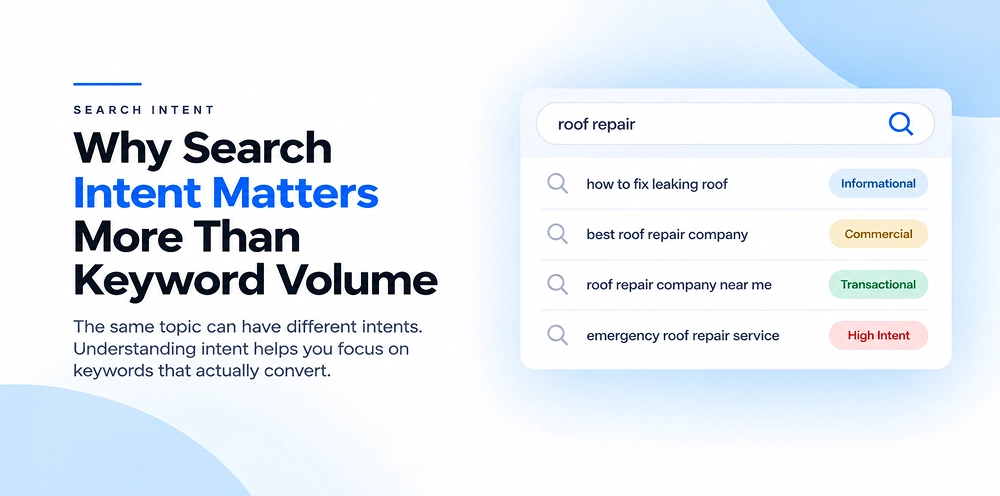
Search volume shows how frequently a term is being searched for, but it will not indicate whether the person searching is a quality customer. Intent provides the missing piece. The query could be informational, commercially investigative, transactional, navigational, or highly localized/service-based, and all of these can make a big difference in the keyword’s usefulness in paid search.
Let’s take the example of a roofing company. “How to fix leaking roof” would probably be an information-oriented search. “Roof repair company near me” would indicate a search for a service provider. “Emergency roof repair service” would indicate both service needs and urgency. None of these categories is set in stone, but they can give valuable insights to the advertiser on where the customer is at.
What Makes a PPC Keyword High-Intent?
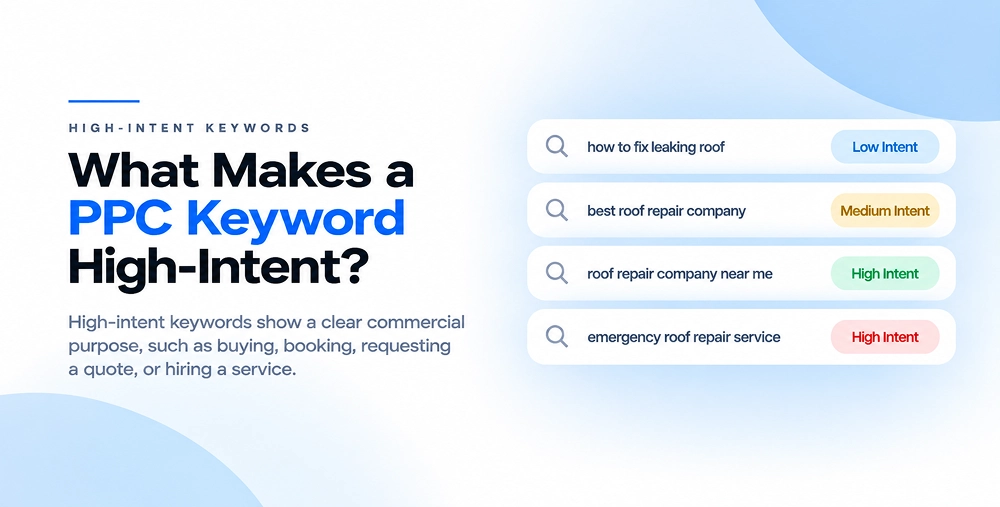
The typical high-intent PPC keyword usually implies that the user is interested in finding some commercial result: a product, service, provider, pricing information, quotation, booking, appointment, consultation, etc. Keywords including modifiers like “buy,” “pricing,” “quote,” “service,” “agency,” “provider,” “hire,” “booking,” or “near me” can be quite helpful.
However, a modifier is no guarantee of profit either. “Cheap PPC agency” can be both profitable and aimed at users comparing prices. Similarly, “PPC services” can work well for an agency but be too general for an expert selling ecommerce accounts only.
This way, the analysis of high intent should include relevance, intent, conversion potential, customer value, economics, competition, landing page suitability, and geographic specificity, if any.
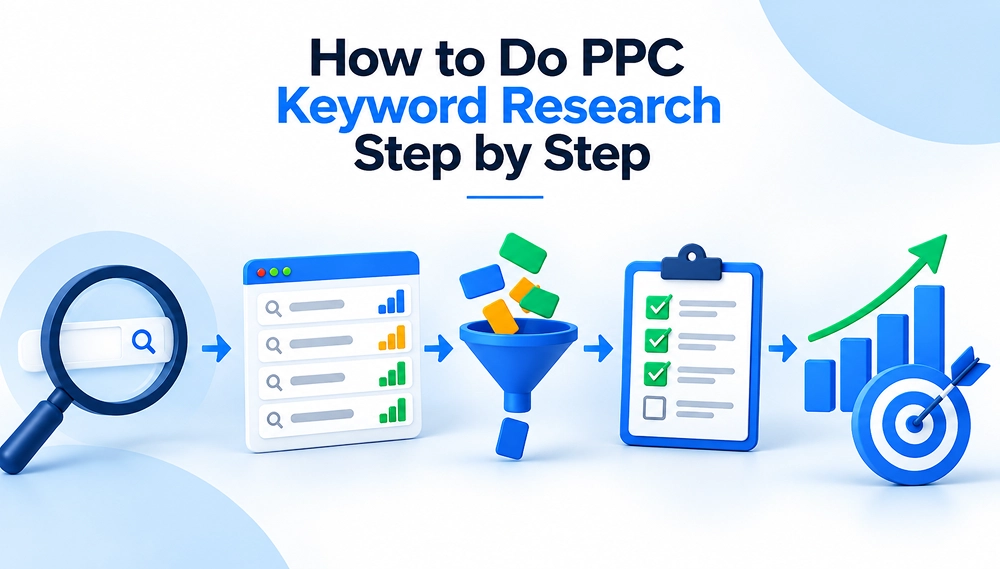
How to Do PPC Keyword Research Step by Step
1. Begin with the Business and Offering
Write down the actual items or services you wish to advertise via the pay-per-click search. This is where you will figure out the best customers, target markets, profit-making offers, and the desired conversion action. Information from sales calls, customer relationship management notes, customer emails, site navigation, and the sales team’s language will give clues about potential search terms.
2. Create Seed Concepts
Go for a few key concepts instead of attempting to think of every conceivable search term. You can get information from the products or services, customer problems or solutions, customer needs, customer language, categories, and locations. For a dentist, the seeds could be “emergency dentist,” “dental implants,” and “dentist appointment.” Not just a long list of all things “dental.”
3. Expand Your Keyword Concepts
Expand the seeds to create more related keyword ideas using the Google Keyword Planner. The Google Keyword Planner is described as a tool for research on keywords for Search campaigns. It will offer keyword ideas, estimated number of monthly searches, and even cost-related estimates. It will help in the addition of keyword ideas to a plan and forecasts too.
4. Relevancy and Intent Check
Consider each candidate with respect to the offer. What does the searcher want to do? Can the business satisfy their need? Exclude words that relate to your products/services, audience, and problems you don’t solve.
5. Consider Search Volume and Cost Data
The former may provide information on whether there is enough interest in the subject to consider testing it. The latter will assist in thinking through the competition and economics involved. Don’t take either data point in isolation. A very expensive keyword may be well worth the cost based on the customer value that comes from it; an inexpensive one may turn out to be a poor choice because there aren’t many customers there.
6. Group Similar Keywords
Organize keywords into meaningful groups to allow the ad and the landing page to be more relevant to the searcher’s need. Avoid extremes of a huge ad group with many services and tiny ones that create excessive management effort.
7. Develop Negative Keyword Lists
Developing negative keywords can help in making sure that the ads do not appear in irrelevant searches. Begin with obvious negative keywords and then extend the list based on actual search data. Be careful with negative keywords; just because a search term is informational does not necessarily mean that it’s useless for the business.
8. Launch, Review Search Terms, and Adjust
Keyword research continues even after the launch. The Search terms report provides information regarding those search terms that caused impressions and clicks, allowing you to compare the language of actual customers with your initial expectations.
How to Prioritize PPC Keywords
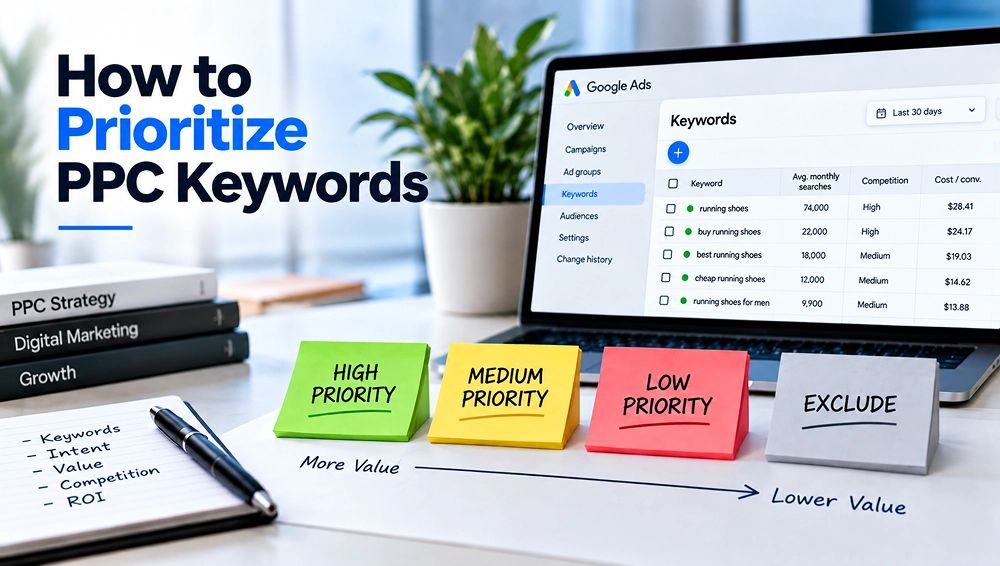
Once you have a workable list, rank the keywords by business value rather than by volume alone. A simple priority framework can keep the decision grounded:
Priority | Likely Intent | Relevance | Typical Role |
|---|---|---|---|
| High | Strong commercial or transactional | Very high | Core campaign candidates |
| Medium | Commercial investigation | High | Secondary themes or controlled tests |
| Low | Weak, uncertain, or early research | Variable | Testing or observation |
| Exclude | Clearly outside the offer | Low | Negative keyword candidate |
How to Use Google Keyword Planner for PPC Research
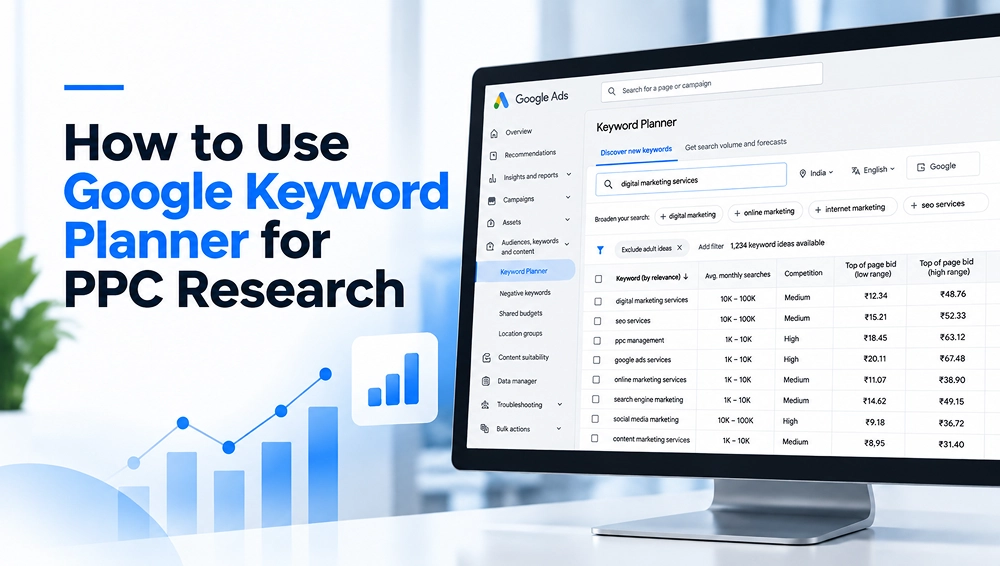
Google’s Keyword Planner is most useful when you enter the tool with a clear commercial hypothesis. Start with seed keywords, discover related ideas, review search estimates and cost signals, filter the list, and organize the terms into themes that make sense for the campaign.
A useful workflow is to export or organize the candidates into a working sheet with columns for keyword, intent, relevance, location, customer value, estimated cost, landing page, priority, and negative-keyword notes. This makes the strategic decision visible instead of hiding it inside a keyword tool.
How Search Terms Data Improves Keyword Selection
This is important because, while conducting any research process, there are some assumptions made by advertisers that could be wrong. For instance, a general keyword might attract queries for something that you do not offer; a keyword that seems generic to you might help you to find out about services that you did not even consider.
There are three applications of the search terms report:
1) Finding out the keywords that need to be tested.
2) Finding the search queries that should be excluded.
3) Comparing the language of converting customers with your initial research language.
Negative Keywords: Protecting Budget Without Over-Excluding
Negative keywords help Google Ads to filter out those searches that will not trigger your ads. They form an essential component of PPC keyword research; every irrelevant search means that there is something wrong with your targeting assumptions.
The basis for the construction of negative keywords should be the mismatch between your business and a particular search. It could be that your company does not provide those goods or services being sought, does not deliver to a certain location, seeks not candidates but customers, offers not free or do-it-yourself services but paid ones, or any other mismatch supported by the account statistics.
How Match Types Fit Into PPC Keyword Research
Google Ads currently uses three keyword match types for Search campaigns: broad, phrase, and exact. Match type controls how closely a keyword needs to relate to a person’s search for the ad to be considered.
The practical lesson is not “always use exact” or “always use broad.” Match type is one targeting control within a larger system. Evaluate the search terms you actually receive, the quality of the resulting traffic, conversion data, bidding approach, and the strength of your negative keyword strategy. A keyword’s label alone does not tell you whether the traffic is profitable.
How Keywords, Ads, and Landing Pages Should Work Together
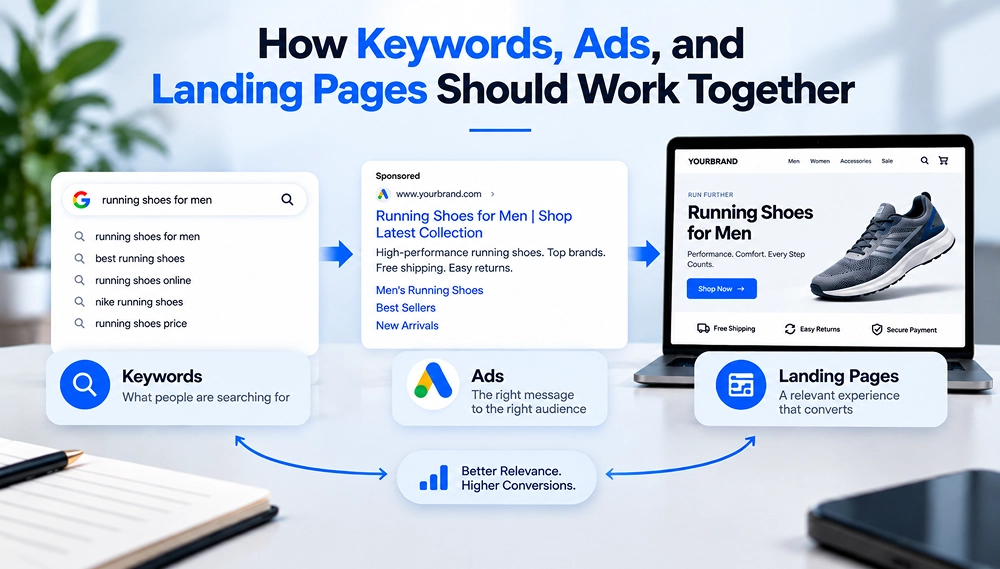
It is important to note that the process of keyword research should end with the creation of a cohesive customer journey, where the search query represents the need, ad copy fulfills the need, and landing pages provide the next course of action. Otherwise, no matter how much research you do on the keyword, the results would be bad.
This is because, for instance, if the search query is “emergency plumber near me,” taking that person to the home page would mean they are trying to find something they have come there searching for. The logical step would be to take the traffic to an emergency plumbing page that addresses their needs.
The same principle applies to B2B. Someone searching for “PPC audit service” should not land on a generic digital-marketing page if a focused audit service page exists. AdwordsPPCExpert’s PPC audit service is an example of a destination built around that specific commercial need.
PPC Keyword Research Mistakes That Waste Ad Budget
Choosing keywords only by search volume: High volume can create the illusion of opportunity while masking weak commercial relevance.
Ignoring search intent: A keyword can be related to your industry without representing someone who wants your offer.
Targeting overly broad terms without a plan: Broader reach can be useful, but it needs appropriate controls, conversion goals, and search-term review.
Using irrelevant high-volume keywords: Traffic that cannot become a customer is not a win simply because it is cheap or plentiful.
Failing to review search terms: Without looking at real queries, you miss both waste and new customer language.
Neglecting negative keywords: Unwanted searches can continue to consume attention and budget when exclusions are justified.
Mixing unrelated themes: Unrelated services in the same structure make it harder to align ads, landing pages, and reporting.
Ignoring landing-page relevance: A strong keyword cannot compensate for a destination that does not answer the searcher’s need.
Ignoring business economics: Customer value, margins, sales cycle, geography, and close rates matter when deciding what a click is worth.
Assuming expensive keywords are better: Competitive pricing does not make a keyword valuable by itself.
Assuming cheap keywords are efficient: Low CPC traffic can still be commercially weak.
Treating research as a one-time task: Search behavior changes, and actual campaign data should feed the next round of research.
When Should You Outsource PPC Keyword Research and Management?
Outsourcing can make sense when the account is important to revenue, but the internal team does not have the time or specialist capacity to manage research, campaign structure, search-term analysis, bidding, conversion tracking, landing-page alignment, and ongoing optimization together.
It can also be useful for agencies that want specialist execution without building every PPC capability in-house. In that situation, white-label PPC outsourcing can provide an execution layer behind the agency’s client relationships.
The key is to outsource the work, not the accountability. Whoever manages the account should be able to explain why keywords were selected, what search-term patterns are being excluded, how budget is being prioritized, and how the account’s conversion data is changing the strategy.
Frequently Asked Questions
1. What is PPC keyword research?
PPC keyword research is the identification, evaluation, segmentation, and prioritization of search terms that can be used to attract paid search traffic. It involves intent research, relevance checks, costs, negative keywords, and continuous optimization through campaign data.
2. How can I find high-intent PPC keywords?
Based on what you actually sell, look for search terms that reflect the need for a provider, solution, pricing, quotation, purchase, booking, or consulting. Validate your terms based on their relevance, customer value, geographical aspect, economics, and landing page.
3. What is the best PPC keyword research tool?
Google Keyword Planner is an excellent first-party keyword research tool for Google AdWords since it offers ideas for keyword planning and forecasting. Google Keyword Planner must be complemented by your business expertise, customer language, website, and real search-term performance.
4. Which comes first, search volume or search intent?
Search intent comes first, while search volume serves as a demand indicator. Even though search volume is low, the term could be more valuable than a high search volume term that is less business-related.
5. How frequently should PPC keywords be reviewed?
Refresh keywords on an ongoing basis as you gather information from running campaigns rather than considering research as a one-time activity done before setting up campaigns. The optimal frequency will depend on budget, traffic volumes, seasonal fluctuations, and dynamics of changing search behavior.
6. Why are negative keywords needed?
Negative keywords are helpful for preventing your ads from appearing for irrelevant searches. Information about search terms becomes very valuable when looking for repetitive cases of irrelevant searches and determining what to exclude.
7. Could better PPC keyword research increase conversion rates?
Better keyword research would help to get more relevant traffic into your campaign, but better research alone cannot ensure a high conversion rate. Besides keyword research, there are many other factors involved.
Conclusion
Strong PPC keyword research is not about finding the biggest list. It is about making better decisions about where paid-search budget should go. Start with the business and its customers, build seed terms from real commercial language, expand them with research tools, and then judge each theme by intent, relevance, customer value, economics, competition, geography, and landing-page fit.
If you are searching for a reliable partner to help you with keyword research and ppc ads, contact us today for expert consultation.

Ami Singh is a highly skilled AdWords PPC Specialist, known for creating profitable Google Ads strategies that elevate brands. With deep expertise in Google Search, Display, Shopping, YouTube Ads, and advanced bidding techniques, Ami consistently converts data into performance-driven results.
With a sharp analytical mind and a strong understanding of online consumer behavior, Ami designs campaigns that maximize ROI, boost quality scores, and reduce acquisition costs. His approach blends technical expertise with strategic thinking—making him a go-to expert for businesses aiming to dominate Google Ads.
Ami doesn’t just adapt to the fast-changing PPC industry, but he also stays ahead of the curve by testing new features, adopting automation smartly, and refining what works. Clients trust him for his transparency, insights, and ability to scale campaigns sustainably.
Looking to take your Google AdWords performance to the next level? Connect with Ami Singh at Softtrix and discover how he can help you get the maximum growth through powerful PPC strategies.