
Most Google Ads don’t fail because of bad targeting or weak offers. Rather, they fail due to lazy, generic ad copy. Your headlines and descriptions are the first and often the only chance to attract and convince users that your offerings are the best solution. Weak headlines and vague descriptions not only waste your budget but also lower the Quality Score, raise CPC, and send the wrong visitors to your landing page.
Great ad copy covers three things at once. This includes matching users’ intent, differentiating your product or service from others, and driving users towards clear action. Better ad relevance improves expected CTR and Quality Score, which in turn lower your Cost Per Click (CPC) and help your ads win more auctions.
In this guide, you will get a step-by-step framework for writing Google Ads copy that actually converts. From crafting compelling headlines and persuasive descriptions to writing effective CTAs, adding trust signals, and optimizing Responsive Search Ads (RSAs), this guide will help you create ads that attract qualified clicks and drive more conversions. Whether you are managing your own campaigns or writing copy for clients, these steps provide a data-driven process to attract more users and improve conversion.
Key Takeaways
- Google Ads copy is the written text that appears in your ads, designed to grab users’ attention and persuade them to click.
- High-converting Google Ads copy closely matches user search intent. Your ads should speak directly to what users are looking for.
- Your Google Ads copy should be focused on benefits and outcomes rather than just highlighting the features. It should give users a compelling reason to click and convert.
- Your Google Ads copy should include a strong headline that captures attention and a clear, intent-matched CTA that encourages action.
- You can build credibility with trust signals like reviews, ratings, certifications, or years of experience that increase users’ confidence and improve conversions.
- It is crucial to keep your ad copy consistent with your landing page to avoid confusion. Both of them should carry the same intent and message.
- You should continuously test and optimize your ad copy while regularly reviewing headlines and descriptions.
What Is Google Ads Copy?
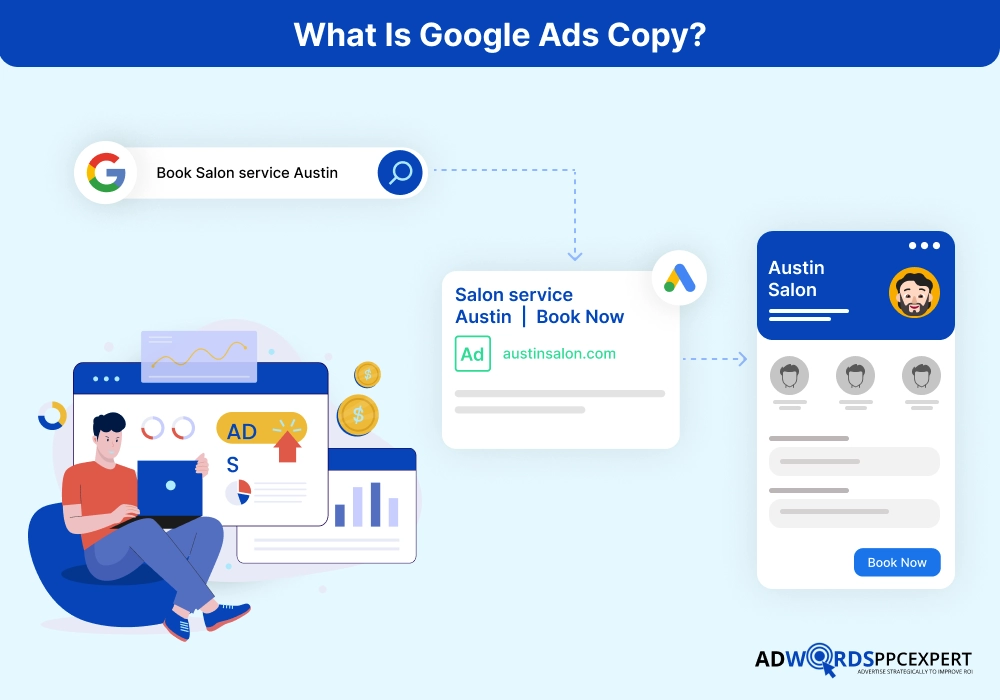
Google Ads copy is the text that users see in your ads and is meant to encourage them to click. It generally includes headlines, descriptions, display URL path, and supporting assets. Each of these components has its own specific purpose.
For an effective and persuasive Google Ads copy, every element should collectively work together to improve its relevance, increase click-through rates (CTR), and drive qualified traffic to your landing page.
Here’s a breakdown of the core components of Google Ads copy and the role each one plays in creating high-performing search ads.
Component |
Purpose |
Best Practice |
|---|---|---|
| Headlines | Grab attention and match search intent | Include target keywords, key benefits, and unique value propositions |
| Descriptions | Explain the offer and encourage users to take action | Highlight benefits, trust signals, and include a clear CTA |
| Display URL / Path | Reinforce ad relevance and improve user confidence | Use descriptive, keyword-rich paths where appropriate |
| Assets | Provide additional information and increase ad visibility | Use sitelinks, callouts, structured snippets, call, and location assets |
Step-by-Step Guide to Writing High-Converting Google Ads Copy
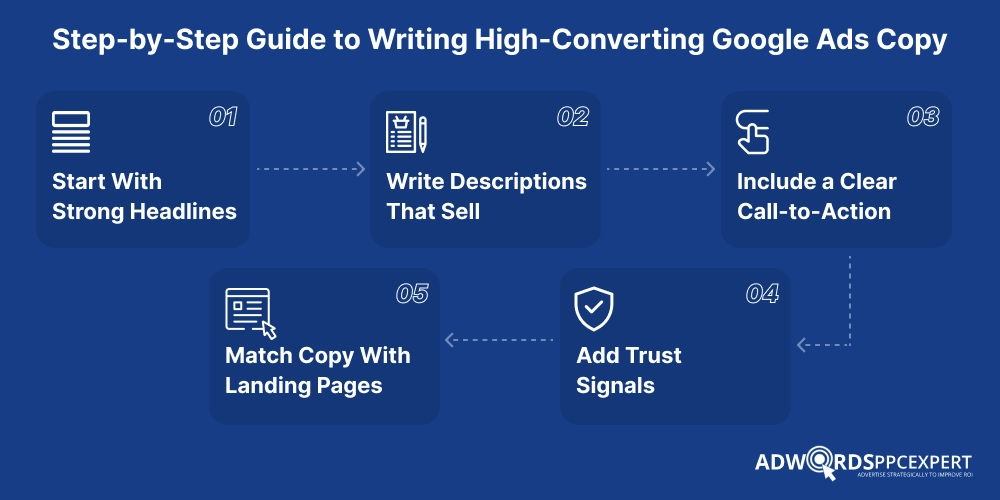
Writing Google Ads copy that converts is a skill. You need to follow a structured approach and create ads that match users’ intent, communicate your brand message clearly, and encourage users to click and convert. You need a headline that grabs attention, a description that convinces users, a CTA that drives action, trust signals that add to your credibility, and a landing page that aligns perfectly with your Google Ads copy. These five elements work together to form highly persuasive ad copy that attracts qualified users and improves conversion.
Before getting into details, here is a quick overview of five steps you can follow while creating efficient, high-converting Google Ads copy.
Step |
Focus |
Goal |
|---|---|---|
| Write Strong Headlines | Capture attention with keywords, benefits, and offers | Increase ad relevance and click-through rate (CTR) |
| Write Persuasive Descriptions | Explain your value, build trust, and encourage action | Improve conversions and lead quality |
| Add a Clear CTA | Tell users exactly what to do next | Drive more clicks and qualified leads |
| Include Trust Signals | Add reviews, ratings, guarantees, and certifications | Build credibility and increase user confidence |
| Match the Landing Page | Keep messaging, offers, and keywords consistent | Improve Quality Score and conversion rate |
1. Start With Strong Headlines
Your headline is the backbone of your Google Ads copy. It’s the first thing that grabs users’ attention, making it the most crucial component of your Ads. It’s often the deciding factor on whether the user skips your ad or clicks.
A strong headline should:
- Include keywords naturally to improve relevance and Quality Score.
- Directly address the user’s problem or specific requirements.
- Highlight benefits like reducing risk or saving time.
- Add numbers for credibility and use problem-solving language to connect with users.
Here’s a quick reference table on how you can apply these variations in headlines to make it stronger.
Technique |
Why It Works |
Example |
|---|---|---|
| Keyword Inclusion | Improves ad relevance and Quality Score | “Affordable SEO Services Near You” |
| Benefit Highlight | Focuses on the outcome instead of just the feature | “Boost Traffic in 30 Days” |
| Numbers / Offers | Adds credibility, clarity, and urgency | “Save 40% on PPC Campaigns” |
| Problem-Solving | Addresses customer pain points directly | “Stop Wasting Ad Spend” |
Here is a quick example:
Weak Ad |
Improved Ad |
|---|---|
| We Provide SEO Services | Grow Organic Traffic with Award-Winning SEO Experts |
| Contact Us | Get Your Free SEO Audit Today |
| Best Prices | SEO Plans Starting at $499/Month |
2. Write Descriptions That Sell
While a strong headline attracts clicks, a description is the one that earns conversions. It lets you expand your offer and persuade users to act. It is the place where users move from “this looks relevant” to “this is exactly what I need” and proceed to act.
You can use the following techniques to write descriptions that are action-oriented and compelling.
Technique |
Example |
|---|---|
| Focus on Benefits | Increase Qualified Leads Faster |
| Address Objections | No Long-Term Contracts |
| Add Trust | Trusted by 1,000+ Businesses |
| Create Urgency | Limited-Time Free Consultation |
| End with a CTA | Book Your Free Audit Today |
Although the principle for writing effective Google Ads copy remains the same, the message needs to be aligned to your niche, audience, and industry.
Here are a few examples of variations of Google Ads copy across multiple industries. However, they are still following the same copywriting principles.
Industry |
Example Headline |
Example Description |
|---|---|---|
| Local Services | Emergency Plumber Near You | 24/7 licensed plumbers. Same-day service with upfront pricing. Call now. |
| Ecommerce | Running Shoes: Up to 40% Off | Shop top brands with free shipping and easy returns. Order today. |
| SaaS | CRM Software for Small Businesses | Manage leads, automate follow-ups, and grow faster. Start your free trial. |
| B2B Services | ROI-Focused PPC Management | Reduce ad spend and increase qualified leads. Book a free consultation. |
| Healthcare | Book a Dentist Appointment Today | Same-week appointments with experienced dentists. Schedule online now. |
3. Include a Clear Call-to-Action
Ad groups organize similar keywords together. Each ad group should focus on one theme. For example:
Campaign – Running Shoes
Ad Groups: Men’s Running Shoes, Women’s Running Shoes, Trail Running Shoes.
Each ad group contains relevant keywords and ads matching that specific topic. This improves relevance between search intent, ad copy, and landing page.
Goal |
CTA Examples |
|---|---|
| Lead Generation | Get a Free Quote, Book a Consultation, Request a Demo |
| Ecommerce | Shop Now, Order Today, Buy Online |
| SaaS | Start Free Trial, Schedule a Demo |
| Local Services | Call Now, Book an Appointment, Get a Free Estimate |
4. Add Trust Signals
Users generally compare your ad with multiple ads before making a buying decision. Strong trust signals not only build confidence but also reassure potential customers that you are a credible choice. However, it is recommended to add specific, verifiable proof instead of vague superlatives.
What you can include:
Trust Signal |
Example |
Relevance |
|---|---|---|
| Ratings | 4.9★ Google Rating | Show star ratings and review volume to build credibility |
| Reviews | Trusted by 500+ Customers | Display genuine customer reviews and testimonials |
| Certifications | Google Premier Partner | Highlight recognized industry credentials and expertise |
| Experience | 15+ Years in Business | Demonstrates long-term reliability and experience |
| Guarantees | 30-Day Money-Back Guarantee | Reduce buyer risk with clear promises and policies |
| Offers | Free Shipping or Free Consultation | Lower the barrier to entry and encourage action |
5. Match Copy With Landing Pages
It is crucial for your landing page to deliver what your Google Ads promise. It should reinforce the same message and offer presented in your Google Ads to ensure consistency and the same experience throughout. This message match helps improve both Quality Score and conversion rate.
Ensure alignment in the following 3 key areas:
- Message match: The core headline (H1) theme and the first 100 words that appear on the screen should closely reflect the ad’s primary message.
- Offer match: Keep the same offer, guarantee, and CTA above the fold.
- Keyword and intent match: The core terms and user intent from the ad group should appear naturally on the landing page.
What Makes Google Ads Copy Convert
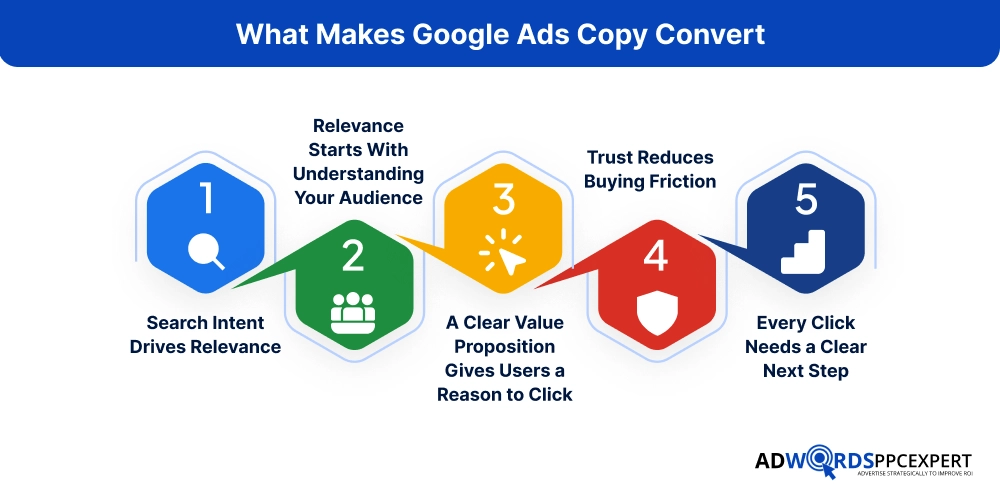
By now, you know the process of writing Google Ads copy. However, knowing why some ads consistently outperform others is equally important. Writing high-converting Google Ads is not just about writing great copy with clever words or stuffing keywords into every headline. It is about delivering the right message to the right person at the right time. You first need to understand user intent and match the conversation going on in the user’s mind. You should know what your potential customers are searching for, what problems they want to solve, and what motivates them to click. Your copy should give them clear reasons to act and choose you.
High-converting ads succeed because they align with how people search, evaluate options, and make buying decisions. The following principles explain why certain ads attract more clicks and conversions than others.
Following are the five Principles Behind High-Converting Google Ads:
1: Search Intent Drives Relevance
Before you start writing the Google Ads copy, you first need to know what searchers actually want.
Search intent generally falls into the following three categories:
- Informational: Users are researching or looking for answers (e.g., "What is PPC management?")
- Commercial: Users are comparing options before making a decision (e.g., "Best PPC agencies near me")
- Transactional: Users are ready to take action (e.g., "Hire a PPC agency")
Google rewards ads that match closely to user search intent. You need to align your message with what users actually want and what they are looking for. Distinguish your copy content according to the search intent, whether informational, commercial, or transactional. Use keywords naturally to improve ad relevance and help Google understand your ad’s context.
2: Relevance Starts With Understanding Your Audience
Write a copy that resonates with your audience, their requirements, and preferred language. You can use Google Search, customer reviews, testimonials, forums, Reddit threads, and support tickets to understand how your audience searches and speaks.
You may understand your audience by answering questions like:
- What problems are they trying to solve?
- What are their goals and expectations?
- What objections might prevent them from clicking?
- What words or phrases do they commonly use?
3: A Clear Value Proposition Gives Users a Reason to Click
Since there are multiple ads for the same search query, to give users a compelling reason to purchase your services, you need to add a unique value proposition to your ad copy. It’s better to highlight the outcomes and benefits rather than just highlighting the features. Include offers or advantages that give a credible reason for someone to buy your product or services.
Here’s what to avoid and how it can be presented better:
Avoid |
Use Instead |
|---|---|
| We Offer Quality Services | Get Results with Proven SEO Strategies |
| Contact Us Today | Book Your Free Strategy Session |
| Best Company in the USA | Trusted by 500+ Businesses |
| Affordable Prices | Plans Starting at $99/Month |
4: Trust Reduces Buying Friction
Trust is generally the deciding factor between two ads offering the same services.
Consider including the following points to make your ad look more appealing and credible:
- Customer ratings and reviews.
- Industry certifications and awards.
- Years of experience.
- Number of satisfied customers or completed projects.
- Money-back guarantees or risk-free offers.
- Free consultations, free audits, or free shipping where applicable.
5: Every Click Needs a Clear Next Step
It is essential for every ad to tell users what to do next. Your CTAs should match the search intent as well as the landing page message for a consistent user experience.
CTA examples you may use:
- Get Free Quote
- Book Your Consultation
- Start Today
- Schedule a Demo
- Shop Now
- Claim Your Discount
Common Google Ads Copywriting Mistakes to Avoid
Some common avoidable mistakes like generic CTA, keyword stuffing, or vague headlines can drain your budget quietly and reduce click-through rates. No matter how well targeted your Google Ads campaigns are, if your copy contains these common avoidable mistakes, your ads will not work out.
Mistake |
Better Approach |
|---|---|
| Stuffing Keywords | Write naturally |
| Generic CTA | Use action-specific CTAs |
| Talking Only About Yourself | Focus on customer benefits |
| Too Many Exclamation Marks | Keep the tone professional |
| Sending All Clicks to the Homepage | Match the landing page to the ad |
Google Ads Copywriting Best Practices
Now that you are acquainted with the core framework for writing high-converting Google Ads and the principles that drive high performance. This section focuses on habits that can keep your copy performing well over time. This includes the words you choose, how you format them, and how often you refresh your ads.
Here are some best practices and quick tips to keep in mind for optimal ad performance:
Best Practice |
Conversion Impact |
Quick Tip |
|---|---|---|
| Emotional Triggers | Higher CTR and engagement | Use words like “Proven,” “Trusted,” and “Exclusive” |
| Numbers in Copy | Builds trust and improves clarity | Use specific proof points like “Over 1,000 Clients Served” |
| Mobile-Friendly | Improves accessibility and user experience | Keep sentences short and CTAs clear |
| Consistent Messaging | Reduces bounce rate | Align ad copy with the landing page headline and offer |
| Regular Refresh | Sustains campaign performance | Test new ad variations every 4–6 weeks |
Google Ads Copy Checklist
Before publishing your ad, use this as your final checklist to review your copy. A final quality check helps you catch common issues, improve your ad relevance, and increase your chances of conversion. Run through these elements to refresh unperforming assets and maintain strong Ad Strength rating.
Check |
Notes / Example |
|---|---|
| Matches Search Intent? | Align the ad with the keyword theme and the user's goal. |
| Primary Keyword in ≥2 Headlines? | Include the main keyword naturally without keyword stuffing. |
| Clear Benefit in First Line? | Focus on the outcome instead of listing features. |
| Strong, Specific CTA? | Use action-oriented CTAs like “Get Free Quote” or “Book Your Consultation.” |
| Trust Signals Included? | Add ratings, reviews, guarantees, or certifications. |
| Message/Offer Matches Landing Page? | Keep the headline, offer, and CTA consistent with the landing page. |
| Mobile-Friendly? | Keep copy concise, front-load important information, and test for truncation. |
| Multiple RSA Variants Tested? | Create 2–3 Responsive Search Ads per ad group and review asset performance monthly. |
Conclusion
High-converting Google Ads aren’t generally the ones with just a clever or catchy headline. It is the result of a process where every element of your ad, such as headlines, descriptions, CTAs, and landing pages, works together to match exactly what a user is looking for. It builds trust and guides users to take action.
If everything works well in coordination, you attract qualified clicks, Quality Score is improved, and you get more conversions. The framework and checklist in this guide give you practical steps you can follow to refine your ads before launching them. You can test different headlines, descriptions, and CTAs, monitor their performance, and optimize them based on real data. At AdwordsPPCExpert, we help you improve Google Ads copy to boost engagement, increase conversions, and get compounding results on ad performance.
Frequently Asked Questions
1: How do I write Google Ads copy that converts?
To write high-converting ad copy, you first need to understand user search intent. Your ad copy should align with what users are looking for. It is recommended to incorporate relevant keywords naturally, highlight the benefits of your product or service, include trust signals where possible, and end with a clear call-to-action. To provide a consistent user experience, ensure your ad copy aligns with your landing page.
2: What makes a good Google Ads headline?
A good Google Ads headline is one that addresses the user’s search intent and includes your primary keyword. It should communicate a compelling reason to encourage users to click. Also, headlines that mention offers, numbers, or problem-solving benefits generally perform well.
3: What should I include in a Google Ads description?
In your Google Ads description, you should explain the value of your offers and try to address common pain points. The focus should be on highlighting benefits for users rather than just illustrating features. The CTA should be clear and action-driven, along with appropriate trust signals.
4: What's the biggest mistake advertisers make with Google Ads copy?
One of the biggest mistakes advertisers generally make is using generic ads and vague claims. They often write for businesses, not customers. There are weak CTAs and mismatched landing pages. Vague claims like “quality service” or “best prices” don’t differentiate your products or services from other competitors, and the ad fails to build any trust. Strong ads generally make specific, verifiable claims and match users’ search intent.
5: How often should I update my Google Ads copy?
It is generally recommended to review your ad asset performance at least once a month and replace low-performing headlines and descriptions, and refresh copy when search terms, offers, or seasonality change. You should also look for common triggers like CTR drops or seasonal or promotional offer changes.
6: Does ad copy still matter with Smart Bidding and AI-driven ad combinations?
Yes, in fact, it holds more importance now. Smart Bidding can control who sees your ad and what you pay, but it doesn’t control whether that person is persuaded to click or convert. AI can only test and optimize combinations from the headlines and descriptions you provide. But if you provide weak or repetitive copy, it limits the overall performance of your ad campaign.
7: Can I use the same ad copy across different ad groups?
It is generally recommended to tailor ad copy to each ad group’s theme and intent. If you are using identical copy across unrelated keyword themes, it may become less relevant and affect your Quality Score.
8: How many headlines and descriptions should I write for an RSA?
Google recommends using around 15 headlines and 4 descriptions. For optimal performance, each one should offer a genuinely different angle (benefit, offer, problem, credibility) rather than reworded versions of the same idea. Focus on creating unique, high-quality headlines rather than multiple variations that repeat the same message.

Ami Singh is a highly skilled AdWords PPC Specialist, known for creating profitable Google Ads strategies that elevate brands. With deep expertise in Google Search, Display, Shopping, YouTube Ads, and advanced bidding techniques, Ami consistently converts data into performance-driven results.
With a sharp analytical mind and a strong understanding of online consumer behavior, Ami designs campaigns that maximize ROI, boost quality scores, and reduce acquisition costs. His approach blends technical expertise with strategic thinking—making him a go-to expert for businesses aiming to dominate Google Ads.
Ami doesn’t just adapt to the fast-changing PPC industry, but he also stays ahead of the curve by testing new features, adopting automation smartly, and refining what works. Clients trust him for his transparency, insights, and ability to scale campaigns sustainably.
Looking to take your Google AdWords performance to the next level? Connect with Ami Singh at Softtrix and discover how he can help you get the maximum growth through powerful PPC strategies.