
Businesses are worried about CPC and increasing their budget aggressively to generate leads. But is it right to burn money on PPC ads in 2026? Well, the answer is pretty simple: quality ads make quality leads.
If you are not budgeting smartly in 2026, you are going to waste most of your ad budget without getting good results.
When operating in the online environment, particularly in conjunction with a digital marketing agency, the budgeting process will become the tool allowing you to spend efficiently rather than spending inefficiently on advertisements.
Let’s dive into the brief guide to your e-commerce Google Ads budgeting process.
Key Takeaways
- Scaling profitable Google Ads for e-commerce requires more thoughtfulness regarding budgeting than spending more on ads.
- Knowledge about CPA, ROAS, and profit margins is important to scale up Google Ads budgets.
- Shopping campaigns and Performance Max campaigns tend to generate more revenue and ROAS for e-commerce.
- It is recommended to split out test campaigns, scalable campaigns, remarketing campaigns, and seasonal campaigns.
- A stable daily budget and gradual scaling help Google’s algorithms work more efficiently.
- Conversion tracking and landing page quality are the key elements affecting ad profitability.
Importance of Budget Planning in E-commerce Google Ads
Effective budgeting is now more important in e-commerce Google Ads due to the increase in competition and CPCs. As most ads are set with automatic bidding and AI, each penny should be wisely spent based on specific profit metrics.
The importance of budget planning is to ensure stability, effective learning by the algorithm, and controllable customer acquisition costs. In addition, budgeting allows for efficient scaling of brands without losses from fluctuating market demands.
- Stability of customer acquisition cost despite the volatility of CPC rates
- Optimal distribution of budget among Search, Shopping, and Remarketing
- Efficient scaling while maintaining profitability
- Effective algorithm learning with constant data flow
Step 1: Start With Business Economics, Not Limiting Yourself to Ad Spend
The most successful ecommerce advertisers don’t ask themselves “how much should I spend?”. Instead, they ask, “How much am I able to spend on acquiring customers?” This is done by understanding:
- The margins of their products
- Average order value (AOV)
- Purchase frequency
- Operational costs
One of the most important fundamentals when advertising in e-commerce is the breakeven ROAS, which dictates whether a campaign will be profitable or not. If you have 50% gross margin, then your breakeven ROAS would be 2.0x.
E-commerce Budget Readiness Benchmarks
Business Stage |
Monthly Ad Spend Range |
Primary Goal |
|---|---|---|
| Startup Store | $500 – $2,000 | Market validation & testing |
| Growth Stage | $3,000 – $10,000 | Scaling profitable products |
| Established Brand | $10,000+ | Market dominance & expansion |
Break-Even ROAS Example
Profit Margin |
Break-Even ROAS |
Meaning |
|---|---|---|
| 20% | 5.0x | Very tight profitability window |
| 30% | 3.33x | Balanced scaling zone |
| 50% | 2.0x | High scalability potential |
Step 2: CPA before Setting Final Budget
The Cost per Acquisition metric is the single most important aspect when setting up your budget.
For calculating sustainable budget levels:
- Find the max allowed CPA according to the margin
- Compare it with the current conversion rate
- Estimate the traffic volume for revenue goals
For instance, if you are earning $20 profit per unit sold, your CPA must be less than that number, otherwise you’ll be losing money.
CPA vs Profitability Relationship
Product Profit per Sale |
Safe CPA Limit |
Scaling Status |
|---|---|---|
| $10 | <$10 | Not scalable |
| $25 | <$25 | Break-even zone |
| $50 | $20 – $35 | Scalable |
| $100+ | $40 – $70 | High-growth potential |
Industry CPA Benchmarks (Ecommerce Google Ads)
Industry |
Average CPA Range |
|---|---|
| Fashion | $20 – $60 |
| Beauty & Skincare | $25 – $80 |
| Electronics | $50 – $120 |
| Home & Furniture | $40 – $100 |
| Luxury Products | $80 – $200+ |
High-profit niches such as beauty or accessories can afford to incur higher expenses for customer acquisition, while low-profit sectors require strict control.
Step 3: Structuring Budget Across Google Ads Campaign Types
A strong e-commerce PPC budget is never allocated to a single campaign type. Instead, it is distributed based on intent hierarchy and conversion probability.
Recommended Budget Allocation Model
Campaign Type |
Budget Share |
Strategic Role |
|---|---|---|
| Shopping / Performance Max | 40% – 60% | Revenue engine |
| Search Campaigns | 25% – 40% | High-intent capture |
| Remarketing | 10% – 20% | Conversion recovery |
| Testing Campaigns | 5% – 10% | Scaling experiments |
Search Campaigns (High Intent Capture)
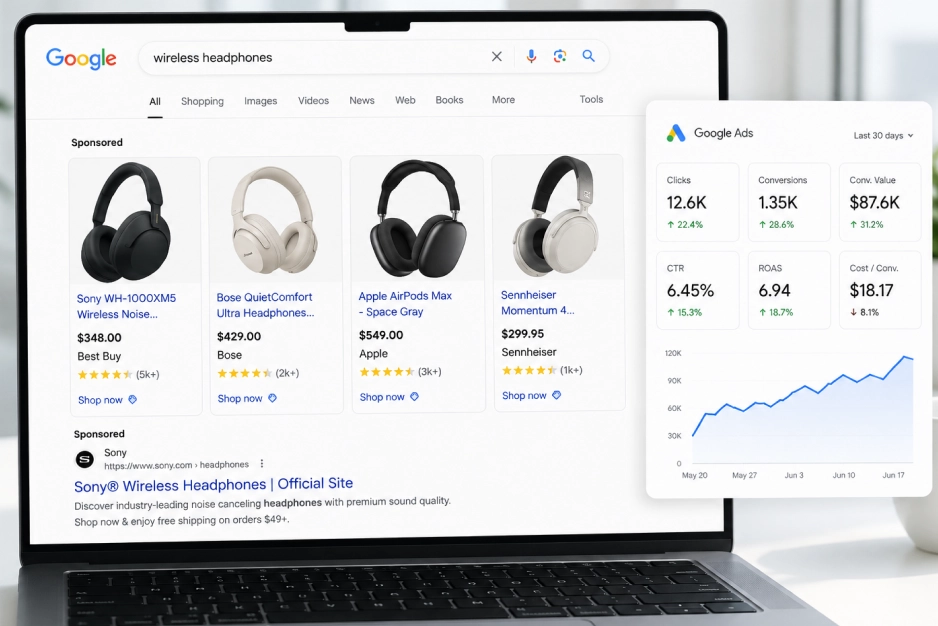
Search campaigns focus on people who are specifically searching for products such as “purchase leather shoes online” or “best wireless headphones.”
Conversion rate in these campaigns is usually high due to clear intent. On average, Search Campaigns account for 30% – 40% of the overall spend.
The main takeaway from the analysis of industry results is that Search campaigns have 2x to 3x higher conversion rates than display traffic because of clear intent.
Shopping & Performance Max Campaigns (Revenue Engine)
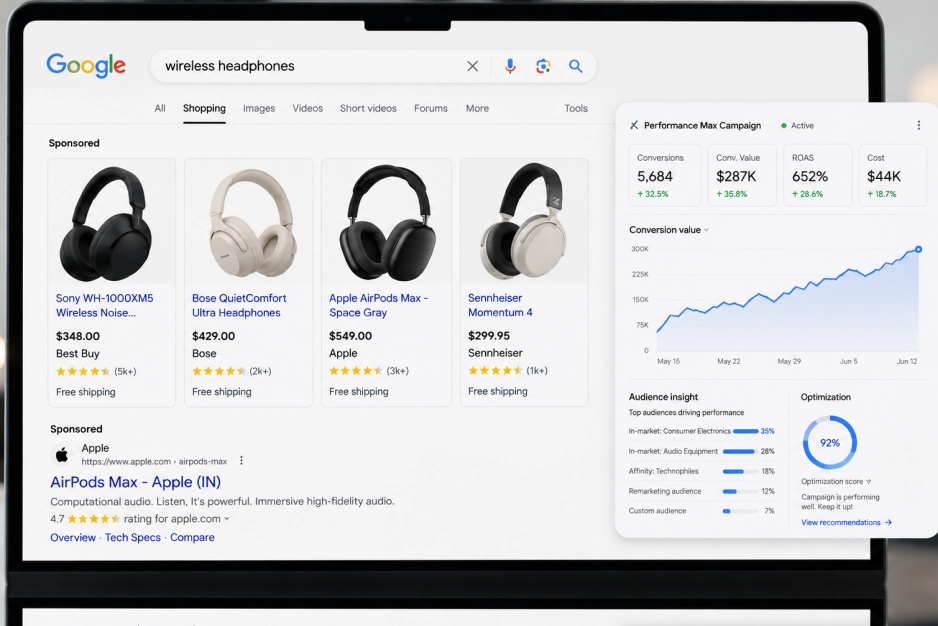
These campaigns are considered the core of e-commerce campaigns in Google Ads. They display product images, prices, and vendor information in SERP.
They normally account for 40% – 60% of the overall campaign spend since they attract scalable and purchase-intent-driven traffic.
From my experience with performance results, it can be mentioned that Shopping campaigns are usually the most effective in terms of ROI.
Remarketing Campaigns (Conversion Recovery Layer)
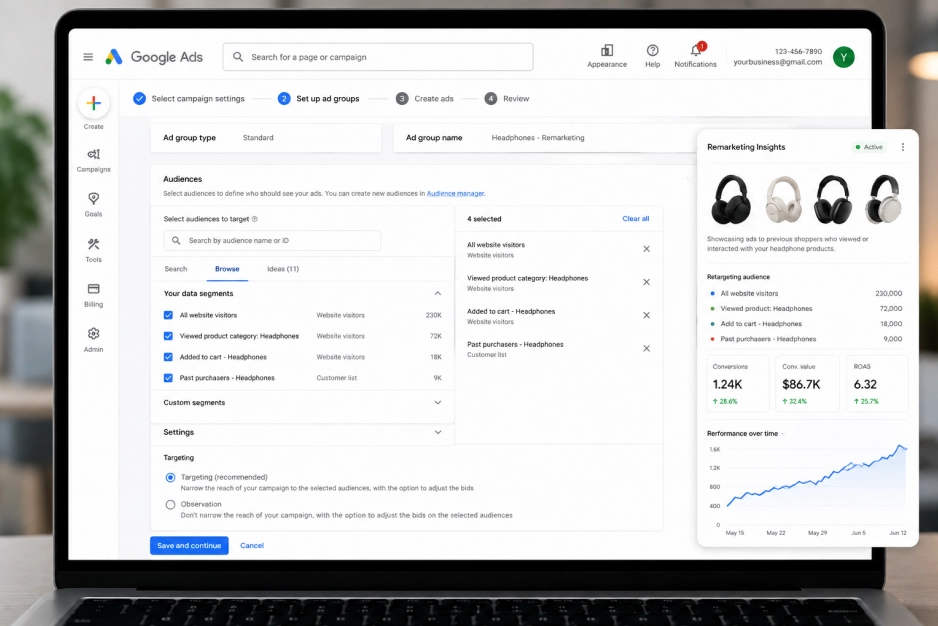
Remarketing involves targeting individuals who have engaged with your store but did not make a purchase.
The budget for remarketing is usually 10%–20% and generates the greatest ROI of all segments.
Based on industry results, remarketing campaigns can boost conversion probability up to 70% higher than first-touch campaigns, becoming the most effective use of your budget.
Step 4: Seasonal Adjustments and Demand Forecasting
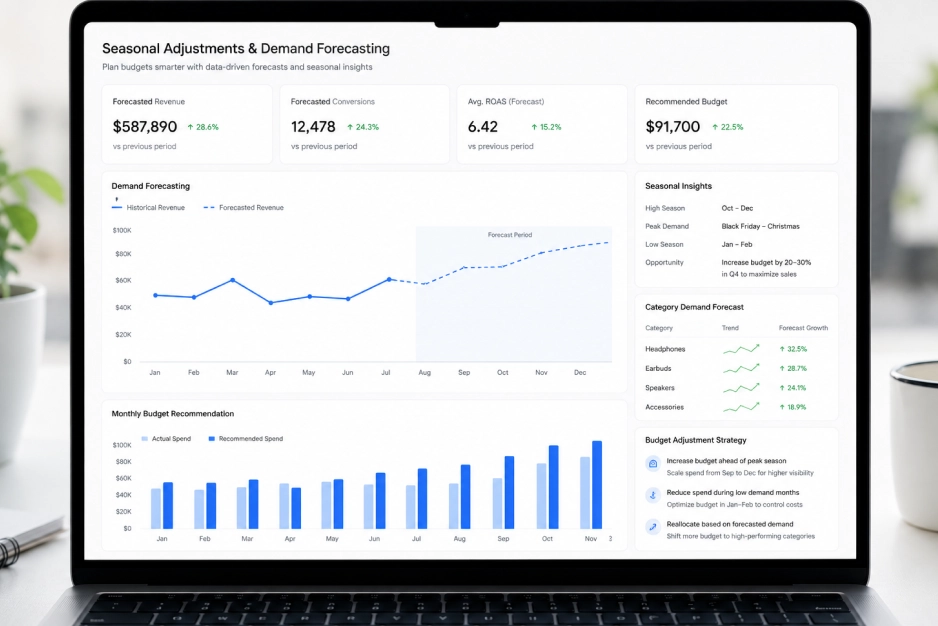
Demand in e-commerce is cyclical. A fixed budget would mean you miss out on valuable periods of sales opportunity.
Important factors include:
- Seasonal shopping seasons
- Black Friday/Cyber Monday seasonality
- Demand surges for specific categories (fashion, technology, gift products)
E-commerce Seasonal Budget Behavior
Season Type |
Budget Change |
Market Behavior |
|---|---|---|
| Peak Season (Festive / Black Friday) | +30% to +80% | High demand + high CPC |
| Normal Season | Baseline | Stable conversions |
| Off Season | -10% to -30% | Lower demand |
Companies that don’t scale budgets during high-intent seasons will miss out on potential income when their competitors are rapidly scaling up their spending.
Step 5: Scaling Budgets Using Performance Data Rather Than Emotions
After campaigns have started producing data, scaling should now be based solely on performance.
KPIs in scaling include:
- ROAS
- Conversion Rate
- Customer Lifetime Value
- CTR
The incremental scaling rule involves:
- Increasing budgets by 10%-20% in each cycle
- Watching for stable CPAs before any more scaling
- Expanding only profitable campaigns or product lines
Safe Scaling Framework
Performance Condition |
Budget Action |
|---|---|
| Stable ROAS for 7–14 days | Increase 10–20% |
| Rising CPA | Pause scaling |
| High ROAS + Stable CPA | Aggressive expansion allowed |
| No Conversion Data | Reduce spend / optimize first |
A key industry insight is that aggressive budget increases without stability often lead to algorithm disruption and rising CPA.
Step 6: Aligning Budget With Conversion Infrastructure
Budget performance is not only dependent on ads—it is directly influenced by store quality.
Even well-funded campaigns fail when:
- Product pages are not optimized
- Landing pages lack trust signals
- Tracking is incomplete or inaccurate
- Product feeds are poorly structured
The effectiveness of Google Ads today relies greatly on feed optimization, conversion rate optimization (CRO), and signals from the audience, and not on bidding.
Such agencies as AdWords PPC Expert work with this alignment all along the marketing funnel to make sure that their clients’ advertising dollars generate sales and not just traffic.
Step 7: Developing a Sustainable Scaling Model
For long-term e-commerce development, there needs to be a flexible budget model.
It should have such elements as:
- Expansion of profitable product lines
- Optimization of the product feed
- Performance Max creative rotation
- Audience testing
- ROAS benchmarking
E-commerce Growth Budget Evolution
Stage |
Budget Behavior |
Focus |
|---|---|---|
| Testing | Controlled low spend | Validation |
| Stabilization | Moderate scaling | Efficiency optimization |
| Growth | Aggressive scaling | Winning campaigns expansion |
| Maturity | High stable spend | Market dominance |
In mature ecommerce accounts, budget planning becomes less about control and more about efficiency expansion—putting more money into proven profit zones.
Daily Budget vs Monthly Budget in E-commerce Google Ads
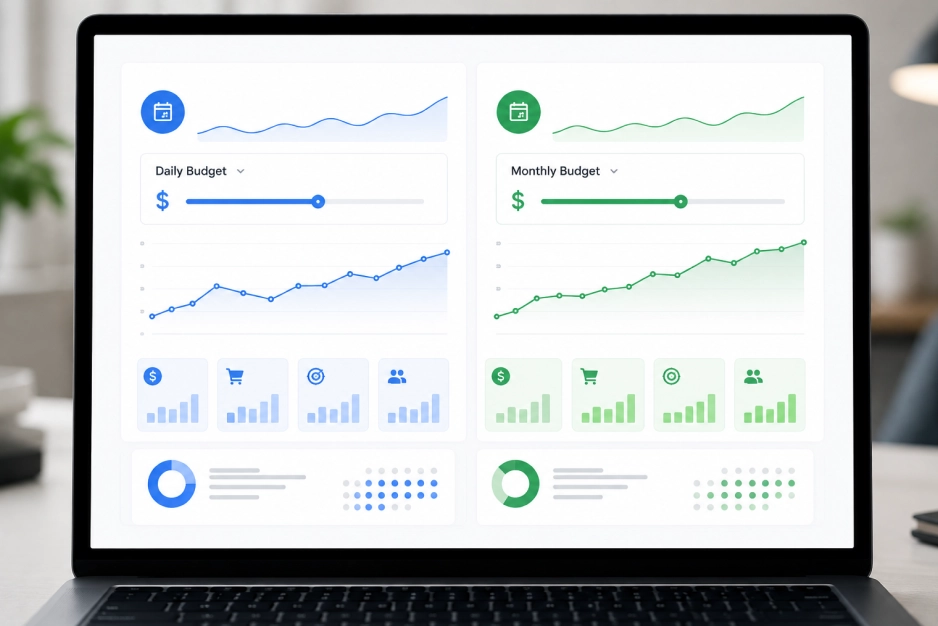
Yet another aspect of making a budget for e-commerce Google Ads campaigns is knowing the distinction between a daily budget and a monthly budget. While many companies concentrate solely on monthly budgeting, their stability largely depends on the structure of the daily budget used for ad campaigns.
While the monthly budget shows how much money in total will be spent each month on advertising, the daily budget determines the average daily sum that can be spent by Google Ads on the campaign. Sometimes Google Ads may spend more or less per day, yet in the end, the monthly spending rate becomes equal.
The monthly budget helps to determine the growth targets for e-commerce, while the daily budget manages the process itself.
Daily Budget vs Monthly Budget Comparison
Factor |
Daily Budget |
Monthly Budget |
|---|---|---|
| Purpose | Controls daily campaign spending | Defines overall monthly ad investment |
| Focus | Campaign pacing and traffic consistency | Revenue and profitability planning |
| Flexibility | Changes based on auction demand | More stable strategic allocation |
| Impact on Performance | Directly affects campaign delivery | Affects long-term scaling ability |
For instance, when an e-commerce company expects to pay $3,000 monthly on Google Ads, it means that their daily budget will approximately be $100. Nevertheless, Google might surpass the budget for the day by paying more if it forecasts that there is a higher chance of getting sales.
Often, many marketers fail by allocating insufficient daily budget to prevent data accumulation and slow down algorithmic optimization. Otherwise, an aggressive daily budget with no proper CPA control will result in unstable ROAS and unnecessary spending.
How AdWords PPC Expert Scaling E-commerce Brands
In order to scale Google Ads profitably, one has to consider more aspects apart from raising the budget, since such things as structure, product feed, conversion tracking, and ROAS optimization have a direct effect on performance.
Core Areas of Focus
Service Area |
Purpose |
|---|---|
| Google Shopping & Performance Max | Drive scalable e-commerce revenue |
| Search Campaign Optimization | Capture high-intent buyers |
| Product Feed Optimization | Improve Shopping ad performance |
| Conversion Tracking Setup | Ensure accurate performance data |
| Remarketing Campaigns | Recover lost conversions |
| ROAS Optimization | Improve profitability and scaling |
AdWords PPC Expert agency helping e-commerce brands to make their ads more efficient through aligning ad budgets with business goals, profit margins, and conversion metrics.
Common Budget Mistakes E-commerce Brands Make
It is true that most e-commerce ad accounts make losses, not because Google Ads cannot deliver results, but due to some common structural problems, including:
- Budget setting without considering margins.
- Expanding too fast right after achieving good returns.
- No segmentations.
- Automated bidding without data.
- No consideration of seasonal changes.
Sometimes, avoiding these problems helps make profits better than increasing spending.
FAQs about Budgeting for Google Ads Campaigns in E-commerce
1. What is the minimum budget that is necessary to start an advertisement campaign using Google Ads for e-commerce?
Start-ups that work in the sphere of e-commerce generally set budgets from $500 to $2,000 per month.
2. How much of the budget should I spend on my Google Ads campaign?
To make a campaign with Google Ads, 10% – 30% of the budget is necessary to spend.
3. When should I increase my budget for the Google Ads campaign?
It should be increased when ROAS is positive at a certain percentage of 10%-20%.
4. Can I allocate the most significant part of the budget for one Google Ads campaign?
Most of the budget should be allocated for Shopping campaigns and Performance Max ads.
5. Why does my Google Ads campaign not provide any outcomes despite having a sufficient budget?
Several factors can influence this problem: poor quality feed, lack of tracking or data to use algorithms.
Final Thoughts
Allocating budgets in e-commerce Google Ads is now not only a process of determining how much to spend – it is the process of creating a scalable system for growth.
Everything from knowing CPA and ROAS to allocating budgets to search, shopping, performance max, and remarketing campaigns directly affects the profitability of a business.
Moreover, data-backed budgeting can help with the development of algorithms, campaign management, and the customer acquisition process.

Ami Singh is a highly skilled AdWords PPC Specialist, known for creating profitable Google Ads strategies that elevate brands. With deep expertise in Google Search, Display, Shopping, YouTube Ads, and advanced bidding techniques, Ami consistently converts data into performance-driven results.
With a sharp analytical mind and a strong understanding of online consumer behavior, Ami designs campaigns that maximize ROI, boost quality scores, and reduce acquisition costs. His approach blends technical expertise with strategic thinking—making him a go-to expert for businesses aiming to dominate Google Ads.
Ami doesn’t just adapt to the fast-changing PPC industry, but he also stays ahead of the curve by testing new features, adopting automation smartly, and refining what works. Clients trust him for his transparency, insights, and ability to scale campaigns sustainably.
Looking to take your Google AdWords performance to the next level? Connect with Ami Singh at Softtrix and discover how he can help you get the maximum growth through powerful PPC strategies.