
Paid promotion of e-commerce stores looks easy enough: set a budget, start a campaign, and let the sales roll in. But the truth is, cost breakdowns associated with PPC show quite a different picture. The price per click can range between $0.50 and $3 across almost all industries, with particularly competitive niches going beyond the $5 mark. This implies that even a minimal budget might not last long if campaigns are poorly executed.
In order to succeed, ecommerce stores will have to target a ROAS within a 3:1 to 5:1 ratio, which translates into making $3 to $5 for every dollar invested. If this number is not reached, one may be facing problems with their targeting strategy, creatives, and landing pages.
Understanding PPC costs will become essential at such a point. As opposed to making guesses about a budget, ecommerce store owners would require specific benchmarks, estimated prices, and a well-thought-out scaling strategy. In this post, you’ll find out exactly how much PPC will cost you and what sort of returns on investment you’d be able to achieve.
What is E-commerce PPC? Quick Overview
E-commerce PPC (Pay Per Click) is an internet marketing method where the advertiser pays whenever the visitor clicks on their advertisement. Unlike other methods that rely on building traffic organically over time, E-commerce PPC ensures that the advertiser’s products get placed before highly engaged consumers looking for the same kind of product.
Definition of PPC in E-commerce
The objective of PPC advertising for e-commerce is mainly concerned with generating exposure to products, collections, offers, and other things in paid listing ads. Such ads can be posted in search engines, marketplaces, and even on social media platforms in order to allow businesses to gain demand and boost their conversion rates through sales.
Popular PPC Platforms for E-commerce
The choice of the PPC platforms to be used is going to be based on the requirements of the business. On the other hand, some businesses can use all these platforms so that they benefit more from them.
- Google Search Ads: This targets people who use the search engine with the intent of making purchases.
- Google Shopping Ads: This shows your products along with pictures, prices, and customer reviews.
- Meta Ads (Facebook and Instagram): Ideal for discovery ads, retargeting ads, and visually striking ads.
- Amazon Ads: Assist in marketing your product on Amazon, where people actually purchase products.
Role of PPC in E-Commerce Marketing Funnel
Pay-per-click (PPC) marketing is an effective strategy in each stage of the e-commerce marketing funnel:
- Awareness: You can build brand awareness using social media ads.
- Conversion: You can target the highly interested prospects with search & shopping ads.
- Consideration: Retargeting ads work as a reminder for those users who have previously visited your website.
Understand How PPC Pricing Works
It is very important to know the price of e-commerce PPC, where your funds are going, and what factors are behind the costs. There are several ways of e-commerce pricing that depend on different dynamic elements. To be able to manage costs effectively, it’s vital to understand them all.
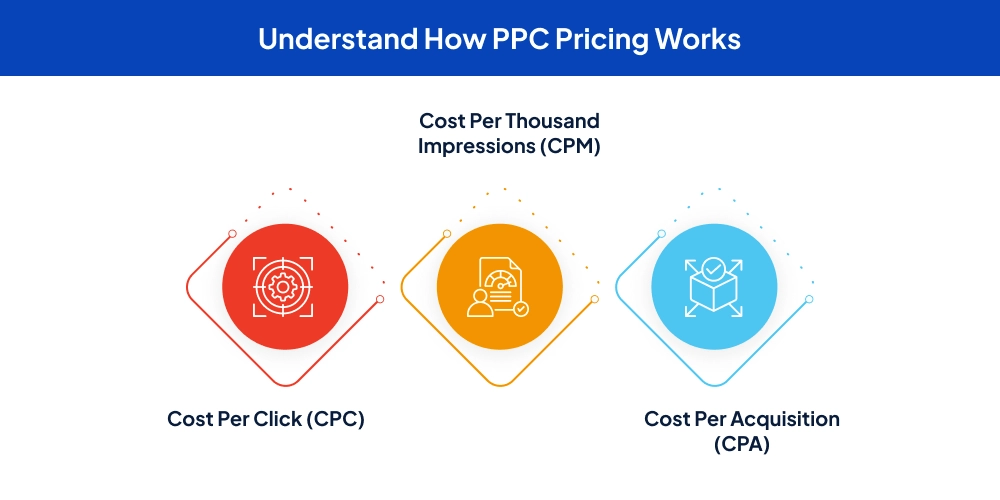
Cost Per Click (CPC)
It’s the most popular PPC pricing strategy used within e-commerce. CPC implies payment per each ad click. The price ranges from $0.50 to $3+, but if you work in competitive niches such as electronics and finance, CPC costs may even exceed $5. It’s the best choice to target people who intend to make a purchase through search and shopping ads.
Cost Per Thousand Impressions (CPM)
CPM pricing implies payment per 1,000 impressions of your ad. It doesn’t depend on the number of ad clicks, hence it’s a better option if the aim is branding rather than conversions. Social media platforms usually apply CPM pricing, which ranges between $5 and $20+.
Cost Per Acquisition (CPA)
Cost per acquisition refers to a pricing model where you only pay for acquisitions or successful conversions. Therefore, when using this form of pricing model, you will pay after an individual has done something that you desire, such as purchasing your product. As far as e-commerce goes, cost per acquisition might range between $10-$50+, depending on the cost of the product being sold.
Factors that Determine PPC Pricing
There are several factors that influence the cost of PPC campaigns. Having an understanding of these factors can help you to build your budget.
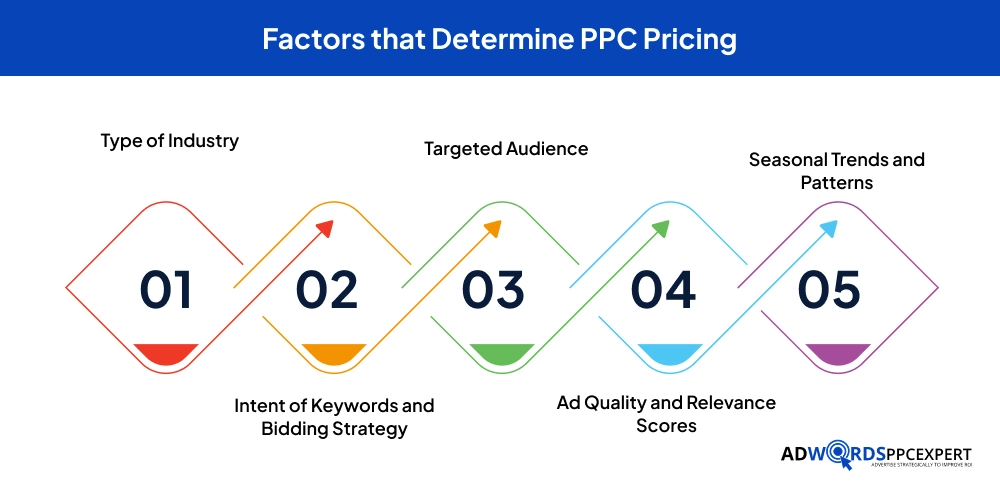
Type of Industry
Certain industries might be highly competitive, resulting in high prices for advertising space. If different brands are competing for space among the same audiences or keywords, CPC rates increase. While fashion might be moderately priced, electronics and luxury goods usually have higher costs.
Intent of Keywords and Bidding Strategy
There are certain terms that might be highly competitive among others. Intent keywords that include “buy running shoes online” would result in higher bids. The two forms of bidding are manual and automated.
Targeted Audience
When targeting people according to their interests, CPC increases. Targeting audiences through interest or previous actions, such as retargeting, could increase CPC or CPM.
Ad Quality and Relevance Scores
Google uses ad relevance scores, click-through rate, and page experience to assess ad quality. Ads with good quality can be cheap and ranked better than others. In contrast, low-quality ads are relatively expensive when compared to ads of good quality.
Seasonal Trends and Patterns
The cost of ads fluctuates with time. The seasonal trends and patterns affect advertising since the competition is usually very high in festive seasons, leading to an increase in CPC and CPM.
Average Ecommerce PPC Costs in 2026
The price of E-commerce PPC is constantly increasing due to the increasing competition. Even though there isn’t a definitive price for E-commerce PPC, most companies know the range in which their prices will lie. It is essential to understand this range to budget accordingly.
Platform-wise cost breakdown
Platform |
Avg CPC/CPM |
Competition |
ROAS |
Use Cases |
|---|---|---|---|---|
| Google Search Ads | $1.50 – $6+ CPC | High | 3:1 – 6:1+ | High-intent conversions |
| Google Shopping Ads | $0.70 – $3 CPC | High | 3:1 – 5:1+ | Product-based traffic |
| Meta Ads (CPC) | $0.80 – $3 CPC | High | 2:1 – 4:1+ | Awareness, retargeting, scaling |
| Meta Ads (CPM) | $12 – $25+ CPM | High | - | Brand visibility & audience reach |
| Amazon Ads | $0.90 – $2.50 CPC | High | 4:1 – 8:1+ | Marketplace conversions |
Industry-Based Cost Variations
Industry |
Avg CPC Range |
Competition Level |
Buying Cycle |
Key Strategy Focus |
|---|---|---|---|---|
| Fashion & Apparel | $0.80 – $2.50 | Medium | Short | Visual ads & retargeting |
| Electronics | $2 – $6+ | High | Medium | High-intent keywords |
| Health & Beauty | $1 – $3+ | Medium–High | Short–Medium | Influencer-style creatives |
| Home & Furniture | $1.50 – $4+ | Medium–High | Long | Remarketing & conversion optimization |
How to allocate the E-commerce PPC budget in 2026?
PPC budgeting is not about setting random numbers and hoping for the best results. It requires an understanding of the industry, budget, margin, competition, and returns. Most e-commerce brands treat PPC as an investment tied to revenue targets, not just a marketing expense. Let’s understand the budgeting based on the specific industry size.
Business Type |
Monthly Budget |
Objective |
Key Focus |
|---|---|---|---|
| Startups & Small Businesses | $500 – $3,000 | Test market & validate products | Data collection, initial conversions |
| Mid-sized E-commerce Brands | $3,000 – $20,000+ | Scale campaigns & improve ROAS | Optimization, audience expansion |
| Enterprise-Level Stores | $20,000 – $100,000+ | Aggressive growth & market dominance | Automation, multi-channel scaling |
Smaller businesses in the initial phase should focus on learning and testing, while mid-range and large enterprises can focus on efficiency and scaling. Consider reading the complete small business Google Ads guide for more in-depth details.
Strategies of Budget Allocation
PPC experts always suggest separating the budget into two phases:
- Testing ( 20-30%): Use the budget to test new creatives, audiences, and campaigns.
- Scaling ( 70-80%): Always allocate more budget to top-performing campaigns.
Channel-Wise Allocation
Splitting the budget on different platforms improves the stability and reach. This is how to diversify the budget:
- Google Ads ( search & shopping ) 40-50%: capture high intent traffic
- Meta Ads ( Facebook, Instagram ) 30-40%: audience building and retargeting
- Other Channels ( Amazon, etc) 10-20%: additional revenue streams
Planning of Retargeting Budget
Retargeting is an effective method that contributes to increasing the conversion rate, especially when targeting certain customers who did not complete their transaction on the site.
- Set aside 10%-20% of the total marketing budget for retargeting.
- Target cart abandoners, product viewers, and loyal customers.
ROAS from retargeting campaigns is generally higher and more cost-effective compared to other advertising methods.
Hidden Costs & Charges of E-commerce PPC You Must Consider
There are many hidden charges related to PPC campaigns that need to be considered. Ad spending is not only an expense, but various other charges also impact the overall budget. Without proper knowledge about these charges may lead you to waste your money on ad campaigns.
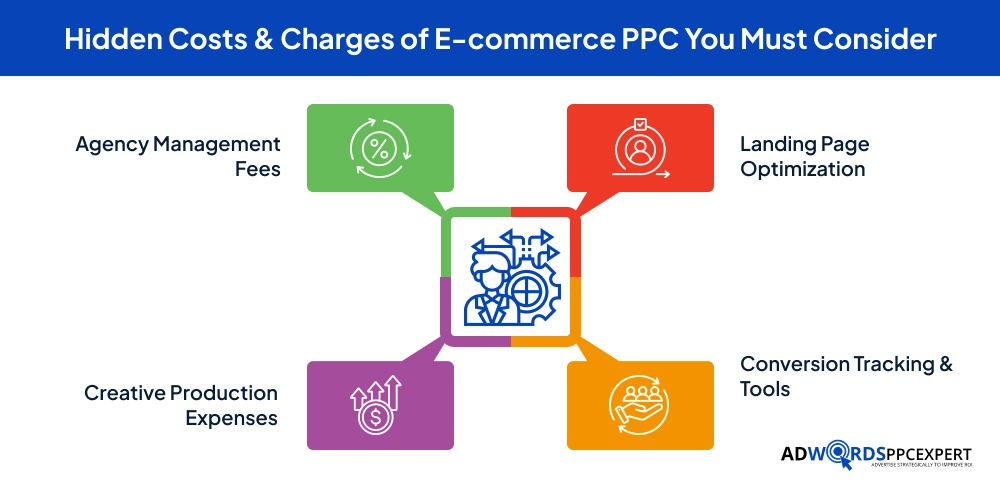
Agency Management Fees
When dealing with a PPC agency, management fees constitute an important part of your expenses.
- Set aside 10%-20% of the total marketing budget for retargeting.
- Target cart abandoners, product viewers, and loyal customers.
It increases your expenses, but the proper agency will help minimize wasted costs and increase ROAS.
Creative Production Expenses
For highly-performing advertisements, creative assets play a very important role.
- Includes ad copy, banners, product images, and videos
- Depends on the amount of material and its quality, but usually ranges between $100 and $5,000+ per month
Testing new creatives on a regular basis is crucial, for example, in the case of Meta, where ad fatigue can make your ads ineffective rather quickly.
Landing Page Optimization
Bringing traffic to the site is one thing; getting conversions from it is very important.
- Involves landing page design, development, testing, and optimizing UX
- The tools and services cost between $50 and $500+ per month
Little adjustments may bring substantial reductions in CPA.
Conversion Tracking & Tools
Having accurate data is essential for growing your PPC marketing efforts.
- Provides tools for analytics, tracking pixels, attribution tools, and heat maps.
- Fees per month can vary between $20-$300+ based on the specific tools utilized.
Without appropriate tracking, it’s very difficult to know what’s effective, making the investment less efficient.
In-House Vs PPC Agency Management: Quick Cost Comparison
The difference between in-house teams and PPC agencies is not only about the structure; both solutions will differ in their pricing. Knowing what each option implies for your marketing budget, you’ll be able to choose a solution that better suits your budget.
Cost of Hiring an In-House Team
Building an in-house team requires time and a huge budget to spend on monthly salaries, ads, and maintenance.
- PPC specialist salary: $40,000 - $80,000+ per year
- Extra roles needed: Designers, writers, analysts (this increases cost significantly)
- Paid tools and software: $200 - $1,000+ per month
- Ongoing training and overheads: Investment in further skills acquisition and project management
Overall, it may require around $70,000 – $150,000+ annual investment, which could be too heavy for the fast-growing e-commerce companies.
Advantages of Partnering with an Agency
Working with a PPC agency implies different options and benefits. An experienced e-commerce PPC agency can scale up your business quickly with a higher ROAS.
- Low initial cost: Usually, 10%-25% of ad spending or a fixed monthly rate.
- Team of Experts: Strategy development, creatives, and PPC specialists included
- Full suite of tools and technologies: No extra payments necessary
- Faster delivery: Experience-based process eliminates unnecessary testing and errors
E-commerce agencies enable companies to develop and launch their campaigns right away without creating an entire team.
Benefits of Choosing a Professional Agency For E-commerce PPC
Conducting a profitable PPC campaign for your e-commerce business requires both setting up the advertisements and optimizing them. With a PPC advertising company, you can enjoy several benefits, since with their help, you won’t risk making costly mistakes, but will rather achieve success
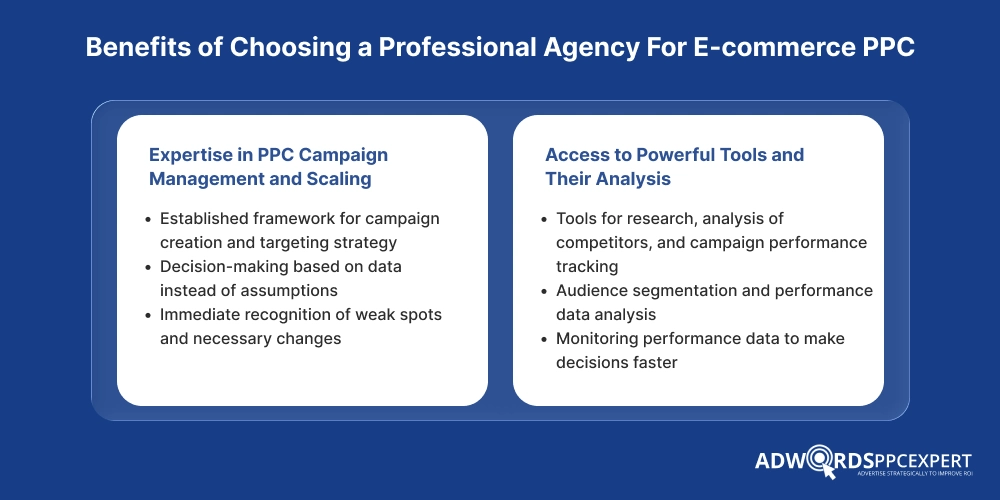
Expertise in PPC Campaign Management and Scaling
Having hands-on experience in working with several industries, a professional agency knows all the nuances.
- Established framework for campaign creation and targeting strategy
- Decision-making based on data instead of assumptions
- Immediate recognition of weak spots and necessary changes
Thus, companies can grow their campaigns more effectively and spend no extra money testing something.
Access to Powerful Tools and Their Analysis
The success of any campaign depends greatly on the use of powerful analytical and other types of tools.
- Tools for research, analysis of competitors, and campaign performance tracking
- Audience segmentation and performance data analysis
- Monitoring performance data to make decisions faster
Final Verdicts: Building a Profitable PPC Plan
However, while PPC can be the secret weapon for boosting ecommerce sales online, unless the strategy is implemented in the right manner, this approach may turn out to be nothing but empty promises without actually driving the bottom-line results.
On average, the CPC would range somewhere between $0.80 and $6+, while the conversions will fall into 2% to 5% range. The only thing that matters when it comes to ROI is the conversion rate, which determines the profitability. It should be emphasized that a profitable company strives for a 3:1 to 5:1 ratio of ROAS, with the best campaigns boasting even higher ratios – above 6:1.
And the only way to achieve such a result is by constantly testing and optimizing the current marketing approach. With a proper optimization of the creative materials, target audience, and website, brands should manage to cut down on the acquisition costs by 20% to 40%.

Ami Singh is a highly skilled AdWords PPC Specialist, known for creating profitable Google Ads strategies that elevate brands. With deep expertise in Google Search, Display, Shopping, YouTube Ads, and advanced bidding techniques, Ami consistently converts data into performance-driven results.
With a sharp analytical mind and a strong understanding of online consumer behavior, Ami designs campaigns that maximize ROI, boost quality scores, and reduce acquisition costs. His approach blends technical expertise with strategic thinking—making him a go-to expert for businesses aiming to dominate Google Ads.
Ami doesn’t just adapt to the fast-changing PPC industry, but he also stays ahead of the curve by testing new features, adopting automation smartly, and refining what works. Clients trust him for his transparency, insights, and ability to scale campaigns sustainably.
Looking to take your Google AdWords performance to the next level? Connect with Ami Singh at Softtrix and discover how he can help you get the maximum growth through powerful PPC strategies.