
Quick Answer :
A landing page is a single web page built for one specific marketing goal, while a website page is part of a larger collection of interconnected pages that provide general information about a business. The right choice depends on the user’s search intent, the ad message, and the action you want visitors to take after clicking the ad.
Have you ever thought about what happens after a user clicks your ad? Whether the visitor takes the desired action or leaves the website, it mainly depends on how well the page matches their search intent. That’s why targeting the right page is an important part of a PPC campaign.
For example, your ad shows “ same-day plumbing repair.” But after the click, visitors go to the general home page; they may have to browse through several pages before finding the relevant service. For sure, many visitors will leave the site without doing this. But still, you have to pay for the click.
This is where the choice between a dedicated landing page and a website page becomes important. A landing page is designed around a specific ad, offer, or conversion goal, while a website page may provide broader information and navigation.
Continue reading this blog to learn how a PPC page is different from a website page and how to select the right page.
Key Takeaways
- A PPC landing page is mainly created for one campaign, offer, audience, or conversion goal.
- Website pages support a wide business goals and may include several subjects, products, services, and calls to action.
- Dedicated landing pages lead to better results for lead generation, special offers, consultations, demos, and place-based campaigns.
- Product pages work better for ecommerce inquiries where users would like to compare options.
- Use a dedicated PPC landing page for focused campaigns and an existing website page when it already provides relevant information.
- Test both pages and track conversions, cost per conversion, and other key metrics to identify which page supports your campaign goal.
What Is a PPC Landing Page and What Makes It High-Converting?
A PPC landing page is a web page built specifically to receive traffic from paid ads like Google Ads, Microsoft Ads, and Meta ads. It is mainly designed for a specific product, service, or offer, and encourages visitors to take a particular action.
For example, you search for “best online running shoes for men” and click on the specific product; then you’re redirected to its main web page where you can see its images, price, features, reviews, and purchase option. The product page is effectively serving as the landing page.
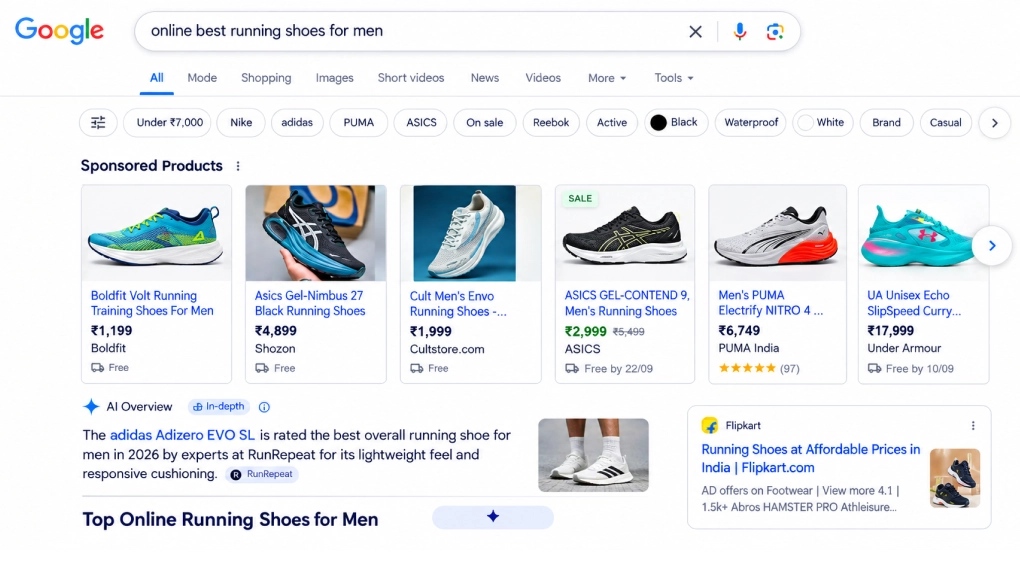
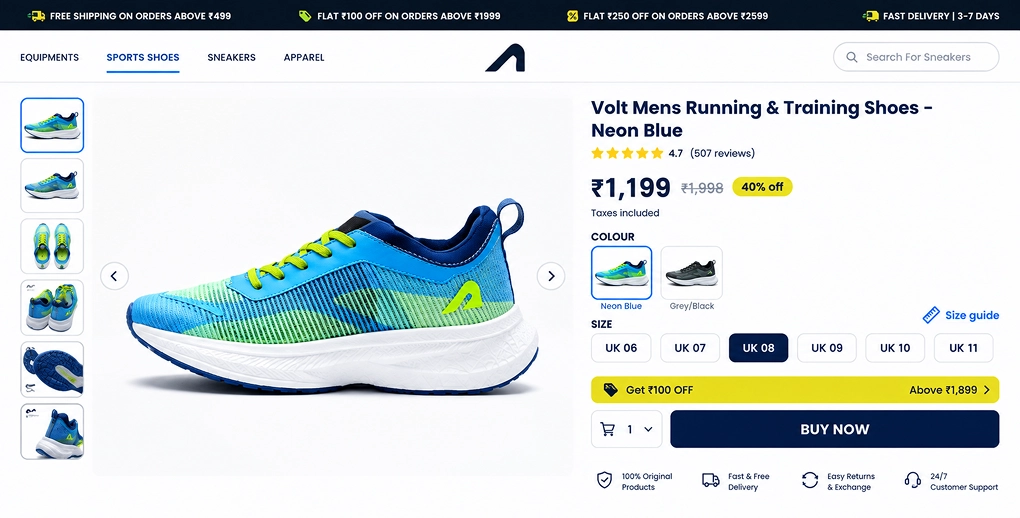
PPC landing page is more focus-oriented. Its goal is to convert visitors into real customers. Instead of browsing through a general website, visitors can immediately find information about the product and take the next step, such as placing an order.
Here are the key elements that make a landing page highly converting
Strong and clear heading
The heading is the first thing that visitors notice after they click on an advertisement.
Hence, it should accurately describe what the page is about and relate to the message in the ad.
For example, if the advertisement says, “Get a Free PPC Audit,” then the heading should be something like, “Get Your Free PPC Audit Today.” That way, visitors instantly know they have landed on the right page.
Add a clear Call to Action (CTA)
The page should have one clear CTA. Visitors should not be required to wonder what to do next. A PPC landing page should clearly guide them toward taking an action.
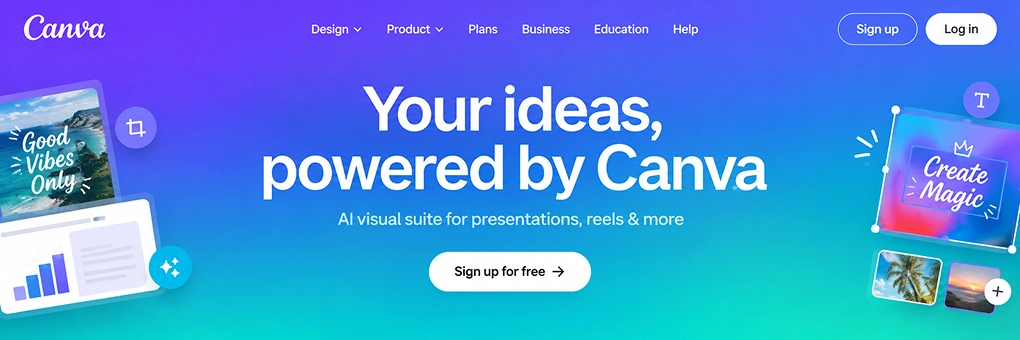
Depending on the campaign, the CTA may be:
* Request a call
* Book a Free Consultation
* Schedule a Demo
* Start a Free Trial
* Call Now
A Clear Value Proposition
A business should present what our business offers and why you should consider its services more clearly and simply so that new visitors can easily understand it.

Focus on :
* What is being offered?
* Who is it for?
* What problem does it solve?
* Why should the visitor take action?
For example, instead of simply stating Professional Accounting Services, a business should provide more specific information like Online Accounting Services for Small Businesses With Dedicated Financial Support. This gives a clearer idea of the service to the visitors.
A strong value proposition should be easy to understand without requiring visitors to read through several paragraphs.
Relevant and Focused Content
A landing page should provide relevant information regarding products or services to the visitors so that they can take better and quicker actions.
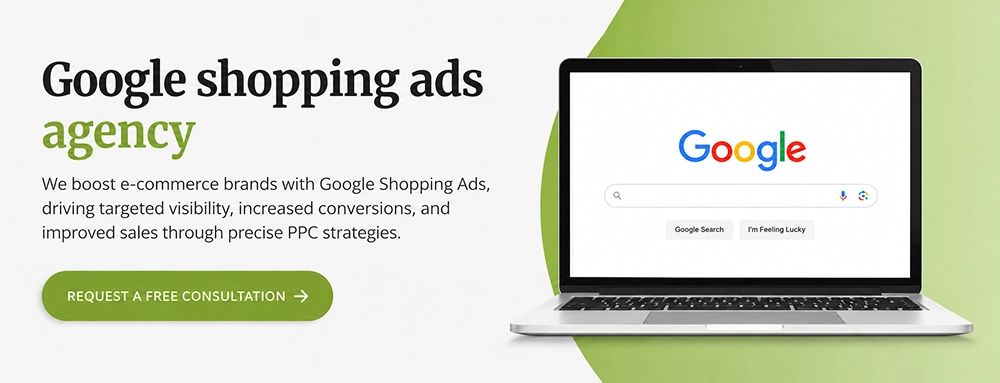
For example, if you run an ad about e-commerce businesses, then the page must give information regarding product advertising, shopping campaigns, e-commerce sales, and ROAS.
Sending the visitor to a general digital marketing page containing information about SEO, web design, social media, and email marketing may make the experience less relevant.
A Simple Conversion Process
It is important to make the conversion process simple and ask only for the information needed to complete the desired action.
For example, A lead-generation form may only need details such as name, email, phone number, and business requirement. Asking for unnecessary information can make the process longer and may cause potential customers to leave.
What is a website page, and what makes it high-converting?
It is a standard page of a business website, such as the homepage ( it includes the business information ), product page ( it includes information regarding a specific product ), service page (it includes what services the business offers), category page ( it includes multiple products ), or contact page, where traffic comes from different channels like search engines, referrals, and social media.
For example, if you simply search for sports shoes for women on Google, you may land on a category page of the store showing multiple products where you can browse multiple options and compare them based on your preference, such as product type, color, and price, before taking action.
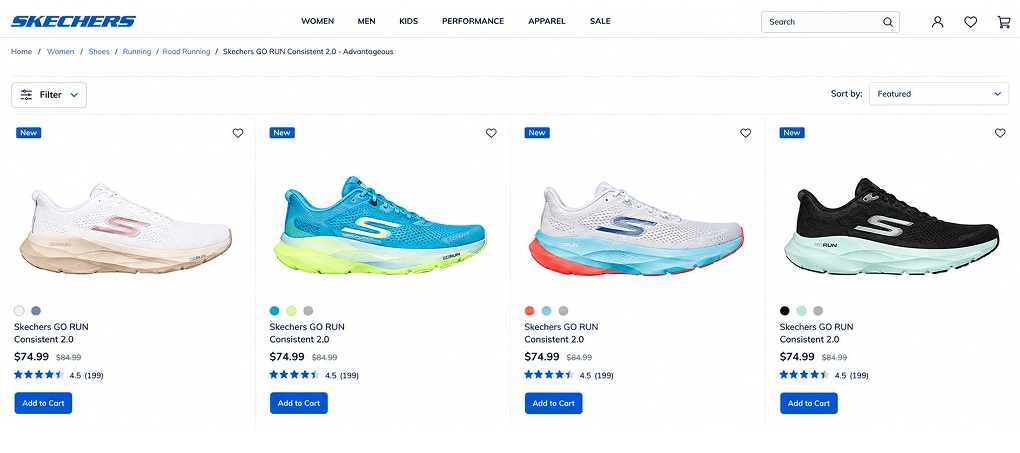
A website page may give visitors more opportunities to explore information, compare options, and understand the business before taking action.
However, having more information or options does not automatically make a page high-converting. The page should still make it easy for visitors to find what they need and move toward the intended action.
Here are key elements for high-converting Website pages:
1. Clear Purpose of the Page
There are multiple types of website pages, such as e-commerce websites, blog websites, and educational websites, etc. Every webpage should have a clear purpose.
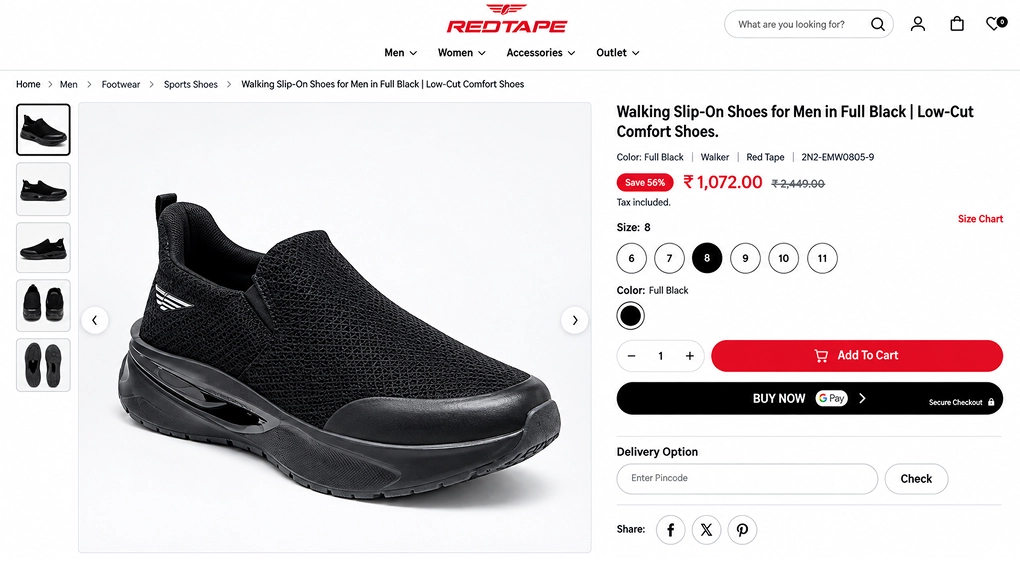
For example, A product page should display detailed information about the product along with its images, CTAs, and other details.
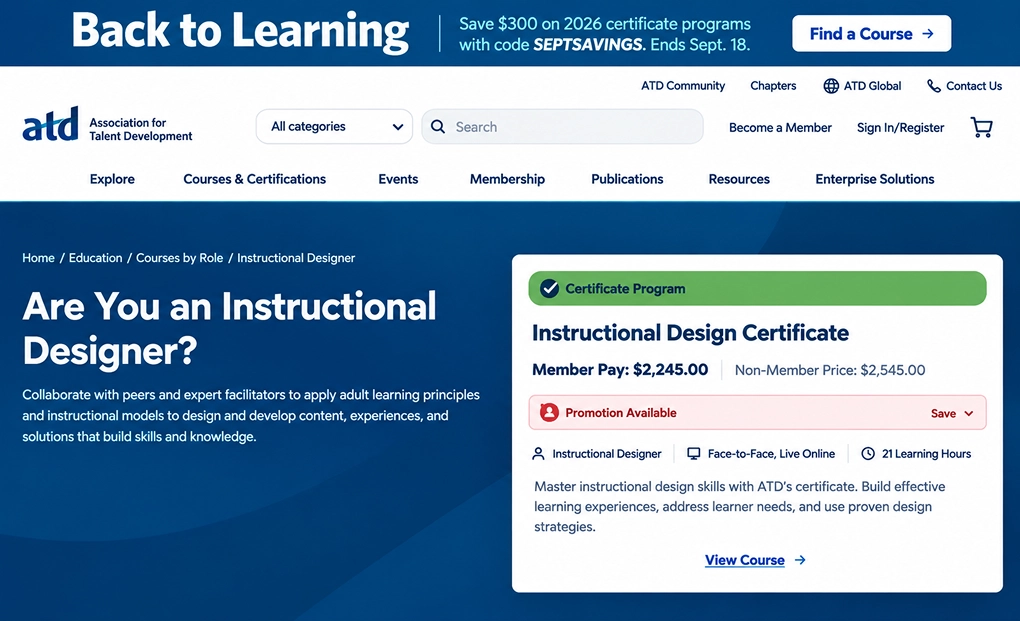
Similarly, a service page should explain what the service means and make it easy for visitors to request a quote or contact the business.
2. Easy Navigation
Before making any final decision, visitors usually browse through several websites.
Hence, it is important to provide clear navigation, as it would help them find the needed info without getting lost.
For example, if someone is interested in hiring PPC services, they may want to go from Services → PPC Services → Case Studies → Contact.
However, navigation should support the visitor’s journey rather than distract them with too many unrelated choices.
3. Enough Information to Make a Decision
The website page must give enough information to visitors so that they can make a better decision.
For example, if someone searches for ” How PPC Services Deliver Instant Results, they expect to find information such as the PPC services, experience, areas of expertise, client results, reviews, and case studies.
Meeting visitors’ expectations helps them understand whether the agency is suitable for their business before they decide to contact them.
4. Fast, mobile-friendly design
Users mainly browse queries through their smartphones these days. So, your website pages must be responsive on all devices, including smartphones, laptops, and desktops.
For example, if someone clicks a Book a Free Consultation button on their phone, the page should load quickly, have readable text, and make the consultation button or form easy to find and use.
Check :
- Text is easy to read without zooming.
- Buttons are large enough to tap comfortably.
- Images are well optimized so they do not slow down the page.
- Important information and the main CTA appear early.
- Forms are simple to complete on a mobile screen.
5. Build Confidence Before Asking for Action
Visitors are unaware of your business, so it’s important to deliver information regarding services, reviews, case studies, credentials, guarantees, or FAQs to reduce uncertainty.
For example, someone comparing accounting firms may want to see services, client experience, pricing information, and testimonials before requesting a consultation.
Where Should You Send Your PPC Ad Traffic?
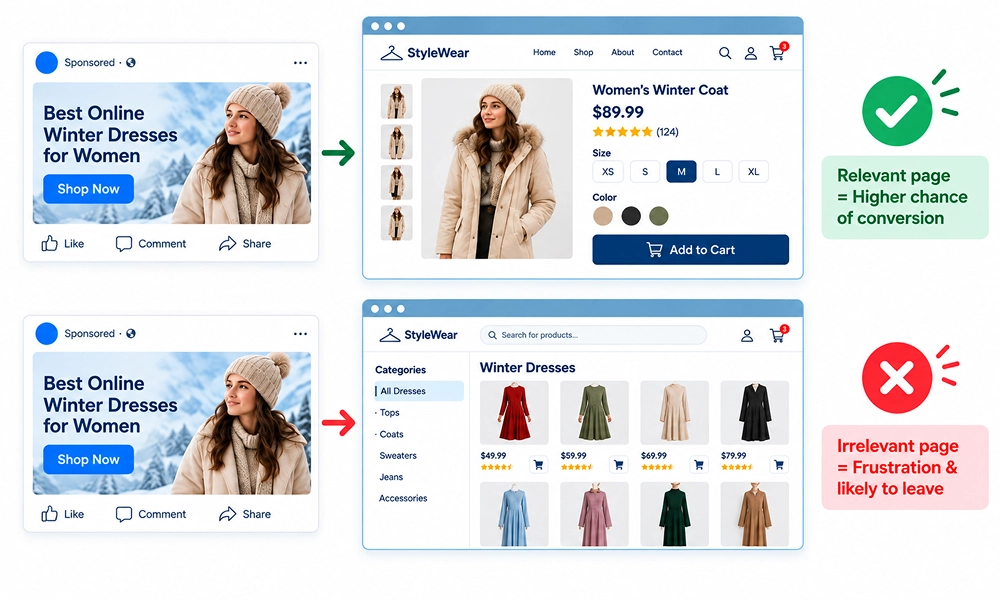
Targeting a single page for every PPC campaign is wrong. What landing page you are targeting depends on 3 parameters: what the visitor searched for, what your ad promises, and what the visitor needs to do next.
To make the right decision, analyze what the potential customer wants.
If a person is searching for a specific service and your ad is about the same service that the user is looking for, a dedicated landing page can give them a direct path to conversion.
Here is a clear table showing where you should send PPC traffic :
Visitor’s intent | Recommended destination |
|---|---|
| If the user is searching for a specific service or offer, for example, “Free PPC Audit for Small Businesses” | Directs to a dedicated landing page or relevant service page |
| Searching for a specific product, for example, “ Buy Nike Air Max Running Shoes” | Directs to product page |
| If the user is searching for a specific product category, for example, “Women’s Running Shoes” | Directs to the relevant category page where they can browse different products. |
| If the user is looking for multiple products to compare, for example, “ Best Laptops Under $1,000” | Directs visitors to a page showing multiple products so they can compare options. |
| If a user is searching for a location-based query, for example, best seo services in the USA | Directs visitors to a location-specific service or landing page |
Note: It’s not always necessary to use a separate landing page. If you have an existing page on your website with information that relates to the query, you can direct users there instead.
Check before creating a new web page
- What are your visitors searching for?
- What does the ad promise?
- Does the existing page deliver that promise?
- Does the visitor need to explore or take one specific action?
- Can they reach that action without unnecessary steps?
Landing Page vs. Website Page: Key Differences
Here is a clear and simple comparison of the key differences between a PPC landing page and a website page.
Dimension | PPC landing page | Website page |
|---|---|---|
| Primary purpose | If the purpose is to generate leads getting bookings, then creating a PPC landing page is the best option. | The main purpose of this is to educate visitors about the business services or products, pricing, and reviews, or in short, an overall view of the business through website pages that encourage visitors to contact the business. |
| Audience | It is usually designed for a defined group of paid visitors who clicked a particular ad based on their search, interest, location, or other targeting criteria. | It can receive visitors from many different sources, including organic search, direct traffic, referrals, social media, email, and paid advertising. |
| Focus | Mainly focuses on one audience, one message, or one CTA | Focuses on several products, services, or topics. |
| CTA | It involves one CTA such as “Book Now “ or Shop Now “ | May include several CTA, such as viewing services, reading blogs, contacting the business, or browsing products. |
| Visitor behaviour | The page is designed to guide visitors toward a relatively direct action after they click the ad. It minimizes the steps between the visitor's intent and the desired conversion. | The page supports different types of behaviour, including browsing, researching, comparing options, learning more about the business, and eventually converting. |
| Suitable for | Suitable for lead generation, special offers, product promotions, demonstrations, and location-based campaigns. | Suitable for brand searches, detailed research, service exploration, and general website visits. |
When a PPC Landing Page Is the Better Choice?
If your campaign has a specific goal, audience, or offer, then creating a PPC landing page is the best option. It allows you to create a page that closely matches what the visitor searched for and what the ad promised.
A brief table below shows when a PPC landing page can be a better choice:
When to use a PPC landing page | Why it can be a better choice? |
|---|---|
| Targeting a specific audience | Targeting a specific audience allows you to create content based on a specific audience’s needs or preferences. |
| Driving one primary conversion | If your goal is to drive one particular conversion, then creating a specific page can guide visitors toward one clear action with fewer distractions. |
| Your existing page is too broad | If your website covers many pages such as services, reviews, contact, and case studies, visitors may struggle to find what the ad promised. |
| Testing a new campaign | A separate page makes it easier to test different headlines, offers, layouts, forms, and CTAs without changing an important website page used by other visitors. |
When an Existing Website Page Is the Better Choice
An existing website page can be the better choice when it already matches the visitor’s search intent, provides the information they need, and offers a clear next step.
The table below highlights situations where using an existing website page may be more suitable:
When to use an existing website page | Why it can be a better choice |
|---|---|
| The page closely matches the ad | There is no need to create a separate page if the existing page already delivers what the ad promises. |
| Visitors want to compare options | Website pages such as product categories can give visitors several options to browse and compare before making a decision. |
| Visitors need detailed information | A detailed service or product page can provide in-depth knowledge to visitors that helps in making decisions. |
| Visitors are searching for your brand | Existing customers who already know the business may want to explore the specific service rather than respond to a single campaign offer. |
How to Test Landing Page vs Existing Page
Here’s a practical framework for testing pages effectively:
1. Define Goal
Start by deciding the goal for each page. It may be :
- Generating leads
- Increase purchases
- Increasing demo or consultation requests
- More sign-ups
2. Prepare Both Pages
Create 2 pages, version one named as the existing page and version 2 named as the landing page. Keep important factors consistent, including:
- The same advertising campaign.
- The same target audience.
- The same traffic source.
- Similar testing dates.
- The same conversion tracking setup.
This ensures that differences in performance are caused mainly by the page experience rather than by unrelated factors.
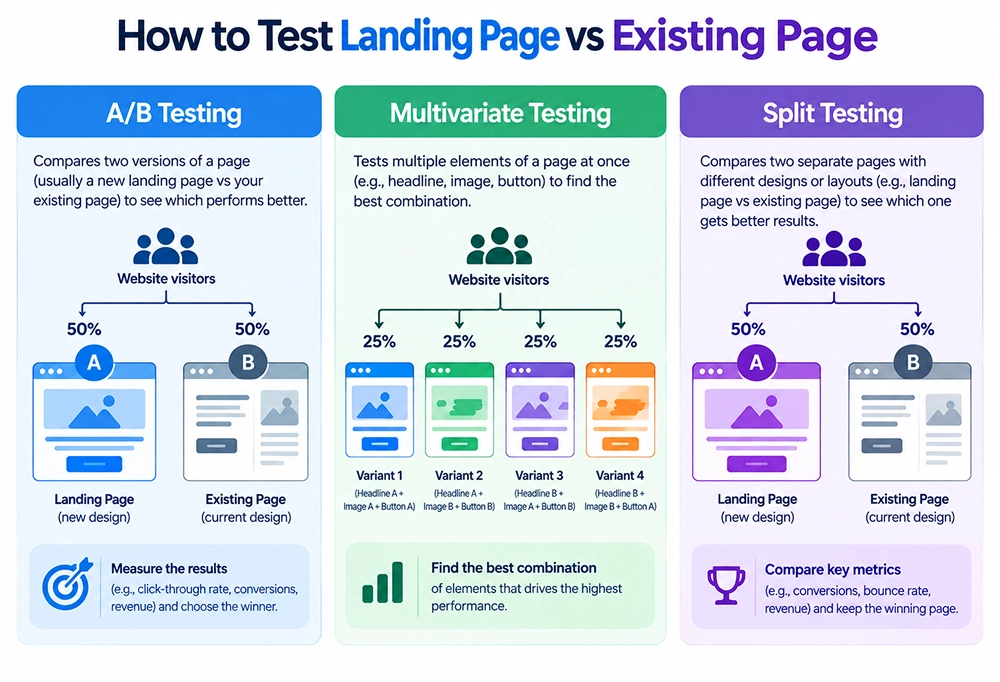
3. Choose a Testing Method
Choose one of the following testing methods:
- A/B Testing: Compare two versions of a page to see which performs better.
- Split Testing: Send visitors to two different URLs and compare their performance.
- Multivariate Testing: Test multiple page elements at the same time to find which combination performs best.
4. Check Technical Performance
Before sending visitors to pages, test both versions carefully:
- Check that all buttons and links work.
- Submit every form and verify that data reaches the CRM or email inbox.
- Test confirmation messages and thank-you pages.
- Check the pages on mobile, tablet, and desktop.
5. Analyze and Implement the Results
Check important metrics like:
- Conversion rate
- CTA click-through rate
- Form completion rate
- Bounce rate
- Engagement time
- Scroll depth
Also check whether the new page affects organic visibility or page performance. If one page performs better with reliable data, implement it and continue monitoring its performance.
If the results are unclear, test individual elements such as the headline, CTA, form, or trust signals.
Common PPC Landing Page Mistakes Advertisers Should Avoid
Here are some issues advertisers should avoid making when sending paid traffic to their website.
Not Targeting the Right Page
If you see an ad related to the best online winter dress for women and you would expect that after clicking on the ad, you will be directed to a page that shows relevant dresses along with price, size, add to cart button.
However, if the ad takes you to the general category page showing multiple dresses. This can be frustrating, and you leave the site without taking any action.
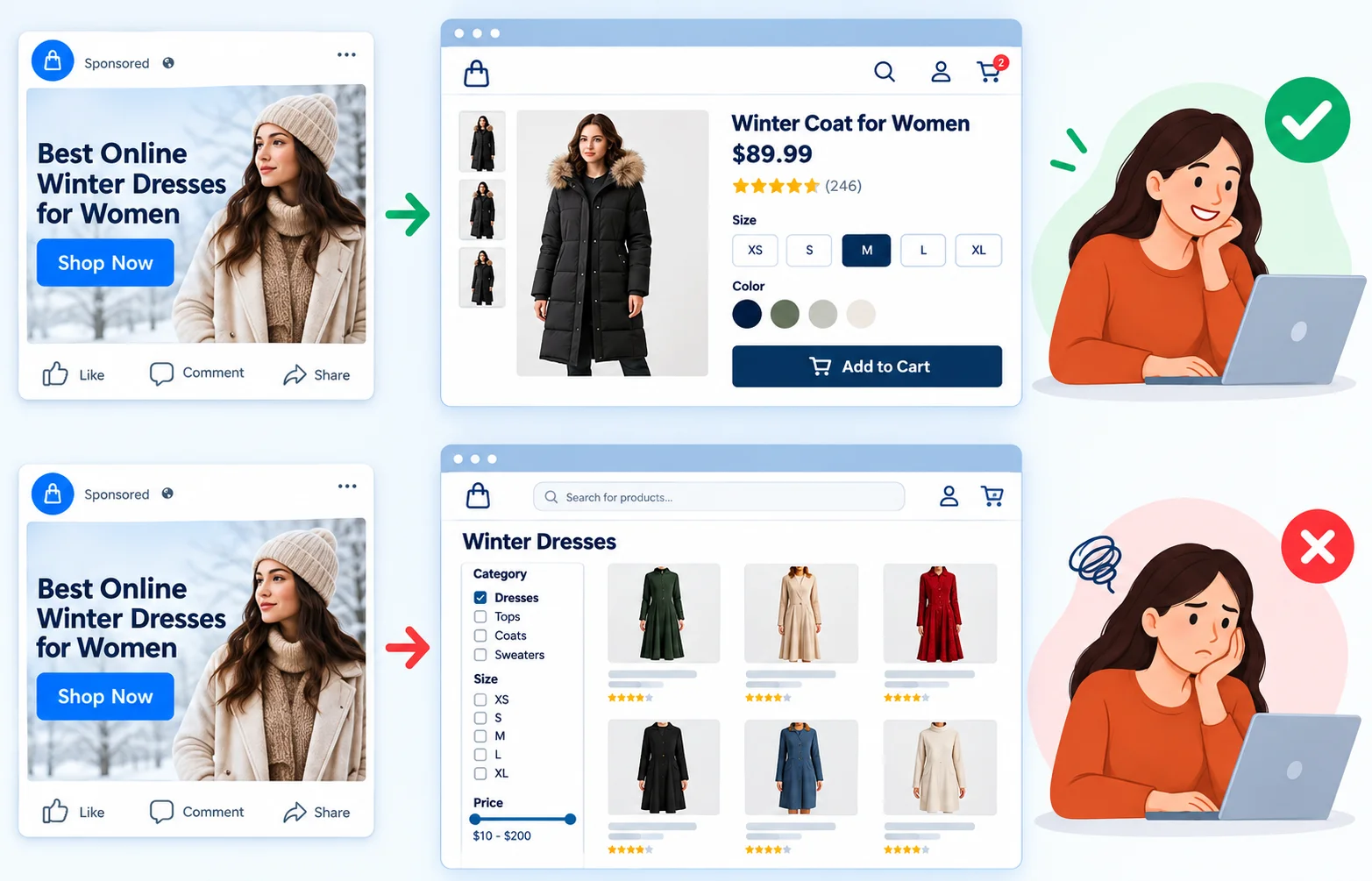
The target page should closely match the product, service, or offer mentioned in the ad. When visitors can immediately find what they were looking for, they are more likely to continue exploring the page and complete the intended action.
Ignoring budget optimization
Spending money on PPC Ads without tracking or checking where the amount is going may lead to significant waste of advertising spending. Certain campaigns or ads may provide profitable conversions, while others may consume a large portion of the budget without producing meaningful results.
If businesses continue to invest the same amount in all ads without tracking any performance it may lose more profitable opportunities.
A business should start tracking ad metrics within 24 to 48 hours of launch, but you should wait 2 to 4 weeks before making major decisions or judging overall success.
Ineffective use of keyword match types
Using incorrect keyword match types can cause your ads to show for searches that are too general or not relevant to your product or service. As a result, you may pay for clicks from users who probably won’t convert.
Advertisers should understand the purpose of broad match, phrase match, and exact match and select them according to the campaign goal. Effective PPC keyword research also helps identify relevant search terms, understand search intent, and find negative keywords that can reduce irrelevant traffic.
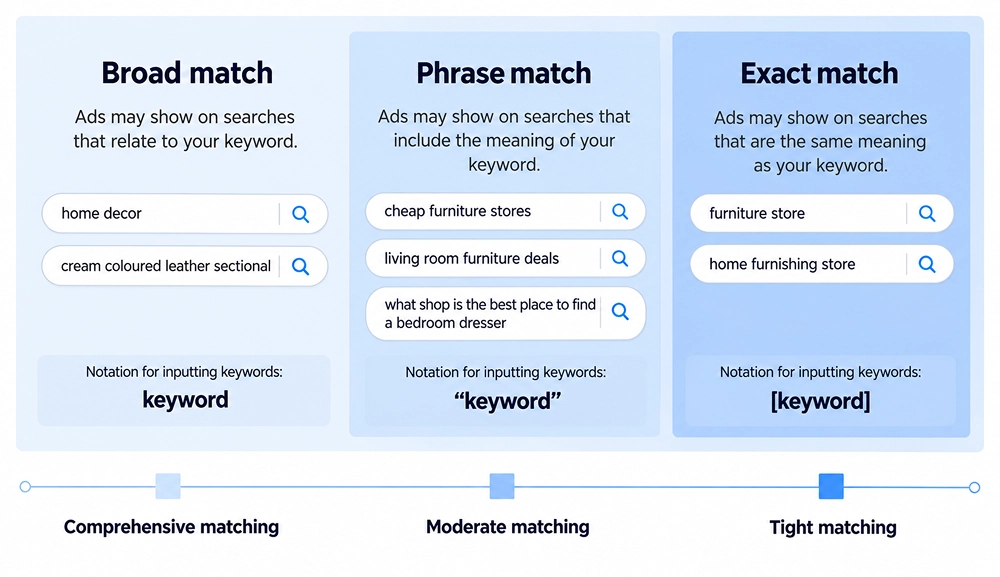
For example, if you are selling a product by using a keyword that is too broad may result in searches that are not relevant to what you are selling.
Performing search term analysis and excluding negative searches will allow you to improve the quality of the traffic and control costs.
Ignoring landing page optimization
If your landing page has technical issues like slow loading speed, is difficult to navigate, or has irrelevant information, this makes it harder for users to convert; clicks won’t translate into sales or leads.
Not using a clear CTA
Visitors may understand your product or service but still not know what they should do next if the page does not provide a clear call to action. Every PPC campaign should have a CTA that supports its primary objective.
For example, an ad promoting a free consultation could use “Book Your Free Consultation,” while an ecommerce ad could use “Add to Cart” or “Buy Now.”
The CTA should be easy to find, clearly communicate the next step, and appear in relevant places on the page. Avoid using several competing CTAs that can make the visitor’s decision more difficult.
How Can You Choose the Right Page for Your Campaign?
Choosing between using a PPC landing page or an existing site page begins with knowing what the visitor is looking for after clicking on the advertisement
Check the following things before choosing the destination:
- Find out whether the search is about a specific product or service, offer, or category, or something broader.
- The landing page should provide what the ad claims to provide.
- If the existing product, service, or category page has the information needed, then there is no need to create another landing page.
- Check the relevance, navigability, mobile usability, loading speed, and whether visitors can easily do what they need to do on the page. Landing page effectiveness
Conclusion
Choosing between a PPC landing page and an existing website page depends on various factors such as the visitor’s search intent, the ad message, and targeted action.
A dedicated landing page can be the best choice when a campaign focuses on one specific offer, service, audience, or conversion goal. An existing related page featuring products or services can be used as long as it presents information that visitors are looking for.
Before driving paid traffic to the page, make sure it delivers what the ad promises and provides a clear next step. That can be done easily by testing different URLs and analyzing conversions along with different metrics relevant to advertising.
Frequently Asked Questions
1. Is a PPC landing page always better than a website page?
No. The right choice depends on factors such as search intent, ad message, page relevance, and campaign goal. An existing page can work well when it already provides the information and action promised in the ad.
2. Can I use my homepage as a PPC landing page?
Yes, but it may not fit all campaigns. If the ad is about a specific product, service, or offer, it would be better to use a more relevant page.
3. Does landing page experience affect Google Ads performance?
Yes. Landing page experience is one of the components of Quality Score according to Google, along with ad relevance and expected CTR.
4. How often should I test my PPC landing pages?
Test when you have a clear reason to make a change and enough traffic or conversion data to evaluate the results. Avoid making conclusions from very limited data.
5. Can ChatGPT build a landing page?
Yes, ChatGPT can help you build a landing page by writing copy, generating HTML/CSS code, or integrating with specialized tools

Ami Singh is a highly skilled AdWords PPC Specialist, known for creating profitable Google Ads strategies that elevate brands. With deep expertise in Google Search, Display, Shopping, YouTube Ads, and advanced bidding techniques, Ami consistently converts data into performance-driven results.
With a sharp analytical mind and a strong understanding of online consumer behavior, Ami designs campaigns that maximize ROI, boost quality scores, and reduce acquisition costs. His approach blends technical expertise with strategic thinking—making him a go-to expert for businesses aiming to dominate Google Ads.
Ami doesn’t just adapt to the fast-changing PPC industry, but he also stays ahead of the curve by testing new features, adopting automation smartly, and refining what works. Clients trust him for his transparency, insights, and ability to scale campaigns sustainably.
Looking to take your Google AdWords performance to the next level? Connect with Ami Singh at Adwordsppcexpert and discover how he can help you get the maximum growth through powerful PPC strategies.