
PPC management covers keyword research, campaign setup, ad optimization, bid and budget management, audience targeting, conversion tracking, and ongoing performance monitoring. The goal is to reduce wasted spend and improve conversions, leads, or sales.
Most businesses think PPC management is only launching campaigns. The process is just choosing keywords, writing ads, setting a budget, and hitting publish.
But that’s just setup.
In reality, the actual game starts after the campaign goes live.
Presently, the searches are evolving drastically.
Costs move.
Some keywords bring qualified customers while others quietly eat up your budget.
Most of the time marketer notice that some campaigns that performed well last month may need to change today.
PPC can get expensive quickly.
And the numbers show how much can be at stake.
WordStream’s 2026 Google Ads benchmarks, based on more than 13,000 U.S. campaigns, found an average conversion rate of 8.18%, average CPC of $5.42, and average cost per lead of $66.69.
In fact, PPC management is an ongoing process, even after the campaign is live. This means watching performance and checking what’s working. Fixing what isn’t and moving the budget where it can do more.
There is no doubt that AI has changed the way campaigns are managed. Smart bidding can adjust bids for individual auctions using signals such as search query and context.
So good PPC management isn’t about making more changes. It’s about making the right changes based on reliable data and real business results.
In this guide, we’ll break down what PPC management includes, how often it should happen, and what effective campaign optimization actually looks like.
What Is PPC Management and Campaign Optimization?
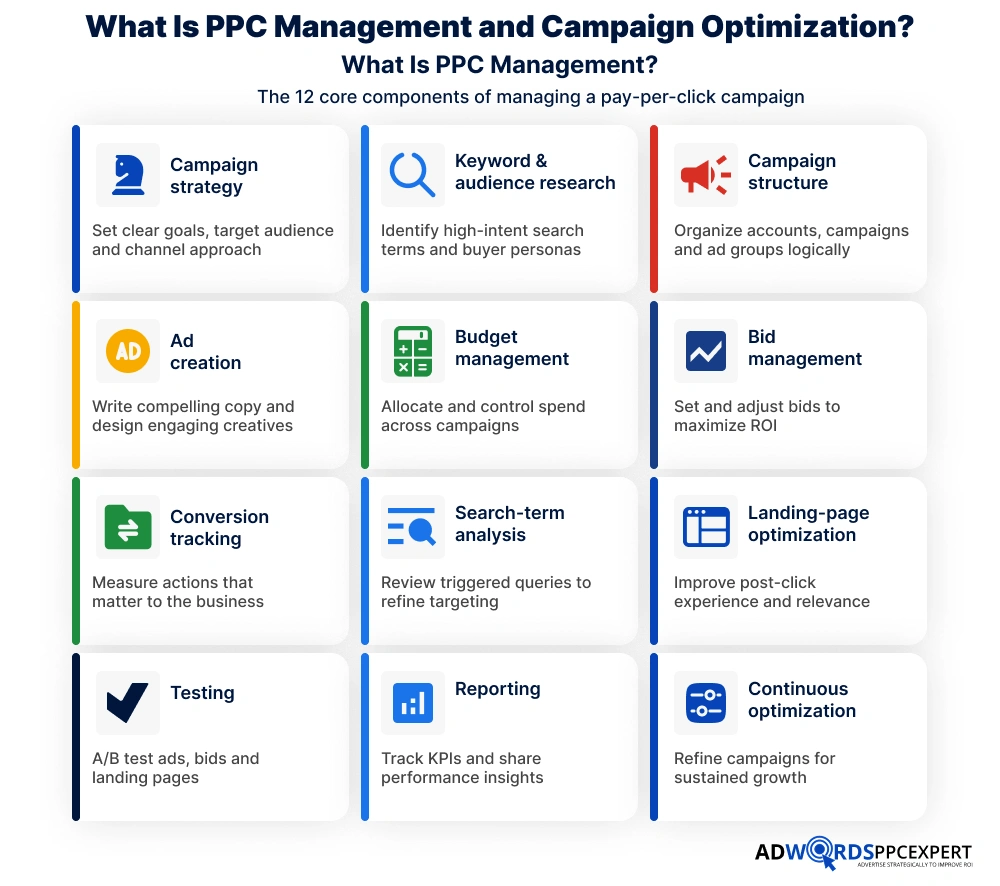
PPC management is the ongoing process of controlling and improving your paid advertising campaigns so your budget produces better results.
In a nutshell, launching a campaign is just the starting point; the real game starts after that. Once your ads are live, you need to understand who is clicking, what they are searching for, where your money is going, and what those clicks are actually producing.
A PPC manager uses this information to make decisions. They may pause keywords that waste money, add negative keywords, adjust bids, move budget to better-performing campaigns, test new ad messages, fix conversion tracking, or improve the landing page.
The goal isn’t simply to get more clicks. It’s to get more valuable clicks and conversions without wasting your ad spend.
PPC Management Services: What’s Included?
Let’s look at what’s actually included in PPC campaign management. These are the key activities that make up effective PPC management:
1. PPC Account Audit and Initial Strategy
Before changing anything, you need to know what is happening in the account. So the first step is to conduct a PPC audit of the account.
It’s important that a PPC expert first checks the campaign’s structure, keywords, ads, budget, bidding, conversions, and landing pages. The aim is simple: find what is working, what is wasting money, and what needs attention.
For example, a campaign may be getting plenty of clicks but very few leads. That could mean the keywords are wrong, the ads are attracting the wrong people, the landing page is weak, or the conversion tracking isn’t working properly.
So the audit isn’t about finding as many problems as possible. It’s about finding the problems that are actually affecting performance and deciding what should be fixed first.
2. Keyword and search intent
Now, it comes to the second point, which is to check the keyword and search intent. Keywords are the set of search terms that customers are typing into the search engine.
Good PPC keyword research is not about collecting as many keywords as possible. It is about understanding what someone is looking for and whether that search can lead to a customer.
For example, someone searching “what is PPC advertising” is probably still learning. But someone searching “agency for dental PPC” is already looking for a solution.
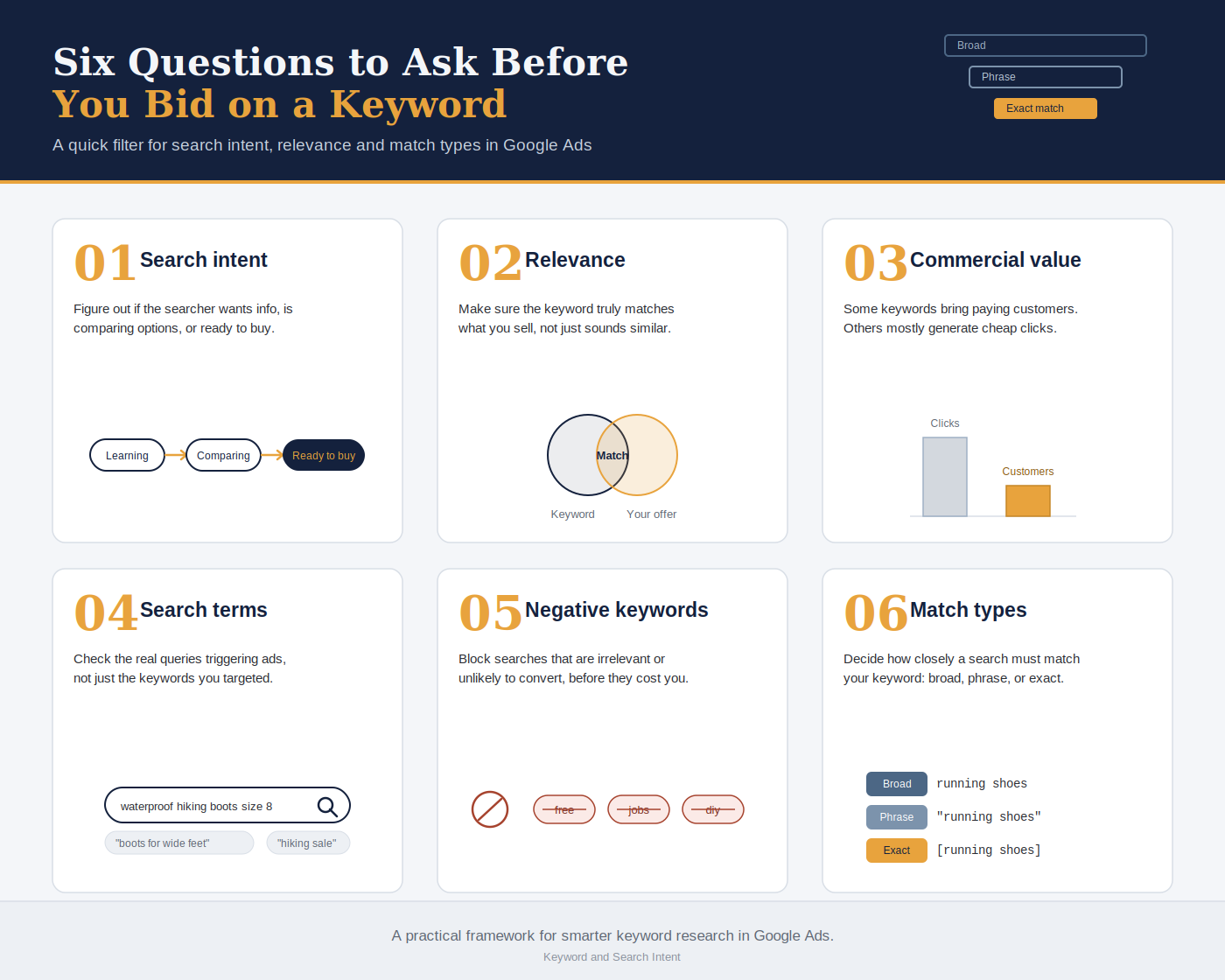
A PPC manager looks at this difference before adding a keyword to a campaign. They consider:
Search intent: Is the person looking for information, comparing options, or ready to take action?
Relevance: Does the search actually match the product or service being advertised?
Commercial value: Can this keyword bring customers, or will it mostly generate cheap clicks?
Search terms: What are people actually typing when they trigger the ads?
Negative keywords: Which searches should be blocked because they are irrelevant or unlikely to convert?
Match types: How closely should Google match a user’s search to the targeted keyword?
Keyword management doesn’t stop after adding keywords; search data and user behavior can reveal new opportunities over time. The goal is to keep refining keywords so your ads reach people who are more likely to become leads, sales, bookings, or customers.
Keyword Signal |
Management Action |
|---|---|
| High conversions + profitable | Scale |
| High spend + no conversions | Investigate/pause |
| Low volume + high conversion rate | Protect/test |
| Irrelevant search terms | Add negatives |
| High clicks + poor lead quality | Review intent |
3. Campaign and Ad Group Structure
When setting up campaigns, a good PPC manager will usually organize them around what actually matters for the business, whether that’s the product or service being sold, the locations being targeted, what people are actually searching for, or how the budget needs to be prioritized.
Take an agency that offers both SEO and PPC services, for example. It makes sense to split those into separate campaigns. Then, within each one, ad groups can group together searches that are closely related to each other.
Why bother? Because this kind of structure gives you real control. You can set budgets where they matter, make sure your ads actually match what people are searching for, and quickly see which parts of your account are bringing in results — and which ones are quietly draining your money.
At the end of the day, a tidy account isn’t the point. The real goal is having enough control to make smarter decisions.
4. Ad Copy, Creative, and Asset Management
PPC management includes creating and improving ads that match what people are looking for. This covers responsive search ads, headlines, descriptions, calls to action, offers, and clear reasons to choose your business over others.
The goal is not simply to get the click. It’s beyond that; each ad should reflect the keyword and answer the searcher’s need, and lead them to a relevant page.
In 2026, Google’s AI Max can help adjust ad text and match ads with more search terms. This makes regular review even more important. A PPC manager checks whether automated changes protect the brand message, attract the right audience, and bring valuable conversions.
5. Bid Strategy and Bid Management
Bid management decides how Google spends your budget to get clicks, leads, or sales.
It may include:
Manual bidding: You set bids yourself.
Maximize Conversions: Google aims for more conversions within the budget.
Target CPA: Google aims for conversions at a chosen cost.
Maximize Conversion Value: Google aims to generate the highest possible sales value.
Target ROAS: Google aims to achieve a chosen return on ad spend.
The best strategy depends on the campaign’s goal and the data it can trust. A lead campaign needs accurate lead tracking, while an ecommerce campaign needs correct sales values.
Avoid changing bid strategies too often. Frequent changes can interrupt learning and make performance unstable.
A better question to ask: What reliable data does this campaign have enough of to optimize toward?
6. Budget Management and Spend Allocation
PPC management also means making sure the budget goes to the campaigns that can produce the best business results.
A PPC manager looks for wasted spend, identifies campaigns that need more budget, and reduces spend where performance is weak.
For example, if Service A generates leads at $80 each while Service B generates them at $35, giving both the same budget may not make sense.
But the decision shouldn’t be based on lead volume alone. Lead quality, conversion value, and profit also matter.
7. Search Term Monitoring and Negative Keyword Management
The keyword you target isn’t always the exact search a person makes. A relevant keyword can still trigger searches that have little chance of becoming a customer.
A PPC manager regularly reviews the Search Terms Report to find irrelevant or low-intent searches and adds them as negative keywords.
At the same time, useful new searches can be added as keywords.
This helps reduce wasted spend, improve traffic quality, and find new opportunities that keyword research may have missed.
8. Conversion Tracking and Measurement
Conversion tracking shows what happens after someone clicks an ad. It helps businesses see which campaigns generate real leads, sales, and revenue.
PPC management should track actions such as:
- Form submissions
- Phone calls
- Purchases
- Appointment bookings
- Chat leads
- Offline sales or qualified leads
This usually involves Google Ads conversion tracking, Google Analytics 4, Google Tag Manager, CRM integration, and enhanced conversions where suitable.
Tracking must come before optimization. If Google receives the wrong signals, it may spend more budget on low-quality actions.
Bad data leads to bad optimization, which leads to poor budget decisions.
For example, if every form fill is counted as a valuable lead, automated bidding may increase spend on campaigns that bring spam, irrelevant enquiries, or leads that never become customers. Accurate tracking helps the campaign optimize for outcomes that actually matter to the business.
What conversion would show the most real value for the businesses you want to target?
9. Landing Page and Conversion Rate Optimization
Getting the right person to click the ad is only half the job. The landing page must deliver on what the ad promised.
A PPC manager looks at the full journey:
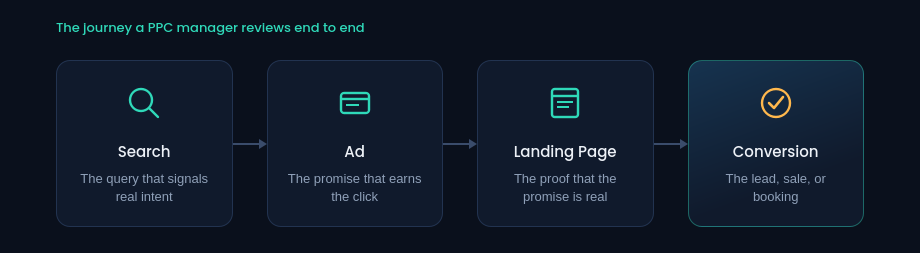
They check whether the message matches the search, the CTA is clear, the page works well on mobile, the form is easy to complete, and there are enough trust signals to encourage action.
The goal is simple: turn more of the relevant clicks you’re already paying for into leads, sales, or bookings.
10. Audience and Geographic Targeting
Not every person, location, device, or time period is equally valuable to a campaign.
PPC management means finding where your best customers are coming from and adjusting targeting around that data. This can include locations, radius, devices, audiences, demographics, and the days or hours when ads perform best.
For example, if one city brings more qualified leads at a lower cost than another, the budget may need to shift toward that location.
The same applies to devices and audiences. The goal is not to reach more people. It is to spend more on the people who are more likely to become customers.
11. A/B Testing and Experimentation
PPC optimization isn’t about changing everything at once. You need to know what change actually improved the results.
A PPC expert can test different ad messages, offers, landing pages, CTAs, bidding strategies, or audience targeting.
For example:
Ad A: “Book a Free PPC Audit”
Ad B: “Find Out Why Your Ads Aren’t Converting”
If Ad B generates more qualified leads, the insight can guide future ad messaging.
The purpose of testing isn’t to make random changes. It’s to learn what works and use that insight to improve the campaign.
12. Performance Monitoring and Ongoing Optimization
Once a campaign is live, PPC management becomes a continuous process of monitoring, diagnosing, and improving performance.
A PPC manager tracks metrics such as spend, CPC, CTR, conversions, CPA, ROAS, search terms, and budget pacing to spot changes or problems.
The process is simple:
Monitor → Identify the problem → Find the cause → Make the right change → Measure the impact
For example, if conversions drop while clicks remain steady, the manager investigates whether the issue is with traffic quality, ads, landing pages, bidding, or conversion tracking before making a change.
The goal is not to make constant changes. It is to make informed changes that improve business results.
PPC Optimization by Performance Problem
Problem |
Possible Cause |
Optimization |
|---|---|---|
| Deep impressions, low clicks | Weak relevance/message | Improve targeting and ads |
| High clicks, low conversions | Landing page/intent problem | Review search terms + landing page |
| High conversions, poor lead quality | Wrong intent/tracking | Review qualification + conversion signals |
| High CPA | Poor traffic or bidding | Analyze query, bid and conversion data |
| Low impression share | Budget/rank constraints | Evaluate budget and auction performance |
| Good ROAS but low volume | Limited reach/budget | Identify scalable opportunities |
| Spend rising without conversions | Search-term/bidding issue | Diagnose waste and bidding signals |
How has AI changed PPC management?
AI now plays a larger role in Google Ads, especially in bidding, search matching, ad creation, and landing-page selection. But it does not remove the need for PPC management. It changes the manager’s role from making every small adjustment manually to guiding, checking, and improving the system.
AI-supported PPC management includes:
AI-powered bidding: Smart Bidding adjusts bids in each auction using signals such as device, location, time, audience behaviour, and likelihood of conversion.
To understand how these automated bidding decisions work, see our guide on [How Google’s AI-Powered Smart Bidding Works].
AI Max for Search: AI Max can expand search-term matching, customize ad text, and choose more relevant landing pages.
Campaign migration: During September 2026, Google began moving some eligible Search campaigns using campaign-level broad match or standalone automatically created assets to AI Max.
Better testing options: Google also introduced AI Max experiments for testing budgets and ROI targets across several Search campaigns.
Common PPC Management Questions
1. How to Know if Your PPC Management Is Actually Working
Look beyond clicks and impressions. Your PPC management is working when qualified leads or sales are increasing, conversion costs are under control, and your ad spend is producing profitable results.
2. What Isn’t Normally Included in PPC Management?
PPC management usually covers campaign setup, optimization, bidding, keyword management, ad testing, and reporting. Website development, major landing-page redesigns, branding, and sales-team work are often separate services, so confirm what your package includes.
3. How Much Does PPC Management Cost?
PPC management can range from a few hundred to several thousand dollars per month, depending on your ad spend, number of campaigns, platforms, and level of management. Ask whether the fee is flat-rate, percentage-based, or tied to performance.
Questions to Ask Before Hiring a PPC Management Company
Ask:
1. How will you measure PPC success?
2. What will you optimize first?
3. How often will you review the account?
4. How do you handle wasted ad spend?
5. Will I have access to my Google Ads account and data?
6. Can you show relevant case studies or results?
Final says!
PPC management goes beyond launching campaigns. It includes keyword research, campaign structure, ad creation, budget and bid management, conversion tracking, testing, and ongoing optimization to keep performance on track.
AdWords PPC Experts provides strategic PPC services and handles these tasks for businesses, from campaign setup and keyword management to performance monitoring and optimization. The focus is simple: reduce wasted ad spend and generate more valuable leads or sales.
Effective PPC management is an ongoing process of monitoring results, fixing what isn’t working, and improving what is.

Ami Singh is a highly skilled AdWords PPC Specialist, known for creating profitable Google Ads strategies that elevate brands. With deep expertise in Google Search, Display, Shopping, YouTube Ads, and advanced bidding techniques, Ami consistently converts data into performance-driven results.
With a sharp analytical mind and a strong understanding of online consumer behavior, Ami designs campaigns that maximize ROI, boost quality scores, and reduce acquisition costs. His approach blends technical expertise with strategic thinking—making him a go-to expert for businesses aiming to dominate Google Ads.
Ami doesn’t just adapt to the fast-changing PPC industry, but he also stays ahead of the curve by testing new features, adopting automation smartly, and refining what works. Clients trust him for his transparency, insights, and ability to scale campaigns sustainably.
Looking to take your Google AdWords performance to the next level? Connect with Ami Singh at Softtrix and discover how he can help you get the maximum growth through powerful PPC strategies.