
In 2026, digital advertising has become faster, smarter, and more competitive than ever. Google Ads auctions no longer require advertisers to constantly monitor past performance and manually adjust their bids. With Google processing millions of searches every day, every search triggers a fresh, unique auction with its own context and competition.
This is where Smart Bidding comes in. It is Google’s AI-powered bidding system that automatically sets bids in real time using machine learning to predict which clicks are likely to convert. Instead of relying on manual bid adjustment or one static bid for the day, it analysis hundred of signals in milliseconds and makes a smarter bidding decision on your behalf.
Understanding how Smart Bidding works can help you make better campaign decisions, improve your campaigns’ performance, and make the most out of your Google Ads budget. In this article, we will break down what Smart Bidding is, how it works, discuss different bidding strategies, and best practices to help you get the maximum out of your campaigns.
Key Takeaways
- Smart Bidding is Google’s AI-powered automated bidding system in Google Ads that uses machine learning to set bids in real time based on signals and conversion predictions.
- For every Google search, a new, unique auction takes place in milliseconds.
- Google evaluates each auction on the basis of signals in real time. These signals include device, location, time of day, browser, language, and prior interaction.
- Google’s AI-powered Smart Bidding system works by collecting hundreds of real-time signals and combining them.
- Machine learning processes these signals to predict the likelihood of conversion.
- There are various types of Google Smart Bidding strategies, such as Maximize Conversions, Target CPA, Target ROAS, and Maximize Conversion Value.
- You can choose a Smart Bidding strategy based on your campaign objective and business goals.
- Smart Bidding helps save time, make better bidding decisions, improve conversion rates using real-time signals, and reduce manual work.
- To get the best results from Smart Bidding, ensure accurate conversion tracking, a sufficient budget, and enough time for the system to learn and optimize.
- A Smart Bidding strategy paired with a strong landing page, proper conversion tracking, and regular performance monitoring can become a powerful tool to scale campaigns.
What Is Smart Bidding?
Smart Bidding is Google’s AI-powered automated bidding system in Google Ads. It uses machine learning to help set the right bid for each auction. Instead of using one fixed bid for each search, it adjusts bids in real time, analyzing signals like location, time, and user intent. It makes highly accurate predictions about which clicks are most likely to lead to valuable actions such as purchase, lead, or app install.
Unlike manual bidding, where advertisers set and update bids themselves, smart bidding makes the decisions in real time, considering your goal of maximizing conversion as per the strategy chosen by advertisers.
How Google's AI-Powered Smart Bidding Works: Step-by-Step
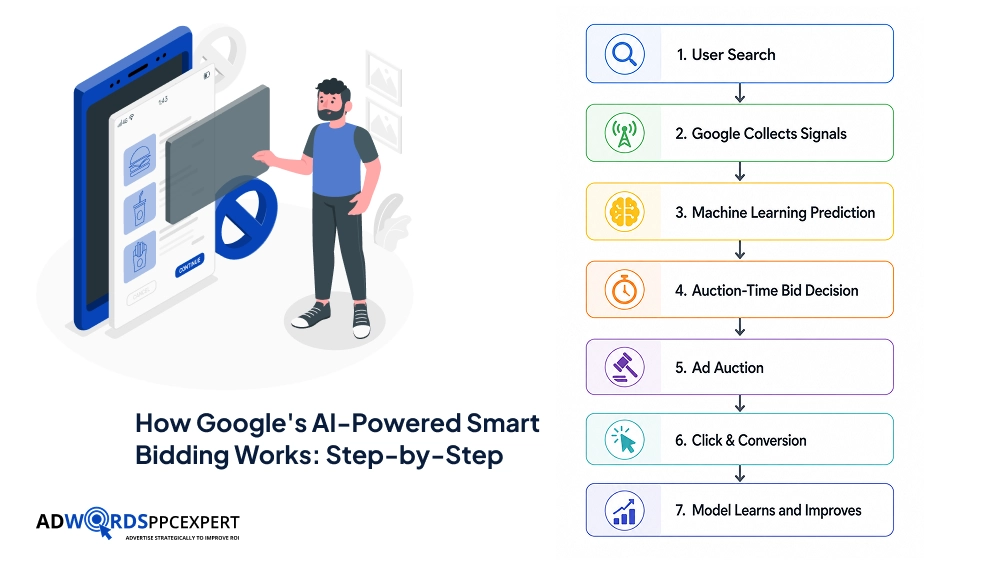
Every time someone types something on Google, a brand new auction kicks off in the background in just a fraction of a second. The system looks for real-time signals like device, location, and time of search to predict how likely the user is going to take action. Each auction becomes a real-time decision-making process. Google doesn’t just directly consider the highest bidder but goes through this auction every time. Here’s what happens behind the scenes:
1: Every Search Starts a New Ad Auction
- Whenever someone searches on Google, a new ad auction begins.
- Google re-evaluates bids every single time. Each auction is unique, happening in milliseconds.
- Even if the same person types the same keywords again, the auction process restarts every time.
2: Google Collects Hundreds of Real-Time Signals
Before displaying the search results, Google gathers a vast range of contextual signals about the person, such as device, location, time, browser, language, and prior interaction with your business, to understand behavior and estimate how likely that person is going to convert. Some of these important signals include:
Signal Category |
Examples |
Why It Matters |
|---|---|---|
| Device | Mobile, desktop, tablet | User intent often varies by device |
| Location | City, region | Local searches can convert differently |
| Time | Hour, day of week | Performance changes throughout the day |
| Search Intent | Search query | Indicates what the user is looking for |
| Audience | Remarketing, customer lists | Returning users may be more likely to convert |
| Browser & OS | Chrome, Safari, Android, iOS | Can correlate with user behavior |
3: Google Combines Those Signals
- Google doesn’t just look at signals one by one but mixes them together to understand the bigger picture.
- For instance, a person searching ‘pizza delivery near me’ on a mobile phone at around 9 PM is more likely to order the food right away.
- A person searching the same query on a desktop at around 10 AM is more likely to have a general query and is searching for a future plan.
4: Machine Learning Predicts the Likelihood of a Conversion
- Google AI uses these signal combinations to predict how likely a user can become your customer.
- AI model analyzes past data from the user's ad account and similar searches across Google to understand patterns and predict the likelihood of conversion.
- Using machine learning, it predicts both whether the user is likely to convert and how valuable that conversion could be for the business.
5: Auction-time Bidding Sets the Best Bid Instantly
- Based on conversion probability, Google’s smart bidding instantly calculates the optimal bid for that specific auction. This is called auction-time bidding.
- This bid is set milliseconds without any delay.
- If the chances of conversion seem high, Google may bid more. Likewise, if the chances of conversion look low, it may bid less.
- This smart bidding happens for every search every time. Instead of using one fixed bid for everyone, Google adjusts bids in real time.
- This is why two people with the same search query trigger different bids due to differences in location, time, and past behavior.
- Smart bidding is focused on context and intent. It bids more aggressively on searches that are more likely to convert and less on searches with lower conversion potential.
6: The System Learns and Improves Over Time
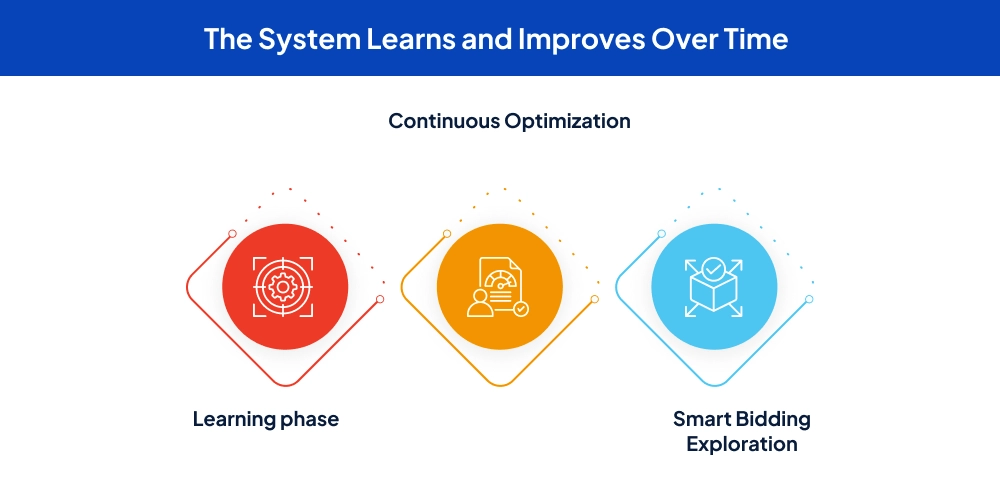
To improve future bidding decisions and refine smart bidding, the system continues to learn from campaign performance.
Learning phase
- Google enters a learning phase once you switch to smart bidding or make significant changes in your campaign, such as bidding strategy or conversion settings.
- During this phase, the system collects fresh data, tests different bid levels, and adjusts its predictions.
- Google may take 1 or 2 weeks to adjust, depending on your campaign and conversion data availability.
- During this period, the performance might fluctuate.
Continuous Optimization
Google AI continuously refines its models and improves predictions based on conversion data. It learns the following patterns over time:
- Which audiences are most likely to convert.
- Which times of day produce the best results.
- Which locations deliver the highest-value customers.
- How seasonal trends affect user behavior.
- Which search queries consistently generate conversions.
Smart Bidding Exploration
- This feature lets Google test new and relevant search opportunities outside the usual pattern to find additional traffic that may convert.
- The more conversion data it gathers, the smarter it becomes.
- This helps improve the campaign over time rather than just relying on past data.
- It works with ROAS tolerance so you can decide how much flexibility you wish to give to Google.
What Are the Types of Google Smart Bidding Strategies
To help optimize your campaign, Google offers several Smart Bidding strategies. Each strategy is designed to achieve different campaign objectives such as generating more conversions, improving traffic, ad visibility, and revenue. You can choose a strategy based on your business goals and advertising objectives. All true Smart Bidding strategies use machine learning or auction-time bidding to optimize for conversion.
Strategy |
Goal |
Best For |
|---|---|---|
| Maximize Conversions | Get the highest number of conversions | Small budgets, lead generation campaigns |
| Maximize Conversion Value | Drive the most revenue | Ecommerce, high-value transactions |
| Target CPA | Achieve a set cost per acquisition | Consistent lead generation |
| Target ROAS | Hit a specific return on ad spend | Ecommerce, revenue-focused campaigns |
| Maximize Clicks | Increase traffic volume | Awareness campaigns |
| Target Impression Share | Dominate visibility for certain keywords | Branding campaigns |
| Enhanced CPC | Hybrid manual & automated bidding | Legacy campaigns, cautious testers |
- Maximize Conversions: Focuses on generating maximum conversions in your budget. Best when your goals are quick leads and sign-ups.
- Maximize Conversion Value: Primary focus is on maximizing conversion value rather than the number of conversions. Useful for businesses like e-commerce seeking purchase value.
- Target CPA: Helps to achieve a specific average cost per acquisition. It helps keep cost per lead steady and work with predictable budgets.
- Target ROAS: Sets bids while aiming for a specific target return on ad spend. Perfect for sales-driven campaigns where businesses measure success based on revenue.
- Maximize Clicks: Automated bidding strategy designed to drive as many website visits as possible.
- Target Impression Share: Primary purpose is increasing ad visibility and brand awareness.
- Enhanced CPC: Hybrid bidding strategy that combines manual bidding with automated bid adjustments. It is useful to advertisers who still look for small manual control.
Please note that Maximize Conversions, Maximize Conversion Value, Target CPA, and Target ROAS are Google’s true Smart Bidding strategies as they use machine learning to optimize conversion value. Maximize Clicks, Target Impression Share, and Enhanced CPC are automated bidding strategies.
What Is the Difference Between Smart Bidding & Manual Bidding?
Now that you are familiar with how Smart Bidding works and what its strategies are, it is worth understanding exactly how it differs from the traditional Manual Bidding approach. Although both approaches are designed to determine how much an advertiser should bid, they differ significantly in how bids are managed, calculated, and optimized. You can choose the strategy based on your campaign goals, available data, and desired level of control. The following are key differences between the two approaches:
Aspect |
Manual Bidding |
Smart Bidding (AI-Powered) |
|---|---|---|
| Bid Adjustments | Manually updated by the advertiser | Automatically adjusted for every auction |
| Data Used | Limited signals and manual analysis | Hundreds of real-time signals combined by AI |
| Optimization | Based on human decisions | Uses machine learning to predict conversion likelihood |
| Speed | Updates made manually over time | Bid calculated in milliseconds during each auction |
| Performance | Depends heavily on manual expertise | Can improve conversion efficiency when supported by quality data |
| Time Required | Higher ongoing management | Significantly less manual work |
| Learning Capability | No automatic learning | Continuously improves using new campaign data |
| Best For | Advertisers who want maximum control | Most businesses focused on conversions and growth |
What Are the Benefits of Google's AI-Powered Smart Bidding?
Running ads on Google requires more than just showing up. You need to show up in front of the right audience, at the right time, and with the most appropriate bid. This is what Smart Bidding helps you with. By analyzing hundreds of real-time signals, it takes away the guesswork and automatically adjusts bids for every auction. It saves time, helps you spend your advertising budget more efficiently, and makes it easier to scale your campaigns with confidence.
- Saves time: Smart Bidding automates bid adjustments, eliminating the need for manual monitoring and updating bids.
- Better bid decisions: It uses machine learning to evaluate hundreds of signals, predict the likelihood of conversions more accurately than human judgment, and enable making informed bidding decisions.
- Improves conversion rates: It prioritizes users who are ready to take action, helps optimize campaigns for leads and sales instead of just clicks.
- Uses real-time signals: Google evaluates a wide range of contextual signals, including device, location, time of day, search query, browser, audience lists, and user behavior. This allows bids to be tailored dynamically to each individual search opportunity.
- Learns over time: As your campaign collects more conversion data, Google's machine learning models continuously refine their predictions. This ongoing optimization helps them provide accurate bidding predictions over time.
- Reduces manual work: It reduces repetitive bid management tasks to save time and manage large campaigns efficiently.
What Are the Limitations of Smart Bidding?
Smart Bidding is helpful, but it is not a set-and-forget solution. It relies on accurate data, clear campaign goals, and enough time to learn from conversion data. Advertisers need to understand its limitations to avoid common mistakes and ensure optimum results
Common Limitations of Smart Bidding:
- Needs conversion tracking: It needs proper conversion tracking. Without accurate tracking, Smart Bidding has no data to learn from and what to count as a lead or sale.
- Learning period: After the launch of a campaign or when significant changes are made, Google enters a learning phase. Performance usually fluctuates during this period, and results would be uneven.
- Less manual control: While the automation saves time, it allows little to no manual control over bidding.
What Are the Best Practices for Using Google's Smart Bidding Strategy?
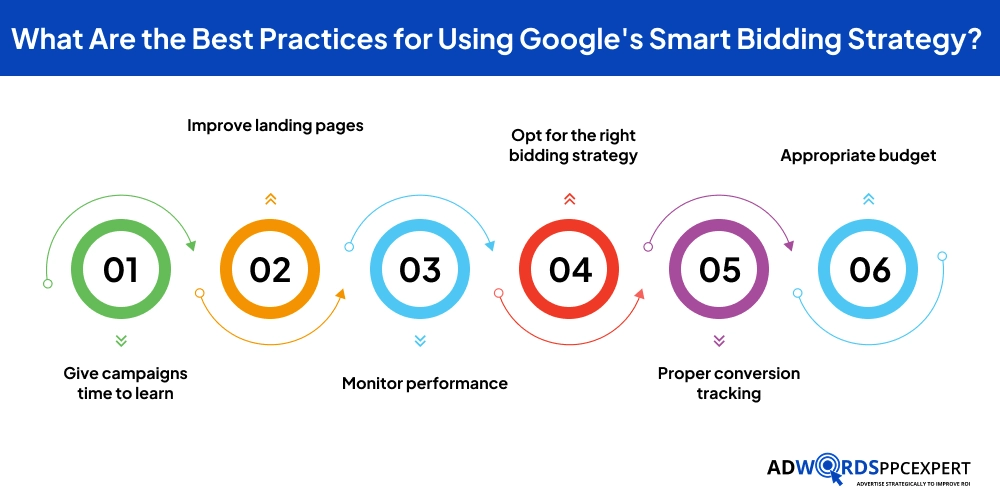
Smart Bidding strategy works best when advertisers set it up correctly while giving the system the right conditions to learn. Following are the best proven practices to ensure Google AI optimizes effectively and delivers stronger results:
- Give campaigns time to learn: Allow the algorithms to stabilize before proceeding with any further changes. Don’t make changes too quickly.
- Improve landing pages: Even your best bidding will not work if your landing page is weak. High-quality landing pages improve conversions and help Smart Bidding perform efficiently.
- Monitor performance: Review results regularly to ensure the campaign is moving in the right direction.
- Opt for the right bidding strategy: If you choose a strategy that doesn’t match your campaign goals, it leads to wasted ad spend. For example, you can’t use a value-based strategy if your conversion data is weak.
- Proper conversion tracking: Clean data is the foundation of Smart Bidding. Tracking needs to be accurate to ensure the right predictions. Wrong or incorrect tracking misguides the algorithm and leads to inaccurate predictions.
- Appropriate budget: To ensure AI has enough data to learn, you need an appropriate budget. Too little budget can limit data collection and make it harder for AI to optimize correctly.
Final Thoughts
Google AI Smart Bidding system has changed the way advertisers manage Google Ads. It has shifted from manual guesswork to AI-powered real-time decisions. This saves time, improves efficiency, and helps campaigns focus on users who are most likely to convert.
Although Smart Bidding has revolutionized the whole bidding process, it is still not a magic solution. Its success depends on accurate conversion tracking, choosing the right bidding strategy, allowing the campaigns to have enough time to learn, and regularly monitoring performance. When set up correctly and paired with a strong landing page, it becomes a powerful tool to scale campaigns. At AdwordsPPC expert, we provide you with the best strategy, accurate tracking, and ongoing optimization to help you maximize your return on ad spend.
Whether you are running a small lead generation campaign or managing a large ecommerce account, understanding how smart bidding works and pairing it with smart management can help you make informed decisions and get the most value out of your Google Ads investment.
Frequently Asked Questions About Smart Bidding
1. What is Smart Bidding in Google Ads?
Smart Bidding is Google’s AI-powered automated bidding system that uses machine learning to adjust bids in real time. It analyzes signals such as location, time, and user intent to accurately predict which user is likely to convert.
2. What's the difference between Smart Bidding and Manual Bidding?
Manual Bidding requires advertisers to set and adjust bids themselves. Smart Bidding automatically adjusts bids for every auction using machine learning and real-time signals to optimize campaign performance.
3. Which Smart Bidding strategy should I choose?
You choose a strategy based on your campaign objective:
- Maximize Conversions for generating more leads or sales.
- Target CPA for maintaining a specific acquisition cost.
- Target ROAS for maximizing revenue.
- Maximize Conversion Value for increasing the overall value of conversions.
4. Can I switch from Manual Bidding to Smart Bidding?
Yes, you can switch from Manual Bidding to Smart Bidding. However, you have to keep this in mind: after the switch, Google will enter a learning phase and collect data. During this phase, campaign performance may fluctuate temporarily.
5. What data does Smart Bidding use?
It analyzes hundreds of signals in real time. These include location, time, user intent, and audience.
6. Is Smart Bidding the same as automated bidding?
No, they are closely related terms with slightly different meanings. All Smart Bidding strategies are automated, but not all automated strategies are Smart Bidding. For example, automated strategies such as Maximize Clicks or Target Impression Share don’t optimize for conversions, so they aren’t considered Smart Bidding strategies.
7. Is Google Smart Bidding worth it?
Yes, Google Smart Bidding can be highly effective when your campaign has accurate conversion tracking and sufficient data. It can help automate bid optimization using AI, allowing advertisers to save time and improve conversion performance.
8. How long does Google Smart Bidding take to learn?
Once you launch Smart Bidding, Google enters a learning phase. This phase can last from a few days to a couple of weeks, depending on the amount of conversion data. In general, it lasts for 1 to 2 weeks. In some cases, it lasts longer if the account has low volume or frequent changes.

Ami Singh is a highly skilled AdWords PPC Specialist, known for creating profitable Google Ads strategies that elevate brands. With deep expertise in Google Search, Display, Shopping, YouTube Ads, and advanced bidding techniques, Ami consistently converts data into performance-driven results.
With a sharp analytical mind and a strong understanding of online consumer behavior, Ami designs campaigns that maximize ROI, boost quality scores, and reduce acquisition costs. His approach blends technical expertise with strategic thinking—making him a go-to expert for businesses aiming to dominate Google Ads.
Ami doesn’t just adapt to the fast-changing PPC industry, but he also stays ahead of the curve by testing new features, adopting automation smartly, and refining what works. Clients trust him for his transparency, insights, and ability to scale campaigns sustainably.
Looking to take your Google AdWords performance to the next level? Connect with Ami Singh at Softtrix and discover how he can help you get the maximum growth through powerful PPC strategies.