

Running a digital marketing agency in 2026 means your clients expect more than ever before. SEO alone no longer satisfies a client who watches their competitor dominate the top of Google search results through paid advertising. Web design alone does not justify a retainer when the website you built is not generating measurable leads. At some point, and for most agencies, that point arrives sooner than expected, your clients start asking about Google Ads, and the question becomes less about whether to offer paid search management and more about how to deliver it without taking on the financial risk and operational complexity of building an in-house team from scratch. That is where AdwordsPPCExpert white label PPC enters the picture. And if you are researching it seriously, the first question you need answered is also the one that gets the least straight answer anywhere online: what does it actually cost, and is the investment genuinely worth it for an agency at your stage? This guide answers that question honestly.
Everyone tells you that SEO is “free” and PPC is “expensive.” But that is not the whole story. SEO is not just free, it requires time, content, and expertise. And PPC is not just expensive, it can actually be profitable when done right. The real question is not which one costs more upfront. It is which one gives you better value over time?
The PPC vs SEO cost comparison is one of the most critical decisions you will make for your business. These two strategies both get you visible on Google, but they work in fundamentally different ways. PPC is like paying rent, which means you get immediate visibility, but the moment you stop paying, you disappear. SEO is like buying property, which means it takes time and money upfront, but once you own that real estate on Google’s first page, it keeps delivering value year after year.
In this guide, we will break down everything you need to know about the PPC vs SEO cost comparison. No confusing jargon. No unrealistic promises. Just honest, practical information to help you make a smart decision with your hard-earned marketing dollars. Whether you are working with a tight budget or have room to invest in both channels, you will walk away knowing exactly what each approach costs and which one makes sense for where your business is right now.
What White Label PPC Actually Means And Why It Is Not Just Outsourcing
There is a tendency in the agency world to treat white label PPC as a polite word for outsourcing, a way to describe passing off work you do not want to do. That framing undersells what the model actually is, and it leads agencies to make poor decisions about how to structure it. White label PPC is a managed service arrangement in which a specialized provider runs paid advertising campaigns on your behalf, fully under your agency’s brand. Your clients interact with you. Your name appears on every report, every strategy document, every communication. The provider operates in the background, entirely invisible to the client. You retain the relationship, you set the strategy direction, and you collect the margin between what the provider charges you and what you bill the client.
The distinction from simple outsourcing is important because it changes the economics. In an outsourced model, you are simply buying labor to reduce your own workload. In a white label model, you are buying a productized capability that becomes part of your agency’s service offering, one that you sell, that generates recurring revenue, and that deepens your value to clients who would otherwise need to hire a separate PPC agency. That difference in framing changes how you price it, how you present it to clients, and how you evaluate whether a provider is actually delivering for your business.
In terms of what the service covers, a professional white label PPC arrangement manages the full operational cycle of paid advertising: keyword research and competitive analysis, campaign architecture, ad group structuring, ad copy development and testing, bid strategy design, audience targeting and remarketing Services configuration, conversion tracking implementation, ongoing optimization, and regular performance reporting. Depending on the tier, it may also include landing page consultation, CRM integration, and cross-channel campaign coordination. Platforms most commonly covered include Google Ads across Search, Shopping, Display, Performance Max, and YouTube, as well as Microsoft Advertising, Meta Ads, LinkedIn Ads, and Amazon Advertising. The scope you define at the outset shapes what you pay, which is why vague agreements almost always lead to pricing disputes or performance disappointment.
The 2026 White Label PPC Pricing Landscape: What the Numbers Actually Mean
If you have done any research on white label PPC pricing before landing on this page, you have almost certainly encountered a frustrating spread of numbers, quotes ranging from $300 a month to $5,000 a month for services that appear, on the surface, to be the same thing. That spread is not arbitrary, and it is not the result of providers making up numbers. It reflects real and meaningful differences in provider quality, team seniority, geographic location, platform scope, optimization depth, and service infrastructure. Understanding what drives that range is the prerequisite to evaluating any quote intelligently.
In broad terms, white label PPC management in 2026 runs from approximately $400 per month for straightforward, single-platform campaigns serving small local businesses, up to $6,000 or more per month for enterprise-level, multi-platform management with senior strategic oversight and premium reporting. The middle of that range, that is $900 to $2,500 per month, is where most mid-market client accounts belong: regional businesses, growing e-commerce brands, and B2B companies with meaningful budgets and real performance expectations. Geography still plays a meaningful role in white label PPC pricing. US-based providers with certified senior teams typically start at $1,000 to $1,500 per month, representing the highest-quality end of the market. Philippines and Eastern European-based teams often price between $350 and $900, with technical competence that can be solid, but with communication and oversight trade-offs that vary widely. India-based providers span an enormous quality range. The consistent lesson across every geography: the cheapest quote rarely represents the cheapest outcome. Client churn generated by poor campaign performance is one of the most expensive things that can happen to your agency, and it is almost impossible to separate from the quality of the management behind the campaigns.
The white label PPC market has also grown more sophisticated since 2023. Google’s Performance Max automation, Meta’s Advantage+ campaigns, and Microsoft’s AI bidding have fundamentally changed what expert campaign management actually requires. The providers who have genuinely evolved their practice to work intelligently alongside these systems, designing campaign structures that feed automation with clean data, auditing machine decisions, and intervening strategically when automated behavior drifts, are a different quality tier from those still offering commodity management dressed up in modern terminology. That separation is one of the most important things you will need to identify when evaluating any prospective white label partner.
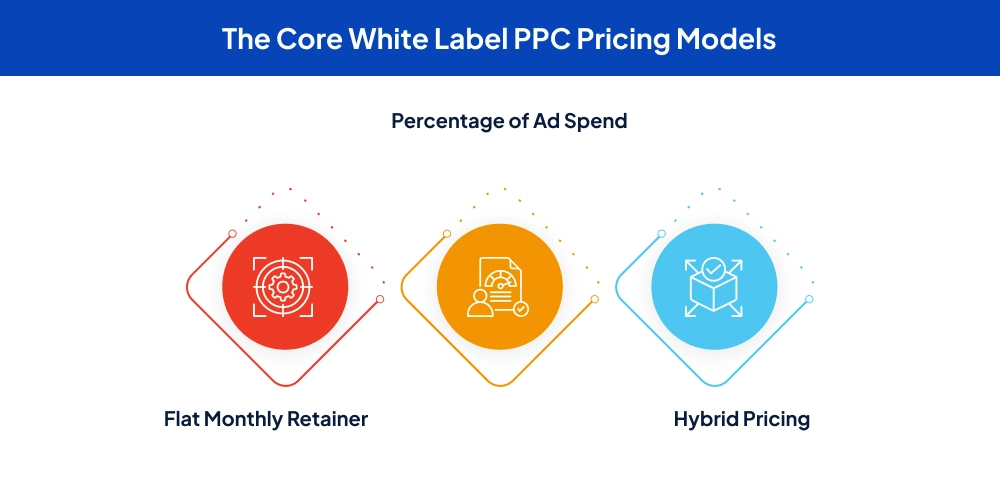
The Core White Label PPC Pricing Models
Most white label PPC providers operate on one of three pricing structures, and understanding the mechanics of each one, not just the headline number, is essential for building a service arrangement that works financially for your agency. Each model has genuine advantages and genuine trade-offs, and the right choice depends on the nature of your client base rather than which model happens to sound simplest.
Flat Monthly Retainer
The flat monthly retainer is the most common structure in the white label PPC market, and for the majority of agencies, it is the most practical starting point. You pay a fixed fee per client account each month, regardless of how much the client spends on advertising. Predictability is the defining strength here. You know your exact provider cost from month to month, which means you can build a clean, consistent margin into your client billing without the math changing under you. For agencies that are just beginning to offer paid search management, that predictability makes business planning significantly less complicated.
Retainer amounts scale with account complexity and media spend volume. A local home services business running a single Google Search campaign on a $2,000 monthly budget might be managed for $500 to $700 per month. A regional business running Search and Performance Max with a $10,000 monthly budget warrants a fee closer to $1,200 to $1,800. A multi-location brand spending $30,000 per month across Google and Meta could run $2,500 to $4,000 in monthly management fees. One nuance worth understanding: flat retainers are always written against an implicit scope, and when a client significantly expands their budget, adds platforms, or requests substantially more management activity, that conversation about adjusting the fee will come. Building that expectation into your client agreements upfront avoids awkward renegotiations later.
Percentage of Ad Spend
Under this model, the management fee is calculated as a defined percentage of the total media budget flowing through the campaigns. Rates across the white label market typically range from 10% to 25%, with the most common band sitting between 12% and 18%. The natural appeal is that the fee scales automatically with client growth, as performance improves and clients invest more, the provider revenue and your agency margin increase proportionally without requiring renegotiation.
The trade-off is revenue unpredictability. Seasonal businesses, clients who reduce spend during slow periods, or clients who pause campaigns while they refresh their website can compress your income in ways a flat retainer insulates you from. There is also a structural dynamic to monitor: a provider compensated as a percentage of spend has a passive incentive to recommend budget increases even when efficiency data does not clearly justify them. This does not mean all percentage-based providers behave this way, but tracking cost-per-acquisition and ROAS closely is especially important in these arrangements. Nearly all percentage-based providers also apply a monthly minimum, typically $350 to $600 per account, to keep the engagement economically viable for lower-spend clients.
Hybrid Pricing
Hybrid pricing combines a base monthly retainer with a percentage-of-spend component that activates above a defined threshold. A provider might charge $900 per month flat plus 8% of any ad spend above $8,000. For a client spending $6,000 per month, the fee is simply $900. For a client who scales to $18,000 per month, the fee becomes $1,700. This model protects the provider’s floor economics while giving your agency a more predictable base cost, and it scales sensibly when client budgets grow. It is particularly well suited for agencies managing clients with seasonal or variable budgets, and many providers who do not offer it by default will negotiate it when approached with a volume commitment or a longer contract term.
The trade-off is revenue unpredictability. Seasonal businesses, clients who reduce spend during slow periods, or clients who pause campaigns while they refresh their website can compress your income in ways a flat retainer insulates you from. There is also a structural dynamic to monitor: a provider compensated as a percentage of spend has a passive incentive to recommend budget increases even when efficiency data does not clearly justify them. This does not mean all percentage-based providers behave this way, but tracking cost-per-acquisition and ROAS closely is especially important in these arrangements. Nearly all percentage-based providers also apply a monthly minimum, typically $350 to $600 per account, to keep the engagement economically viable for lower-spend clients.
Model |
How It's Calculated |
Best For |
Key Consideration |
|---|---|---|---|
| Flat Retainer | Fixed monthly fee per account | Agencies with stable, predictable client budgets | Scope creep when spend or complexity grows |
| % of Ad Spend | 10–25% of total media budget | Agencies with growing, scalable client accounts | Revenue varies with client spend fluctuations |
| Hybrid | Base retainer + % above a threshold | Agencies with variable or seasonal clients | Requires clear documentation of thresholds |
What Is Actually Included at Each White Label PPC Price Tier?
Price and scope are inseparable in white label paid search management, and the gap between what agencies assume is included and what providers actually deliver is one of the most consistent sources of disappointment in this market. Two providers quoting $1,200 per month may be describing fundamentally different service experiences. What follows is a realistic picture of what each tier genuinely delivers and what it does not.
The trade-off is revenue unpredictability. Seasonal businesses, clients who reduce spend during slow periods, or clients who pause campaigns while they refresh their website can compress your income in ways a flat retainer insulates you from. There is also a structural dynamic to monitor: a provider compensated as a percentage of spend has a passive incentive to recommend budget increases even when efficiency data does not clearly justify them. This does not mean all percentage-based providers behave this way, but tracking cost-per-acquisition and ROAS closely is especially important in these arrangements. Nearly all percentage-based providers also apply a monthly minimum, typically $350 to $600 per account, to keep the engagement economically viable for lower-spend clients.
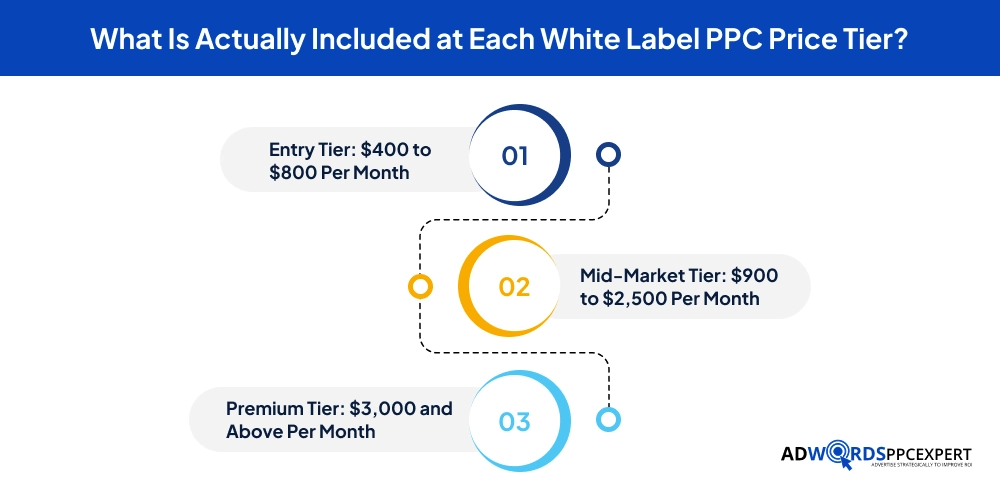
Entry Tier: $400 to $800 Per Month
At this price level, you should expect competent management of a straightforward Google Search or Microsoft Advertising campaign for a client with modest budgets and relatively stable campaign requirements. The provider should handle keyword research and initial campaign structure, write a core set of responsive search ads, implement conversion tracking correctly, apply a documented bid strategy, and deliver a white-labeled monthly performance report bearing your agency’s branding. What you should not expect is dedicated account management, proactive strategic recommendations, mid-month optimization reviews, or sophisticated audience segmentation. Entry-tier management is appropriate for small local businesses that simply need professional campaign execution. It is not suitable for competitive verticals, clients with high-spend accounts, or any client whose expectations include active performance dialogue beyond the monthly report.
Mid-Market Tier: $900 to $2,500 Per Month
The mid-tier is where the majority of agency client accounts should sit, and the quality difference compared to entry-level management is significant and meaningful. At this investment level, you should have access to a dedicated account manager, who is a specific, named practitioner who knows your client’s account history, understands their business context, and is genuinely accountable for performance outcomes rather than simply completing tasks in a shared queue. That single distinction matters more than almost any other feature in the package. You should also receive a documented weekly or bi-weekly optimization cadence with a written change log explaining every adjustment made and the strategic reasoning behind it. A/B testing on ad copy, active audience segmentation, and evolving negative keyword management should all be happening systematically. For e-commerce clients, Google Shopping and Performance Max campaign architecture should be part of the core scope. At this tier, quarterly strategy reviews that adapt to competitive shifts and seasonal patterns are a reasonable and appropriate expectation.
Premium Tier: $3,000 and Above Per Month
Premium white label PPC management is characterized not by what it does more of, but by the quality of judgment applied to the work. At this level, your clients’ campaigns are managed by senior practitioners with deep platform expertise, professionals who design full-funnel campaign architectures that serve different stages of the buying journey simultaneously, integrate CRM data to optimize toward actual revenue rather than just platform-reported conversions, and conduct formal competitive intelligence monitoring that directly informs campaign strategy. Reporting at this tier goes beyond monthly PDFs. Live branded dashboards, real-time performance monitoring, and executive-level quarterly business reviews are all standard expectations. If your agency is presenting itself as a premium paid search partner to sophisticated clients, premium-tier management behind you is not optional, it is the only arrangement that lets you actually deliver on that positioning.
Pro Tip: Before committing to any white label provider, request a sample client report from an actual live account with data appropriately anonymized. Read it carefully: does it explain what changed and why, or does it simply display charts? Does it connect platform metrics to business outcomes? Does it include forward-looking recommendations? That document is the most accurate preview you will get of what your clients’ experience actually looks like.
What Drives Your White Label PPC Cost Up or Down
Even within a defined pricing tier, the specific cost of managing any given client account is shaped by a range of variables. Understanding these factors lets you anticipate how providers will build their quotes, protect your margins across different client types, and have far more productive conversations with prospective partners about what you actually need and what you are prepared to pay for.
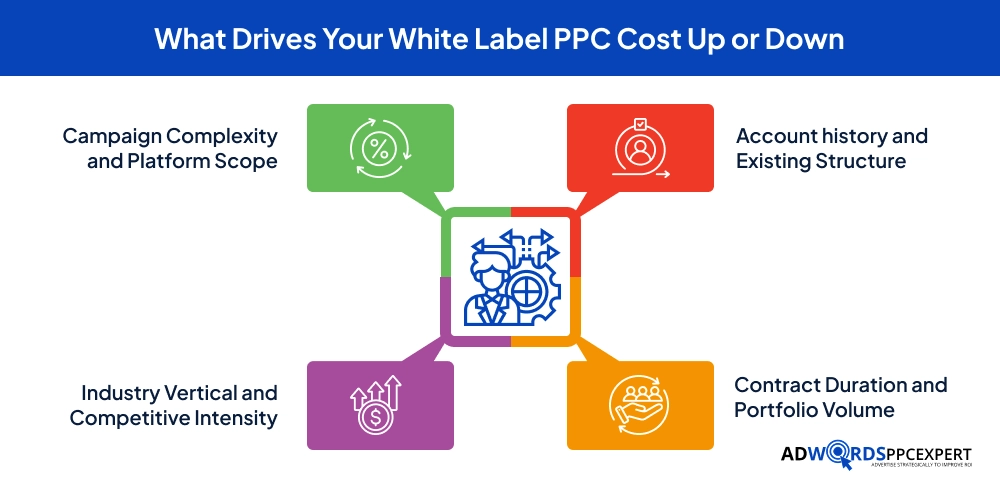
Campaign Complexity and Platform Scope
These are the most direct cost drivers. A single Google Search campaign targeting one city with ten tightly scoped ad groups is a fundamentally different management challenge from a national campaign running simultaneously across Search, Shopping, Performance Max, YouTube, and Display, with separate strategies by audience segment and purchase intent level. Every platform you add, every geographic layer you introduce, and every product category you include creates genuine incremental management work. Providing a clear, specific description of the account structure you need when requesting quotes is not just helpful, it is the only way to get pricing that is actually accurate to your situation.
Industry Vertical and Competitive Intensity
They matter significantly more than most agencies expect when first pricing white label arrangements. In high-competition verticals, personal injury law, HVAC and home services, insurance, addiction treatment, financial products, cost-per-click rates can run from $20 to well over $100, and every keyword decision, match type selection, and bid adjustment carries outsized financial consequence. Managing these accounts well requires a higher-frequency optimization cadence, more aggressive negative keyword management, and constant competitive monitoring. Providers who specialize in high-competition verticals appropriately charge 20 to 40% more for those account types. That premium is almost always worth paying, because substandard management in a competitive vertical can drain weeks of a client’s budget with nothing measurable to show for it.
Account history and Existing Structure
They affect pricing more than agencies often realize. Building a campaign from scratch, that is from keyword research through full architecture, ad creation, and tracking implementation, is substantially more work than inheriting a well-organized mature account. Most providers charge a one-time onboarding fee for new builds, ranging from $300 to $1,200, depending on complexity. Ask about this explicitly during the sales process so it does not appear unexpectedly on your first invoice. These fees are frequently negotiable when you are committing to a longer contract term or bringing multiple accounts simultaneously.
Contract Duration and Portfolio Volume
They are two of the strongest pricing levers available to agency buyers. Providers universally prefer revenue predictability, and a commitment to a 12-month agreement rather than month-to-month typically reduces per-account costs by 10 to 20%. Bringing multiple client accounts to a single provider creates operational efficiency that providers will frequently pass back to you through volume pricing. Even three to five accounts can shift the fee negotiation meaningfully. If you are evaluating a provider for a single account today but anticipate growing your portfolio, make that expectation explicit, it opens an entirely different conversation about pricing and partnership terms.
White Label PPC vs. Building an In-House Team: The Real Cost Comparison
Many agency owners instinctively assume that building in-house PPC capability is the more professional and ultimately more economical path. When you run the actual numbers, that assumption rarely holds, at least not until your agency is managing a significant volume of active PPC clients simultaneously.
Cost Element |
In-House Hire (US) |
White Label Provider |
|---|---|---|
| Base Salary | $65,000 – $85,000 / yr | Included in management fee |
| Benefits & Payroll Taxes | $15,000 – $25,000 / yr additional | Not applicable |
| Tools & Software Stack | $5,000 – $15,000 / yr | Typically included or discounted |
| Hiring & Ramp-Up Cost | $8,000 – $20,000 one-time | Minimal onboarding fee if any |
| Risk if Specialist Leaves | High — history and context leaves with them | Low — provider maintains continuity |
| Scalability | Requires rehiring each time volume grows | Near-instant — add accounts, not headcount |
How to Evaluate Any White Label PPC Provider Before You Commit
The quality range in the white label PPC provider market is genuinely enormous. Price is an unreliable signal of where any given provider sits on that range. The evaluation framework below is designed to cut through surface-level positioning and identify partners who will genuinely protect and strengthen your client relationships.
Certifications and Platform Credentials
Start with these, but go beyond the badge. Any provider managing Google Ads professionally should hold a current Google Premier Partner designation, awarded to the top 3% of partners based on performance metrics, managed spend thresholds, and certification standards. That badge at the organization level matters, but ask to see the current certifications of the specific practitioners who will manage your clients’ accounts. An agency’s Premier Partner status does not help your clients if the person actually touching their campaigns is a junior analyst without current platform credentials.
Vertical Experience
Probe for genuine vertical experience that is relevant to your specific client base. Ask directly, what experience does your team have with clients in this industry? Providers who have managed campaigns in legal services, healthcare, SaaS, home improvement, or e-commerce bring institutional knowledge, typical CPCs, effective messaging patterns, and seasonal performance dynamics that generalists simply do not have. Ask for anonymized performance case studies or industry-specific benchmarks. The ability to speak fluently about your clients’ competitive landscape is a strong signal that expertise will translate into campaign results.
Team Structure and Account-To-Manager Ratios
Ask specifically about team structure and account-to-manager ratios. Best-practice white label operations maintain ratios of 10 to 15 accounts per manager for complex campaigns. Beyond 25 or 30 accounts per manager, meaningful optimization depth per account becomes structurally impossible regardless of individual talent.
And confirm unconditionally that your agency or your client owns all advertising accounts, the Google Ads MCC, Meta Business Manager, and Microsoft Advertising accounts. Never the provider. If the relationship ends, you must be able to take full account history, audience lists, conversion data, and campaign structure with you. Any structure that creates account ownership dependency on the provider is a red flag that should end the conversation or change the terms before anything else moves forward.
Final Thoughts
White label PPC pricing is not complicated once you understand what you are actually buying at each tier and how to build a margin structure that makes the service genuinely profitable. The model works exceptionally well for agencies at nearly every stage of growth, from those adding paid search to their offering for the first time to established full-service agencies looking to scale their PPC delivery without scaling their headcount proportionally. The foundation in all cases is the same: choose a provider whose quality matches your clients’ expectations, structure the pricing so your margins are real and defensible, define the scope in writing before anything is signed, and stay engaged enough with the client relationship that you are adding visible value beyond what the management team delivers technically.
The agencies that struggle with white label PPC do so almost entirely because of decisions made before the first campaign goes live, choosing a provider on price alone, leaving scope ambiguous, or failing to protect account ownership. Avoid those three mistakes, and you will find white label PPC to be one of the most reliable recurring revenue lines your agency can build. The compounding financial value of well-retained paid search clients, growing budgets, and the natural expansion into adjacent services makes the investment in a genuinely good white label partner one of the best decisions a growing agency can make.
If your agency is ready to add white label PPC services, or if you are re-evaluating an existing arrangement that is not delivering at the level it should, our team at AdWords PPC Expert is ready to have that conversation. We bring certified expertise, proven Google Ads management, and fully white-labeled reporting that makes your agency look exceptional, at every tier your client base requires.
Frequently Asked Questions (FAQs)
1. Is the white label management fee separate from the client's advertising budget?
Always, and this distinction is critical both for your own cost modeling and for client communication. The management fee covers the provider’s expertise, time, and campaign management work. The media budget, the actual dollars spent in the Google, Meta, or Microsoft advertising auction, is a completely separate cost billed directly through the platforms. Always present these as two distinct line items to clients. Combining them creates confusion during billing reconciliation and can seriously undermine trust in your financial transparency, particularly with more sophisticated clients who understand how digital advertising actually works.
2. Are there setup or onboarding fees on top of the monthly management fee?
For new account builds, yes, most reputable providers charge a one-time onboarding fee ranging from $300 to $1,200, covering the foundational work that precedes ongoing management: keyword research, campaign architecture design, ad copy development, negative keyword list creation, conversion tracking setup, and audience configuration. This fee is legitimate because it represents real work that a monthly retainer is not priced to include. These fees are frequently negotiable when you are committing to a longer contract term or bringing more than one account at the outset. The important thing is to ask about them explicitly during the sales conversation so they do not become a surprise on your first invoice.
3. How do I handle it if a client asks directly who is managing their campaigns?
This situation arises more often than many agency owners expect, particularly with larger or more analytically minded clients. The appropriate response is to present all management work, reports, optimizations, and strategic recommendations as your agency’s own, which is accurate because you are the accountable party in the client relationship. You designed the service model, you set the strategy direction, you quality-assure the execution, and you are ultimately responsible for performance outcomes. For clients who probe further, the standard framing is that your agency operates with a specialized delivery team whose expertise is part of your proprietary service infrastructure. This is both honest and professionally appropriate without disclosing the specific white label arrangement.
4. What should I do if my white label provider's performance starts deteriorating?
Document the specific issues clearly, declining conversion rates, missed optimization commitments, reporting delays, communication breakdowns, and raise them through a formal account review rather than an informal complaint. Professional providers respond to structured, evidence-based feedback with concrete corrective plans and meaningful timelines. If the issues persist without improvement through two or three escalation cycles, begin transitioning to a new provider. This process is clean and manageable only if account ownership and data portability were confirmed correctly at the outset, another reason why those contractual terms are non-negotiable before any campaigns go live.

Ami Singh is a highly skilled AdWords PPC Specialist, known for creating profitable Google Ads strategies that elevate brands. With deep expertise in Google Search, Display, Shopping, YouTube Ads, and advanced bidding techniques, Ami consistently converts data into performance-driven results.
With a sharp analytical mind and a strong understanding of online consumer behavior, Ami designs campaigns that maximize ROI, boost quality scores, and reduce acquisition costs. His approach blends technical expertise with strategic thinking—making him a go-to expert for businesses aiming to dominate Google Ads.
Ami doesn’t just adapt to the fast-changing PPC industry, but he also stays ahead of the curve by testing new features, adopting automation smartly, and refining what works. Clients trust him for his transparency, insights, and ability to scale campaigns sustainably.
Looking to take your Google AdWords performance to the next level? Connect with Ami Singh at Softtrix and discover how he can help you get the maximum growth through powerful PPC strategies.