
SaaS PPC campaigns are not about spending large budgets now in 2026. As we see today’s increasing CPCs, AI-powered bidding strategies, and complex customer purchase journeys, each penny needs to be directly connected to your goals, like customer acquisition cost (CAC) and sales revenue.
It won’t work anymore to estimate the PPC budget based on assumptions and percentages. Modern high-performing SaaS companies calculate their PPC budgets based on funnel metrics and use them for forecasting.
This way, the industry evolves: PPC has become much more than a traffic source. Today, this guide will help you to build a strategic SaaS PPC budget.
What is SaaS PPC? Quick Introduction
SaaS PPC is a form of online marketing where software firms target prospective customers via paid advertisements on platforms such as Google Ads and LinkedIn. Under this system, payment for the advertisement is made only when an individual clicks on the firm’s advertisement. This form of online marketing is different from conventional PPC; it emphasizes lead generation from highly qualified prospects such as people seeking free trials or demos of the software services offered.
What is the SaaS PPC Economic Structure? Why is it Crucial for Success?
SaaS companies must consider their basic economic structure before investing in PPC. Unless this is taken into account, your budget for paid advertising could be very wasteful and unsustainable.
Creating a solid financial model will guarantee that you can use PPC services as an effective channel towards profitability.
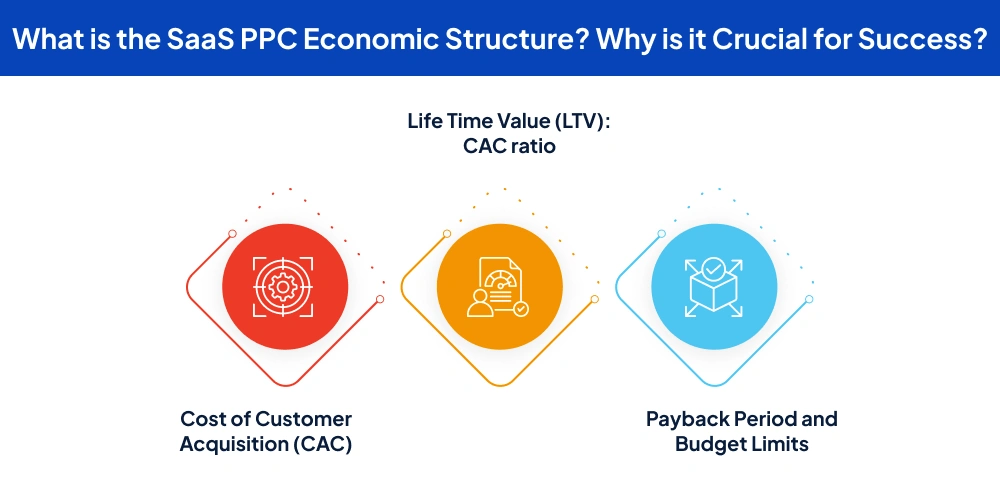
Cost of Customer Acquisition (CAC)
The expense involved in acquiring a paying client is referred to as the cost of customer acquisition (CAC). It is perhaps the most vital number to remember while allocating funds. Information on CAC determines how much you can spend on advertisements profitably.
How CAC impacts PPC budgeting:
- Sets a clear ceiling for cost per conversion
- Helps identify inefficient campaigns early
- Enables better forecasting of marketing ROI
- Marketing is consistent with financial objectives
Life Time Value (LTV): CAC ratio
LTV stands for the total value generated by every single customer over the duration of their life. Alongside LTV, CAC is what makes SaaS growth sustainable.
If you have a good LTV: CAC ratio, it means your PPC campaign is not only bringing you customers, but also profitable customers.
Tips for budgeting with an eye on LTV:
- Ensure that the LTV: CAC ratio is at least 3:1
- Only raise your PPC budget when LTV justifies it
- Customer segmentation helps identify valuable customers
- Retention techniques will allow you to increase LTV
Payback Period and Budget Limits
Payback period is the amount of time required to break even. With SaaS being subscription-based, it is a key limit to how much you can spend on PPC.
With shorter payback periods, you can reinvest more in growth.
Importance of payback period:
- Avoid cash flow problems
- Sustainable growth through increased ad spending
- Helps focus on converting campaigns
- Optimizes your onboarding process
Core PPC Metrics You Must Know
| Metric | Definition | Ideal Benchmark |
|---|---|---|
| CAC | Cost to acquire a customer | $200 – $1,200+ |
| LTV | Revenue per customer over lifetime | 3× CAC minimum |
| CPL | Cost per lead | $80 – $180 (avg SaaS) |
| CTR | Click-through rate | 3% – 6% |
| Conversion Rate | % of visitors converting | 5% – 6% (optimized funnels) |
| ROAS | Return on ad spend | 3× – 5×+ |
How to Define PPC Goals According to Your SaaS Growth Stage
The PPC goals should be set according to the current business position. When you begin with something new, there are going to be many trials with varying messages and audiences to get that perfect product-market fit. However, when you move to the scale level, the only goal will be generating leads.
It is important to understand how companies manage their monthly budget for PPC to align objectives as per budgetary requirements.
Early-Stage SaaS (Product-Market Fit)
At this stage, the focus will be on making sure your product is validated and reaching the correct audience. PPC can help scale these tests.
How to Budget PPC for Early-Stage SaaS:
- Spend small budgets on testing
- Explore various audience targets and messaging
- Prioritize insights over ROI
- Apply your learnings to product positioning
Broken or incomplete conversion tracking is found in the majority of underperforming accounts. If your tracking is off, every decision you have been making, which keywords to bid on, which campaigns to scale, which ads to run, has been based on inaccurate data. Before you optimise a single thing, verify that every important action on your website is being tracked correctly. This is non-negotiable.
Growth-Stage SaaS (Scaling Customer Acquisition)
If you’ve found product-market fit, the next step is to scale your customer acquisition. PPC will become a major factor in growing your pipeline.
How to Budget PPC for Growth-Stage SaaS:
- Double down on successful campaigns
- Target keywords and audiences that convert
- Add retargeting and multichannel efforts
- Focus on driving MQLs and SQLs
Mature SaaS (Profitability & Growth)
The mature SaaS company is primarily concerned about efficient performance and profitability.
Budget Strategy for Mature SaaS
- Maximize efficiency through optimization of current campaigns
- Eliminate wasteful spending and focus on accurate targeting
- Increase budgets for retention and upselling campaigns
- Use data to make budget decisions accurately
SaaS PPC Budget Allocation Model
By allocating budget in a systematic way, the SaaS company will be able to meet all the customer journey milestones with adequate budget. It is important to have the right budget allocations across channels rather than focusing only on one.
Channel-wise budget allocation
There are different roles for each PPC channel within the acquisition funnel. This is why a balanced budget allocation is required.
Recommended channel allocation:
- Google search: For high-intent conversions
- Social media advertising: For demand creation
- Display and retargeting: Conversion support
Funnel-based budget allocation
By distributing budgets in the funnel approach, the SaaS company will not only attract traffic but also ensure successful conversion.
- Top of Funnel (TOFU): 30–40% – Traffic Generation
- Middle of Funnel (MOFU): 30–35% – Lead Nurturing
- Bottom of Funnel (BOFU): 25–30% – Conversion-Focused
Budget Allocation Between Branding and Non-Branding Strategies
Campaigns for branding focus on intent-driven people who have an interest in your brand and convert effectively. Non-branded campaign strategies, on the other hand, focus on bringing customers via intent-driven generic keywords.
Recommended split:
- Google search: For high-intent conversions
- Social media advertising: For demand creation
- Display and retargeting: Conversion support
Funnel-based budget allocation
By distributing budgets in the funnel approach, the SaaS company will not only attract traffic but also ensure successful conversion.
- Top of Funnel (TOFU): 30–40% – Traffic Generation
- Middle of Funnel (MOFU): 30–35% – Lead Nurturing
- Bottom of Funnel (BOFU): 25–30% – Conversion-Focused
Budget Allocation Between Branding and Non-Branding Strategies
- Focus on brand campaigns to capture the search demand
- Majority budget should be allocated to non-brands
- Monitor brand CPCs
- Use brand campaigns to increase conversion
How to calculate SaaS PPC Budget
Calculating a SaaS PPC budget is not about guessing a number—it’s about working backward from your revenue goals and unit economics. The goal is to determine how much you can spend to acquire customers while staying profitable.
PPC budget = target customers x CAC
If your goal is 500 customers/month and CAC is $300
Budget = $150,000/month
Keep in mind:
- Adjust CAC based on growth stage
- Factors in conversion rates
- Include retargeting and testing budgets
Avoid Common SaaS PPC Budgeting Mistakes
SaaS companies may find themselves having trouble with PPC ads despite ample budget, which is why the way a company allocates and optimizes its marketing resources matters greatly. Small errors can have significant consequences and result in high costs of acquisition as well as unstable growth.
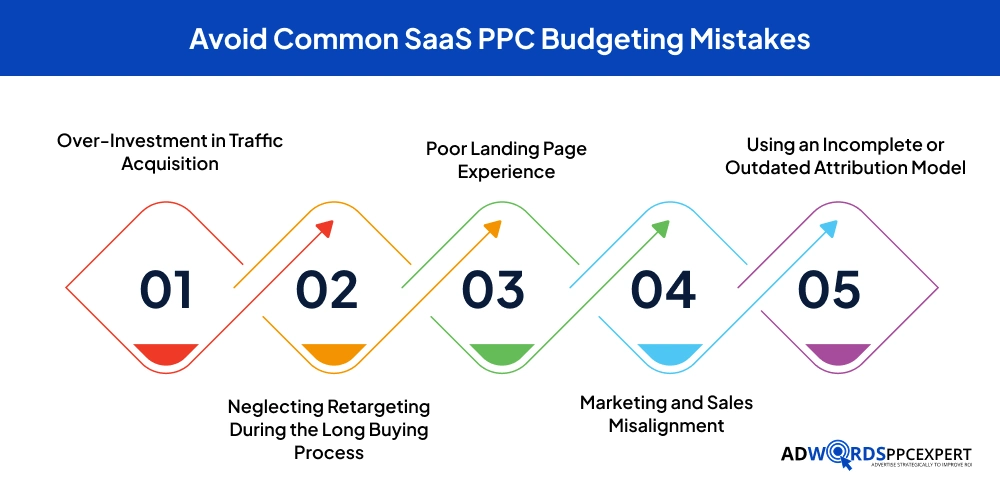
Over-Investment in Traffic Acquisition
When trying to build awareness and bring traffic, many SaaS companies tend to focus a lot of budget on attracting potential customers. The problem is that if there is no efficient conversion process in place – whether it is landing page optimization or an effective message delivery system – all those efforts go in vain.
Neglecting Retargeting During the Long Buying Process
SaaS products have a long decision-making process with multiple touches before the conversion. Therefore, when a business ignores retargeting, it misses out on converting interested users. It ends up wasting its budget on continuously generating more traffic instead of focusing on converting those users who were already engaged by advertising.
Poor Landing Page Experience
Besides the advertising aspect, the other side of PPC campaign failure is neglecting the landing page experience. The fact is, many companies neglect landing page optimization and create landing pages that do not reflect ad intent or value proposition. Thus, even with good PPC traffic, there will be no leads generated.
Marketing and Sales Misalignment
While it may be the objective of marketers to create more and more leads, and salespeople aim to close business. It may hurt their performance due to the fact that not all leads generated have been validated to ensure that they meet certain criteria. Marketers and salespeople should come together to meet the same objectives in a PPC campaign.
Using an Incomplete or Outdated Attribution Model
The problem is, most SaaS companies use the last-click attribution model. However, since users come across multiple touchpoints prior to conversion, there is a chance that PPC campaigns that truly drive conversions will go unnoticed. In this case, important channels such as retargeting or mid-funnel campaigns can suffer from a lack of budget.
Expert Tips to Upgrade Budget Strategies in 2026
Updating PPC budget planning methods in 2026 will imply going from the traditional approach to a much more flexible one that relies on analytics and data. To achieve optimal results, the company should consider focusing on the following:
- Identifying high-intent keywords/audiences who are already close to making a conversion.
- Utilizing machine learning and AI in the budget management for automatic optimization.
- Allocating a part of the budget to retargeting for increased conversion effectiveness.
- Investing in different stages of the funnel – TOFU, MOFU, and BOFU – to ensure growth.
- Optimizing based on CAC and not CPL to increase profits.
- Keeping 10%-15% of the total budget aside for experimentation.
- Taking advantage of first-party data in order to enhance targeting.
- Scaling the budget in small increments to maintain its performance.
- Combining PPC, SEO, and CRO into a synergic marketing strategy.
- Hire an expert PPC agency for results-driven strategies
Tools & Platforms for SaaS PPC Budget Management
Implementing an efficient PPC plan requires having the appropriate toolset and platform in order to monitor, analyze, and improve PPC performance.
Tools include:
- Google and LinkedIn ads
- Google Analytics 4
- CRM integrations for conversion tracking
- AI-driven automation platforms
Approach by AdWords PPC Expert: Feed Your SaaS Campaigns
Adwords PPC Expert approach is a component of an overarching growth strategy and not a separate initiative in itself. It emphasizes building systems to achieve sustainable and scalable growth through PPC campaigns.
Key offerings from Adwords PPC Expert:
- Data-driven PPC systems designed specifically for SaaS companies
- End-to-end campaign management from start to finish
- SEO, CRO, and analytics integration
- Continual optimization for maximum ROI
Conclusion
The budgeting for SaaS PPC campaigns in 2026 goes beyond just assigning budgets. It is about establishing a system where you can leverage metrics like CAC and LTV to distribute funds across all the different funnel levels.
By optimizing through AI and implementing the full-funnel strategy, SaaS organizations will be able to allocate less budget while delivering higher ROIs on their investment.
It all comes down to making sure that the organization treats PPC campaigns not as an individual marketing channel but as a component of the entire growth system.
To take advantage of the budgeting process, get in touch with an expert and build your growth engine.
Frequently Asked Questions
How much investment is enough for PPC in 2026 for a SaaS business?
It is impossible to provide an accurate figure; yet, as a rule, one might allocate 8-15% of their ARR towards marketing costs, out of which 40-60% will go to PPC advertising. This number may be somewhat larger for a startup trying to establish itself.
Why is the customer journey of 2026 so much longer?
The modern customer touches at least 15+ points of contact between AI search, social, and reviews before converting. With more competitors in the game and the emergence of Dark Social (word of mouth), it will be crucial to ensure you budget for more time in consideration than before.
Should I switch to Last-Click attribution?
Absolutely not! In 2026, Last Click attribution is obsolete for SaaS companies, as it simply doesn’t consider the brand development effort. It’s recommended to try out Multi-Touch attribution (MTA) or data-driven attribution.
What will happen to my budget with AI-automated bidding?
Bidding via an automated AI system needs a learning budget. This implies that the system is given more money than average to use within two to four weeks during the learning period. The AI system, after being optimized, usually returns a 20-30% higher ROAS compared to manual bidding due to targeting high-intent users.
Is SEO superior to PPC for SaaS in 2026?
Not at all – both are equally useful. While PPC offers the data and coverage for high-intent keywords, SEO takes care of building equity. In 2026, many firms adopt PPC to determine which keywords bring in conversions, and then start building SEO strategies for the same keywords six months later.

Ami Singh is a highly skilled AdWords PPC Specialist, known for creating profitable Google Ads strategies that elevate brands. With deep expertise in Google Search, Display, Shopping, YouTube Ads, and advanced bidding techniques, Ami consistently converts data into performance-driven results.
With a sharp analytical mind and a strong understanding of online consumer behavior, Ami designs campaigns that maximize ROI, boost quality scores, and reduce acquisition costs. His approach blends technical expertise with strategic thinking—making him a go-to expert for businesses aiming to dominate Google Ads.
Ami doesn’t just adapt to the fast-changing PPC industry, but he also stays ahead of the curve by testing new features, adopting automation smartly, and refining what works. Clients trust him for his transparency, insights, and ability to scale campaigns sustainably.
Looking to take your Google AdWords performance to the next level? Connect with Ami Singh at Softtrix and discover how he can help you get the maximum growth through powerful PPC strategies.