
What if the reason your pipeline feels inconsistent has nothing to do with how hard you are working?
The market does not care how many years you have been in the business. It does not care how good you are at your job, how many five-star reviews you have collected, or how much you genuinely love helping people find their perfect home. If the right people can’t find you at the exact moment they are ready to make a move, you lose the deal to whoever shows up first. Every single time.
And right now, “showing up first” means showing up on Google.
Think about what happens the moment someone decides to sell their house. They do not call the agent who mailed them a calendar magnet two Christmases ago. They pick up their phone, open Google, and type something like “sell my house fast in Massachusetts” or “what’s my home worth right now.” That search takes seconds. The decision about which agent to contact happens in the next thirty. And if your name is not at the top of that page when it does, someone else’s is.
Meanwhile, you are watching another agent in your market, not necessarily more talented or more experienced than you, consistently close deals month after month. You have heard they run Google Ads. You have thought about trying it yourself. But before you spend a single dollar, you have the one question that every smart real estate professional asks before committing to a new marketing channel:
“How much does real estate PPC actually cost, and is it really going to work for my business?”
It’s a fair question. And it’s the right one to ask. Too many agents have either burned through budget on poorly managed PPC campaigns that delivered nothing, or they have held back entirely because the costs sounded intimidating without any context around them.
But here is the truth. Real estate Pay-Per-Click advertising in 2026 is not cheap. But it is measurable, scalable, and, when done correctly, one of the highest-ROI lead generation tools available to agents and brokerages of any size. The problem is not the cost of PPC. The problem is not understanding what drives those costs, what results to realistically expect, and how to make every dollar work as hard as possible.
That is exactly what this guide is here to fix. We are going to break down what you will actually pay per click, per lead, and per closed deal, walk through the ROI math, and give you the specific strategies that separate profitable campaigns from money pits. Whether you are a solo agent who is never run a paid ad in your life or a growing brokerage ready to scale, this is the guide you have been looking for.
Let’s get into it.
What Is Real Estate PPC and Why Is It the Most Powerful Lead Channel in 2026?
Pay-Per-Click (PPC) advertising is exactly what the name implies, you only pay when someone actually clicks your ad. Unlike a billboard or a print ad that charges you for exposure regardless of who responds, PPC is fully performance-based. You choose specific keywords, the exact phrases your ideal buyers and sellers are typing into Google right now, your ad appears at the top of search results, and you are only charged when a real person clicks through to your website or landing page.
This model fundamentally changes the economics of real estate marketing. Instead of broadcasting your message to a general audience and hoping someone relevant sees it, you are placing yourself directly in front of people who are actively, right now, searching for the exact service you provide. That kind of intent-driven targeting is rare in any advertising medium, and in real estate, where a single transaction can mean $10,000–$30,000+ in commission, it’s nothing short of a game-changer.
The National Association of Realtors consistently reports that over 95% of today’s home buyers begin their search online. That is not a statistic you can afford to ignore. In 2026, more than half of all real estate ad clicks come from mobile devices, and Google’s AI-powered auction system has become sophisticated enough to serve your ads to exactly the right person at exactly the right moment. When someone searches “sell my house fast in Massachusetts” at 9 PM on a Tuesday, Google knows their intent is commercial and urgent, and that is when your ad can appear.
SEO is a powerful long-term strategy, but it takes 6 to 12 months or more to show results. PPC puts you on the first page of Google from day one. That speed and precision are why real estate PPC has become the go-to lead generation engine for serious agents and brokerages across the country.
Why Smart Real Estate Professionals Choose PPC
Before we get into the cost numbers, it’s important to understand why so many top realtors and brokerages make real estate PPC a central part of their marketing budget year after year. These are not theoretical advantages, they are the reasons PPC continues to deliver when other channels fall flat.
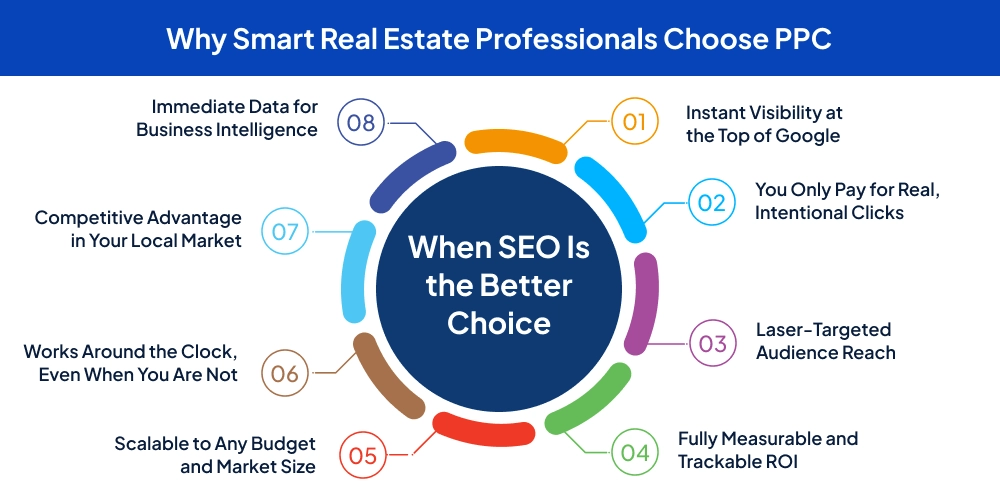
Instant Visibility at the Top of Google
Unlike organic SEO or social media, PPC puts your name at the top of Google search results the moment your campaign goes live. You don’t wait months to build authority, you appear immediately when motivated buyers and sellers are actively searching. In a competitive market, that top-of-page positioning is invaluable.
You Only Pay for Real, Intentional Clicks
PPC’s pay-per-click model means you are not spending money on passive impressions. Every dollar in your budget is tied to an action, a real person making a deliberate choice to click on your ad. This makes PPC one of the most efficient forms of advertising available, especially when compared to traditional media, where you pay for reach without a guarantee of response.
Laser-Targeted Audience Reach
Real estate PPC lets you target buyers and sellers by the specific words they are searching, by exact geographic location (even down to ZIP code or neighborhood), by device type, time of day, and audience demographic. This level of precision means your ad dollars are never wasted on people who are not potential clients.
Fully Measurable and Trackable ROI
Every click, every form submission, every phone call from your PPC campaign can be tracked and attributed. Unlike a referral, a yard sign, or a mailer, you know exactly how much you spent to acquire each lead and what percentage of those leads turned into closed deals. This data-driven transparency allows you to optimize continuously and tie your marketing spend directly to your commission income.
Scalable to Any Budget and Market Size
Whether you are a solo agent investing $900 a month or a large brokerage spending $15,000+ monthly, PPC scales with your business. You can start small, prove the model, and confidently increase investment as the returns justify it. No other lead channel offers this kind of linear, controllable scalability.
Works Around the Clock, Even When You Are Not
Your Google Ads campaign doesn’t sleep. It runs 24/7, capturing seller intent at midnight and buyer curiosity at 6 AM. While you are at a showing, at dinner with your family, or asleep, your ads are working to fill your pipeline. That kind of always-on lead generation is simply not possible with manual outreach.
Competitive Advantage in Your Local Market
Most real estate agents in any given market are not running optimized PPC campaigns. Many have tried it once, had a poor experience due to mismanagement, and walked away. That means a well-run real estate PPC campaign can give you a dominant presence in local search results that your competitors simply cannot match through organic methods alone.
Immediate Data for Business Intelligence
PPC campaigns generate a wealth of real-time data about what buyers and sellers in your market are actually searching for, what messaging resonates, which neighborhoods show the most search interest, and what offers drive action. This intelligence is valuable far beyond the ads themselves, it informs your content strategy, your farm area decisions, and your overall business development.
Real Estate PPC Cost in 2026: What Does a Click Actually Cost?
Let’s talk numbers. The first metric every real estate professional needs to understand is Cost Per Click (CPC), the amount you pay each time someone clicks on your ad. The often-cited industry average CPC for real estate sits around $2.37 to $2.53. That number sounds reassuringly affordable until you realize it’s a blended average that combines extremely low-competition informational keywords with highly competitive, high-intent transactional keywords.
In reality, what you will pay per click depends enormously on what you are advertising and to whom. Here is how real estate CPCs break down in 2026:
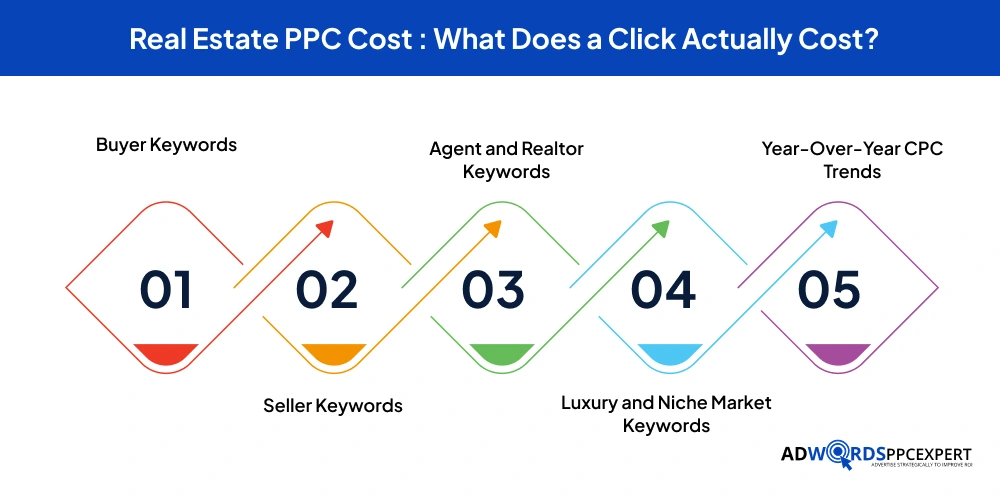
Buyer Keywords
Broad buyer keywords like “homes for sale” or “buy a house” carry relatively modest CPCs, typically in the $0.50 to $3.00 range. When you add geographic modifiers (e.g., “homes for sale in Austin TX” or “condos for sale in downtown Chicago”), costs rise slightly to around $0.28–$5.00 per click depending on the market’s competitiveness. These keywords attract high traffic volume, but they cast a wide net that includes many early-stage researchers who would not be ready to transact for months.
Seller Keywords
Seller-focused keywords are where CPCs climb steeply, and with good reason. Phrases like “sell my house,” “list my home,” or “home value estimate” can cost anywhere from $5 to $30 per click. High-urgency seller keywords like “sell my house fast,” “cash home buyers,” or “sell home without a realtor” regularly cost $15 to $65+ per click in competitive metro areas. Why so expensive? Because the agent who captures that seller lead and wins the listing stands to earn $15,000–$40,000+ in commission. Even at $50 per click, the economics work decisively in your favor if your follow-up is strong.
Agent and Realtor Keywords
Branded service keywords, searches like “realtor near me,” “top real estate agent in New York,” or “best listing agent in the neighborhood”, fall in the $10 to $25 range per click. These keywords indicate a buyer or seller who has moved past the browsing phase and is now actively evaluating agents to work with. Higher CPC, but also significantly higher conversion probability.
Luxury and Niche Market Keywords
Targeting luxury properties or niche markets (e.g., “luxury homes for sale Manhattan,” “waterfront property listings,” “historic homes Los Angeles”) typically costs $3 to $20 per click. The lower competition in niche markets can make these campaigns surprisingly efficient, and a single luxury listing commission can fund months of ad spend.
Year-Over-Year CPC Trends
Real estate CPCs have increased approximately 7% year-over-year entering 2026. This is a meaningful but manageable increase compared to other high-competition industries. Insurance CPCs have risen by nearly 12%, legal by 15%, and financial services by 18%. Real estate remains one of the more accessible professional verticals for digital advertising, especially when campaigns are properly optimized to maximize Quality Score and reduce effective CPC.
From Click to Lead: Understanding Real Estate PPC Cost Per Lead in 2026
Cost Per Click tells you what you pay to get someone to your landing page. Cost Per Lead (CPL) tells you what you actually pay to get their contact information, and CPL is the metric that should drive your budget decisions and performance benchmarks.
CPL is calculated with a simple formula: divide your total ad spend by the number of leads generated. But what makes or breaks your CPL is your conversion rate, the percentage of visitors who land on your page and actually submit their contact information.
CPL = Total Monthly Ad Spend ÷ Number of Leads Generated in That Month
In 2026, healthy real estate PPC benchmarks look like this for search campaigns, a 2.47% to 5% conversion rate on well-optimized campaigns, with best-in-class campaigns hitting 8% or more through dedicated landing page optimization. Display campaigns average closer to 0.80%.
Here is what that translates into for CPL across different lead types:
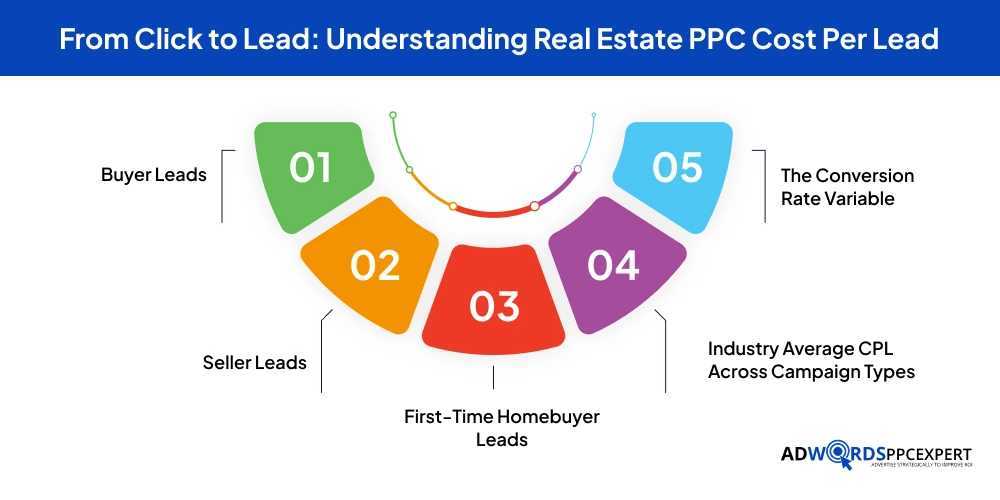
Buyer Leads
Well-managed buyer lead campaigns typically generate contacts at a cost of $6 to $50 per lead in most markets. The lower end reflects secondary and tertiary markets with less competition; the higher end reflects major metros. It’s important to remember that buyer leads generally have a longer transaction timeline, often 3 to 6 months from first contact to closing, and require consistent nurturing to convert.
Seller Leads
Seller leads are more expensive to generate, typically $50 to $200 per lead, depending on market tier and keyword targeting. But they also carry higher transaction urgency, higher commission value, and often produce a referral chain if the experience is exceptional. Paying $120 for a seller lead that turns into a $20,000 commission is an excellent investment, it’s a 166x return on that single lead.
First-Time Homebuyer Leads
First-time buyer leads sit in the middle of the cost spectrum, typically $40 to $90 per lead. This segment is growing significantly in 2026 as millennials and Gen Z continue entering the housing market. While they require more education and hand-holding through the process, they often become loyal long-term clients and referral sources.
Industry Average CPL Across Campaign Types
Across all real estate PPC campaign types on Google Search, the industry average CPL in 2026 falls in the range of $65 to $170. This wide range reflects the enormous variation in market competitiveness, targeting precision, and landing page quality. Campaigns that are well-structured with geo-targeted keywords, purpose-built landing pages, and consistent ad copy relevance consistently perform in the lower half of this range. Poorly configured campaigns, broad targeting, homepage destinations, generic ad copy, often land at the high end or above.
The Conversion Rate Variable
One of the most impactful and most overlooked cost-reduction levers in real estate PPC is the landing page conversion rate. The industry average conversion rate for real estate landing pages is around 2.47%. Well-optimized, purpose-built landing pages consistently achieve 5–8%, and exceptional ones reach 10–15%. Consider what this means in practice:
At a $3 CPC and 1,000 clicks ($3,000 spend), a 2.5% conversion rate generates 25 leads at a CPL of $120. At a 7.5% conversion rate, achieved purely through landing page optimization without changing the ad spend, the same $3,000 generates 75 leads at a CPL of just $40. That is a 67% cost reduction through landing page work alone.
The most cost-effective investment in your real estate PPC program is not always more budget, it’s often a better landing page.
How Much Should You Budget for Real Estate PPC in 2026? A Tier-by-Tier Breakdown
There is no universal “right” budget for real estate PPC. But there are clear, data-backed ranges that correspond to your business size, your market’s competitiveness, and the lead volume you need to sustain your income goals. Here is how to think about it across four tiers:
Tier 1: The Solo Agent Getting Started ($500 – $900/Month)
At the $500–$900 per month range, you can run a focused, single-campaign strategy, ideally targeting one specific audience (buyers or sellers, not both) in a defined geographic area. This is a viable entry point for secondary markets with lower competition, but there are important caveats. Below $500/month, Google’s machine learning algorithm simply doesn’t have enough conversion data to optimize your campaign effectively. You will generate some leads, but expect higher CPLs and slower optimization. At $900/month in a mid-sized market with a well-built landing page, a realistic expectation is 5 to 12 leads per month.
Tier 2: The Growth-Focused Solo Agent or Small Team ($900 – $2,000/Month)
This is the sweet spot for most solo agents and newly formed teams. At $1,000 to $2,000 per month, you can run concurrent buyer and seller campaigns, dedicate meaningful budget to high-intent seller keywords, begin building a PPC retargeting audience, and still keep CPLs manageable. In a competitive mid-market, expect 15 to 30 leads per month at this budget level. Closing just one deal every 2–3 months from PPC leads at an average $12,000 commission generates a 2x–3x ROI, which only improves as your campaign matures.
Tier 3: The Established Team or Growing Brokerage ($2,000 – $5,000/Month)
At this investment level, you can run a comprehensive multi-campaign strategy, separate buyer and seller campaigns, hyper-local neighborhood targeting, retargeting to warm audiences, and seasonal budget adjustments for peak buying season. Teams spending $3,000–$5,000/month in competitive markets should realistically generate 40 to 100 leads per month. This volume also provides enough conversion data for Google’s smart bidding algorithms to operate effectively, which further improves efficiency over time.
Tier 4: The Large Brokerage or Multi-Market Operation ($5,000 – $15,000+/Month)
Enterprise-level real estate companies and large brokerages with 10+ agents operating across multiple markets typically allocate $5,000 to $15,000 per month for PPC, with some regional powerhouses in major metros spending $20,000 to $50,000+ monthly. At this scale, Performance Max campaigns, advanced audience segmentation using first-party data, and dedicated campaign management become essential. Lead volumes at the high end of this tier can exceed 300+ per month, making CRM capacity and follow-up speed as important as the ads themselves.
Key Rule: Never invest in more leads than your follow-up system can actually handle. Lead volume and contact capacity must be in sync, a $1,500/month campaign that generates 20 leads you can personally follow up with is more valuable than a $5,000 campaign generating 80 leads that go cold in your inbox.
The Six Factors That Directly Determine What You Will Pay for Real Estate PPC
Understanding what drives your costs is as important as knowing the averages. These six variables have the most direct influence on what you will pay per click and per lead in your market:
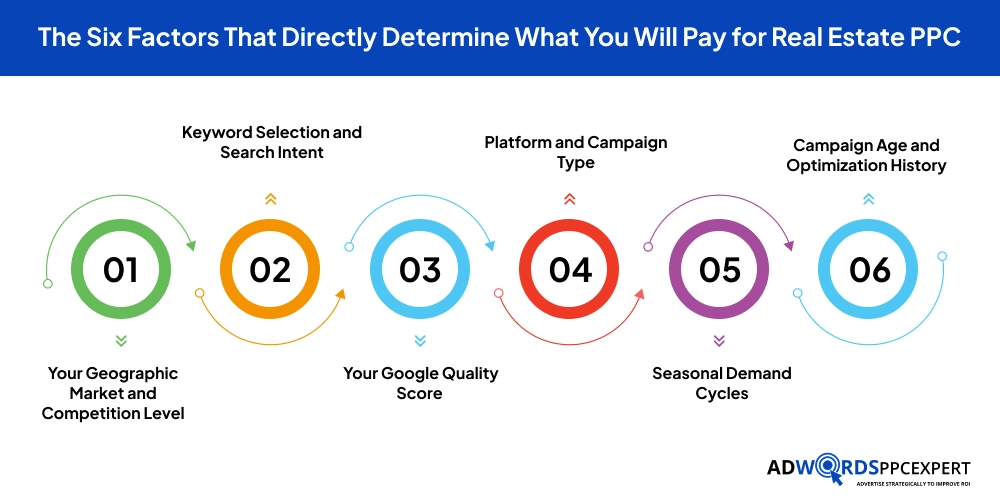
1. Your Geographic Market and Competition Level
Your location is the single biggest determinant of your CPC. Advertising in Manhattan, Beverly Hills, or Miami’s luxury market means bidding against some of the most well-funded real estate brands in the country, and paying accordingly. Seller keywords in these markets regularly exceed $50–$65 per click. In a mid-sized Midwestern city or suburban secondary market, the same keywords may cost a fraction of that. Smart advertisers in competitive metros combat this by going hyper-local, targeting specific ZIP codes or neighborhoods rather than city-wide searches, which dramatically reduces competition and improves relevance.
2. Keyword Selection and Search Intent
Not all keywords cost the same, and not all clicks are worth the same. Broad informational keywords attract browsers; specific, transactional keywords attract buyers and sellers ready to act. Long-tail, intent-rich phrases like “sell my house fast in Mexico” or “3-bedroom homes for sale under $400k in LA” cost less than generic terms and convert far better. Your keyword strategy has more influence over your CPL than almost any other single factor.
3. Your Google Quality Score
Google assigns every keyword in your account a Quality Score from 1 to 10 based on three signals: expected click-through rate (how often people click your ad relative to how often it’s shown), ad relevance (how closely your ad matches the searcher’s intent), and landing page experience (how useful and relevant your page is). A score improvement from 5 to 8 can reduce your CPC by 30% or more. Improving Quality Score costs nothing in additional ad spend, it’s purely the result of better ad writing, smarter keyword targeting, and a more relevant landing page.
4. Platform and Campaign Type
Where you advertise determines your cost structure. Google Search captures users with declared, active intent, the highest-quality source of real estate leads, at an average CPC of $2.37 to $5.50. Google Display ads carry much lower CPCs (around $0.75) and work well for retargeting and brand awareness but rarely generate direct leads on their own. Meta (Facebook and Instagram) offers CPCs of $0.50 to $2.00 and excels at visual property showcasing and demographic targeting, though lead intent is generally lower than search. Google’s Local Service Ads operate on a pay-per-lead model and include a “Google Guaranteed” badge that significantly boosts credibility. YouTube ads, at $0.10 to $0.30 per view, offer exceptional brand-building efficiency for agents investing in video content.
5. Seasonal Demand Cycles
Real estate has well-established seasonal rhythms, and PPC costs move in lockstep with market activity. Spring (March through June) is consistently the most competitive and expensive period for real estate PPC, CPC can rise 15 to 25% compared to the winter months as buyers and sellers flood the market. Summer sees sustained competition with a slight cooling in July and August. Fall brings a second wave of activity, while December through February is typically the slowest and cheapest period to advertise. Smart campaign managers adjust monthly budgets to align with these cycles, holding back during slow months and pushing aggressively during peak seasons when lead-to-close rates are highest.
6. Campaign Age and Optimization History
New campaigns pay a “learning tax.” In the first 30 to 60 days, Google’s algorithm is gathering data, adjusting bids, and learning which users are most likely to convert for your specific account. This initial learning phase typically produces higher CPCs and lower conversion rates. By months two and three, as Quality Scores improve and the algorithm identifies your highest-performing keyword and audience combinations, CPL begins to fall. This is why many agents who judge their PPC campaign in the first month and abandon it are quitting right before the returns start compounding.
The Real Estate PPC ROI Calculator
The most important mindset shift in real estate PPC is moving from “how much does this cost?” to “what is this generating?” PPC is not an expense, it’s an investment with a measurable, attributable return. Let’s walk through the math in a straightforward way.
ROI = (Revenue Generated − Total Ad Spend) ÷ Total Ad Spend × 100
A Realistic Scenario for a Solo Agent
Let’s say you are investing $1,500/month in a buyer-seller split campaign in a competitive mid-market. Here’s what the funnel might realistically look like:
- Monthly ad spend: $1,500
- Average CPC: $3.50
- Monthly clicks: approximately 430
- Landing page conversion rate: 3.5%
- Leads generated: approximately 15 leads/month
- Lead-to-appointment rate: 30%
- Appointments set: roughly 4–5 per month
- Close rate from appointments: 25–30%
- Closed deals per month: 1–1.5 (let's say 1 deal every 5–6 weeks)
- Average commission per deal: $12,000
- Monthly revenue attributed to PPC: approximately $6,000–$8,000
- ROI: ($7,000 − $1,500) ÷ $1,500 × 100 = 367%
That’s a 3.5x return on a $1,500 monthly investment. And that’s in the early stages of campaign optimization. As Quality Scores improve, landing page conversion rates increase, and your team gets sharper at follow-up, those numbers improve materially. Most well-managed real estate PPC campaigns target a 3x to 5x return on ad spend (ROAS) as their benchmark.
The Seller Lead ROI: Higher Cost, Higher Return
Let’s run the math specifically for seller campaigns, where CPCs and CPLs are higher but commission potential is also much greater. Assume a dedicated seller campaign spending $1,200/month targeting motivated seller keywords:
- Monthly spend: $1,200
- Average CPC on seller keywords: $18
- Monthly clicks: approximately 67
- Conversion rate (landing page for home valuation): 6%
- Seller leads generated: approximately 4 per month
- Close rate on seller leads: 15–20%
- Closed listings per month: 0.6–0.8 (roughly 1 listing every 5–6 weeks)
- Average seller commission: $18,000
- Monthly revenue: approximately $10,800–$14,400
- ROI: ($12,600 − $1,200) ÷ $1,200 × 100 = 950%
Even with a lower lead volume, the unit economics of seller leads are extraordinary. One listing every 5–6 weeks from a $1,200/month campaign is a result that most agents would consider life-changing for their business, and it’s entirely achievable with the right keyword strategy, landing page, and follow-up system.
The Critical Factor Nobody Talks About: Speed to Lead
Here is a number that doesn’t appear in any ad platform dashboard but has enormous influence over your real estate PPC ROI: response time. Research consistently shows that agents who respond to a new online lead within 5 minutes are 100 times more likely to make meaningful contact than those who wait even 30 minutes. The real estate PPC market is competitive enough that a motivated seller who submits their information to your landing page is probably also on Zillow and two competitor sites simultaneously. First contact wins.
Improving your speed-to-lead response costs nothing in additional ad spend. It is a process and systems change that can dramatically improve your lead-to-appointment rate and, ultimately, your PPC ROI.
Hidden and Indirect Expenses Beyond Ad Spend
Your Google Ads budget is just one piece of the total investment in a real estate PPC program. To accurately calculate your true CPL and ROI, you need to account for these additional costs:
PPC Management and Strategy Fees
Unless you are managing campaigns yourself, which requires significant expertise and ongoing time investment, you’ll need a PPC specialist or agency like AdwordsPPCExpert. Industry-standard pricing runs from $500 to $1,500 per month for flat retainer arrangements, or 10% to 20% of your ad spend for percentage-based models. For agents spending $1,000–$2,000/month on ads, a management fee of $500–$750/month is typical. These fees are justified when a skilled manager can reduce your CPL by 30–50% through optimization, the math almost always favors professional management at any meaningful budget level.
Landing Page Design and Optimization
A custom, conversion-optimized landing page is non-negotiable for serious real estate PPC. The difference between sending traffic to your homepage (1–2% conversion rate) and a purpose-built landing page (5–12% conversion rate) is so significant that skipping this investment is arguably the most expensive mistake in real estate advertising. Professional landing page design runs $100 to $1,000, depending on complexity, though platforms like Placester, Sierra Interactive, and BoldLeads include real estate-specific templates as part of their marketing suites.
Creative Assets and Visual Content
High-quality photography and video dramatically improve performance, especially on Meta, YouTube, and Google Display. Professional real estate photography runs $200 to $500 per session. Video listing highlights or brand videos can range from $500 to $2,000+. While these are one-time or infrequent costs, they factor into your total marketing investment and should be planned for.
CRM and Lead Nurturing Tools
Generating leads without a CRM is like filling a bucket with a hole in the bottom. A purpose-built real estate CRM, like Follow Up Boss, LionDesk, or HubSpot, is essential for capturing, tracking, and nurturing PPC leads through what can be a 3–6 month buyer or seller journey. Pricing runs from $50 to $300/month, depending on platform and team size. This is not an optional expense for anyone investing serious money in paid lead generation.
Eight Proven Strategies to Lower Your Real Estate PPC Costs Without Sacrificing Lead Quality
Rising CPCs don’t have to mean declining ROI. These are the most effective cost-control strategies real estate professionals are using in 2026:
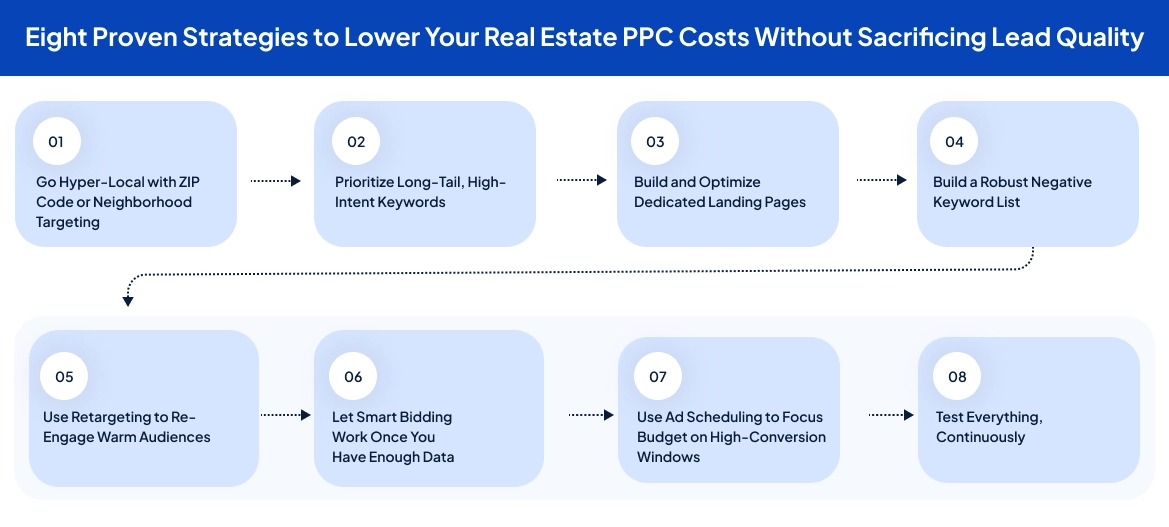
1: Go Hyper-Local with ZIP Code or Neighborhood Targeting
Instead of targeting an entire city or metro area, narrow your campaigns to specific ZIP codes, neighborhoods, or custom-radius targeting around your office. This reduces your competition pool, makes your ads more relevant, and typically produces lower CPCs and higher conversion rates. Agents who’ve made this shift often report CPL reductions of 30–40%.
2: Prioritize Long-Tail, High-Intent Keywords
Targeting “homes for sale” puts you in direct competition with Zillow, Realtor.com, and every major brokerage in your market. Instead, pursue specific transactional phrases like “4-bedroom homes for sale in neighborhood” or “sell my house fast in Florida.” These have lower search volume but dramatically better conversion rates and lower competition.
3: Build and Optimize Dedicated Landing Pages
Every ad group should drive traffic to a purpose-built landing page that mirrors the ad’s specific promise. A seller keyword campaign should land on a home valuation page. A buyer campaign should land on an IDX search or property discovery page. Generic homepage destinations waste 70–80% of your ad spend. This single change often produces the largest CPL reduction of any optimization.
4: Build a Robust Negative Keyword List
Negative keywords prevent your ads from showing up for irrelevant searches. In real estate, critical negative keywords include: “rental,” “apartment,” “jobs,” “careers,” “HUD,” “section 8,” “commercial,” “foreclosure help,” and “free.” Without negative keywords, a meaningful portion of your budget pays for clicks from people who have zero interest in buying or selling.
5: Use Retargeting to Re-Engage Warm Audiences
The majority of visitors who click your ad will not convert on their first visit, they may need to think about it, compare options, or come back when they are ready. Retargeting lets you serve follow-up ads to these visitors on Google Display and Meta, reminding them of your offer at a fraction of the cost of acquiring a cold click. Retargeting audiences are your highest-converting traffic, and they should be a cornerstone of any mature PPC strategy.
6: Let Smart Bidding Work Once You Have Enough Data
Google’s AI-powered smart bidding strategies, Target CPA, Target ROAS, and Enhanced CPC, optimize your bids in real-time based on predicted conversion probability. They work best when campaigns have accumulated 30–50 conversions. For new campaigns, start with manual bidding to retain control and build data, then graduate to smart bidding for sustained efficiency gains.
7: Use Ad Scheduling to Focus Budget on High-Conversion Windows
Real estate buyers and sellers are most likely to search and convert during specific time windows, typically evenings (6–10 PM) and weekend mornings. By using ad scheduling to concentrate your budget during these peak periods and reducing (or pausing) ads during low-engagement hours, you extract more leads from the same monthly spend.
8: Test Everything, Continuously
Small, consistent improvements compound into major CPL reductions over time. A/B test different ad headlines, landing page CTAs, form lengths, and page layouts on a regular basis. Even a 0.5% improvement in conversion rate generates measurable cost savings month after month without touching your ad budget.
The Most Expensive Real Estate PPC Mistakes Agents Make
Learning from the field’s most common errors can protect your budget and your sanity. These are the mistakes we see most frequently, and the ones that drain ROI fastest:
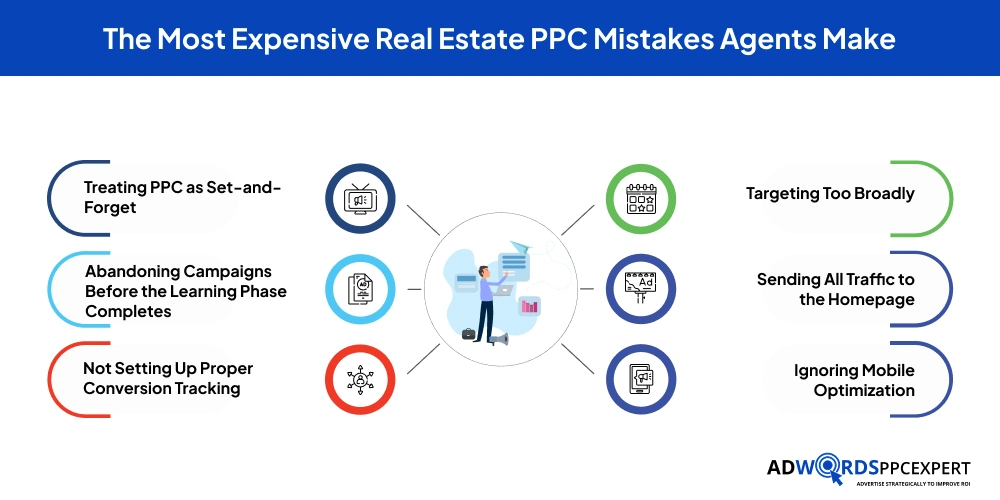
Mistake 1: Targeting Too Broadly
Bidding on city-wide, generic keywords without geo-refinement or audience segmentation is one of the fastest ways to burn through budget with little return. Start narrow, gather data, then expand strategically.
Mistake 2: Sending All Traffic to the Homepage
Your website homepage is designed to educate and orient visitors, not to convert them. PPC traffic sent to a homepage converts at 1–2%. The same traffic sent to a purpose-built landing page converts at 5–12%. This one change alone can cut your CPL in half.
Mistake 3: Ignoring Mobile Optimization
More than 52% of real estate ad clicks come from mobile devices. If your landing page is slow-loading, difficult to navigate on a phone screen, or requires too many taps to submit a form, you are losing the majority of your potential leads. Mobile optimization is not optional, it’s foundational.
Mistake 4: Not Setting Up Proper Conversion Tracking
Running PPC without conversion tracking is like driving blindfolded. Without tracking form submissions, phone calls, and chat interactions, Google’s algorithm optimizes for clicks rather than leads. You have no visibility into which keywords or ads are actually generating business, and you have no data to improve from.
Mistake 5: Abandoning Campaigns Before the Learning Phase Completes
The most common reason real estate PPC “doesn’t work” is quitting too early. The first 60–90 days of any campaign involve a learning period during which CPCs are higher and conversion rates are lower. Agents who pull the plug after 30 days of sub-par results miss the compounding optimization benefits that make PPC profitable over time.
Mistake 6: Treating PPC as Set-and-Forget
PPC campaigns require active, weekly management. Keyword performance shifts, competitor bids change, seasonal patterns fluctuate, and ad copy grows stale. Without regular review and adjustment, even a well-built campaign will degrade in performance over time.
What the Top 10% of Real Estate PPC Advertisers Do Differently
After analyzing dozens of high-performing real estate PPC campaigns across markets of all sizes, a handful of consistent behavioral patterns distinguish the agents and brokerages generating exceptional ROI from those who struggle:
- They build the full system before spending the first dollar. Top performers don't launch an ad and hope for the best, they build the complete pipeline first, that is a dedicated landing page, CRM integration, automated lead response, and a personal follow-up protocol. The ad is the last piece, not the first.
- They respond to every lead within 5 minutes. Speed-to-lead is one of the most powerful variables in real estate PPC ROI and it costs nothing to improve. The top performers treat lead response like it's an emergency, because in a competitive market, it is.
- They run separate buyer and seller campaigns. Different audiences, different keywords, different CPCs, different landing pages, different follow-up sequences. Combining everything into one campaign is a guaranteed way to dilute performance and make data unreadable.
- They review performance data every single week. Top PPC performers are not passive investors. They review search term reports, pause underperforming keywords, test new ad copy, and adjust budgets weekly. The market moves fast; campaign management must move with it.
- They pair PPC with a long-term SEO and content strategy. PPC generates leads immediately; SEO builds authority over time. The most effective real estate marketers use both in parallel, PPC to fill the pipeline now, content and SEO to reduce CPL over the next 12–24 months as organic traffic grows.
- They track everything back to commission income, not just leads. The best campaigns are evaluated on closed deals and commission generated, not on clicks or even CPL. This mindset keeps optimization focused on what actually matters: revenue.
Is Real Estate PPC Worth It in 2026?
The short answer, yes for the right agents and brokerages, with the right foundation in place.
Real estate PPC is not a magic lead machine. It doesn’t produce results the moment you fund your Google Ads account. It’s a sophisticated, data-driven marketing channel that rewards preparation, patience, and consistent optimization. The agents who are frustrated by PPC are almost always frustrated because they went in without a landing page, without conversion tracking, without a CRM, or without a clear follow-up protocol and then judged the results after 30 days. That’s not a PPC problem. That is an infrastructure problem.
PPC is the right investment for you if you have a monthly budget of at least $900 to $1,000 (ideally $1,500 or more), you have a conversion-optimized landing page ready before you spend your first dollar; you have a CRM and a speed-to-lead follow-up system in place; you have 5 to 10 hours per week available for lead response and campaign oversight, or access to a PPC specialist who can manage it for you; and you have the patience to allow the campaign 60 to 90 days to reach full optimization.
PPC may not be the right fit right now if: your total available budget is under $500/month; you don’t have any lead follow-up infrastructure in place; you need instant results and won’t allow for an optimization period; or your market is so specialized or small that search volume for your target keywords is insufficient to generate meaningful data.
The agents and brokerages thriving with PPC in 2026 are not necessarily spending the most, they are spending the most strategically. Precise targeting, compelling landing pages, fast follow-up, and rigorous ongoing optimization consistently outperform larger, lazily managed campaigns regardless of budget size.
A well-run real estate PPC campaign should generate a 3x to 5x return on ad spend. For every $1,000 invested, your target should be $3,000 to $5,000 in gross commission income, and exceptional campaigns with mature optimization and strong close rates do significantly better.
Final Thoughts
If you started reading this guide wondering whether real estate PPC is worth the investment, here is the straightforward answer, it absolutely can be, and for thousands of agents across the country, it already is.
Yes, CPCs are up 7% year-over-year. Yes, competition in the most desirable markets is real, and some seller keywords will make you wince when you see the cost-per-click. But here’s the context those numbers need: in what other advertising channel can you place your business directly in front of a motivated seller who typed “sell my house fast in New Jersey” two minutes ago? In what other medium can you trace a $20,000 commission check all the way back to a specific keyword, a specific ad, a specific day and time?
That level of measurability, accountability, and precision is what makes real estate PPC fundamentally different from any other marketing channel available to you. The agents winning with it in 2026 are not spending recklessly, they are investing deliberately. They are going hyper-local. They are building landing pages that actually convert. They are responding to leads within minutes, not hours. And they are giving their campaigns the time and attention needed to mature into real, compounding revenue engines.
Whether you are starting with $1,000 a month or scaling a brokerage-level campaign to $10,000+, the principles in this guide give you everything you need to approach real estate PPC with clarity, confidence, and a realistic expectation of what it can do for your business.
At AdWordsPPCExpert.com, we specialize in building real estate PPC campaigns that don’t just generate clicks, they generate closings. If you are ready to stop wondering and start winning, we are here to help you every step of the way.
Ready to find out exactly how much a real estate PPC campaign should cost for your market and your goals? Contact AdWordsPPCExpert.com today for a free campaign audit and a personalized budget plan tailored specifically to your business.
Frequently Asked Questions (FAQs)
How much does Google Ads cost for real estate agents in 2026?
The average CPC for real estate Google Ads in 2026 ranges from $2.37 to $5.50, depending on keyword type and market. Broad buyer keywords can be as low as $0.50 per click, while high-intent seller keywords can reach $65+ per click in major metros.
How long before my real estate PPC campaign starts delivering results?
You can start receiving leads within the first week of a live campaign. However, campaigns typically take 60 to 90 days to fully optimize for consistent, profitable CPLs. Don’t make major strategic changes or budget decisions during this initial learning phase, the data you need to make smart decisions requires time to accumulate.
Should I use Google Ads or Facebook Ads for real estate leads?
Google Ads Search campaigns are best for capturing high-intent users who are actively searching for real estate help right now. Facebook and Instagram Ads are better for brand awareness, visual property showcasing, and retargeting warm audiences who have already visited your site. The most effective real estate advertisers use both platforms in a coordinated strategy, search to capture active intent, social to nurture and retarget.
What is the difference between PPC and SEO for real estate?
PPC delivers immediate visibility at a direct per-click cost, you pay for every visitor. SEO builds organic search visibility over 6 to 12+ months through content and technical investment, with no per-click charge once established. PPC is faster and more controllable; SEO is more durable and cost-efficient at scale. Combining both produces the most powerful and sustainable real estate lead generation system.

Ami Singh is a highly skilled AdWords PPC Specialist, known for creating profitable Google Ads strategies that elevate brands. With deep expertise in Google Search, Display, Shopping, YouTube Ads, and advanced bidding techniques, Ami consistently converts data into performance-driven results.
With a sharp analytical mind and a strong understanding of online consumer behavior, Ami designs campaigns that maximize ROI, boost quality scores, and reduce acquisition costs. His approach blends technical expertise with strategic thinking—making him a go-to expert for businesses aiming to dominate Google Ads.
Ami doesn’t just adapt to the fast-changing PPC industry, but he also stays ahead of the curve by testing new features, adopting automation smartly, and refining what works. Clients trust him for his transparency, insights, and ability to scale campaigns sustainably.
Looking to take your Google AdWords performance to the next level? Connect with Ami Singh at Softtrix and discover how he can help you get the maximum growth through powerful PPC strategies.