
You are staring at your marketing budget, trying to figure out where every dollar should go. Should you put money into Google Ads and see results tomorrow? Or invest in SEO and wait months for organic traffic to build up? It is a question that keeps business owners up at night, and for good reason, hence making the wrong choice could mean thousands of dollars wasted.
Everyone tells you that SEO is “free” and PPC is “expensive.” But that is not the whole story. SEO is not just free, it requires time, content, and expertise. And PPC is not just expensive, it can actually be profitable when done right. The real question is not which one costs more upfront. It is which one gives you better value over time?
The PPC vs SEO cost comparison is one of the most critical decisions you will make for your business. These two strategies both get you visible on Google, but they work in fundamentally different ways. PPC is like paying rent, which means you get immediate visibility, but the moment you stop paying, you disappear. SEO is like buying property, which means it takes time and money upfront, but once you own that real estate on Google’s first page, it keeps delivering value year after year.
In this guide, we will break down everything you need to know about the PPC vs SEO cost comparison. No confusing jargon. No unrealistic promises. Just honest, practical information to help you make a smart decision with your hard-earned marketing dollars. Whether you are working with a tight budget or have room to invest in both channels, you will walk away knowing exactly what each approach costs and which one makes sense for where your business is right now.
What is PPC and How Much Does It Really Cost?
Pay per click advertising, commonly called PPC, means you pay money every single time someone clicks on your ad. The most popular platform for this is Google Ads, where your business appears at the very top of search results with a small “Ad” label next to it.
How PPC Pricing Works
When someone searches for something related to your business, Google runs a quick auction. Advertisers bid on keywords, and the winners get their ads shown. You only pay when someone actually clicks your ad and visits your website.
The cost per click can range anywhere from less than a dollar to hundreds of dollars, depending on what industry you are in and how competitive your keywords are. For example:
- A click for "running shoes" might cost a few dollars
- A click for "personal injury lawyer" could cost over a hundred dollars
- A click for "plumber near me" might cost around ten dollars
The Total Investment in PPC
But the cost per click is just one piece of the puzzle. Here is what you are really paying for with PPC:
Your Monthly Ad Spend: This is the money that goes directly to Google or other advertising platforms. Most small businesses spend somewhere between a thousand and several thousand dollars monthly. Competitive industries might spend tens of thousands or more.
Someone to Manage Your Campaigns: You can not just throw money at Google Ads and hope for the best. Someone needs to watch your campaigns, adjust your bids, write new ads, and make sure you are not wasting money. If you hire someone to do this, expect to pay a significant monthly fee or a percentage of your ad spend.
Landing Pages That Convert: When people click your ads, they need to land on a page that’s specifically designed to turn them into customers. Creating and testing these pages costs money upfront and requires ongoing improvements.
The Hidden Truth About PPC Costs
Here is what most people do not realize when they evaluate the PPC vs SEO cost comparison. PPC costs usually go up over time, not down. As more businesses compete for the same keywords, the price per click increases. The campaign that costs you a certain amount today will likely cost more next year to get the same results.
Understanding SEO Costs: The Long-Term Investment
Search engine optimization is the process of getting your website to show up in organic search results. The regular listings that appear below the ads. Unlike PPC, you do not pay Google every time someone clicks on your link.
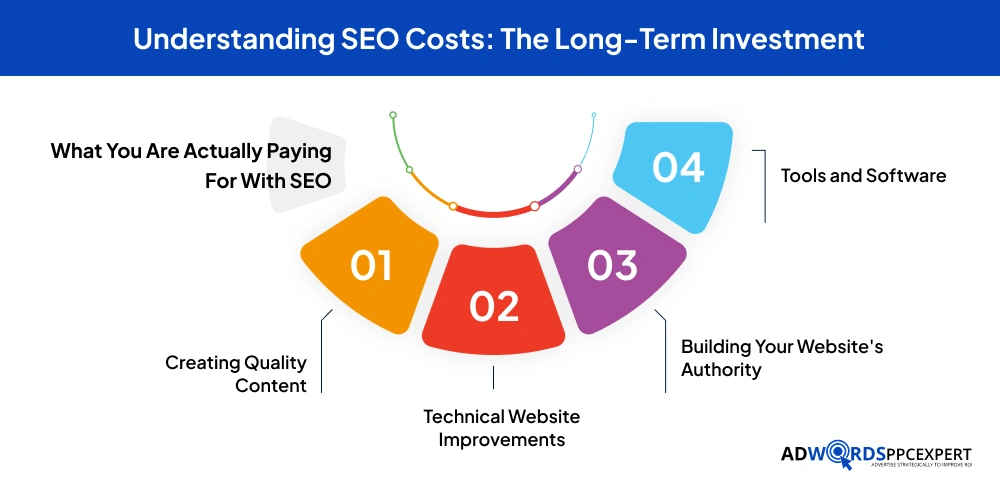
What You Are Actually Paying For With SEO
Many people mistakenly think SEO is free, but it’s not. You are investing time and resources instead of paying for clicks. Here is where the money goes:
Creating Quality Content: Your website needs helpful, informative content that answers the questions your customers are asking. Every blog post, guide, or page takes time to research, write, and publish. Whether you are paying a writer or doing it yourself, there is a real cost here.
Technical Website Improvements: Search engines need to be able to find and understand your website. This means making sure your site loads quickly, works on mobile phones, and does not have technical problems. You might need a developer or technical expert to help with this.
Building Your Website’s Authority: Google looks at how many other reputable websites link to yours. Getting these links requires creating content that people want to share, reaching out to other website owners, and building relationships. This takes consistent effort and sometimes requires hiring someone who specializes in this.
Tools and Software: Professional SEO requires access to data about how your website is performing, what keywords you should target, and what your competitors are doing. These tools typically have monthly subscription costs.
Why SEO Costs Work Differently
When doing a PPC vs SEO cost comparison, the big difference with SEO is that your investment compounds over time. The content you create this month continues working for you next month, next year, and years down the line. Once you rank well for a keyword, you keep getting traffic from it without paying for each click.
SEO vs PPC: What Is Better for Your Business?
This is the question we hear most often, and the answer depends on where your business is right now and what you are trying to accomplish.
When PPC Makes More Sense
Pay per click advertising works best when you need results quickly. Here are situations where PPC shines:
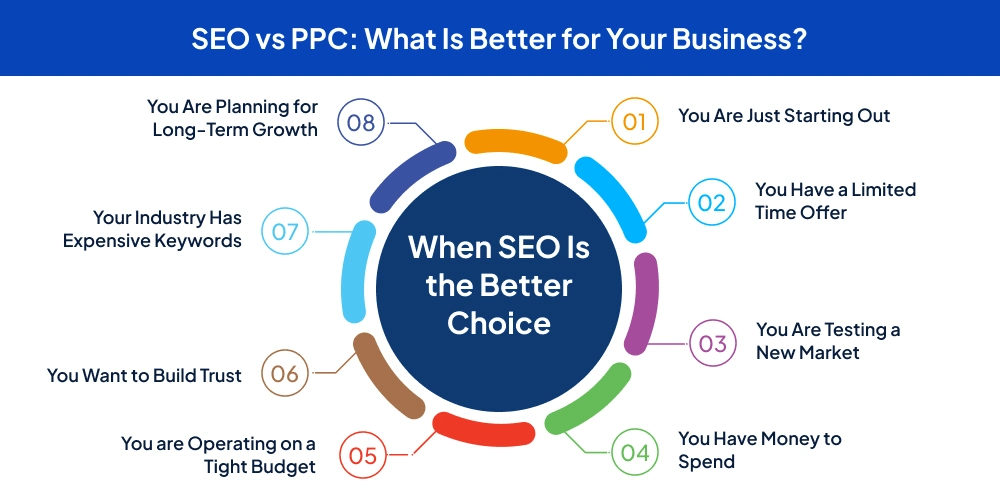
You Are Just Starting Out: New businesses often need customers right away, not in six months. PPC can start bringing people to your website within hours of launching a campaign.
You Have a Limited Time Offer: Running a sale that ends next week? Promoting a seasonal product? PPC lets you turn traffic on and off like a faucet, which is perfect for time-sensitive promotions.
You Are Testing a New Market: Before investing heavily in SEO for a new product or service, you can use PPC to quickly see if people are actually interested. Think of it as market research that also generates sales.
You Have Money to Spend: If your business has a healthy marketing budget and can afford ongoing advertising costs, PPC provides reliable, predictable traffic.
When SEO Is the Better Choice
Organic search makes more sense for businesses that can think long-term and want to build sustainable growth:
You are Operating on a Tight Budget: SEO requires investment, but it does not require the same kind of ongoing cash flow as PPC. Once you rank, you can keep getting traffic even during months when money is tight.
You Want to Build Trust: Studies show that people trust organic search results more than they trust ads. When you rank organically, it signals to potential customers that you are an authority in your field.
Your Industry Has Expensive Keywords: If you are in an industry where clicks cost a fortune, SEO becomes much more attractive. Building organic rankings might take longer, but you will save massive amounts of money over time.
You Are Planning for Long-Term Growth: If you are building a business that you plan to grow over years, not months, SEO creates a foundation that keeps getting stronger with time.
The Real PPC vs SEO Cost Comparison Over Time
Let us look at how costs actually play out over different timeframes. This part of the PPC vs SEO cost comparison is crucial for making the right decision.
Months 1-3: PPC Shows Early Results
In the first few months, the PPC vs SEO cost comparison heavily favors PPC if you need immediate results. Here is what typically happens:
With PPC, you launch campaigns and start getting visitors almost immediately. If you are spending well and your campaigns are set up correctly, you could be generating leads within the first week. However, you are paying for every single click.
With SEO, your investment is going toward creating content, fixing technical issues, and building links. You might see a trickle of traffic, but it’s not enough to write home about. Search engines are still discovering and understanding your content.
During this period, PPC delivers faster returns, which is why it works well for businesses that can not wait.
Months 4-12: SEO Starts Gaining Momentum
This is when things get interesting in the PPC vs SEO cost comparison, and the economics start to shift:
With PPC, you are still paying the same amount (or more) for each click. Your campaigns might be optimized and performing better, but the costs remain constant. To maintain the same level of traffic, you need to keep spending.
With SEO, the content you created months ago is starting to rank. You are seeing steady increases in organic traffic. The articles you published are attracting links naturally. Every month, more keywords start ranking, and traffic grows without requiring proportional increases in spending.
Years 2-3: SEO Takes the Lead
This is where the long-term cost comparison becomes crystal clear:
With PPC, you are likely paying even more than you did in year one because competition has increased and click costs have risen. To maintain your position, you need to keep investing. If you stop paying, the traffic stops instantly.
With SEO, the investment you made in years one and two is now paying massive dividends. Your content library attracts thousands of visitors monthly. You have built authority in your niche, making it easier to rank for new keywords. While you still need to maintain and expand your SEO efforts, the return on your investment is exponentially higher than in the beginning.
Breaking Down the True ROI: Which is Cheaper?
When people conduct a PPC vs SEO cost comparison and ask which is cheaper, they are often comparing the wrong things. Let us look at the real return on investment for both.
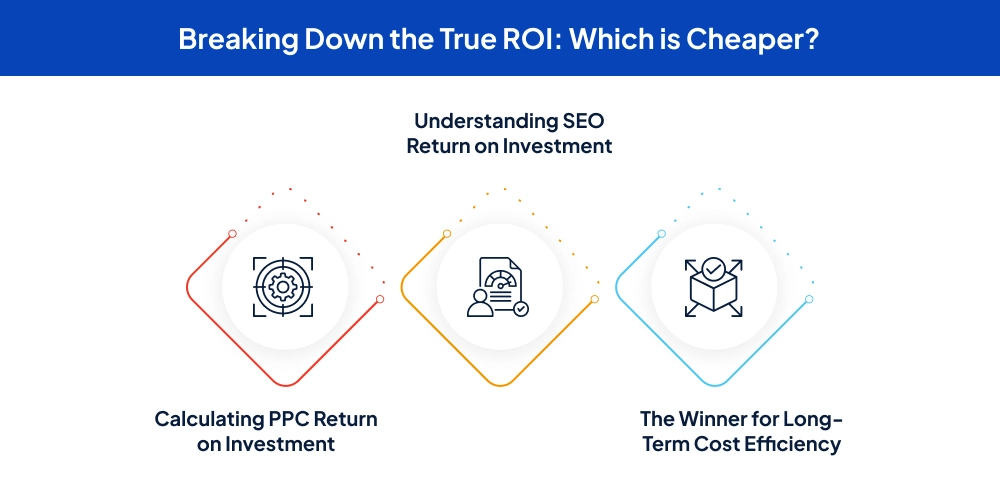
Calculating PPC Return on Investment
PPC ROI is relatively straightforward to measure. You spend a certain amount on ads, and you can track exactly how many sales or leads you got. Most businesses aim for at least breaking even, but ideally, they want to make more money than they spend.
The challenge with PPC is that your ROI tends to stay relatively flat over time. A well-managed campaign might improve gradually, but you won’t see the exponential growth that SEO can provide. You are essentially trading money for immediate traffic at a relatively consistent rate.
Understanding SEO Return on Investment
SEO ROI works completely differently. In the beginning, it might look terrible. You are spending money every month with minimal results to show for it. But here is what makes SEO special:
The traffic you earn keeps coming without ongoing per-click costs. As your website’s authority grows, it becomes easier to rank for new keywords. The content you create continues working for you indefinitely. Your ROI accelerates over time instead of staying flat.
The Google Display Network offers significantly lower Google PPC price points but attracts users at earlier stages of the buying journey, so the intent is different than search ads.
The Winner for Long-Term Cost Efficiency
For long-term cost efficiency, SEO is the clear winner in the PPC vs SEO cost comparison. While PPC can deliver better short-term ROI when you need immediate results, SEO provides increasingly better returns as time goes on. The traffic you are getting in year three from SEO represents a fraction of the cost per visitor compared to what you paid initially.
How to Combine PPC and SEO for Maximum Results
The smartest businesses conducting a PPC vs SEO cost comparison don’t choose between these channels, they use both strategically. Here is how to make them work together:
Use PPC to Test Keywords for SEO
Before investing months of work creating content around a specific keyword, run a small PPC campaign targeting that term. Within days, you will know:
- If people are actually searching for it
- Whether those searchers are interested in what you offer
- What it takes to convert them into customers
This intelligence helps you make smarter decisions about where to focus your SEO efforts.
Use SEO Content to Lower PPC Costs
When you have strong organic content on your website, it helps your PPC campaigns in several ways. Your landing pages perform better because they are optimized for conversions. Your quality scores improve because Google sees you as an authority on the topic. Higher quality scores mean lower costs per click.
Fill SEO Gaps with PPC
Even the best SEO strategy has gaps. Keywords that are too competitive to rank for quickly, or seasonal terms that are only relevant for a short time. Use PPC to cover these gaps while your organic efforts catch up.
Dominate the Search Results
When someone searches for your target keywords, would not it be great to appear both in the ads and in the organic results? Studies show that having both significantly increases the likelihood that someone will click through to your website. You are essentially doubling your presence.
Organic Traffic vs Paid Search: Quality Differences
The PPC vs SEO cost comparison is not just about cost, the quality of traffic from each source matters too.
Why Organic Traffic Often Converts Better
Studies consistently show that organic search traffic tends to convert at higher rates than paid traffic. There are a few reasons for this:
People trust organic results more than ads. When you rank organically, it suggests that you are a legitimate authority, not just someone with money to spend on advertising.
Organic visitors often have better intent. They are looking for information and solutions, not avoiding ads. They are more likely to spend time on your site and engage with your content.
The Advantages of Paid Search Traffic
That said, PPC traffic has its own benefits. With paid advertising, you have precise control over who sees your ads. You can target people based on their location, their interests, their income level, and more.
PPC also lets you show up for searches that would be impossible to rank for organically, at least in the short term. You can appear for competitive keywords immediately instead of waiting months or years.
Making the Right Choice for Your Marketing Budget
Your marketing budget determines what is possible in the PPC vs SEO cost comparison, so let us talk about realistic budget allocation.
Small Budget (Under $1,000 per month)
If you are working with a limited budget, you probably need to choose one channel and do it well rather than spreading yourself too thin.
For most small businesses in this situation, focusing primarily on SEO makes the most sense. Your limited budget will get you started building content and making technical improvements. While results will take time, you are building an asset that will serve you for years.
You might allocate a small portion to PPC for testing purposes or to cover immediate needs, but the bulk should go toward SEO.
Medium Budget ($1,000 - $5,000 per month)
With a moderate budget, you can start doing both channels effectively. A common split is putting more into SEO while using PPC strategically:
Consider putting the majority toward building your organic presence while using the rest for PPC campaigns targeting your highest-value keywords or immediate business needs.
Larger Budget (Over $5,000 per month)
With a healthy budget, you can run comprehensive campaigns on both fronts. The key is making sure they work together rather than competing for resources.
You might allocate substantial resources to building comprehensive content, authoritative backlinks, and technical excellence, while simultaneously running PPC campaigns for competitive keywords, seasonal opportunities, and retargeting engaged visitors.
Common Mistakes in the PPC vs SEO Cost Comparison
Many businesses make critical errors when conducting their PPC vs SEO cost comparison. Avoid these common pitfalls:
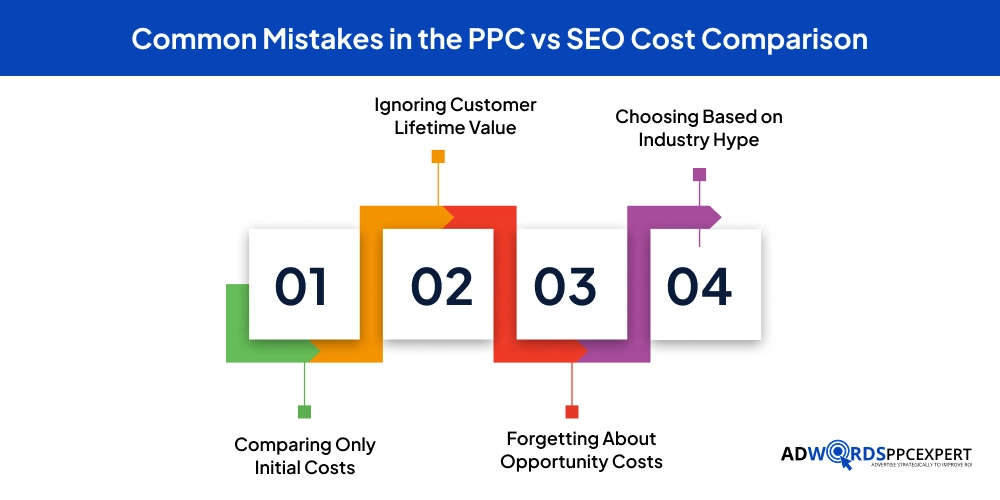
Comparing Only Initial Costs
When evaluating the PPC vs SEO cost comparison, looking at just the first few months of costs gives you a completely misleading picture. SEO costs look high when you have not seen results yet, while PPC looks efficient because it’s delivering immediate traffic. You need to project costs and returns over at least a year, ideally longer.
Ignoring Customer Lifetime Value
Not all customers are equal. If customers acquired through organic search tend to stay with your business longer or spend more over time, that dramatically changes the economics. Factor in the full lifetime value, not just the initial sale.
Forgetting About Opportunity Costs
When you invest in SEO, you are accepting that results will take time. For some businesses, that delayed gratification represents a real opportunity cost. Money you could have made if you would used PPC instead. Be honest about whether your business can afford to wait.
Choosing Based on Industry Hype
Just because someone in your industry swears by PPC doesn’t mean it’s right for your specific situation. Similarly, SEO success stories might not apply to your circumstances. Make decisions based on your goals, timeline, and resources.
Which Strategy Wins for Different Business Types?
Let us get specific about which approach makes sense for different types of businesses based on the PPC vs SEO cost comparison.
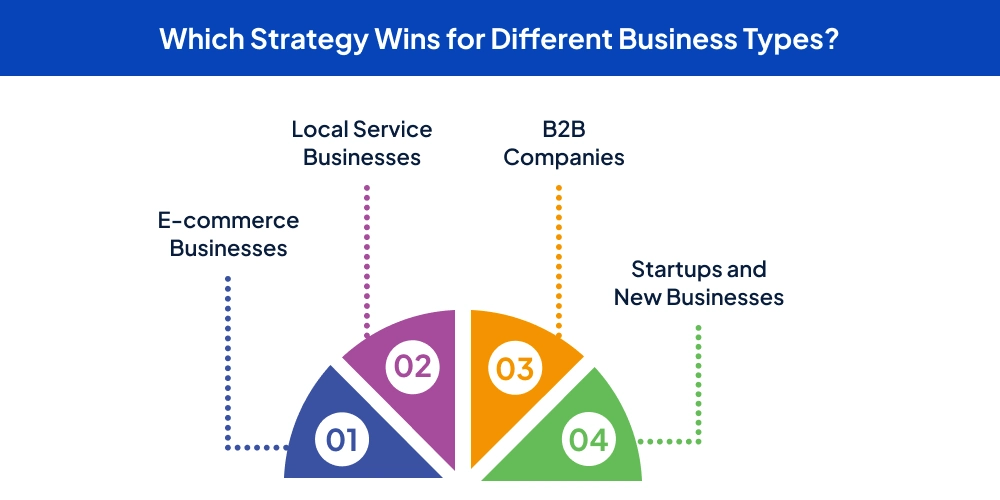
E-commerce Businesses
Online stores often benefit from a hybrid approach. Use PPC for:
- New product launches
- High-margin items where advertising costs make sense
- Seasonal products and holiday promotions
- Retargeting people who abandoned their carts
Meanwhile, invest in SEO for:
- Product category pages
- Buying guides and comparison content
- Your unique or signature products
- Building long-term brand authority
Local Service Businesses
Plumbers, electricians, lawyers, and other local service providers face unique considerations. The cost comparison for local businesses often favors a balanced approach:
Use PPC when you have immediate capacity and need to fill your calendar quickly. Local PPC can be relatively affordable and highly effective.
Invest in SEO to build long-term dominance in your local area. Once you rank well locally, you get a steady stream of leads without ongoing advertising costs.
B2B Companies
Business-to-business companies with longer sales cycles should typically lean more heavily toward SEO. Here is why:
B2B buyers do extensive research before making decisions. They are looking for educational content, not ads. Having a library of helpful content positions you as an expert.
The lifetime value of B2B customers is typically high, which justifies the longer timeline of SEO. A client you acquire through organic search could be worth tens or hundreds of thousands of dollars.
However, PPC still has a role for:
- Reaching decision-makers with specific titles or at specific companies
- Promoting events, webinars, or special offers
- Retargeting engaged prospects
Startups and New Businesses
New businesses face a chicken-and-egg problem. You need customers to have money for marketing, but you need marketing to get customers. Here is a practical approach:
Start with a small PPC budget to generate immediate revenue and validate your market. Use this to fund operations while simultaneously beginning your SEO efforts.
As organic traffic grows, gradually shift more budget toward SEO while maintaining PPC for strategic keywords and immediate needs.
The Future: How AI and Automation Are Changing This Comparison
The digital marketing landscape is evolving, and that affects the PPC vs SEO cost comparison:
Changes in Paid Advertising
Automation and AI are making PPC more efficient in some ways. Platforms like Google Ads use machine learning to optimize bids and targeting automatically. This means you can potentially get better results with less hands-on management.
However, it also means competition is getting more sophisticated, which can drive up costs. Everyone has access to the same automation tools.
Evolution of Organic Search
Google’s search results are changing dramatically. AI-powered features are giving people answers directly in search results, sometimes without them needing to click through to any website. This means SEO strategies need to evolve.
The good news is that high-quality, comprehensive content is more valuable than ever. Google’s AI needs to pull information from somewhere, and authoritative websites become the source.
Your Action Plan
Based on everything we have covered about the PPC vs SEO cost comparison, here is how to move forward with your decision:
Step 1: Define Your Timeline
Be honest about when you need results. If you need customers next week, you need PPC. If you can invest in results in six months, SEO becomes viable.
Step 2: Assess Your Budget Realistically
Don’t just look at what you can spend this month. Consider what you can commit to for at least six months to a year. Stopping and starting either strategy wastes money.
Step 3: Understand Your Industry
Research typical costs in your industry for both channels. Some industries have astronomical PPC costs that make SEO much more attractive. Others have less competitive organic search, where SEO results come faster.
Step 4: Start Small and Test
You don’t have to commit all your resources immediately. Start with a small budget on one or both channels, track your results carefully, and scale what works.
Step 5: Plan for the Long Term
Even if you start with PPC for immediate needs, begin planning your SEO strategy. The sooner you start building your organic presence, the sooner you will see returns.
Measuring Success: Metrics That Matter
Whether you choose PPC, SEO, or both, tracking the right metrics helps you know if you are getting good value.
Essential PPC Metrics
- Cost Per Click: How much you are paying for each visitor
- Conversion Rate: What percentage of clicks turn into customers
- Cost Per Acquisition: How much you spend to get one customer
- Return on Ad Spend: How many dollars you make for each dollar spent
If your cost per acquisition is higher than your customer lifetime value, you have a problem.
Critical SEO Metrics
- Organic Traffic Growth: Are you getting more visitors from search engines over time?
- Keyword Rankings: Are you moving up for your target search terms?
- Conversion Rate: Do organic visitors turn into customers?
- Cost Per Lead from Organic: Your total SEO investment divided by leads generated
Remember that SEO metrics should improve over time. If they are not, you need to adjust your strategy.
The Bottom Line
After examining both channels thoroughly in this PPC vs SEO cost comparison, it is clear that for long-term cost efficiency and sustainable growth, SEO wins. The numbers don’t lie, while you pay for PPC traffic forever, SEO traffic keeps flowing after your initial investment. Your cost per customer drops dramatically over time with SEO, while PPC costs typically increase as competition grows.
However, that doesn’t mean you should ignore PPC. The immediate results, precise targeting, and market testing capabilities of paid search make it invaluable for many business situations. The smartest approach? Use both strategically:
- Start with PPC for immediate revenue while building your SEO foundation
- Use PPC to test keywords before investing heavily in SEO content
- Let SEO handle your core traffic while PPC covers competitive gaps
- Retarget organic visitors with PPC to maximize conversions
Whether you invest heavily in pay per click advertising, focus on building organic search traffic, or use a combination of both after evaluating the PPC vs SEO cost comparison, the key is starting with a clear strategy. Don’t let analysis paralysis stop you from taking action. Choose a path, track your metrics, and adjust as you go.
Need expert help exploring the digital marketing strategy that fits your business the best? At AdWords PPC Expert, we specialize in helping businesses maximize their ROI while building sustainable organic growth. The businesses that thrive online are not the ones that picked the “right” channel, they are the ones that made strategic decisions based on data and executed consistently over time.
Remember:
This cost comparison is not just about which is cheaper today. It is about which delivers better value for your business over the timeframe that matters to you. PPC is renting visibility, whereas SEO is building equity. Both have their place in a smart digital marketing strategy. The key is knowing when and how to use each one.

Ami Singh is a highly skilled AdWords PPC Specialist, known for creating profitable Google Ads strategies that elevate brands. With deep expertise in Google Search, Display, Shopping, YouTube Ads, and advanced bidding techniques, Ami consistently converts data into performance-driven results.
With a sharp analytical mind and a strong understanding of online consumer behavior, Ami designs campaigns that maximize ROI, boost quality scores, and reduce acquisition costs. His approach blends technical expertise with strategic thinking—making him a go-to expert for businesses aiming to dominate Google Ads.
Ami doesn’t just adapt to the fast-changing PPC industry, but he also stays ahead of the curve by testing new features, adopting automation smartly, and refining what works. Clients trust him for his transparency, insights, and ability to scale campaigns sustainably.
Looking to take your Google AdWords performance to the next level? Connect with Ami Singh at Softtrix and discover how he can help you get the maximum growth through powerful PPC strategies.