
Paid advertising has entered a new phase. The systems that decide which ads appear, how much they cost, and who sees them have evolved faster than most advertisers realize. Strategies that once delivered predictable results are now producing inconsistent outcomes, not because PPC no longer works, but because the rules governing performance have changed.
Understanding modern PPC trends means understanding how ad platforms think today. Algorithms prioritize intent over keywords, signals over settings, and data quality over manual control. Campaign success is now shaped by automation, creative relevance, and how well advertisers align with machine-driven decision-making.
This ultimate guide here explores the most important PPC trends redefining how ads perform today, not at a surface level, but at a strategic one. Each section explains why the trend exists, how it directly impacts performance, and what advertisers must do to adapt.
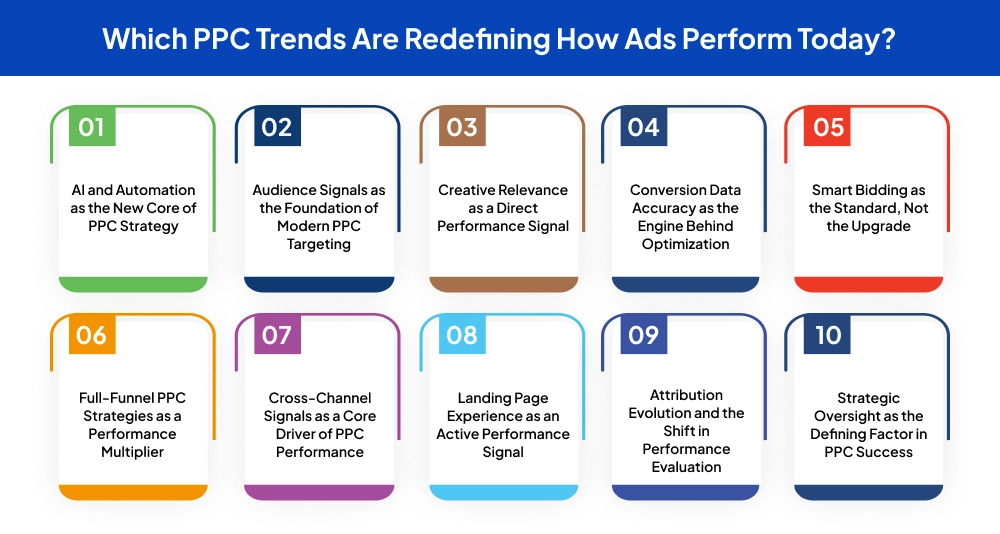
1. AI and Automation as the New Core of PPC Strategy
Artificial intelligence is no longer an add-on to paid advertising platforms. It has become the engine that drives nearly every major performance decision. From bidding and targeting to creative rotation and budget allocation, AI influences outcomes at every stage of a PPC campaign.
Why AI Has Become Central to PPC Performance
Ad platforms process billions of searches, impressions, and interactions every day. No human-led system can analyze this volume of data in real time. AI enables platforms and an AI ad maker to evaluate countless intent signals instantly, determining which ad has the highest probability of converting in a specific auction.
These systems assess factors such as search context, user behavior patterns, device usage, location, time sensitivity, and historical engagement. Instead of reacting after performance drops, AI optimizes proactively, adjusting delivery before inefficiencies occur.
Automation Beyond Bidding
Early automation focused mainly on bid adjustments. Today, automation controls entire campaign ecosystems. Formats like Performance Max and Demand Gen distribute ads across multiple placements, dynamically choosing where, when, and how ads appear.
The role of the advertiser has shifted from micromanaging settings to defining strategy, supplying quality inputs, and ensuring conversion data accuracy.
Key takeaway: PPC success now depends on understanding how to guide automation rather than override it.
2. Audience Signals as the Foundation of Modern PPC Targeting
Audience targeting in PPC has undergone a fundamental transformation. While keywords still play an important role, they no longer operate as the primary driver of performance on their own. Instead, platforms are placing greater emphasis on audience signals to determine relevance, intent, and delivery efficiency.
This shift reflects how users interact with search engines and platforms today. People rarely search in perfectly structured keyword phrases anymore. They explore, refine, compare, and return across devices and sessions. As a result, PPC platforms have adapted to focus less on literal keyword matching and more on understanding the person behind the search.
Why Audience Signals Matter More Than Keywords Today
Modern PPC systems are designed to interpret intent, not just queries. When a user searches, platforms evaluate a wide range of contextual signals beyond the keyword itself. These include prior search behavior, browsing history, engagement with similar ads, demographic indicators, device usage, and even recent purchasing patterns.
Broad match keywords paired with smart bidding allow platforms to connect these signals and surface ads for searches that may not contain exact keyword phrasing but still indicate strong commercial intent. This explains why tightly restricted keyword strategies often struggle to scale in today’s environment.
The Growing Importance of First-Party and Behavioral Data
First-party data has become one of the most valuable assets in PPC. Website visitors, previous converters, CRM uploads, and engaged users provide platforms with clear indicators of high-quality traffic. These signals allow algorithms to find similar users who demonstrate comparable behaviors, even if their search terms differ.
As third-party cookies fade and privacy regulations increase, advertisers who invest in clean, consent-based first-party data gain more stable and predictable performance over time.
Key takeaway: PPC targeting now succeeds by understanding users, not just managing keywords. Campaigns built around audience signals adapt faster and perform more consistently.
3. Creative Relevance as a Direct Performance Signal
Creative quality is no longer a secondary consideration in PPC services. It has become a direct input into how platforms evaluate ad relevance and decide which ads receive priority placement. In many cases, creative performance now has as much influence on results as bidding strategy or targeting configuration.
This change reflects platform incentives. Advertising systems are designed to maximize user engagement. Ads that resonate with users generate better experiences, which platforms reward with lower costs and broader reach.
How Creative Impacts Algorithmic Confidence
When users interact positively with ads, by clicking, watching videos, scrolling through carousels, or engaging with extensions, platforms interpret this behavior as a signal of relevance. These engagement metrics feed directly into learning models that influence future ad delivery.
Low engagement tells the opposite story. Even with strong bids and accurate targeting, ads that fail to connect with users lose visibility over time as platforms deprioritize them in favor of higher-performing creatives.
Asset Variety and Machine Learning Optimization
Modern ad formats rely heavily on asset-level testing. Responsive search ads, Performance Max creatives, and social ad formats continuously mix and match headlines, descriptions, images, and videos to identify winning combinations.
Advertisers who supply limited or repetitive creative assets restrict the system’s ability to learn. In contrast, campaigns with diverse messaging angles, value propositions, and visual styles allow algorithms to optimize more effectively across audiences and placements.
Key takeaway: Creative relevance directly influences PPC efficiency. Strong messaging and asset diversity give platforms the signals they need to scale performance.
4. Conversion Data Accuracy as the Engine Behind Optimization
Modern PPC platforms do not optimize based on assumptions. They optimize based on data. One of the most influential PPC trends redefining ad performance today is how deeply campaign success depends on the accuracy and reliability of conversion tracking.
In an automated environment, conversion data is not just a reporting metric. It is the feedback loop that teaches algorithms what success looks like. When that feedback is incomplete or inaccurate, optimization breaks down at every level.
Why Conversion Data Quality Directly Impacts Performance
Automated bidding systems learn by analyzing which clicks lead to meaningful actions. If conversions are misconfigured, duplicated, or missing, the system begins optimizing toward the wrong behaviors. This can result in increased spend on low-quality traffic, unstable cost-per-acquisition trends, and inconsistent performance across campaigns.
Accurate conversion tracking allows platforms to distinguish between high-intent users and casual browsers. Over time, this leads to smarter budget allocation, improved efficiency, and stronger scalability.
Adapting Conversion Tracking to a Privacy-First Environment
Privacy regulations and browser changes have reduced traditional tracking reliability. In response, advertisers are adopting enhanced conversions, first-party tracking solutions, and server-side data collection. These methods allow platforms to receive more complete conversion signals without compromising user privacy.
Advertisers who proactively adapt to these changes maintain stronger optimization stability compared to those relying on outdated tracking setups.
Key takeaway: PPC automation is only as smart as the data it receives. Clean, reliable conversion tracking is foundational to performance.
5. Smart Bidding as the Standard, Not the Upgrade
Manual bidding once gave advertisers a sense of control. Today, it often limits performance. One of the most defining PPC trends is the widespread shift toward smart bidding as the default approach to auction management.
Smart bidding systems evaluate each individual auction in real time, something manual strategies simply cannot replicate.
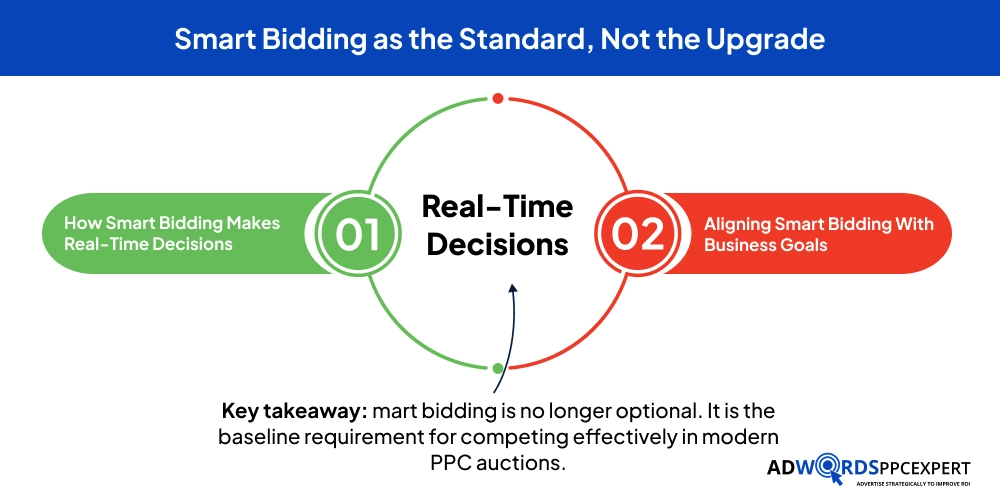
How Smart Bidding Makes Real-Time Decisions
Rather than relying on average performance metrics, smart bidding assesses the likelihood of conversion for every impression. It considers factors such as device type, location, time of day, user behavior, and contextual intent before adjusting bids dynamically.
This allows platforms to bid aggressively when conversion probability is high and pull back when it is low, maximizing efficiency across thousands of micro-auctions.
Aligning Smart Bidding With Business Goals
The effectiveness of smart bidding depends on choosing strategies aligned with campaign objectives. Lead generation campaigns often perform best with CPA-focused bidding, while ecommerce Services benefit from ROAS-driven strategies that prioritize revenue quality over volume.
Providing clear goals and sufficient conversion volume allows these systems to stabilize faster and deliver consistent results.
Key takeaway: Smart bidding is no longer optional. It is the baseline requirement for competing effectively in modern PPC auctions.
6. Full-Funnel PPC Strategies as a Performance Multiplier
PPC is no longer limited to capturing demand at the moment of purchase. One of the most impactful PPC trends is the integration of full-funnel strategies that influence users long before they are ready to convert.
This shift reflects how buying decisions actually happen today. Users research, compare, and revisit brands multiple times before taking action.
The Role of Upper-Funnel Campaigns
Upper-funnel campaigns, such as video and discovery ads, introduce brands to new audiences and shape perception early in the decision process. These touchpoints often increase branded search volume and improve performance in lower-funnel campaigns.
Advertisers who ignore the upper funnel often see rising acquisition costs as they compete only for bottom-funnel traffic.
Aligning Messaging Across the Funnel
Effective full-funnel PPC strategies tailor messaging to intent stage. Educational content builds awareness, value-driven messaging supports consideration, and urgency-based messaging drives conversions. Consistency across stages builds trust and improves overall efficiency.
Key takeaway: PPC performs best when campaigns support the entire customer journey, not just the final click.
7. Cross-Channel Signals as a Core Driver of PPC Performance
PPC campaigns no longer operate in isolation, even when advertisers manage them that way. One of the most quietly powerful changes in paid advertising is how platforms now interpret user behavior across channels before deciding how ads are delivered. Search, social, display, and video activities all contribute to how platforms assess intent and relevance.
This shift exists because user journeys are no longer linear. People interact with brands repeatedly across different platforms before converting, and PPC systems have adapted to reflect that reality.
Why PPC Platforms Now Look Beyond a Single Channel
When a user watches a video ad, engages with a social post, or visits a website organically, those interactions create behavioral signals. Even if a conversion eventually happens through a paid search click, platforms recognize that the intent was built over time, not in a single moment.
Modern PPC systems evaluate these interactions collectively. A user who has previously engaged with brand content is often considered higher intent, even if their final search query appears generic. As a result, ads are more likely to be shown to users who have already demonstrated familiarity or interest across channels.
How Cross-Channel Exposure Improves PPC Efficiency
Cross-channel visibility reduces friction. When users recognize a brand in search results because they have seen it elsewhere, click-through rates increase and conversion resistance decreases. Platforms reward this behavior because it leads to better user experiences.
Advertisers who invest in multiple channels often see improved performance in core PPC campaigns, not because budgets are larger, but because intent signals are stronger.
Key takeaway: PPC performance improves when campaigns are designed as part of a broader ecosystem, not treated as isolated traffic sources.
8. Landing Page Experience as an Active Performance Signal
Landing pages are no longer neutral destinations that simply host conversions. They are now evaluated as part of the PPC system itself. One of the most underestimated PPC trends is how strongly post-click behavior influences ad delivery and cost efficiency. Platforms do not stop learning once a user clicks. They observe what happens next.
Why Post-Click Behavior Matters to Ad Platforms
When users land on a page and immediately leave, struggle to navigate, or abandon forms, platforms interpret this behavior as a mismatch between ad promise and user experience. High bounce rates, low engagement, and poor mobile usability reduce algorithm confidence.
On the other hand, pages that load quickly, present clear information, and guide users smoothly toward action reinforce relevance signals. Over time, this can lead to lower costs and improved impression share.
Message Consistency and Conversion Clarity
Landing pages must deliver exactly what the ad promises. Inconsistent messaging creates doubt and reduces trust. Clear headlines, focused layouts, and direct calls to action reduce friction and improve conversion rates.
This alignment helps platforms confirm that the ad experience meets user expectations from click to conversion.
Key takeaway: Landing pages are an extension of your ads. A strong post-click experience strengthens performance at the auction level.
9. Attribution Evolution and the Shift in Performance Evaluation
How advertisers measure success has changed dramatically. One of the most important PPC trends redefining decision-making is the move away from last-click attribution toward more realistic performance models. This shift exists because last-click metrics no longer reflect how people actually buy.
Why Last-Click Attribution Distorts PPC Strategy
Most users interact with multiple ads before converting. They may see a display ad, watch a video, click a social post, and then perform a branded search days later. Last-click attribution assigns all credit to the final interaction, ignoring everything that influenced the decision beforehand.
This leads advertisers to undervalue awareness and consideration campaigns, even though those efforts drive demand.
How Data-Driven Attribution Changes Optimization
Modern platforms use machine learning to analyze conversion paths and distribute credit across touchpoints. This provides a clearer understanding of how campaigns work together rather than competing for credit.
Advertisers who embrace this model make better budget decisions and avoid cutting campaigns that contribute indirectly to conversions.
Key takeaway: Better attribution does not just improve reporting, it changes how PPC strategies are built and scaled.
10. Strategic Oversight as the Defining Factor in PPC Success
As automation takes over execution, the role of human expertise has evolved rather than disappeared. One of the most defining PPC trends today is the shift from tactical control to strategic oversight.
The tools now execute faster than humans ever could. The advantage lies in knowing what to direct them toward.
How the Role of PPC Management Has Changed
Modern PPC professionals focus less on bid changes and more on defining success metrics, shaping creative direction, ensuring data accuracy, and aligning campaigns with business objectives. Strategy now determines outcomes more than settings. Poor strategy leads to poor automation results, regardless of platform sophistication.
Balancing Automation With Human Judgment
Automation excels at pattern recognition and speed but lacks context. Human insight ensures campaigns align with brand positioning, market realities, and long-term growth goals.
Advertisers who understand this balance outperform those who either over-control or blindly trust automation.
Key takeaway: In an automated PPC environment, strategy is the real competitive edge.
Your Strategic PPC Checklist For What To Do Next
Knowing which PPC trends are reshaping ad performance is one thing, but knowing how to act on them is what drives results. This checklist is designed to turn insights into action, ensuring your campaigns not only follow trends but also utilize them strategically for growth.
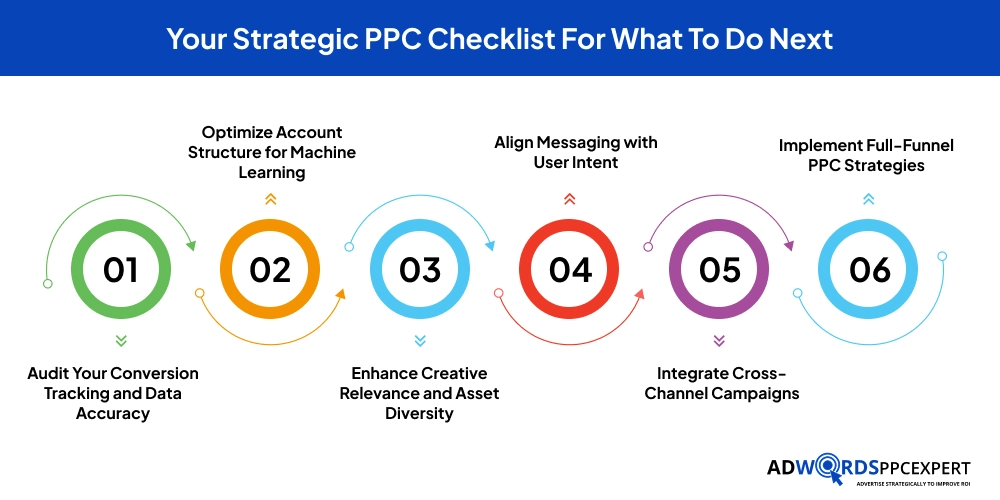
1. Audit Your Conversion Tracking and Data Accuracy
The foundation of any successful PPC campaign is clean, reliable conversion data. Without it, automation and smart bidding operate on incomplete signals, leading to wasted spend and suboptimal performance.
Action Steps:
- Review all conversion events across platforms to ensure proper firing and accurate attribution.
- Implement enhanced conversions, first-party tracking, or server-side setups to address privacy changes.
- Remove low-value or irrelevant actions that could confuse optimization algorithms.
Why it matters: Accurate conversion data ensures that machine learning can identify high-quality traffic and optimize bids effectively, rather than chasing misleading signals.
2. Optimize Account Structure for Machine Learning
Traditional hyper-segmented campaigns often limit algorithm learning. Modern PPC requires account structures that consolidate data while providing clear signals for automation to act on.
Action Steps:
- Group campaigns and ad groups by meaningful objectives rather than individual keywords alone.
- Ensure each campaign has sufficient conversion volume to feed algorithms effectively.
- Align campaigns with clear, measurable goals like CPA or ROAS.
Why it matters: Simplified, goal-aligned structures allow AI-driven systems to learn faster and make better predictions, improving performance across all campaigns.
3. Enhance Creative Relevance and Asset Diversity
Creatives are no longer cosmetic, but rather a performance signal. Ads that resonate with users receive higher engagement, lower costs, and more impression share.
Action Steps:
- Supply multiple headlines, descriptions, and visuals for responsive ad formats.
- Test different messaging angles, value propositions, and calls to action.
- Monitor engagement metrics and iterate on underperforming creatives.
Why it matters: Platforms prioritize ads that drive strong user interaction. Diverse, high-quality creative gives algorithms the material needed to maximize conversions.
4. Align Messaging with User Intent
Understanding where users are in the buying journey allows you to match messaging to their mindset, improving click quality and conversion likelihood.
Action Steps:
- Segment audiences by funnel stage: awareness, consideration, and conversion.
- Tailor ad copy and visuals to the needs and motivations of each segment.
- Review search query reports to ensure your messaging aligns with actual user intent.
Why it matters: Intent-driven messaging reduces wasted spend, improves conversion rates, and provides cleaner signals for automated systems to optimize.
5. Integrate Cross-Channel Campaigns
Single-channel campaigns are less effective today. User behavior spans search, social, display, and video. Coordinating these channels maximizes performance by reinforcing engagement across touchpoints.
Action Steps:
- Map the customer journey across channels and ensure consistent branding and messaging.
- Use remarketing audiences to capture users who interacted with other channels.
- Monitor cross-channel performance to identify patterns that drive conversions.
Why it matters: Cross-channel exposure strengthens user familiarity, improves engagement, and gives algorithms richer signals to optimize ad delivery.
6. Implement Full-Funnel PPC Strategies
Focusing only on the bottom-of-funnel misses opportunities to nurture and educate prospects. Full-funnel campaigns build awareness, consideration, and conversion pathways.
Action Steps:
- Launch upper-funnel campaigns with video, display, or discovery formats.
- Link messaging from upper to lower funnel campaigns to maintain consistency.
- Measure how upper-funnel activity influences lower-funnel conversions.
Why it matters: A full-funnel approach ensures long-term campaign efficiency, reduces acquisition costs, and creates sustainable growth.
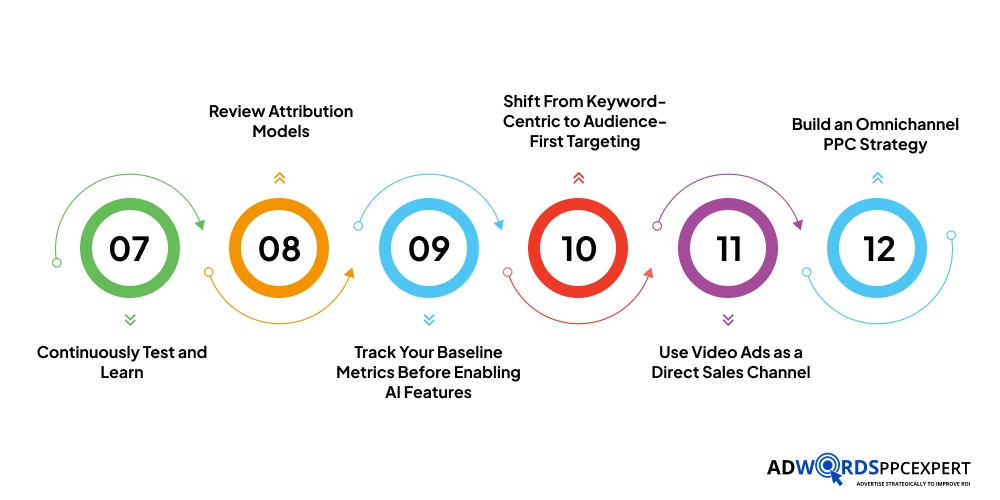
7. Continuously Test and Learn
Testing is not optional in a machine-learning environment, rather it is essential to enable algorithmic learning. Without testing, campaigns stagnate, and performance plateaus.
Action Steps:
- Run multivariate tests on creatives, audiences, and ad formats.
- Keep campaigns stable during tests to avoid disrupting learning.
- Analyze performance results before making structural changes.
Why it matters: Effective testing accelerates optimization, uncovers new high-performing combinations, and allows automation to work at peak efficiency.
8. Review Attribution Models
Accurate attribution ensures you understand which campaigns and touchpoints truly drive conversions. Moving beyond last-click attribution gives you the insights needed to allocate budgets strategically.
Action Steps:
- Shift to data-driven or multi-touch attribution models where possible.
- Analyze the full path to conversion to identify assisting campaigns.
- Adjust budgets to reflect true contribution rather than just last-click results.
Why it matters: Proper attribution prevents underinvestment in valuable campaigns and ensures your strategy aligns with actual user behavior.
9. Track Your Baseline Metrics Before Enabling AI Features
Before deploying AI-driven campaigns, it is critical to understand your starting point. Baseline metrics provide context, allowing you to measure real improvement and detect issues early.
Action Steps:
- Record key performance indicators (KPIs) like CTR, CPA, conversion rate, and ROAS.
- Start with free built-in platform tools before investing in third-party paid platforms.
- Audit your conversion tracking to ensure data quality.
- If using Google properties, set up Performance Max campaigns to unify Search, Display, Shopping, and YouTube placements.
Why it matters: Establishing a baseline ensures AI-driven automation can be evaluated accurately, allowing you to optimize with confidence.
10. Shift From Keyword-Centric to Audience-First Targeting
Keywords alone no longer define targeting. Modern campaigns prioritize who sees your ads in addition to what they are searching for.
Example: An outdoor recreation shop may use broad keywords like “best tents for camping” combined with in-market or Customer Match audiences. This approach prioritizes high-intent shoppers, not casual browsers.
Action Steps:
- Add in-market audiences to top-performing campaigns.
- Create Customer Match audiences from your CRM.
- Test broad match keywords combined with audience layers.
- Remarketing to behavioral audience segments.
- Review performance monthly and shift budgets accordingly.
Why it matters: Audience-first targeting ensures your ad spend reaches users most likely to convert, not just those using specific search terms.
11. Use Video Ads as a Direct Sales Channel
Video is no longer just for awareness. Platforms like TikTok, Instagram Ads, and YouTube Shorts now allow integrated purchases directly from ads.
Action Steps:
- Select the platform most aligned with your audience.
- Hook viewers in the first 3 seconds.
- Design videos for sound-off viewing.
- Keep ads short (15–30 seconds) with clear calls to action.
Why it matters: Short-form video with transactional elements can drive immediate conversions, making it a valuable part of the funnel.
12. Build an Omnichannel PPC Strategy
Diversifying campaigns across search, social, and retail media reduces dependence on a single platform and reaches customers at multiple stages of the journey.
Action Steps:
- Set up cross-channel tracking in GA4.
- Use Performance Max to unify Google channels.
- Add retail media campaigns on platforms like Amazon, Walmart, or Target if relevant.
- Track performance monthly and optimize based on results.
Why it matters: Omnichannel strategies increase visibility, reduce risk from platform-specific algorithm changes, and capture buyers throughout their journey.
How to Avoid Misapplying PPC Trends in Your Campaigns
Following PPC trends can dramatically improve campaign performance, but misinterpreting them is a common source of wasted spend and missed opportunities. Many advertisers fall into patterns of overconfidence, misapplication, or assumption, which undermine the very advantages trends are meant to provide.
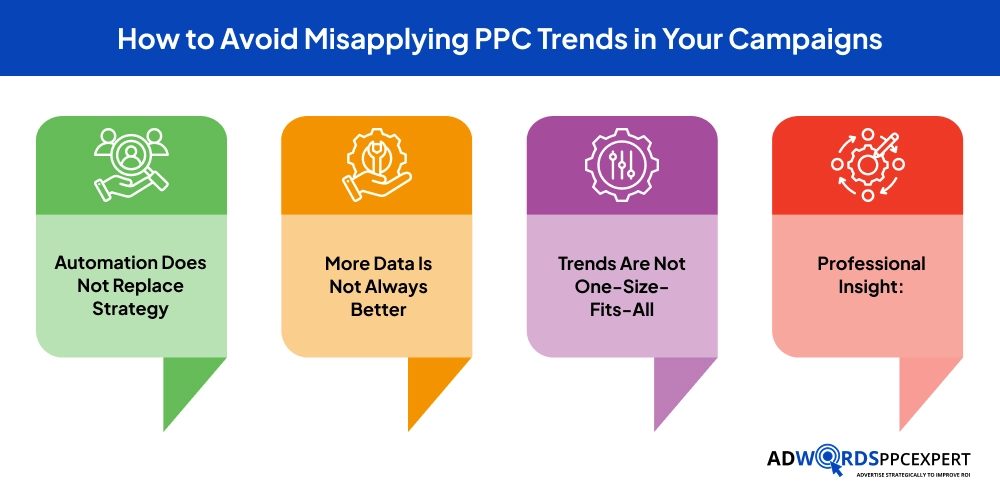
Automation Does Not Replace Strategy
A frequent mistake is assuming that automated bidding, campaign setups, or audience targeting eliminates the need for human oversight. Automation is powerful, but without strategic guidance, it often magnifies inefficiencies rather than solving them. Many campaigns fail simply because goals are unclear, data is incomplete, or automated decisions are left unchecked.
More Data Is Not Always Better
Collecting every possible conversion signal or micro-action does not guarantee improved results. In fact, too much low-value data can confuse optimization algorithms. High-quality, meaningful signals are far more impactful than an abundance of irrelevant metrics. Focusing on actionable data allows machine learning to operate with clarity and efficiency.
Trends Are Not One-Size-Fits-All
PPC trends are insights, not rules. What drives success in one industry or campaign type may fail in another. Blindly copying tactics from competitors without testing or contextual adaptation can result in wasted budgets and underperformance. Each trend must be interpreted through the lens of your unique business objectives, audience behavior, and platform nuances.
Professional Insight:
The most successful advertisers treat trends as guides, not prescriptions. They combine awareness of emerging practices with strategic judgment, rigorous testing, and continuous oversight. Avoiding misapplication is just as critical as adopting the trend itself, sometimes more so.
Wrapping Up
Ready to turn these PPC trends into real results? Start by auditing your campaigns, testing audience-first strategies, and leveraging AI-driven automation while keeping creative relevance, conversion tracking, and data accuracy top of mind. The advertisers who succeed are those who act strategically, continuously learn, and adapt to the evolving PPC landscape rather than reacting passively.
Modern PPC is no longer just about clicks and impressions. It is about understanding how platforms interpret signals, how users interact across channels, and how AI can amplify well-structured campaigns. Implementing trends without strategy or oversight may yield inconsistent outcomes, but when combined with thoughtful execution, these trends become powerful levers for growth.
For businesses looking to implement these strategies effectively and maximize ROI, AdwordsPPCExpert offers guidance, insights, and hands-on support to ensure your campaigns stay ahead of the curve. From setting up AI-powered campaigns to optimizing creative, tracking conversions accurately, and designing full-funnel strategies, their team helps turn complex PPC insights into actionable results.
Don’t just follow trends, understand them, apply them strategically, and use them to outperform your competition. By prioritizing data-driven decisions, nurturing high-value audiences, and integrating cross-channel insights, your campaigns can achieve consistent growth, higher efficiency, and stronger returns in 2026 and beyond.
Frequently Asked Questions (FAQs)
1. What are the most important PPC trends to watch in 2026?
The key PPC trends include AI and automation, audience-first targeting, creative relevance, full-funnel strategies, cross-channel signals, first-party data usage, video ads as a sales channel, and smarter attribution models. Staying on top of these trends ensures campaigns remain competitive and efficient.
2. How does AI improve PPC campaign performance?
AI evaluates massive datasets in real time, identifying high-intent users, optimizing bids, and distributing ads across placements. It allows campaigns to adapt proactively to changing behavior, maximizing conversions and reducing wasted spend.
3. Why is audience-first targeting more effective than keyword-only strategies?
Modern platforms prioritize understanding user intent over literal keyword matches. Audience-first targeting leverages demographics, behavior signals, and first-party data to reach high-value users even if they are not using exact keywords, improving both efficiency and ROI.
4. How can creative relevance impact ad performance?
Platforms treat ad creatives as performance signals. High-quality, engaging creatives improve user interaction, reduce costs, and increase visibility, while poor or repetitive creatives can limit reach and hinder algorithmic learning.
5. Are smart bidding strategies always better than manual bidding?
Yes, in most modern campaigns. Smart bidding uses real-time data to adjust bids per auction, maximizing efficiency and conversions. Manual bidding can limit performance because it cannot react at scale to every auction opportunity.

Ami Singh is a highly skilled AdWords PPC Specialist, known for creating profitable Google Ads strategies that elevate brands. With deep expertise in Google Search, Display, Shopping, YouTube Ads, and advanced bidding techniques, Ami consistently converts data into performance-driven results.
With a sharp analytical mind and a strong understanding of online consumer behavior, Ami designs campaigns that maximize ROI, boost quality scores, and reduce acquisition costs. His approach blends technical expertise with strategic thinking—making him a go-to expert for businesses aiming to dominate Google Ads.
Ami doesn’t just adapt to the fast-changing PPC industry, but he also stays ahead of the curve by testing new features, adopting automation smartly, and refining what works. Clients trust him for his transparency, insights, and ability to scale campaigns sustainably.
Looking to take your Google AdWords performance to the next level? Connect with Ami Singh at Softtrix and discover how he can help you get the maximum growth through powerful PPC strategies.