
Have you ever looked at your Google Ads dashboard and thought, ” We are spending a decent amount here, so why do the results feel so unpredictable?” Some months are great. Others are a mystery. The budget goes out the door, but the leads, the sales, the revenue, they just do not follow at the same pace. If that sounds familiar, you are not dealing with a platform problem. You are dealing with a planning problem.
Most businesses that struggle with PPC are not doing anything obviously wrong. They are picking keywords, writing ads, setting bids. But they are doing all of it without a structured strategy connecting those decisions to their actual business goals. And that gap between running ads and running a real paid advertising strategy is exactly where budget quietly disappears.
A PPC growth blueprint changes that. It is a documented, end-to-end strategy that ties every campaign decision, from which keywords you target to how you write your ads to how you measure success, back to what your business actually needs to grow. When everything in your account is aligned and working together, PPC stops feeling like a gamble and starts working like a system.
This guide walks you through how to build that system from the ground up. Every section covers a real, practical layer of a high-performing paid advertising strategy, written in plain language, with no fluff and no filler. By the end, you will have a clear, actionable framework you can start applying today.
Before getting into the details, though, it helps to understand what a PPC growth blueprint actually looks like in practice, and why so many businesses skip building one entirely without realizing how much that decision is costing them.
What a PPC Growth Blueprint Actually Looks Like And Why Most Businesses Do Not Have One
A PPC growth blueprint is not a complicated document or a rigid rulebook. It is simply a clear, connected strategy that covers every major decision in your paid advertising, such as, what you want to achieve, who you are targeting, how your campaigns are structured, what your ads say, where your traffic lands, and how you improve over time. Think of it as the difference between having a map and just driving in the general direction of your destination.
Why Most Businesses Skip It
Most businesses skip the blueprint stage because building it feels slower than just launching campaigns. There is an urge to get started, to see something live, to feel like progress is being made. And so campaigns go live before goals are clearly defined, before keyword intent has been thought through, before landing pages have been built for conversion. The result is always the same, a few weeks of mediocre results, a round of random tweaks, and a growing frustration that paid advertising just does not seem to work for businesses like theirs.
What Having a Blueprint Actually Changes
When you operate with a blueprint, every decision in your account has a reason behind it. You know what success looks like in measurable terms. You know why certain campaigns exist and what job each one is doing. You have a process for testing, learning, and improving week after week, month after month. The result is not just better performance. It is compounding performance. Campaigns get smarter over time. Budget gets more efficient. And the results become genuinely predictable rather than a monthly surprise.
The businesses that consistently win with Google Ads are not always the ones with the biggest budgets. They are the ones with the clearest plan. A disciplined $3,000-per-month campaign built on a strong blueprint will outperform a chaotic $10,000-per-month account almost every single time. The plan is the edge.
Set Your Goals First, Everything Else Follows From Here
Before you write a single ad or choose a single keyword, you need to know what you are actually trying to achieve. Not in vague terms like “more leads” or “better results” but in specific, measurable numbers that you can track and optimise toward. This is the foundation of your entire blueprint, and getting it right up front saves enormous amounts of wasted spend down the line.
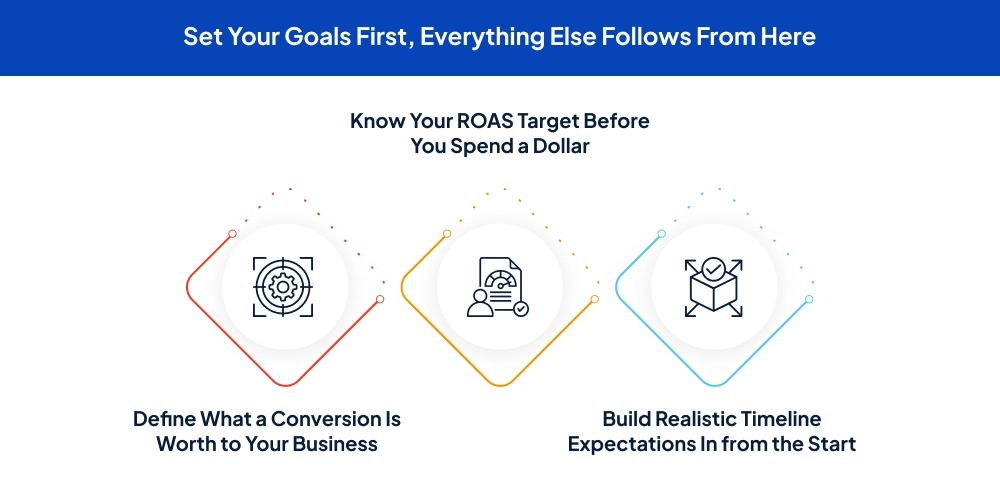
Define What a Conversion Is Worth to Your Business
The single most important number in your PPC strategy is your maximum acceptable Cost Per Acquisition, the most you can afford to pay to acquire one customer or lead while still being profitable. To figure this out, you need your average customer lifetime value, your profit margins, and your lead-to-customer conversion rate. Once you have that number, you have a clear benchmark to optimise your campaigns toward rather than just hoping the monthly report looks good.
Know Your ROAS Target Before You Spend a Dollar
For ecommerce businesses, especially, Return on Ad Spend is your north star metric. A ROAS of 400 percent means you are generating four dollars in revenue for every one dollar spent on advertising. Setting a ROAS target before you launch means you always have a clear reference point, you are not just watching numbers move up and down, you are measuring them against a standard that reflects whether the campaigns are actually profitable for your business.
Build Realistic Timeline Expectations In from the Start
PPC campaigns need time to learn and optimise. The algorithm needs conversion data to make good bidding decisions. You need enough data to know what is working and what is not. Most campaigns need at least 60 to 90 days to reach their real performance potential. Businesses that pull the plug after two or three weeks because results are not where they want them are not giving their investment a fair chance. Plan for the learning curve. Build it into your timeline from the beginning.
Before You Build Anything New, Look at What You Already Have
If your business already has a Google Ads account running, the smartest thing you can do before building a new strategy is run a thorough audit of what already exists. Most accounts that underperform are not failing because the approach is fundamentally wrong. They are failing because of a handful of fixable problems that have been quietly draining budget for months, sometimes years.
Check Your Campaign Structure for Overlap and Waste
Campaign structure problems are more common than most advertisers realise. Multiple campaigns bidding on overlapping keywords. Ad groups are crammed with dozens of loosely related terms. Old campaigns are still running on outdated settings from years ago. Each of these issues creates budget waste and performance drag that is completely avoidable once you know what to look for.
Dig Into Your Quality Scores
Google’s Quality Score is a 1 to 10 rating that reflects how relevant your keywords, ads, and landing pages are to each other and to what people are actually searching for. Low Quality Scores mean you are paying more per click than a competitor with a more relevant setup. Improving relevance across your account lowers your costs and improves your ad positions, without touching your budget at all.
Fix Your Conversion Tracking Before Anything Else
Broken or incomplete conversion tracking is found in the majority of underperforming accounts. If your tracking is off, every decision you have been making, which keywords to bid on, which campaigns to scale, which ads to run, has been based on inaccurate data. Before you optimise a single thing, verify that every important action on your website is being tracked correctly. This is non-negotiable.
Keyword Research Done Right - It Is About Intent, Not Just Search Volume
Great keyword research is not about collecting the most popular search terms. It is about understanding what a person means when they type something into Google and whether that intent aligns with where they are in the buying journey. Two people can search for similar things and have completely different levels of readiness to buy. Your keyword strategy needs to reflect that difference.
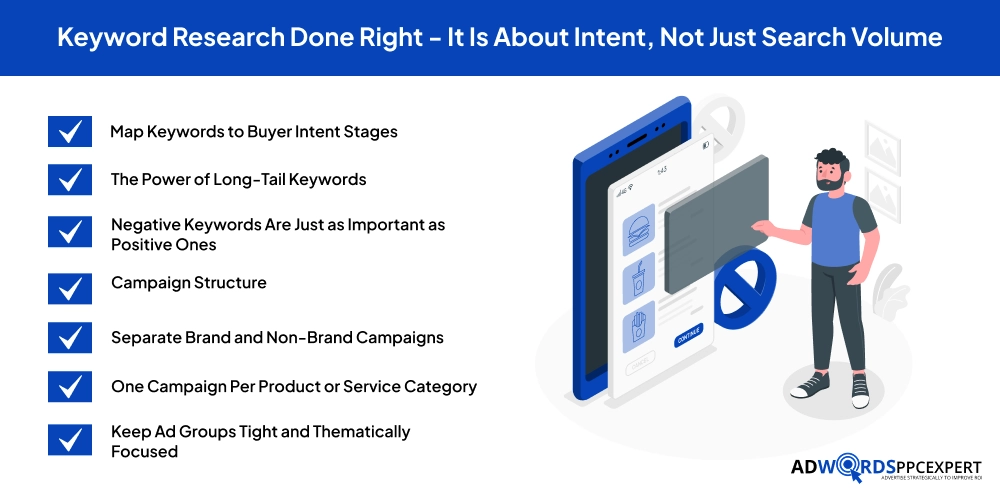
Map Keywords to Buyer Intent Stages
Think of search intent in three broad stages. At the top are people who are aware of a problem but just starting to research – they use broad, informational terms. In the middle are people who know what they need and are comparing their options. At the bottom are people who are ready to act – they use specific, commercial terms that include words like “hire,” “agency,” “cost,” “pricing,” or “near me.” Your biggest bids and most careful attention belong to those bottom-of-funnel keywords, because that is where conversions happen.
The Power of Long-Tail Keywords
Long-tail keywords are longer, more specific phrases that attract smaller audiences but far more qualified ones. A term like “Google Ads management for dental clinics in Austin” gets fewer searches than “Google Ads management”, but the person searching it knows exactly what they want and is far more likely to convert. Long-tail keywords also tend to cost less per click because fewer advertisers are competing for them. Building your keyword strategy around a strong long-tail foundation is one of the most effective ways to get more from a limited budget.
Negative Keywords Are Just as Important as Positive Ones
Every keyword you add tells Google when to show your ad. Every negative keyword tells Google when not to. Without a strong negative keyword list, your ads will appear for irrelevant searches, such as, people looking for jobs, free tools, tutorials, or products completely unrelated to what you offer. Most unmanaged accounts waste 20 to 30 percent of their total budget this way. Build your negative keyword list from day one and update it weekly based on the actual search terms report in your account.
Campaign Structure
How you organise your Google Ads account has a bigger impact on performance than most people realise. Clean, logical structure makes it easier to control budget, write relevant ads, spot problems quickly, and scale confidently. Poor structure creates confusion, budget overlap, and reporting blind spots that make it nearly impossible to improve performance systematically.
Separate Brand and Non-Brand Campaigns
Brand campaigns, where you bid on your own business name, behave very differently from non-brand campaigns. Brand keywords cost less, have higher Quality Scores, and convert at higher rates. Mixing brand and non-brand keywords in the same campaign obscures what is really driving your results and makes budget allocation much harder. Always keep them separate.
One Campaign Per Product or Service Category
If your business offers multiple products or services, each major category deserves its own campaign. This gives you independent budget control, allows you to write ads specific to each offering, and lets you send visitors to the most relevant landing page for whatever they searched. The closer the match between the search, the ad, and the page, the better your Quality Score, the lower your cost per click, and the higher your conversion rate.
Keep Ad Groups Tight and Thematically Focused
An ad group should contain keywords that are genuinely close in meaning so that every ad in that group speaks directly to every keyword it covers. Bloated ad groups with dozens of loosely related keywords make it impossible to write ads that feel genuinely relevant. Tighter ad groups mean more relevant ads, better Quality Scores, lower costs, and better results across the board.
Ad Copy That Makes People Stop Scrolling and Start Clicking
Your ad is competing for attention alongside several other results on the same page. Someone scanning those results makes a split-second decision about which one to click, and that decision is almost entirely based on whether your headline immediately signals that you have exactly what they are looking for. Ad copy is not just creative writing. It is one of the most commercially important things in your entire campaign.
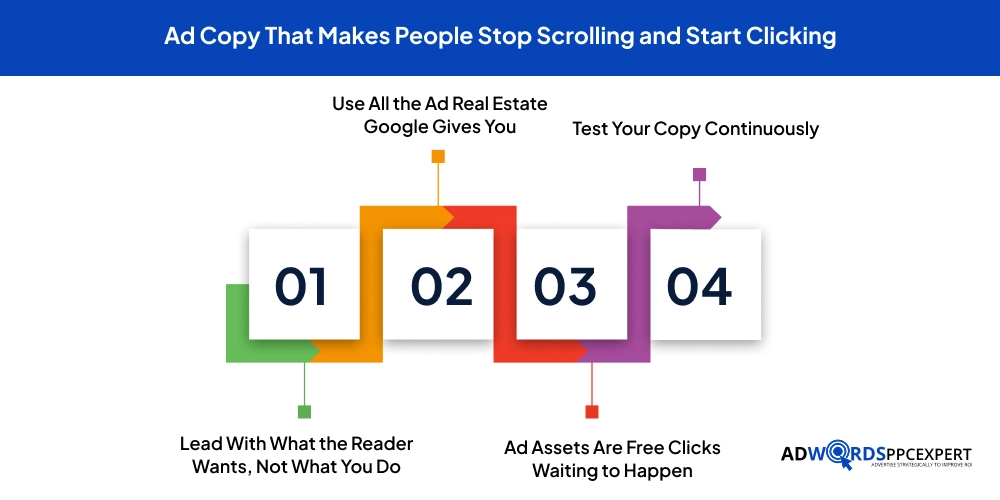
Lead With What the Reader Wants, Not What You Do
There is a critical difference between ads that describe your service and ads that speak to the outcome the reader wants. “We Offer Full-Service PPC Management” tells someone what you do. “Get More Qualified Leads Without Wasting Your Ad Budget” tells them what they get. Always lead with the benefit. Always write for the reader’s problem, not your own portfolio.
Use All the Ad Real Estate Google Gives You
Responsive Search Ads allow up to 15 headlines and 4 descriptions. Most advertisers use far fewer and leave significant performance on the table. Write a wide variety of headlines focused on the problem, the benefit, the offer, the location, and the credibility. Give Google enough variation to test and find the combinations that resonate most with your specific audience.
Ad Assets Are Free Clicks Waiting to Happen
Ad assets, previously called extensions, expand your ad with additional information and links without increasing your cost per click. Sitelinks direct people to specific pages. Callouts highlight short benefits. Call assets show your phone number directly in the ad. Location assets display your address. These additions make your ad more informative, more prominent on the page, and significantly more clickable. Use them in every campaign without exception.
Test Your Copy Continuously
Even a small change in a headline, a different value proposition, a stronger call to action, a more specific offer can meaningfully improve your click-through rate over time. Test new ad variations regularly. Let the data tell you what works. Some of the most impactful improvements in PPC come from ad copy changes identified during a PPC audit that nobody expected to make much difference.
The Landing Page Is Where Your Budget Either Pays Off Or Goes to Waste
You can have perfectly structured campaigns, well-researched keywords, and compelling ad copy and still lose conversions if your landing page does not follow through on the promise your ad made. The landing page is the bridge between a click and a customer. Yet it is consistently the most overlooked part of the entire paid advertising proce
Message Match Is Everything
Whatever your ad promises, your landing page must deliver immediately and visibly. If someone clicks an ad that offers a free audit, the first thing they should see on the landing page is that exact offer not a general homepage that asks them to figure out where to go next. Every click you send to a mismatched page is a wasted opportunity, and those add up fast.
What the Top of Your Page Needs to Do
Before a visitor scrolls, your page needs to confirm they are in the right place, show them the value of taking the next step, and present a clear, obvious call to action. If someone has to scroll or search to understand what the page is about, you are losing conversions that should belong to you. The above-the-fold section of your landing page is prime real estate. Treat it that way.
Speed and Mobile Experience Are Not Optional
More than half of all paid search clicks now happen on mobile devices. A landing page that loads slowly or looks broken on a phone is handing those conversions directly to your competitors. A one-second improvement in load time can noticeably lift conversion rates. Check your page speed regularly on both desktop and mobile, and treat any performance issues as a direct threat to your ROI.
Build Trust Before You Ask for Action
First-time visitors do not know you yet. Client testimonials, case study results, star ratings, industry certifications, and recognisable brand logos all help build credibility quickly and reduce the hesitation that keeps people from filling out a form or making a call. Social proof is not decoration, it is a conversion tool. Use it intentionally throughout your landing page.
What No One Tells You About PPC: The Hidden Reasons PPC Campaigns Quietly Fail
There are the obvious PPC mistakes, such as bad keywords, weak ad copy, and no landing page. Those get talked about everywhere. But there is another category of problems that are far harder to spot because they do not show up obviously in your dashboard. These are the hidden reasons that smart, well-intentioned campaigns quietly underperform for months without anyone understanding why.
You Are Optimising for the Wrong Thing
This is more common than anyone likes to admit. A campaign gets optimised toward the metric that looks best in reports, which is click-through rate, impression share, and number of conversions, rather than the metric that actually matters for the business. A campaign with a high conversion count but a low average deal value might be significantly less profitable than one with fewer but higher-value conversions. Always anchor your optimisation decisions to revenue and profitability, not platform metrics that look impressive in a slide deck.
Your Tracking Is Lying to You
Duplicate conversion tracking is one of the most widespread and most damaging issues in Google Ads. When the same conversion gets counted twice through both Google Tag Manager and a hardcoded tag on the thank-you page, for example, your data shows twice as many conversions as you are actually generating. Smart Bidding then optimises based on that inflated data, overpays for traffic, and underdelivers on real results. It looks fine in the platform. It is costing you significantly in reality.
Broad Match Without Guardrails Is a Budget Leak
Broad match keywords, when used without strong negative keyword lists and smart bidding, can expand your reach in ways that feel productive but are not. Your ads start appearing for searches that are tangentially related at best, and you are paying for every click. The platform frames this as “reach expansion.” In practice, it is often just budget dilution. Broad match can work well, but only inside a well-controlled account with mature conversion data and robust negative keyword coverage.
The Competition Changed, and Nobody Noticed
PPC does not happen in isolation. Your competitors are constantly adjusting their bids, launching new campaigns, and testing new offers. A campaign that was performing well six months ago can quietly start declining, not because anything changed on your end, but because the auction around you got more competitive. Checking your Auction Insights report regularly is the only way to catch this early enough to respond. Ignore it, and you can spend months wondering why performance is slipping without ever identifying the real cause.
Ad Fatigue Is Real, Even in Search
Most advertisers think about ad fatigue in the context of social media or display advertising. But it happens in search, too. When your remarketing audiences see the same ad message every time they return to searching, response rates decline gradually. Regularly rotating in fresh ad variations, updating your messaging to reflect current offers or seasons, and testing new creative angles keeps your campaigns feeling relevant and maintains engagement over time.
Smart Bidding and Budget
Bid strategy and budget allocation are where a lot of the financial leverage in your PPC account lives. Getting these right does not mean spending more, it means making sure every dollar you do spend is pointing in the right direction and doing the most productive work it can.
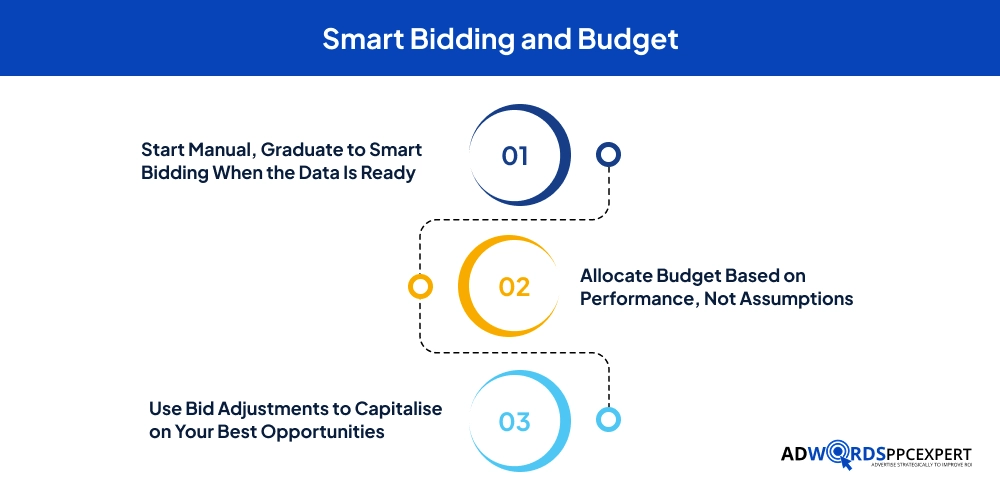
Start Manual, Graduate to Smart Bidding When the Data Is Ready
New campaigns do not have the conversion history that Smart Bidding needs to function well. Starting with manual CPC or Maximize Clicks lets you gather that data without the algorithm making premature decisions based on a handful of early signals. Once you have a consistent flow of conversions, typically 30 to 50 per month as a minimum, you have enough data to switch to Target CPA or Target ROAS bidding and let the machine learning work properly.
Allocate Budget Based on Performance, Not Assumptions
A practical budget allocation rule is to put 70 to 80 percent of your spend behind proven, high-performing campaigns and reserve the rest for testing. This protects your core results while still allowing you to explore new keywords, audiences, and campaign types. As new tests prove themselves, you shift budget toward them. This rolling approach to allocation means your budget is always gradually moving toward what works best.
Use Bid Adjustments to Capitalise on Your Best Opportunities
Your data will show you patterns, certain times of day, days of the week, devices, and locations that consistently convert better than others. Bid adjustments let you increase your presence during peak conversion windows and pull back during low-converting periods. These are not dramatic changes. But applied consistently and updated as new data comes in, they compound into meaningful efficiency gains that lower your overall cost per acquisition over time.
Conversion Tracking
Conversion tracking is the foundation that everything else in your PPC strategy is built on. Without it, you are flying blind. You have no reliable way of knowing which keywords are driving real results, which campaigns are profitable, or which ads are actually resonating with your audience. Every optimisation decision becomes a guess, and guesses with an advertising budget are expensive.
Track Every Action That Has Business Value
At minimum, you should be tracking form submissions, phone calls, purchases, chat initiations, and any other action that represents a genuine lead or sale. Each conversion should have a real monetary value assigned to it wherever possible. Value-based conversion data is what allows Smart Bidding algorithms to optimise toward actual business outcomes, not just conversion volume.
Set Up Google Tag Manager and Connect Everything Properly
Google Tag Manager is the cleanest way to manage all your tracking tags in one place. It lets you deploy and update tags without developer involvement every time, and it reduces the risk of tracking conflicts and duplicate counts. Connect it properly to both Google Ads and Google Analytics 4 so you have a complete, cross-channel view of how paid search is contributing to the customer journey.
First-Party Data Is Your Long-Term Competitive Advantage
As third-party cookies disappear, the businesses with strong first-party data strategies will have a significant edge. Uploading your customer email lists to Google Ads lets you target existing customers, exclude past buyers from acquisition campaigns, or use them as seed audiences to find lookalike prospects. Customer Match audiences consistently outperform standard targeting by wide margins. Building your first-party data infrastructure now is not just good practice, it is a long-term competitive moat.
Remarketing - A to Turn Missed Opportunities Into Conversions
Around 90 percent of first-time website visitors leave without converting. That is not a failure, it is just how people make decisions, especially for anything above impulse-purchase price. They browse, compare, get distracted, and come back later. Remarketing is how you stay visible and relevant during that gap between first visit and final decision, and it is one of the highest-ROI strategies available in paid advertising.
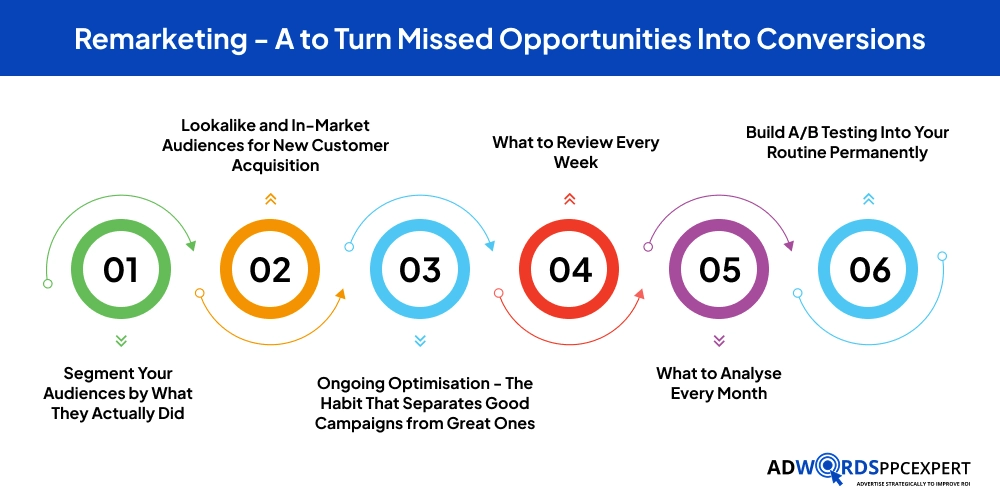
Segment Your Audiences by What They Actually Did
Not all past visitors are equal. Someone who spent three minutes on your pricing page is far closer to converting than someone who bounced from the homepage after five seconds. Someone who started a checkout and abandoned it is closer still. Create remarketing audiences based on specific behaviours, pages visited, time spent, actions taken, and write messaging that speaks to where each group is in their decision process. Relevant remarketing dramatically outperforms blanket retargeting.
Lookalike and In-Market Audiences for New Customer Acquisition
Beyond remarketing to existing visitors, audience targeting can significantly improve your prospecting campaigns, too. In-market audiences let you reach people who are actively researching products or services in your category right now. Lookalike audiences, built from your uploaded customer lists, let you find entirely new people who share key characteristics with your best existing customers. Combined with remarketing, these tools create a complete audience strategy that captures new interest and converts existing intent.
Ongoing Optimisation - The Habit That Separates Good Campaigns from Great Ones
Launching a well-built campaign is the start, not the finish. The businesses that achieve consistently strong PPC results are the ones that treat optimisation as a permanent, scheduled practice rather than something they do when performance drops. Campaigns that are actively managed and regularly improved compound their results over time. Those that are left to run on their own gradually decline.
What to Review Every Week
Weekly reviews should cover your search terms report, which is where you identify new negative keywords and uncover new keyword opportunities. Check your spending pace and flag any unexpected changes in click-through rate or conversion rate. Look at Quality Scores for any notable shifts. Weekly reviews do not need to be long. They just need to be consistent. Catching a small problem early is always better than discovering a big one later.
What to Analyse Every Month
Monthly analysis goes deeper. Look at performance broken down by device, location, audience segment, and time of day. Assess your ads and introduce fresh variations to replace anything that has been running without meaningful testing. Review landing page conversion rates alongside ad click-through rates, a strong CTR paired with a weak conversion rate almost always points to a landing page issue, not an ad problem.
Build A/B Testing Into Your Routine Permanently
A/B testing is not a phase. It is a habit. Test one variable at a time, a different headline, a new call to action, an alternative landing page layout, and let each test run long enough to collect meaningful data before drawing conclusions. Most significant performance improvements in PPC are not the result of dramatic overhauls. They are the result of steady, small wins that compound into something substantial over months of disciplined testing.
AI and Automation in PPC
Google Ads is increasingly AI-driven. Smart Bidding, Performance Max, Responsive Search Ads, and Demand Gen campaigns all rely on machine learning to make decisions at a speed and scale no human could match manually. Used well, these tools genuinely improve performance. Used without direction, they can burn through the budget faster than any manual campaign would.
Give the Algorithm Better Inputs Than Your Competitors Do
The quality of your automation is directly tied to the quality of your inputs. Clean conversion tracking with real monetary values. High-quality creative assets across multiple formats. First-party audience data uploaded and kept current. Realistic bidding targets based on actual business economics. When your inputs are better than your competitors’, your automated campaigns will outperform theirs, even if you are spending less.
Automation Needs Guardrails
Google’s platform is designed to encourage spending. Without clear constraints, automated campaigns can drift toward maximising impressions or clicks rather than maximising profit. Set budget caps. Maintain your negative keyword lists. Define your bidding targets based on what is actually profitable for your business, not what the platform suggests as a default. And check in regularly to make sure the automation is still working in your interest, not just the platform’s.
Measuring What Matters
The final layer of a strong PPC growth blueprint is knowing how to measure success in a way that reflects real business outcomes, not just activity. Plenty of campaigns generate impressive platform numbers while delivering poor business results. The metrics that matter are the ones that connect directly to revenue.
Your Primary Business Metrics
Return on Ad Spend and Cost Per Acquisition are your two most important measures of whether your campaigns are actually profitable. ROAS tells you how much revenue you generate per dollar of ad spend. CPA tells you what it costs to acquire each lead or customer. Measure both against the targets you set at the beginning of your blueprint. If they are on target, scale. If they are off, diagnose and improve before spending more.
Your Diagnostic Metrics
Click-through rate, Quality Score, conversion rate, and search impression share are your diagnostic signals. They do not tell you directly whether you are making money, but they tell you where the weak points are. A low CTR points to an ad copy problem. A low conversion rate points to a landing page issue. A low impression share suggests either budget constraints or a Quality Score problem that is limiting your reach.
Review at the Right Frequency
Weekly check-ins keep the account healthy and catch problems early. Monthly deep-dives are where strategic decisions about budget, creative refresh, and campaign expansion get made. Quarterly reviews are the time to step back and ask whether your overall strategy is still aligned with your business goals, and whether anything in your market, your audience, or your competitive landscape has shifted enough to warrant a meaningful change in approach.
Common Mistakes That Quietly Destroy PPC Growth And How to Avoid Them
Even the most carefully planned PPC strategy can be undermined by a small number of persistent, avoidable mistakes. The tricky part is that most of these do not show up dramatically in your dashboard, they just quietly drain budget, suppress results, and make it nearly impossible to understand why performance never reaches its potential. Here are the ones that matter most, and exactly what to do about each.
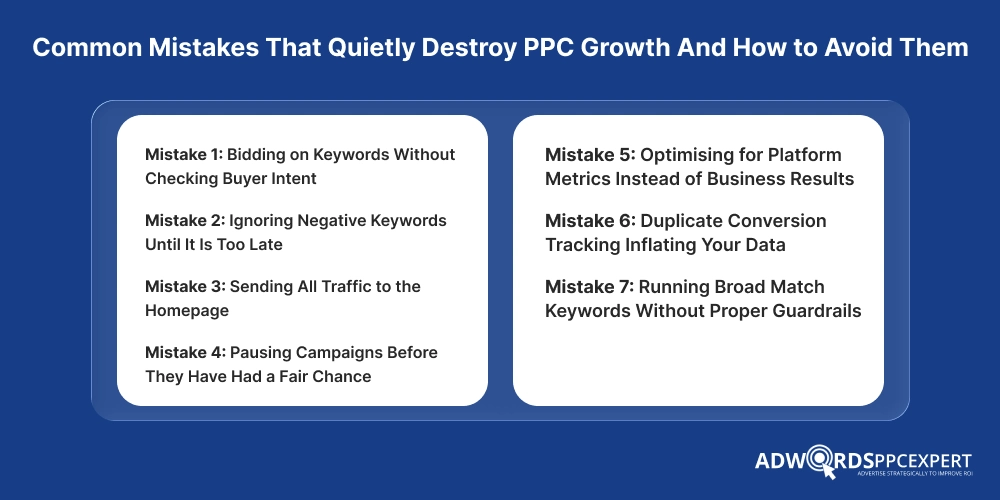
Mistake 1: Bidding on Keywords Without Checking Buyer Intent
One of the most expensive habits in PPC is targeting high-volume keywords without first asking what the person behind that search actually wants, especially when relying only on PPC retargeting. A keyword with 50,000 monthly searches sounds exciting, but if the people using it are researching, comparing, or just curious rather than ready to buy, you are paying for clicks that will never convert. Before investing in any keyword, qualify it by intent. Ask yourself, is someone using this term close to making a decision, or are they still at the awareness stage? Bottom-of-funnel keywords, the ones that include words like “hire,” “agency,” “cost,” “pricing,” or “near me”, deserve your highest bids. Informational terms can support brand awareness, but should never consume the majority of a performance-focused budget.
Mistake 2: Ignoring Negative Keywords Until It Is Too Late
In almost every audit of an underperforming Google Ads account, a weak or nonexistent negative keyword list is the single biggest source of wasted spend. Without negative keywords telling Google when not to show your ad, your campaigns will appear for searches that have nothing to do with your business, job seekers, students, researchers, and people looking for entirely different products. Every one of those clicks costs money and delivers nothing. Build your negative keyword list before your campaigns go live, and review your search terms report every single week to catch new irrelevant queries before they compound into significant budget loss.
Mistake 3: Sending All Traffic to the Homepage
Your homepage is designed to speak to everyone who visits your website, which means it is optimised for no one in particular. When someone clicks a PPC ad with a specific intent, say, they searched for “Google Ads management for e-commerce stores”, sending them to a generic homepage forces them to hunt for the information they came for. Most will not bother. They will leave, and you will have paid for that exit. Dedicated landing pages built around the specific promise of each ad dramatically outperform general website pages in conversion rate. Treat your landing pages as equal partners to your campaigns. Each campaign deserves a page that mirrors its message, speaks to its audience, and drives one clear action.
Mistake 4: Pausing Campaigns Before They Have Had a Fair Chance
PPC campaigns need time to learn. Google’s algorithm needs conversion data to make smart bidding decisions, and you need enough data to confidently identify what is working and what is not. Pausing or dramatically restructuring a campaign after just two or three weeks because results are not yet where you want them is one of the most common ways businesses prevent their campaigns from ever reaching their potential. The first 60 to 90 days are the learning and data-gathering phase, not the performance benchmark. Give your campaigns the time they need, make adjustments based on real data rather than early anxiety, and resist the urge to overhaul everything before the numbers have had time to tell a clear story.
Mistake 5: Optimising for Platform Metrics Instead of Business Results
A Google Ads account can look extremely healthy on the surface, strong optimization score, high click-through rate, rising impression share, growing conversion numbers, while quietly losing money on every single click. Platform metrics are useful diagnostic tools, but they are not the same as business results. A high CTR means your ads are getting clicked; it says nothing about whether those clicks are profitable. A strong conversion count means nothing if the average value of those conversions does not cover your cost per acquisition. Always anchor your analysis to the numbers that actually matter for your business: Return on Ad Spend, Cost Per Acquisition, and the quality and value of the leads or sales being generated. Everything else is context, not the conclusion.
Mistake 6: Duplicate Conversion Tracking Inflating Your Data
This one is particularly dangerous because it is invisible until you know to look for it. Duplicate conversion tracking happens when the same conversion action gets counted twice, for example, when both a Google Tag Manager trigger and a hardcoded page tag fire on the same thank-you page. The result is that your account reports twice as many conversions as you are actually generating. Smart Bidding then optimises toward that inflated number, overpays for traffic, and delivers real results that fall far short of what your data appears to show. Always audit your conversion setup carefully before scaling any campaign. Verify that each action is tracked exactly once, and cross-reference your Google Ads conversion data against Google Analytics 4 to catch any discrepancies early.
Mistake 7: Running Broad Match Keywords Without Proper Guardrails
Broad match keywords have become more capable with AI-driven matching, but they remain one of the fastest ways to burn budget when used without the right controls in place. Without a robust negative keyword list and sufficient conversion data to guide Smart Bidding, broad match expands your reach to searches that are only loosely related to what you offer, and you pay for every click regardless of quality. Broad match can be a genuinely powerful tool inside a well-managed account with a strong conversion history and disciplined negative keyword coverage. Without those guardrails, it is a budget leak dressed up as reach expansion.
The Bottom Line
Pay-per-click advertising is one of the most powerful, fastest-moving growth channels available to any business. It puts you in front of people who are actively searching for what you offer, at the exact moment they are ready to act. When it works well, it works exceptionally well with consistent leads, predictable revenue, and results that improve over time.
But it does not work on autopilot. It does not reward guesswork. And it does not get better on its own. What makes PPC work truly, consistently, and profitably is a clear strategy behind it. A blueprint that connects your goals to your keywords, your campaigns to your audience, your data to your decisions. Without that, even a well-funded campaign is mostly noise. With it, every dollar you spend has a job to do.
The framework in this guide covers every layer of that blueprint from setting goals and auditing your account through to keywords, campaign structure, ad copy, landing pages, bidding, tracking, remarketing, optimisation, and measurement. Each layer reinforces the others. When they all work together, the results compound. And that is when PPC stops being a cost and starts being one of the most reliable growth engines your business has.
Whether you apply this framework yourself or work with a team of specialists to do it for you, the principles are the same. Know what you want. Build a strategy to get there. Track everything honestly. Keep improving. That is what consistent PPC results actually look like, and now you have the blueprint to build them.
Want a PPC growth blueprint built specifically for your business? The certified PPC experts at AdwordsPPCExpert create and manage performance-driven Google Ads strategies that deliver real, measurable, lasting results. Start with a free Google Ads audit by visiting adwordsppcexpert.com or call us today to speak with a specialist.
Frequently Asked Questions
Q1. What exactly is a PPC growth blueprint and how is it different from just running Google Ads campaigns?
Running Google Ads means you have ads live, keywords chosen, and a budget set. A PPC growth blueprint means every one of those decisions is connected to a documented strategy built around your business goals, profit margins, and a clear process for measuring results. Without that structure, even well-funded campaigns plateau and deliver inconsistent results month after month. Campaigns are the execution. The blueprint is the strategy that makes the execution actually work.
Q2. How do you actually start building a PPC growth blueprint for your business?
Start by defining clear, profit-based goals, your maximum Cost Per Acquisition, your target ROAS, and what a realistic 90-day performance looks like. From there, build outward: research keywords mapped to buyer intent, structure campaigns by objective and service, write ads that lead with the customer’s outcome, build dedicated landing pages for each campaign, set up accurate conversion tracking, and schedule regular weekly and monthly performance reviews. Each layer builds on the one before it skipping any one of them creates gaps that show up as wasted spend.
Q3. What are the most important elements of a PPC growth blueprint for businesses with a limited budget?
Focus beats scale every time when budget is tight. Prioritise high-intent, long-tail keywords over broad head terms. Build dedicated landing pages rather than sending traffic to your homepage. Keep ad groups tight and thematically focused. Make sure conversion tracking is accurate so every decision is based on real data. And do not overlook remarketing, since those audiences already know your brand, they convert at higher rates and lower costs than cold traffic, giving you more return from every dollar already spent.
Q4. How do you know if your PPC growth blueprint is working, and what do you do when it is not?
Your two primary indicators are Return on Ad Spend and Cost Per Acquisition. If both are hitting your targets, scale what is working. If they are off, diagnose before spending more. Start with conversion tracking, check for duplicate counting. Then review your search terms report for irrelevant traffic, compare your ad CTR against your landing page conversion rate, and check Auction Insights for competitive shifts. When troubleshooting, change one variable at a time. Changing everything at once makes it impossible to know what actually moved the needle.

Ami Singh is a highly skilled AdWords PPC Specialist, known for creating profitable Google Ads strategies that elevate brands. With deep expertise in Google Search, Display, Shopping, YouTube Ads, and advanced bidding techniques, Ami consistently converts data into performance-driven results.
With a sharp analytical mind and a strong understanding of online consumer behavior, Ami designs campaigns that maximize ROI, boost quality scores, and reduce acquisition costs. His approach blends technical expertise with strategic thinking—making him a go-to expert for businesses aiming to dominate Google Ads.
Ami doesn’t just adapt to the fast-changing PPC industry, but he also stays ahead of the curve by testing new features, adopting automation smartly, and refining what works. Clients trust him for his transparency, insights, and ability to scale campaigns sustainably.
Looking to take your Google AdWords performance to the next level? Connect with Ami Singh at Softtrix and discover how he can help you get the maximum growth through powerful PPC strategies.