

What would it mean for your business if the phone rang more often?
Not cold calls, not spam, just real inquiries from people who are already searching for exactly what you offer, that is people ready to buy, ready to book, ready to sign up. That, is not a fantasy. That is what a well-run paid advertising campaign can do. And for thousands of businesses across the country, it already is.
But here is where most business owners hit a wall. They hear about Google Ads. They see competitors showing up at the top of search results. They know there is something powerful happening up there, and they want in. So they start asking around, maybe reach out to a few agencies, and almost immediately run into a problem, that is nobody seems to give a straight answer about what any of this actually costs or what they are going to do with your money once you hand it over.
That confusion is exactly what this guide is here to clear up. Whether you are exploring PPC for the first time or trying to make sense of what your current agency is charging, you will walk away from this with a grounded, honest understanding of how PPC agency pricing works, and what to look for before you commit.
What Is a PPC Agency and What Does It Actually Do?
Before we talk numbers, it is worth making sure we are on the same page about what a PPC agency actually is and what you are hiring them to do, because a lot of businesses come into this conversation with a vague picture at best.
A PPC agency, short for pay-per-click agency is a team of digital advertising specialists who plan, build, manage, and continuously optimize paid advertising campaigns on your behalf. Pay-per-click is a model of online advertising where you pay a fee each time someone clicks on your ad. The most well-known form of pay-per-click advertising is Google Ads, though PPC campaigns also run across Microsoft Advertising, YouTube, Meta (Facebook and Instagram), LinkedIn, and other platforms.
The core job of a PPC agency is to make sure that every dollar you invest in paid advertising is working as hard as possible, reaching the right people, at the right time, with the right message, and converting that attention into real business outcomes like leads, calls, purchases, and appointments.
Here is a closer look at the specific things a PPC agency does on your behalf:
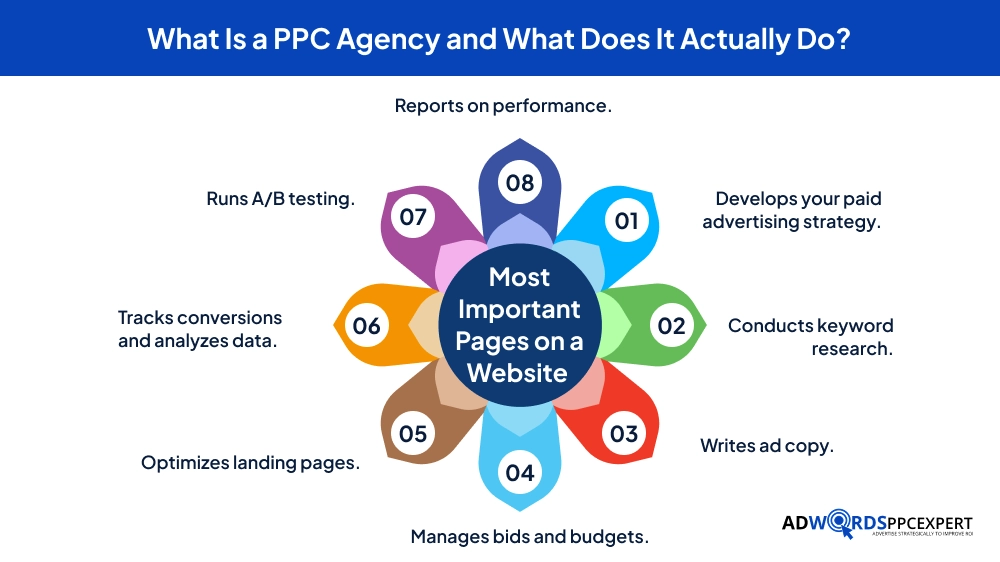
Develops your paid advertising strategy.
A good agency does not just run ads. They start by understanding your business, your goals, your audience, and your competitive landscape, and then build a campaign strategy tailored to all of that. This includes deciding which platforms to advertise on, how to structure campaigns, how to segment audiences, and how to allocate budget across different objectives.
Conducts keyword research.
In pay-per-click advertising, keywords are the foundation of everything. Your agency identifies the specific search terms your ideal customers are using, assesses competition levels and estimated cost per click for each term, and builds a keyword strategy designed to capture high-intent traffic without overpaying. This also involves building comprehensive negative keyword lists to prevent your ads from showing up on irrelevant searches and wasting your ad spend.
Writes ad copy.
Effective ads are not written by accident. A PPC agency crafts compelling headlines, descriptions, and calls to action, and continuously tests variations to find what resonates most with your audience and drives the highest click-through rate.
Manages bids and budgets.
Bid management is one of the most technically involved parts of Google Ads management. Your agency monitors and adjusts bids based on keyword performance, time of day, device type, audience behavior, geographic signals, and competition, always working to lower your cost per click and improve your return on ad spend.
Optimizes landing pages.
Getting a click is only half the battle. If the page someone lands on after clicking your ad is slow, confusing, or unconvincing, that click is wasted. A strong agency evaluates your landing pages against conversion best practices and makes recommendations, or builds new pages, to ensure your paid traffic converts at the highest possible rate.
Tracks conversions and analyzes data.
Conversion tracking is what connects your ad clicks to your actual business results. Your agency sets up and maintains tracking for phone calls, form submissions, purchases, and other meaningful actions, then analyzes that data to understand what is working, what is not, and what to do next.
Runs A/B testing.
Continuous testing is how great campaigns are built. Your agency systematically tests different ad copy variations, landing page elements, bidding strategies, audience segments, and campaign structures, using each test result to make smarter, more informed decisions over time.
Reports on performance.
You should never be left wondering how your campaigns are doing. A reputable PPC agency delivers regular, clear reporting that connects campaign metrics, impressions, clicks, click-through rate, conversion rate, cost per acquisition, and return on ad spend to real business outcomes.
In short, a PPC agency is not just a vendor running ads in the background. The right agency is an active, strategic partner working continuously to grow your business through paid search.
The Two Costs Every Business Needs to Understand
When budgeting for pay-per-click advertising, there are two entirely separate costs involved and confusing them is one of the most common mistakes businesses make.
Ad Spend is the money paid directly to the advertising platform that is on Google, Microsoft, Meta, or whichever platforms your campaigns run on. Every time a user clicks your ad, that cost is charged against your ad spend. Your agency does not keep any portion of your ad spend. It goes entirely to the platform.
PPC Management Fees are what you pay the agency for their time, expertise, tools, strategy, and ongoing work managing your campaigns. This is a separate cost from ad spend and is what most of this guide focuses on.
Both matter, and both need to be factored into your total budget. A useful starting framework is the 80/20 rule, roughly 80% of your total PPC investment should go toward actual ad spend, with around 20% covering management fees and supporting tools. This ratio is not rigid, but it keeps your campaigns adequately funded while ensuring proper expert oversight.
Getting the balance wrong in either direction creates problems. Too much spend with too little management expertise means inefficient campaigns burning money quietly. Too much spent on management fees relative to actual ad spend means not enough runway to generate meaningful data or results.
What Does PPC Agency Pricing Look Like in 2026?
PPC agency pricing varies based on several factors, that is your industry, your monthly ad budget, campaign complexity, the number of platforms involved, and the pricing model your agency uses. But there are realistic benchmarks to orient yourself around.
For small to mid-sized businesses in 2026, the average cost of PPC management sits between $1,500 and $5,000 per month, not including ad spend. Smaller businesses with simpler campaigns may pay $800 to $1,200 per month in management fees. Large or enterprise-level businesses running complex, multi-platform campaigns can see Google Ads management fees of $5,000 to $15,000 or more per month.
When management fees are combined with monthly ad spend, total investments typically look like this:
- Small Business: $500 to $3,000/month in ad spend + $800 to $2,500/month in PPC management fees
- Mid-Sized Business: $3,000 to $10,000/month in ad spend + $1,500 to $5,000/month in management fees
- Enterprise: $10,000 to $50,000+/month in ad spend + $3,000 to $15,000+/month in management fees
Industry data suggests the average monthly spend on PPC management alone hovers around $5,800, while the average total monthly PPC advertising investment, including ad spend, sits around $14,000. Your numbers may differ, but these figures give you a solid benchmark when evaluating agency quotes.
The PPC Agency Pricing Models Explained
One of the most confusing parts of talking to a PPC agency for the first time is that they all seem to charge differently. Some quote a percentage. Others give you a flat monthly fee. Some talk about hourly rates. Others pitch performance-based arrangements. Understanding each model, including its strengths and pitfalls, puts you in a much stronger position before any agency conversation.
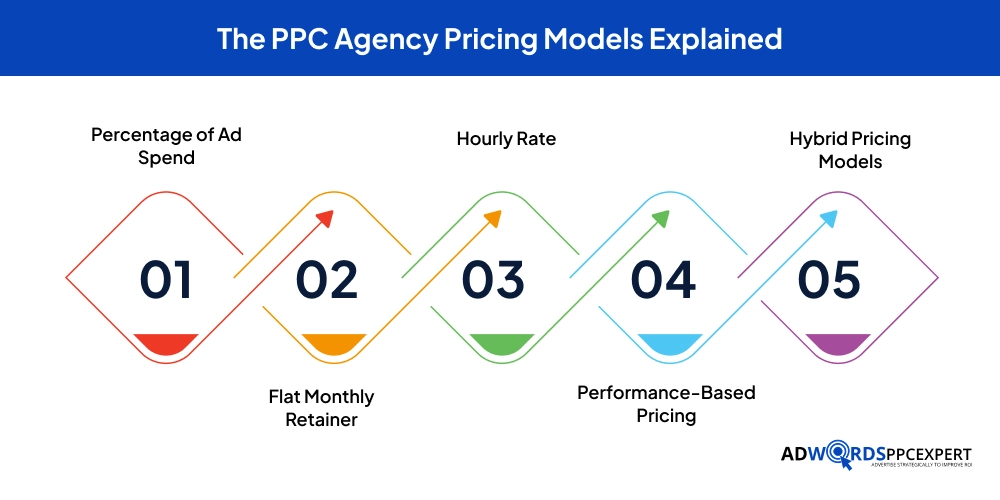
1. Percentage of Ad Spend
This is the most widely used PPC agency pricing model in the industry. The agency charges a percentage of whatever you spend on advertising each month, typically falling between 10% and 20%, though rates can go as high as 30% for smaller-budget accounts.
How it works in practice: If your monthly Google Ads budget is $8,000 and your agency charges 15%, you pay $1,200 per month in PPC management fees on top of that ad spend.
Why agencies favor this model: It scales naturally with the size and complexity of what they are managing. As your budget grows and campaigns become more involved, the fee increases accordingly.
What to watch out for: This model creates a subtle incentive for agencies to recommend increasing your ad spend, since their fee grows along with it. That is not always bad advice, scaling a well-performing campaign is often the right call, but it is a dynamic worth being aware of. Most agencies also set a minimum monthly fee, often $500 to $1,000, for accounts where the percentage calculation alone would not cover their time.
Red flag: If any agency is charging more than 25% of your monthly ad spend without a clear justification, that warrants a direct conversation.
2. Flat Monthly Retainer
With this model, you pay a fixed amount every month regardless of how much you spend on ads. The rate is agreed upon upfront based on scope of work and campaign complexity.
Typical ranges: Flat monthly retainers generally run from $500 to $5,000 or more depending on the number of campaigns, platforms managed, and agency experience level. Most small business accounts fall in the $1,000 to $3,000 per month range.
Why clients often prefer this model: Predictability. You know exactly what your PPC management fees will be every month, making budgeting straightforward. There is also no built-in incentive for the agency to inflate your ad spend, since their fee stays the same regardless.
The trade-off: A flat fee that was appropriate at the start of an engagement may feel misaligned as campaigns grow in complexity. Conversely, if you need to scale back ad spend during a slow period, you are still paying the same management cost. Clear, well-defined scope agreements help manage these situations on both sides.
3. Hourly Rate
Some agencies and independent Adwords consultant charge by the hour. This is more common with freelancers and boutique specialists than with full-service agencies. Experienced PPC professionals typically charge $100 to $150 per hour, with senior-level experts at premium agencies sometimes billing $200 or more.
When hourly billing makes sense: It works well for defined, one-time engagements, a PPC audit, a campaign setup review, or a strategy consultation, where ongoing monthly management is not needed.
For ongoing campaign management: Hourly billing makes costs unpredictable month to month. If your campaigns require unexpected work, such as responding to a competitive shift, rebuilding underperforming ad groups, or navigating a platform update, costs can climb without warning. It can also reduce proactive optimization, since there is no fixed deliverable attached to the fee structure.
4. Performance-Based Pricing
Under a performance-based model, the agency’s fee is tied to specific outcomes, such as leads generated, sales driven, cost per acquisition targets met, or return on ad spend thresholds achieved. The appeal is obvious: if the agency gets paid only when it delivers, interests seem perfectly aligned.
In practice, pure performance-based pricing is relatively uncommon in the PPC space. Google Ads outcomes are influenced by a wide range of variables outside the agency’s direct control, such as your website’s conversion rate, your sales team’s follow-through, seasonal market conditions, and competitor behavior. Most reputable agencies are understandably cautious about tying their entire fee to variables they cannot fully control.
What you are more likely to encounter in practice is a hybrid performance model, that is a base management retainer combined with a performance bonus when specific KPIs are hit, such as achieving a target cost per acquisition or exceeding a defined return on ad spend threshold. This approach balances predictability with meaningful performance accountability.
5. Hybrid Pricing Models
As the name suggests, hybrid pricing blends elements of two or more models. A common example is an agency that charges a percentage of ad spend for core Google Ads management but bills hourly for supplementary work like landing page design, competitive research, or creative asset production.
Hybrid models can be flexible and tailored to the specific scope of your campaigns, but they can also get complex quickly. Before signing anything, make sure you have an itemized, unambiguous breakdown of exactly what is covered under the base fee and what triggers additional billing. Ambiguity here is where unexpected invoices originate.
What Is Actually Included in PPC Management Fees?
This is where the most meaningful differences between agencies show up, not in their pricing, but in what you actually receive for it. Here is what a comprehensive, professional paid search management service should include.
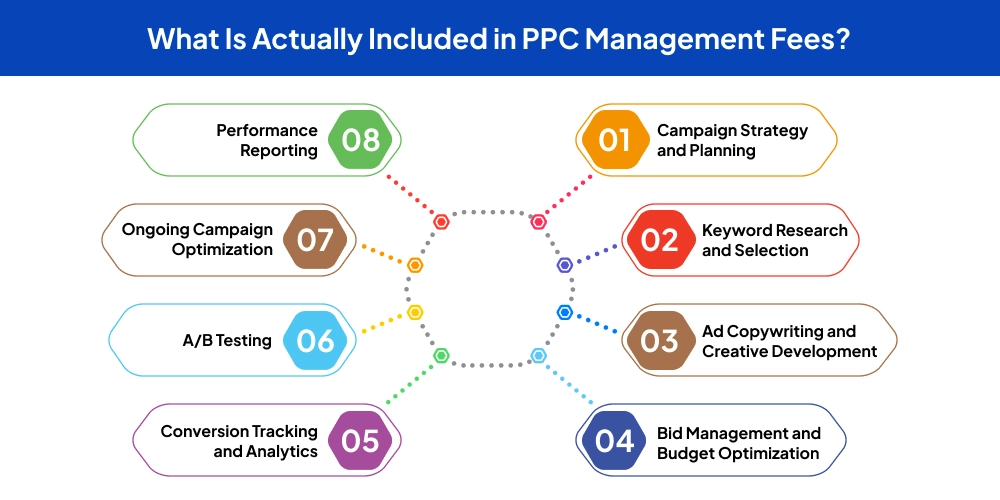
Campaign Strategy and Planning
Before a single ad goes live, a good PPC agency invests significant time understanding your business goals, your target audience, your competitive landscape, and your budget. This phase covers setting clear campaign objectives, defining the KPIs that will measure success, selecting the right advertising platforms, and building an account structure designed for performance and long-term scalability. Cutting corners here creates problems that compound over time.
Keyword Research and Selection
Thorough keyword research is the foundation of any effective pay-per-click campaign. Your agency should identify the exact search terms your ideal customers are using, assess competition levels and estimated cost per click for each term, and build a strategy that captures high-intent, purchase-ready traffic without overspending. This also includes building comprehensive negative keyword lists, search queries that are irrelevant to your business, to prevent your ad spend from being wasted on clicks that will never convert.
Ongoing negative keyword management is not a one-time setup task. It requires continuous attention as campaign data accumulates and new irrelevant search terms emerge.
Ad Copywriting and Creative Development
Writing ads that genuinely convert is a skill that improves with data and testing. A skilled PPC agency creates multiple ad variations, testing different headlines, descriptions, and calls to action, to continuously identify what drives the highest click-through rate and conversion rate for your specific audience. This applies to responsive search ads, display ads, and any other ad format in use across your campaigns.
More complex creative assets, such as custom graphics, video scripts, photography, typically fall outside standard PPC management fees and are quoted separately.
Bid Management and Budget Optimization
Bid management is one of the most technically demanding and ongoing aspects of Google Ads management. Your agency should actively monitor and adjust bids based on keyword performance, time of day, device type, audience signals, geographic factors, and competitive activity, always working to lower your effective cost per click and improve your return on ad spend.
This is also where smart bidding strategies come into play. Automated bidding tools within Google Ads can be powerful, but configuring them correctly, layering in the right audience signals, and knowing when to override automation with manual adjustments requires genuine expertise and experience.
Conversion Tracking and Analytics
You cannot optimize a pay-per-click campaign effectively without accurate data. A professional PPC agency ensures that proper conversion tracking is in place from day one, whether that means phone call tracking, form submission goals, e-commerce purchase events, or other meaningful actions. This typically involves Google Analytics, Google Tag Manager, and the platform’s native conversion tools, all configured and verified to ensure clean, attributable data is flowing through the account.
Without reliable conversion tracking, your agency is managing your campaigns blind, and that is a problem no amount of expertise can fully compensate for.
A/B Testing
Continuous, structured A/B testing is what separates campaigns that improve steadily over time from those that plateau after the initial setup. Your agency should systematically test ad copy variations, landing page elements, bidding strategies, audience segments, and campaign structures, using each test result to inform smarter decisions going forward. Good testing is methodical and data-driven, not random.
Ongoing Campaign Optimization
Once campaigns are live, active management is what drives results. Your agency should be monitoring performance continuously, catching issues early, identifying opportunities, and making proactive adjustments throughout the month. Regular optimization tasks include refining keyword lists, testing new ad variations, adjusting audience targeting, updating geographic settings, pausing underperforming elements, improving Quality Score where possible, and responding to shifts in the competitive landscape.
Quality Score, in particular, deserves attention. It is Google’s internal rating of the relevance and quality of your ads, keywords, and landing pages, and it directly affects both your cost per click and your ad placement. Agencies that actively work to improve Quality Score are working to lower your long-term advertising costs, not just manage your current spend.
Performance Reporting
A reputable PPC agency delivers regular, clear reporting that shows you exactly how your campaigns are performing. Monthly reports should cover key metrics, impressions, clicks, click-through rate, conversion rate, cost per acquisition, return on ad spend, and overall ad spend utilization, and more importantly, connect those metrics to actual business outcomes.
The best reporting does not just recap what happened. It explains what changed since the last period, what the agency is doing about underperforming areas, and what the optimization plan looks like going forward. That kind of narrative, forward-looking reporting is what transforms raw data into actionable insight.
What Is Typically NOT Included in Standard PPC Fees
Just as important as knowing what is covered is understanding what most agencies do not include in their base management fee.
Landing Page Design and Development: If your agency recommends building new landing pages which is common, since a strong ad pointing to a weak landing page wastes every dollar you spend that work is almost always a separate project with its own quote.
Custom Graphic Design and Video Production: Display ad creative, YouTube video ads, and social media graphics typically fall outside the scope of standard pay-per-click management. Budget separately for any custom visual assets.
Additional Platform Management: If your agreement covers Google Ads management and you later want to add Microsoft Advertising, YouTube campaigns, or paid social, expect those to be priced as additional line items. Always clarify upfront exactly which platforms are included.
CRM and Third-Party Tool Integrations: Connecting campaign data to a CRM like Salesforce or HubSpot, or maintaining integrations with other marketing tools, may involve additional technical work billed outside the standard retainer.
Competitive Intelligence Tools: Some agencies include subscription costs for tools like SEMrush or SpyFu in their management fee. Others pass those costs through to clients separately. Clarify this before signing.
Factors That Drive PPC Agency Pricing Differences
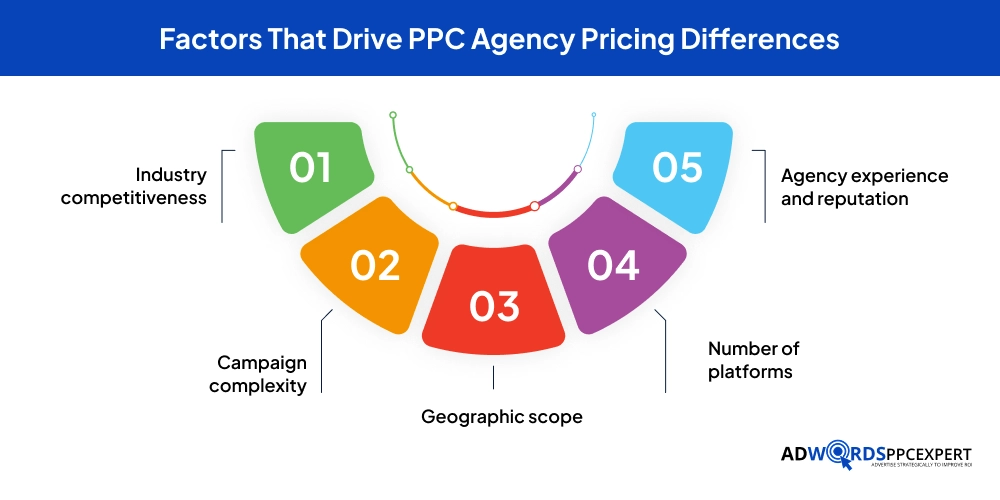
Why does one agency quote $1,500 per month while another comes in at $4,500 for what sounds like a similar scope? Several legitimate factors drive those differences.
Industry competitiveness: Highly competitive industries legal, insurance, financial services, healthcare, home improvement involve significantly higher average cost per click rates and demand more intensive campaign management. Managing a campaign where target keywords cost $50 to $100 per click requires a fundamentally different level of strategic expertise than managing one where clicks average $2.
Campaign complexity: A business running two straightforward campaigns has much simpler Google Ads management needs than one running a dozen segmented campaigns across multiple product lines, audience types, and geographic markets.
Geographic scope: A local campaign targeting a single city requires far less management overhead than a national or international campaign requiring region-specific ad copy, multilingual creative, and granular geo-targeting across many markets.
Number of platforms: Managing Google Ads alone is considerably less involved than simultaneously managing Google, Microsoft Advertising, YouTube, Meta, and LinkedIn campaigns, all of which require platform-specific expertise and ongoing attention.
Agency experience and reputation: An agency with a proven track record in your specific industry typically charges more than a generalist shop. That premium is usually well-justified, experienced agencies make fewer costly mistakes, reach performance benchmarks faster, and apply strategic insight that genuinely moves the needle.
PPC Pricing by Platform
When most businesses think about pay-per-click advertising, Google Ads is the default starting point, and rightfully so. With close to 90% of global search market share, it remains the dominant force in paid search management. But limiting your strategy to Google alone can mean missing out on meaningful and often more cost-efficient reach on other platforms.
Microsoft Advertising (formerly Bing Ads) consistently delivers lower cost per click than Google, sometimes by 40% to 70% while reaching a meaningful segment of the search market. The Microsoft audience also skews toward older demographics and B2B professionals, making it particularly valuable for certain industries. Many agencies recommend running parallel campaigns on both platforms, and managing Microsoft Ads alongside Google typically adds $200 to $600 per month to management fees depending on scope.
YouTube Advertising gives access to more than 2 billion logged-in monthly users through video ad formats. It is especially effective for brand awareness and top-of-funnel audience building, integrating directly within the Google Ads ecosystem. YouTube campaign management is typically priced separately from standard search campaigns or folded into a broader Google channel fee.
Paid Social, Meta, LinkedIn, Pinterest, operates on a fundamentally different model from paid search. Rather than capturing existing demand from users actively searching, these platforms let you reach audiences based on who they are, their demographics, interests, job titles, and behaviors. LinkedIn is especially powerful for B2B pay-per-click advertising, though its cost per click is notably higher than Google’s average. Meta Ads tend to offer lower cost per click but require strong creative and consistent A/B testing to maintain performance over time.
When comparing agency proposals, always ask for a platform-by-platform breakdown of what is covered and how each is priced. A flat monthly fee that sounds reasonable for Google Ads management alone may look very different once you factor in the full multi-platform scope you actually need.
Understanding Setup Fees and What Justifies Them
Many agencies charge a one-time setup fee at the start of a new engagement, typically ranging from $500 to $2,000, separate from ongoing monthly PPC management fees. Some clients bristle at this, especially when they are already committing to a monthly retainer. But when an agency is doing setup work properly, that fee is genuinely warranted.
Building a well-structured PPC campaign from scratch involves designing the right account and campaign architecture, conducting thorough keyword research and building out negative keyword lists, writing the initial round of ad copy across all ad groups, configuring all campaign settings, implementing and verifying conversion tracking, and assessing existing landing pages against best practices for paid traffic. Done thoroughly, this represents 15 to 25 hours of skilled, focused work.
Some agencies waive the setup fee as an incentive for clients committing to longer-term contracts. Others fold it into the first month’s invoice. Either approach is fine, what matters is that the foundational work is completed with the care and precision it deserves.
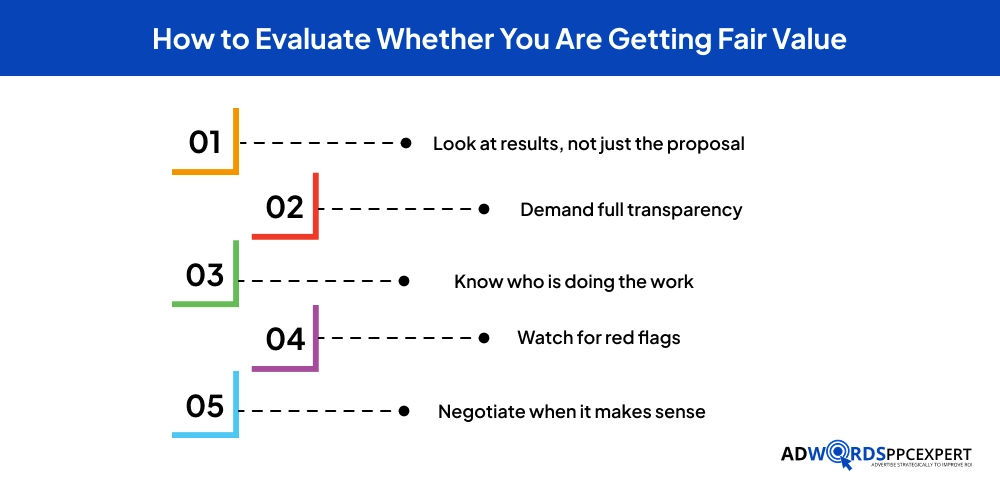
How to Evaluate Whether You Are Getting Fair Value
Price matters, but value is what actually determines whether you have made a good decision. Here is a practical framework for evaluating any PPC agency beyond just their fee.
Look at results, not just the proposal. An agency charging $3,000 per month that consistently delivers strong return on ad spend is a far better investment than one charging $1,000 per month that produces mediocre outcomes. Ask for case studies, client references, and real performance data, not just polished testimonials.
Demand full transparency. A quality agency has nothing to hide. They should give you direct access to your own Google Ads accounts, share complete reporting data, and explain clearly at any time how your budget is being allocated and why. Reluctance to share account access or evasiveness around spending details is a serious warning sign.
Know who is doing the work. Agencies vary widely in how they staff accounts. Ask specifically who will manage your campaigns on a day-to-day basis, what their experience level is, and how many accounts they are managing simultaneously. Overloaded account managers produce mediocre results regardless of how good the agency’s pitch was.
Watch for red flags. Agencies that guarantee specific results, charge more than 25% of ad spend without clear justification, write vague contracts with undefined deliverables, or resist giving you ownership of your account data should all raise immediate concerns.
Negotiate when it makes sense. Many agencies are open to negotiation, particularly for larger budgets or longer commitments. Annual contracts often reduce PPC management fees by 10% to 15% compared to month-to-month pricing. Setup fees are sometimes waived for clients committing to six-month or year-long engagements.
Final Thoughts
Understanding PPC agency pricing is not just about knowing what number to expect on an invoice. It is about knowing what you are paying for, why it costs what it costs, and how to tell the difference between an agency that is genuinely delivering and one that is simply taking up space in your budget.
The businesses that get the most from pay-per-click advertising are the ones that go in prepared. They understand the pricing models. They know what should be included in a solid paid search management package. They ask the right questions before signing and hold their agency to clear, measurable outcomes.
That is exactly the position this guide was designed to put you in.
At AdWords PPC Expert, transparency is not a talking point, it is how we operate. If you are ready to have a straight, honest conversation about what PPC management could look like for your business, we are here for it. Get in touch with our professionals today.

Ami Singh is a highly skilled AdWords PPC Specialist, known for creating profitable Google Ads strategies that elevate brands. With deep expertise in Google Search, Display, Shopping, YouTube Ads, and advanced bidding techniques, Ami consistently converts data into performance-driven results.
With a sharp analytical mind and a strong understanding of online consumer behavior, Ami designs campaigns that maximize ROI, boost quality scores, and reduce acquisition costs. His approach blends technical expertise with strategic thinking—making him a go-to expert for businesses aiming to dominate Google Ads.
Ami doesn’t just adapt to the fast-changing PPC industry, but he also stays ahead of the curve by testing new features, adopting automation smartly, and refining what works. Clients trust him for his transparency, insights, and ability to scale campaigns sustainably.
Looking to take your Google AdWords performance to the next level? Connect with Ami Singh at Softtrix and discover how he can help you get the maximum growth through powerful PPC strategies.