
Not long ago, the blue checkmark on Instagram or Facebook carried a very specific meaning. It was not something you could apply for or purchase. Verification was reserved for celebrities, journalists, politicians, and globally recognized brands. For the average creator, small business, or everyday user, verification was not even part of the conversation. It simply felt out of reach.
That reality has completely changed.
Meta’s decision to launch Meta Verified introduced a paid pathway to verification, and with it, a fundamental shift in how people think about the blue badge. What was once a symbol of public recognition is now positioned as a subscription-based service available to anyone who meets the eligibility criteria and is willing to pay a monthly fee.
This change did not just spark curiosity. It triggered skepticism, debate, and a flood of very practical questions. People did not just want to know what Meta Verified is. They wanted to understand –
- what they are actually paying for,
- whether the cost makes sense over time, and,
- whether the benefits justify turning verification into another recurring expense.
That is why one question dominates search results, creator forums, and marketing discussions today:
How much does Meta Verified cost, and is it actually worth paying for?
Answering that properly requires context. Jumping straight to pricing without understanding what Meta Verified is designed to do often leads to poor decisions, especially for creators and businesses that depend on Meta platforms for income, visibility, or customer trust.
What Meta Verified Actually Is?
Meta Verified is often misunderstood because, on the surface, it appears deceptively simple. A blue checkmark appears next to a name, and many users instinctively associate that symbol with higher reach, increased popularity, or special treatment by the algorithm. Over the years, verification badges on social platforms have become shorthand for influence and visibility, so it’s natural for people to assume the same applies here. Unfortunately, that assumption is where most of the confusion around Meta Verified begins.
In reality, Meta Verified is not a growth hack, nor is it a guarantee of more followers or engagement. It also has very little in common with the traditional verification system Meta used in the past, where badges were awarded based on public notability, media coverage, or cultural relevance. The current system operates on an entirely different model and serves a very different purpose.
At its core, Meta Verified is a subscription-based identity and trust service. When someone subscribes, Meta is not making promises about visibility or popularity. Instead, it is committing to treating that account differently behind the scenes. The platform verifies that the person or business behind the account is real and legitimate, actively works to protect that verified identity from impersonation or misuse, and provides access to faster, more reliable support when account-related issues arise.
Why Meta Created Meta Verified in the First Place?
To understand pricing, it helps to understand why Meta introduced Meta Verified at all.
Over the years, Meta’s platforms faced mounting challenges that became increasingly difficult to manage at scale. Fake profiles impersonating real people and brands became more sophisticated. Scammers began copying creators and businesses with alarming accuracy. Account hacks and takeovers increased, particularly for profiles tied to monetization. At the same time, users grew more frustrated with automated support systems that offered little help during serious account issues.
From Meta’s perspective, this created two parallel problems.
First, trust in the platform was declining. Users were losing confidence in who they were interacting with, especially in direct messages, ads, and marketplace environments.
Second, Meta needed to diversify revenue beyond advertising without fundamentally changing how its core platforms functioned.
Meta Verified addresses both sides of that equation.
For users, it offers identity confirmation, impersonation protection, and better access to support. For Meta, it monetizes trust, security infrastructure, and customer service resources that are costly to maintain at scale.
This is why Meta Verified exists. It is not a badge of fame. It is a paid service layer designed to add stability and accountability to an ecosystem that has grown too large to manage purely through automation.
How Much Does Meta Verified Cost? A Clear, Detailed Breakdown
Now that you know what Meta Verified is and why it exists, the natural next question is – how much does it actually cost? While the headline numbers might seem simple, there is a lot more to consider. Subscription costs vary depending on whether you are signing up via desktop or mobile, which platform you are verifying, whether you have a personal or business account, and how long you plan to maintain the subscription. Understanding all of these factors helps you make a fully informed decision.
Base Meta Verified Pricing for Individuals in 2026
For personal accounts, individual creators, influencers, or everyday users, Meta Verified operates on a monthly subscription model.
Here is a clear comparison table of Meta Verified pricing across major regions on a monthly subscription basis, showing approximate costs for standard individual verification depending on how users subscribe (via web vs mobile).
Region / Country |
Web Price (Desktop) |
Mobile Price (iOS / Android) |
|---|---|---|
| United States | $11.99 per month | $14.99 per month |
| United Kingdom | £9.99 per month | £11.99 per month |
| Canada | $12.99 CAD per month | $16.99 CAD per month |
| Australia | AUD 19.99 per month | AUD 24.99 per month |
| India | ₹599 per month (web plan) | ₹699 per month |
The higher mobile price exists because Apple and Google charge commission fees for in-app purchases, which Meta passes on to subscribers. For anyone aiming to minimize costs, subscribing via the web is almost always cheaper.
It is also important to note that these fees generally apply to one platform at a time. For instance, if you want both Instagram and Facebook verified, you would normally pay separately for each platform unless a bundled plan is offered. Many users assume verification is universal across all Meta platforms, but that is not the case, understanding this prevents surprises when the monthly fees add up.
Why Business Meta Verified Pricing Is Higher
For business accounts, Meta Verified costs are higher because they address risk and operational dependency, not just visibility. Businesses rely on their Meta accounts for revenue, advertising, and customer interaction. Losing access to an account, facing impersonation, or experiencing prolonged restrictions can directly impact revenue and brand credibility.
Business Meta Verified plans are tiered based on the size of the business, audience reach, and account complexity:
- Small businesses: ~$21.99 per month
- Growing brands: ~$44.99 per month
- Established businesses: ~$119.99 per month
- Enterprise brands: up to ~$349.99 per month
At first glance, these prices may seem steep, but they are designed to reflect the value of identity verification, impersonation protection, and priority support. For businesses that rely heavily on Meta for marketing, sales, or customer engagement, the subscription functions as a form of risk management: paying a fixed monthly fee protects against the much higher potential costs of downtime, scams, or account takeovers.
Annualized Costs and Long-Term Perspective
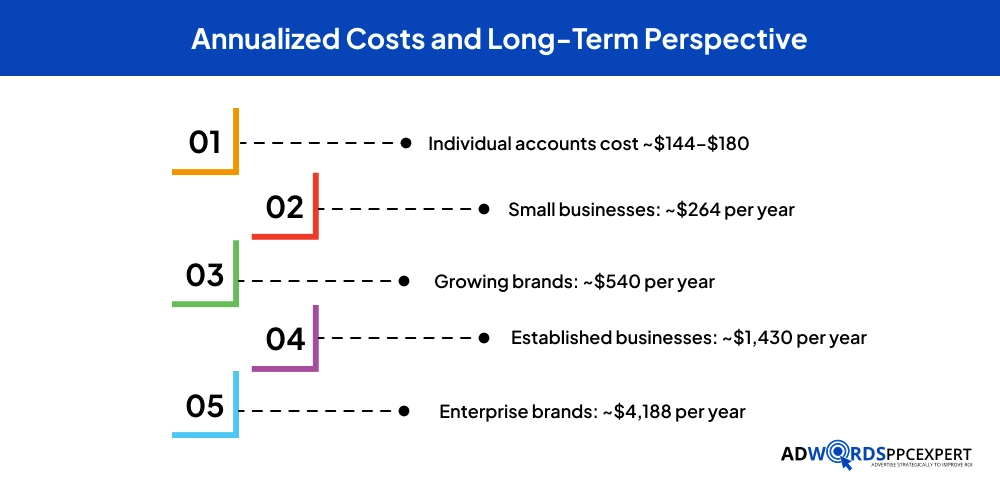
Looking only at monthly fees does not provide the full picture. Over a year:
- Individual accounts cost ~$144–$180
- Small businesses: ~$264 per year
- Growing brands: ~$540 per year
- Established businesses: ~$1,430 per year
- Enterprise brands: ~$4,188 per year
For serious creators and professional businesses, these costs are best evaluated as an investment in stability, security, and credibility. A single impersonation incident, account suspension, or lost revenue opportunity could easily exceed the annual cost of verification. Viewed this way, Meta Verified is less an expense and more a form of account insurance.
Bundles and Multi-Platform Considerations
Many users manage multiple Meta accounts, for example, Instagram, Facebook Pages, Messenger, and connected business accounts. Meta increasingly encourages bundled verification for these multi-platform operations. Bundled pricing often offers small discounts compared to subscribing to each platform individually and provides a consistent level of protection and support across all linked accounts.
For creators and businesses, this is particularly valuable. It reduces administrative complexity, ensures a uniform identity across platforms, and provides centralized verification that strengthens credibility and protection simultaneously.
Is the ROI of Meta Verified Actually Worth It?
The subscription cost should ultimately be weighed against potential benefits and risks. Meta Verified is particularly valuable for those who:
- Depend heavily on their Meta presence for revenue, brand building, or customer interaction
- Face significant impersonation risk due to a large or active following
- Want to build trust with followers, customers, or potential collaborators
- Need faster, human-led support to quickly resolve account issues
Creator ROI vs Business ROI - Who Gets More Value from Meta Verified?
When evaluating Meta Verified, creators and businesses often approach the subscription with very different expectations. While both groups pay for the same underlying service, identity verification, protection, and support, the return on investment (ROI) looks noticeably different depending on how the account is used, how revenue is generated, and how much risk is involved.
Understanding this distinction is critical, because Meta Verified is not a one-size-fits-all upgrade. For some users, the value is subtle but meaningful. For others, it can directly protect income and operations.
Creator ROI - Stability, Credibility, and Protection Over Growth
For creators, the ROI of Meta Verified is not measured in follower spikes or sudden reach increases. This is where many creators misjudge the value. Meta Verified does not change how the algorithm evaluates content, nor does it guarantee higher visibility. Instead, the return comes from stability, trust, and reduced risk.
Creators often rely on their Meta accounts as their primary digital identity. Sponsorships, brand deals, affiliate links, and audience trust are all tied to a single profile. In this context, Meta Verified acts as a safeguard. Verified identity reduces the likelihood of false takedowns, makes account recovery easier, and provides faster access to human support if something goes wrong. For creators who have experienced account lockouts or unexplained restrictions in the past, this alone can justify the cost.
Another key area of ROI for creators is impersonation protection. As creators grow, fake accounts copying their name and content become more common. These impersonators can damage reputation, confuse followers, and even scam audiences. Meta Verified does not eliminate impersonation entirely, but it improves detection and response time, limiting long-term harm.
Finally, the blue checkmark still carries perceived credibility. While it no longer signals fame, it does signal legitimacy. For creators pitching to brands, selling digital products, or building authority in a niche, this added trust can indirectly support monetization efforts, even if it doesn’t increase reach directly.
In short, creator ROI is mostly defensive and reputational. Meta Verified helps creators protect what they have already built, rather than accelerating growth.
Business ROI - Risk Mitigation, Revenue Protection, and Operational Continuity
For businesses, the ROI equation is much more direct and measurable. Business accounts often serve as core revenue channels, handling ads, customer inquiries, lead generation, and sales. Any disruption, impersonation, account suspension, hacking, or delayed support, can result in immediate financial loss.
From a business perspective, Meta Verified functions less like a subscription and more like insurance. The higher monthly cost reflects the higher stakes. Priority support can mean the difference between resolving an issue in hours instead of weeks. Faster recovery from account restrictions or ad disapprovals can prevent lost revenue during peak sales periods.
Impersonation protection also has greater financial implications for businesses. Fake accounts posing as brands can mislead customers, damage trust, and create legal or customer service issues. Meta Verified strengthens internal identity recognition, making it easier for Meta to distinguish legitimate brand accounts from fraudulent ones.
Another major ROI factor for businesses is trust at the point of conversion. When customers see a verified business profile, especially in ads, DMs, or marketplace interactions, it reduces hesitation. This can improve response rates, message engagement, and overall brand confidence, which indirectly supports conversion performance.
For businesses running paid advertising, Meta Verified also adds a layer of stability. While it does not improve ad performance algorithmically, verified businesses are less likely to face prolonged disruptions when issues arise. That reliability has tangible monetary value.
Overall, business ROI is proactive and financial. The subscription protects revenue streams, customer trust, and operational continuity.
A Comparison of Creator vs Business ROI
Creators benefit from Meta Verified by protecting their identity, reputation, and audience relationships. The ROI is strongest for mid-to-large creators who already generate income or face impersonation risk. For small or hobby creators, the value may feel optional rather than essential.
Businesses, on the other hand, often see stronger ROI because the cost of account issues is significantly higher. Even a single prevented outage, impersonation incident, or prolonged support delay can offset the annual subscription cost. For brands that rely on Meta platforms daily, Meta Verified often pays for itself indirectly.
The key difference is, creators use Meta Verified to protect momentum, while businesses use it to protect revenue.
Summary of Costs in 2026
- Individual accounts: $11.99–$14.99/month (~$144–$180/year)
- Small business: ~$21.99/month (~$264/year)
- Growing brand: ~$44.99/month (~$540/year)
- Established business: ~$119.99/month (~$1,430/year)
- Enterprise brand: up to ~$349.99/month (~$4,188/year)
While pricing may vary by region, platform, or bundle, this framework provides a practical guide for evaluating subscription value, risk mitigation, and potential ROI.
Benefits of Meta Verified (What You Are Actually Paying For)
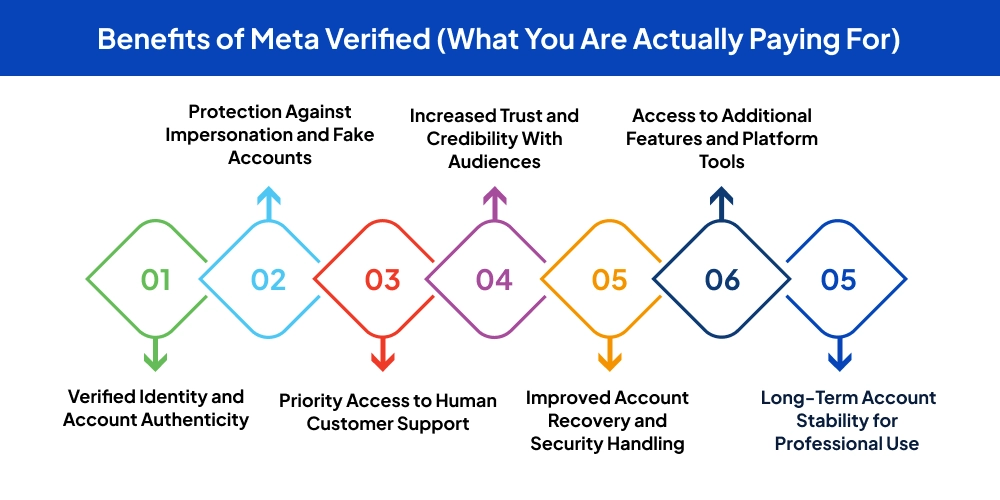
1. Verified Identity and Account Authenticity
One of the core benefits of Meta Verified is identity confirmation. Meta requires government-issued identification for individuals or official business documentation for companies before granting verification. This process ties your profile to a confirmed, real-world identity within Meta’s internal systems. As a result, your account is less likely to be flagged incorrectly, suspended due to false reports, or caught in automated moderation errors. For creators and businesses who rely on their profiles for income or customer communication, this added stability can be more valuable than any visibility-related benefit.
2. Protection Against Impersonation and Fake Accounts
Impersonation is a widespread issue across Instagram and Facebook, particularly for accounts with growing visibility. Scammers often copy profile photos, bios, and usernames to create lookalike accounts that message followers, promote fake offers, or request money. Meta Verified helps reduce this risk by enabling proactive monitoring for identity duplication associated with verified accounts. While it does not eliminate impersonation entirely, it significantly improves detection speed and response times, limiting potential damage to trust and reputation.
3. Priority Access to Human Customer Support
Standard Meta support is largely automated and can be slow, inconsistent, and frustrating, especially during urgent account issues. Meta Verified subscribers receive priority access to human-led support channels, allowing faster escalation and clearer communication. This is particularly valuable when dealing with account lockouts, unexplained restrictions, ad disapprovals, or recovery after hacking attempts. For many users, this benefit alone justifies the subscription cost.
4. Increased Trust and Credibility With Audiences
While the blue checkmark no longer represents fame, it still functions as a trust signal. For new followers, customers, or potential partners encountering your profile for the first time, verification helps reduce skepticism and hesitation. This is especially important for businesses running ads, creators selling digital products, or professionals offering services through direct messages. The badge reassures users that the account they are interacting with is legitimate and officially verified by Meta.
5. Improved Account Recovery and Security Handling
Meta Verified accounts typically receive stronger recovery options if access is lost due to hacking, phishing, or credential compromise. Because the account is tied to verified identity information, Meta can resolve recovery cases more efficiently. This reduces downtime and lowers the risk of permanently losing access to an account that may be tied to revenue, audience relationships, or ongoing campaigns.
6. Access to Additional Features and Platform Tools
Depending on the account type and region, Meta Verified may include access to profile enhancements, exclusive stickers, or early access to certain platform features. While these additions are not the primary value of the subscription, they can enhance brand presentation and offer small usability improvements. Meta continues to evolve these features, making the subscription more functional over time rather than static.
7. Long-Term Account Stability for Professional Use
For users who treat Instagram or Facebook as business assets rather than casual social platforms, Meta Verified provides long-term stability. The combination of identity verification, impersonation protection, and priority support reduces operational risk. Instead of worrying about sudden account disruptions, users can focus on content, engagement, and growth strategies with greater confidence.
Myths vs Reality - What Meta Verified Does and Does Not Change
One of the biggest misconceptions around Meta Verified is the belief that the blue checkmark comes with algorithmic advantages. Because verification used to be rare and associated with public figures, many users instinctively assume that verified accounts are prioritized in feeds, explore pages, or recommendations. This assumption feels logical, but it is not how Meta Verified works.
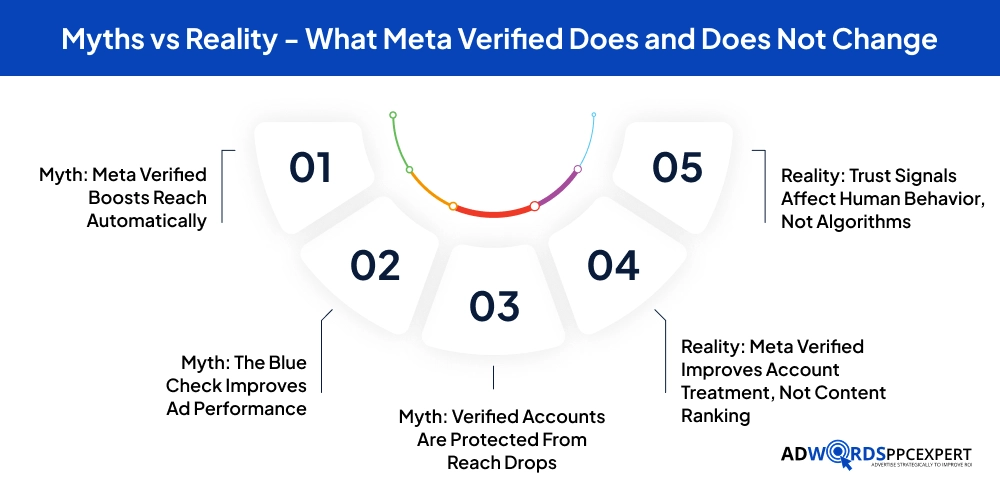
Myth: Meta Verified Boosts Reach Automatically
A common belief is that once an account is verified, Meta’s algorithm will favor its posts, pushing content to more people or increasing engagement. In reality, Meta Verified does not directly influence feed ranking, reach, or discovery. Verified accounts are evaluated by the same content-ranking signals as unverified ones, including engagement quality, watch time, relevance, and user interaction history.
Meta has been explicit that Meta Verified is not a growth tool. The subscription does not change how content is scored or distributed. If a post performs well, it does so because the audience responds positively, not because of the verification badge.
Myth: The Blue Check Improves Ad Performance
Another common assumption is that verified accounts receive better results from paid advertising. While verification can improve trust perception, it does not alter ad delivery mechanics, bidding systems, or targeting capabilities. Meta Verified does not lower ad costs, improve quality scores, or unlock special ad placements.
However, the distinction here is subtle but important. While Meta Verified does not improve ad performance algorithmically, it can improve user trust at the point of interaction. When users click an ad or receive a message from a verified account, they may feel more confident engaging. This can indirectly support performance but it is not a built-in algorithmic advantage.
Myth: Verified Accounts Are Protected From Reach Drops
Some users believe verification prevents shadowbans, reach drops, or content restrictions. This is not accurate. Verified accounts must still follow community guidelines and platform policies. Content that violates rules can still be limited or removed, regardless of verification status.
What Meta Verified does change is how issues are handled. Verified users often receive faster clarification, better communication, and quicker resolution when problems occur. This distinction matters, because it affects recovery time, not algorithmic immunity.
Reality: Meta Verified Improves Account Treatment, Not Content Ranking
The most accurate way to understand Meta Verified is to separate content performance from account treatment. Meta Verified does not influence how your content ranks, but it does influence how your account is treated internally by Meta systems.
Verified accounts benefit from stronger identity recognition, improved impersonation handling, and priority support pathways. When something goes wrong, such as false reports, access issues, or impersonation, verified accounts are more likely to receive faster and clearer responses.
This internal treatment is where the real value lies. For creators and businesses who depend on Meta platforms for income or visibility, faster resolution can prevent prolonged downtime that would otherwise impact reach and revenue indirectly.
Reality: Trust Signals Affect Human Behavior, Not Algorithms
While Meta Verified does not boost reach, it does affect how people perceive your account. The blue checkmark still signals authenticity to users, even if it no longer implies fame. This psychological trust factor can influence follower behavior, message response rates, and willingness to engage or purchase.
In other words, Meta Verified influences human trust, not algorithmic favoritism. This distinction helps explain why some users see indirect benefits, even though no official reach boost exists.
Why This Misunderstanding Persists
The confusion around Meta Verified and algorithms exists because traditional verification was rare and elite. When Meta opened verification to paid subscriptions, the visual cue remained the same, but the underlying meaning changed. Many users still associate the blue checkmark with influence, rather than identity protection.
Once this misunderstanding is corrected, expectations align better with reality, and satisfaction with Meta Verified increases.
Algorithm vs Reality
Meta Verified does not replace content strategy, creative quality, or advertising expertise. Growth still depends on consistency, relevance, and audience engagement. What Meta Verified provides is trust, protection, and stability, ensuring that creators and businesses can operate with fewer disruptions and faster support when issues arise.
Understanding this distinction is critical before subscribing, and is the difference between disappointment and realistic ROI.
When Meta Verified Is Not Worth It (And Who Should Skip It)
While Meta Verified offers real value for many users, it is not universally beneficial. In fact, one of the most important parts of deciding whether to subscribe is understanding when it does not make sense. This clarity helps avoid frustration, wasted money, and unrealistic expectations.
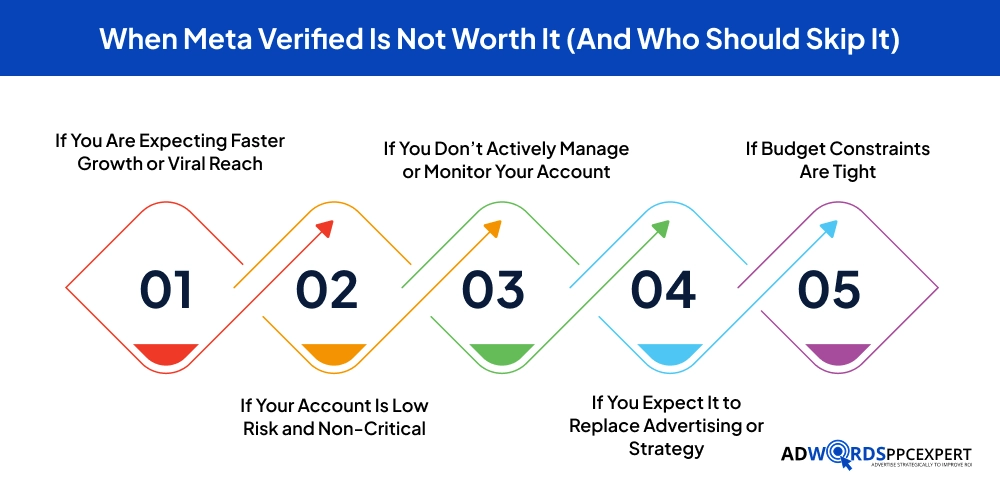
If You Are Expecting Faster Growth or Viral Reach
Meta Verified is not designed to accelerate growth. If your primary goal is to gain followers quickly, increase reach, or trigger algorithmic boosts, Meta Verified will not deliver the outcome you are hoping for. Content quality, posting consistency, audience relevance, and advertising strategy remain the dominant factors for growth.
For creators who are still experimenting with content or building an audience from scratch, the subscription cost may feel disproportionate to the benefits. Without an existing audience, income stream, or impersonation risk, the ROI is limited. In these cases, time and money are often better spent on content development, creative testing, or paid promotion.
If Your Account Is Low Risk and Non-Critical
Meta Verified provides the most value when an account is important to your income, reputation, or operations. If your Instagram or Facebook account is casual, personal, or non-essential, the subscription offers little tangible return.
Users who rarely post, do not monetize their content, and do not rely on Meta platforms professionally are unlikely to benefit meaningfully from impersonation protection or priority support. In these scenarios, Meta Verified becomes a nice-to-have rather than a necessity.
If You Don’t Actively Manage or Monitor Your Account
Verification improves how Meta treats your account internally, but it does not replace responsible account management. Users who are inactive, inconsistent, or unaware of platform policies will not see much benefit from verification alone.
Meta Verified helps when issues arise, but if an account is neglected or poorly managed, those issues may still occur. For users who do not actively engage with their audience or monitor account health, the subscription offers a limited practical advantage.
If You Expect It to Replace Advertising or Strategy
For businesses, Meta Ads Verified does not replace the need for paid advertising, content strategy, or funnel optimization. It does not lower ad costs, improve targeting, or unlock special ad inventory.
Businesses that subscribe expecting Meta Verified to fix weak campaigns or poor engagement will likely be disappointed. The service supports account stability, not performance optimization. Strategy and execution still determine results.
If Budget Constraints Are Tight
Even though Meta Verified may seem affordable monthly, it is a recurring expense. Over time, these costs add up. For creators or small businesses operating on tight budgets, it’s important to evaluate whether the subscription competes with higher-impact investments such as ad spend, tools, or professional services.
If paying for Meta Verified forces you to cut back on growth-driving activities, the tradeoff may not be worth it.
What Really Happens If You Cancel Meta Verified?
Before subscribing to Meta Verified, many users want to know what happens if they decide to cancel. Understanding the cancellation process and its consequences is just as important as understanding the benefits. Fortunately, Meta Verified does not lock users into long-term contracts, but there are important nuances to be aware of.
How Meta Verified Cancellation Works
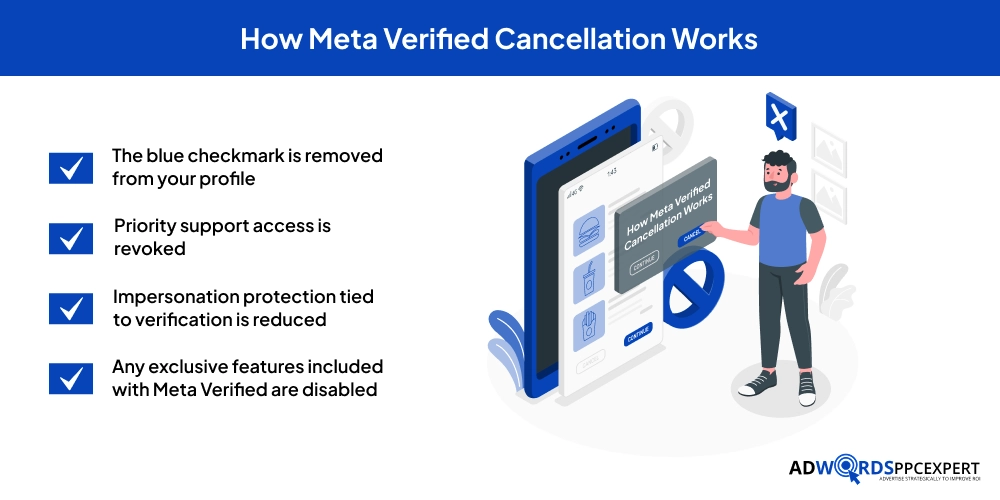
Meta Verified operates on a monthly subscription basis, which means you can cancel at any time. However, cancellation does not immediately remove your benefits. Instead, your verification remains active until the end of the current billing cycle.
Once the subscription period expires:
- The blue checkmark is removed from your profile
- Priority support access is revoked
- Impersonation protection tied to verification is reduced
- Any exclusive features included with Meta Verified are disabled
Your account itself remains intact. Cancelling Meta Verified does not restrict posting, advertising, or general platform usage. You simply return to standard account status.
Where You Cancel Matters
The cancellation process depends on how you originally subscribed. If you signed up through the mobile app, cancellation must be handled through the respective app store. If you subscribed via desktop, cancellation is managed through Meta’s account settings.
This distinction is important because many users mistakenly cancel in the wrong place and assume the subscription has ended when it has not. Checking your billing source ensures cancellation is processed correctly.
Will You Lose Your Verification History?
When you cancel Meta Verified, the verification status is removed entirely. Meta does not currently preserve verification history for future reinstatement. If you choose to re-subscribe later, you may be required to reverify your identity and go through the approval process again.
That said, previously verified users often experience smoother re-approval, especially if account details remain unchanged. Still, cancellation should be viewed as a reset, not a pause.
Does Cancellation Affect Your Account Performance?
Cancelling Meta Verified does not negatively impact reach, engagement, or algorithmic treatment. Meta does not penalize accounts for unsubscribing. Your content continues to be evaluated using the same ranking signals as before.
However, any indirect benefits related to trust perception or faster issue resolution will no longer apply. For users who rely on those protections, this is the most noticeable change.
When Cancellation Makes Sense
There are legitimate reasons to cancel Meta Verified. If your account activity decreases, your impersonation risk drops, or your business temporarily shifts focus away from Meta platforms, pausing the subscription can be a practical decision.
Some creators and businesses use Meta Verified strategically, subscribing during high-risk or high-activity periods, and cancelling when the added protection is no longer essential. This flexible approach aligns well with Meta’s month-to-month model.
Is Meta Verified Worth It for 2026?
By now you know what Meta Verified is, how much it costs, the benefits it provides, and how cancellation works. But the real question most people care about is this:
Is Meta Verified actually worth the cost today in 2026 for your specific situation?
The answer is not a simple yes or no. It depends on who you are, how you use Meta platforms, and what outcomes you care about. Let us break it down clearly.
Meta Verified Is Not a Growth Shortcut
First, let us eliminate a common misunderstanding. Meta Verified is not designed to increase reach, boost engagement, or improve algorithmic ranking on its own. If you are expecting followers to pour in faster or your Reels and posts to get prioritized in explore pages because of the blue checkmark, that is not how the system works.
The verification badge does not change the core ranking signals Meta uses. It does not make content inherently more visible.
So if your primary reason for subscribing is the belief that Meta Verified will magically grow your audience, the service is not worth it for you, at least not for that reason alone.
When Meta Verified Does Deliver Clear Value
The real worth of Meta Verified comes from areas where trust, identity, and reliability matter most. These benefits are particularly meaningful in 2026 because social platforms continue to become more hostile to unverified creators and businesses alike. Deepfake impersonators, cloned profiles, and automated moderation errors are now mainstream problems, not fringe issues.
Here are the most common scenarios where Meta Verified does pay off:
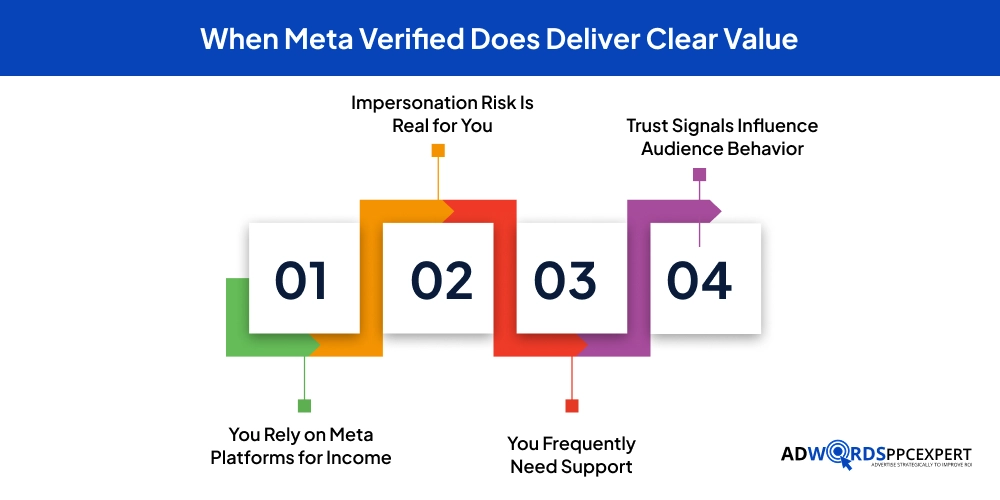
1. You Rely on Meta Platforms for Income
If you earn money through brand deals, affiliate sales, sponsored content, or customer engagements on Facebook/Instagram ads, Meta Verified starts to make financial sense. Losing access during a campaign or having to resolve impersonation issues can cost you far more than the yearly subscription.
In this context, Meta Verified becomes a form of income protection.
2. Impersonation Risk Is Real for You
If your account has visibility, even modest visibility, impersonators can crop up. Fake accounts that mimic your brand or identity harm trust, confuse followers, and can lead to scam messages being sent in your name.
Meta Verified does not eliminate impersonation entirely, but it improves detection and response time. For creators and professionals, this is a genuine reduction in risk that can protect your reputation.
3. You Frequently Need Support
Meta’s standard support channels are notoriously slow and automated. Meta Verified offers access to live human support for account issues, verification problems, ad account troubles, and more.
For anyone whose presence on these platforms directly affects income or business operations, speed of support is a real operational advantage.
4. Trust Signals Influence Audience Behavior
Even if the checkmark does not boost your algorithmic ranking, it does influence how real people perceive your profile. Verified accounts tend to feel more credible to audiences, customers, and potential collaborators, especially in niche communities where trust matters.
This can improve:
- Direct message response rates
- Brand partnership conversions
- Confidence in shopping via social storefronts
Wrapping Up!
By 2026, the question around Meta Verified is not “Will this help me grow faster?” but “What happens if I don’t have it?” Platforms are noisier, impersonation is more common, and getting human support without a verified status is still painfully slow. Meta Verified makes sense when your profile is not just social anymore, it is part of how you earn, sell, or build trust. The subscription does not replace smart content or ads, but it quietly removes risk, friction, and uncertainty in the background. And when that stability is paired with a performance-driven strategy from AdwordsPPCExpert, growth stops being reactive and starts becoming intentional, built on protection, clarity, and control rather than hope and algorithms.
Frequently Asked Questions (FAQs)
1. What is Meta Verified?
Meta Verified is a paid subscription service from Meta that confirms your identity, protects your account from impersonation, and gives you priority access to support. The blue checkmark is the visible sign of these protections, but the real value lies in account security, credibility, and peace of mind, and not algorithmic boosts.
2. Does Meta Verified increase my followers or engagement?
No. Meta Verified does not boost reach or guarantee more followers. Its purpose is trust, protection, and support. Growth still depends on content quality, consistency, and marketing strategies like ads and audience targeting.
3. Does Meta Verified increase my followers or engagement?
No. Meta Verified does not boost reach or guarantee more followers. Its purpose is trust, protection, and support. Growth still depends on content quality, consistency, and marketing strategies like ads and audience targeting.
4. Does Meta Verified replace the need for ads or content strategy?
No. While it improves trust and stability, Meta Verified does not influence algorithm performance or substitute for a strong content and marketing strategy. Paid ads, audience targeting, and creative campaigns remain essential for growth.
5. Is it worth being Meta Verified?
Meta Verified is worth it if your account matters for income, brand, or credibility. It does not boost followers or reach, but it protects your identity, prevents impersonation, and gives faster support, making it a smart investment for creators and businesses who rely on Instagram or Facebook.

Ami Singh is a highly skilled AdWords PPC Specialist, known for creating profitable Google Ads strategies that elevate brands. With deep expertise in Google Search, Display, Shopping, YouTube Ads, and advanced bidding techniques, Ami consistently converts data into performance-driven results.
With a sharp analytical mind and a strong understanding of online consumer behavior, Ami designs campaigns that maximize ROI, boost quality scores, and reduce acquisition costs. His approach blends technical expertise with strategic thinking—making him a go-to expert for businesses aiming to dominate Google Ads.
Ami doesn’t just adapt to the fast-changing PPC industry, but he also stays ahead of the curve by testing new features, adopting automation smartly, and refining what works. Clients trust him for his transparency, insights, and ability to scale campaigns sustainably.
Looking to take your Google AdWords performance to the next level? Connect with Ami Singh at Softtrix and discover how he can help you get the maximum growth through powerful PPC strategies.