

Are you a law firm owner who has poured money into Google Ads only to watch the budget drain with barely a consultation to show for it?
Have you looked at what other firms in your market are doing, firms that seem to be everywhere online and wondered whether paid advertising is actually the reason their phones ring more than yours? Or are you at the very beginning, trying to figure out whether lawyer PPC advertising is even worth considering before you commit to a number that makes you nervous?
If any of those scenarios sound familiar, this guide was written for you. Not for marketers. Not for agencies selling services. For attorneys and law firm owners who need to understand the real cost of winning cases through paid digital advertising in 2026, and whether the investment makes financial sense for a practice like theirs.
Here is the honest truth before we dive in, legal PPC is not cheap. It has never been cheap. And in 2026, it is more expensive than it has ever been. The legal industry consistently ranks among the top three most expensive categories in all of Google advertising, sitting alongside insurance and financial services, industries where high-value transactions justify high acquisition costs. A single click on a competitive personal injury keyword in Los Angeles or New York can cost more than $200. A well-run campaign in a mid-sized market might spend $8,000 a month and still be considered conservative.
But expensive and unprofitable are two entirely different things. And that distinction is the entire point of this guide.
When the economics are understood correctly, when you know what you are actually paying for, what the real benchmarks are, what drives costs up and what pulls them down, and what separates law firms that build their entire case pipeline on paid search from those that burn through budget without results, the question changes. It stops being “is this too expensive?” and starts being “am I set up to make this work?”
That is the conversation we are going to have in this blog. No vague estimates, no oversimplified ballparks. Just what lawyer PPC actually costs, why it costs that much, and what it takes to make those costs generate real cases for your firm.
What Is Lawyer PPC and How Does It Actually Work for Law Firms?
PPC stands for Pay-Per-Click. It is a form of paid digital advertising where you only pay when someone actively clicks on your ad. In the legal context, that means your firm’s advertisement appears at the very top of Google’s search results, above every organic listing, above every local map pack result, and above every competitor who relies purely on SEO, when a prospective client searches for the exact legal service you offer. You pay nothing for the exposure. You only pay when that person chooses to click.
For law firms, this model works on a fundamental insight about how people hire attorneys in 2026. When someone’s car gets hit by a commercial truck, when a loved one is diagnosed with mesothelioma from workplace asbestos exposure, when an employee is wrongfully terminated two weeks before their pension vests, those people don’t wander the internet casually. They search with urgency and specificity. They type “truck accident lawyer in Houston” or “mesothelioma attorney near me” or “wrongful termination lawyer free consultation.” These are not informational searches. These are people actively trying to find someone to hire, often within the hour.
That search intent is what makes PPC structurally different from every other form of law firm advertising. A billboard seen by 50,000 commuters might contain 40 people who need a personal injury attorney, and only a handful of those will remember your firm’s name when they actually need one. A Google Ads campaign, by contrast, only shows your ad to people who are actively searching for what you do, in the moment they are searching for it. You are not interrupting their day. You are answering a question they are already asking.
This is also why understanding the cost of legal PPC requires more context than just knowing what a click costs. The reason a car accident keyword in Miami can cost $175 per click is not because Google is exploiting law firms. It is because the attorney who wins that click, converts it into a consultation, and retains that client may earn $30,000 to $100,000 in fees from a single case. When the unit economics work like that, a $175 click is not expensive, it’s a calculated bet. The question is whether your firm has built the infrastructure to win that bet consistently.
Why Legal PPC Is Uniquely Positioned for Law Firms
Most articles about PPC advertising for any industry list the same generic benefits, that is instant visibility, measurable ROI, scalable budget, and so on. Those things are true, but they don’t explain why paid search is particularly well-suited to the way law firms operate and the way legal clients make decisions. The reasons legal PPC works as well as it does are specific to the legal industry itself.
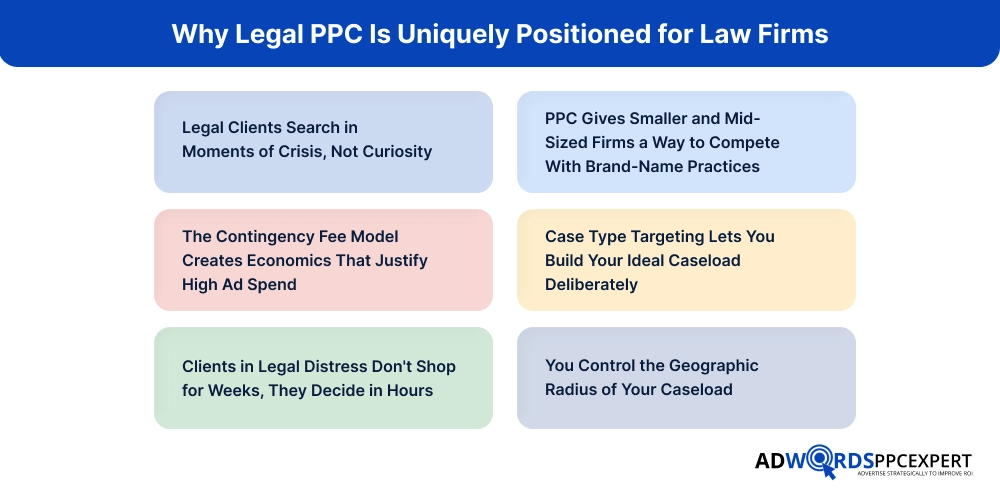
Legal Clients Search in Moments of Crisis, Not Curiosity
Unlike someone shopping for a new pair of sneakers or browsing vacation destinations, people who search for legal help are typically in some form of distress. They have just been arrested. Their spouse served them with divorce papers. They are watching a workers’ comp case drag out while the bills pile up. This emotional urgency creates a search behavior that is fundamentally different from almost any other consumer category. People search with immediate intent, they want answers fast, and they are actively evaluating who to hire, often within the first search session. PPC puts your firm directly in that window of maximum receptivity. No other advertising format can do that with the same precision.
The Contingency Fee Model Creates Economics That Justify High Ad Spend
In personal injury, medical malpractice, mass tort, and many other practice areas, attorneys work on contingency, meaning the firm earns nothing if the case is lost and a percentage of the settlement if it’s won. This model fundamentally changes how law firms should think about acquisition costs. If your average PI case fee is $40,000 and you close one in ten leads, you can afford to pay $4,000 per lead and still break even. In practice, well-optimized campaigns generate leads at far less than that, which means the ROI on paid advertising in contingency-based practice areas can be extraordinary, often 5x to 15x return on ad spend for well-run campaigns.
Clients in Legal Distress Don't Shop for Weeks, They Decide in Hours
Research specific to the legal intake process shows that the majority of people who search for a lawyer contact a firm within the first 24 hours of their search, and a significant portion hire the first attorney who picks up the phone and responds meaningfully. This compressed decision timeline means that appearing at the top of the page at the exact moment of search is not just advantageous, it is often the difference between winning and losing the case opportunity entirely. PPC delivers that top-of-page presence on demand, and no other channel can match the speed and precision of that placement.
PPC Gives Smaller and Mid-Sized Firms a Way to Compete With Brand-Name Practices
For solo attorneys and smaller practices, competing for name recognition against large regional firms with decades of brand equity and television advertising budgets is nearly impossible through organic means. SEO favors established domains. Billboards favor deep pockets. But in a Google Ads auction, a well-optimized campaign from a two-attorney firm can consistently outrank a 50-attorney regional powerhouse, if the Quality Score is higher, the keywords are more specific, and the landing page is better built. PPC is one of the few advertising channels that genuinely levels the playing field for smaller legal practices willing to invest in doing it right.
Case Type Targeting Lets You Build Your Ideal Caseload Deliberately
Law firms don’t just want more cases, they want more of the right cases. A personal injury firm that specializes in trucking accidents doesn’t want slip-and-fall inquiries clogging their intake. A criminal defense attorney focused on federal cases does not want misdemeanor traffic ticket calls. Lawyer PPC advertising allows practice-area-level targeting with surgical precision. You can run entirely separate campaigns for different case types, each with its own keywords, its own messaging, its own budget allocation, and its own landing page, so the volume you build is calibrated to the cases your firm actually wants to take. No other advertising channel gives a law firm that level of intentional pipeline shaping.
You Control the Geographic Radius of Your Caseload
Courts are local. Cases have venue requirements. A personal injury firm licensed in New York has no use for a client inquiry from California. PPC’s geographic targeting lets you define your service area down to the ZIP code, adjust bids by proximity to your office, and focus every dollar on the specific market where your attorneys are licensed and where your firm can actually take cases. For multi-office firms, this means each location can run its own targeted campaigns calibrated to its local market — something that simply is not possible with TV advertising, billboards, or even most directory placements.
The Six Factors That Determine What Your Firm Will Pay Per Click
Before getting into specific cost benchmarks, it’s worth understanding what actually drives CPC in legal advertising, because knowing this gives you actionable leverage over your costs, not just passive awareness of what they are.
Practice Area and Case Value
This is the single biggest driver of legal CPC, and the relationship is direct, the higher the average case value in a practice area, the more law firms are willing to bid per click, and the higher the auction price climbs for everyone. Mesothelioma and mass tort keywords sit at the most expensive end of the spectrum because a single signed case can generate hundreds of thousands of dollars in fees. Personal injury and auto accident keywords are expensive for the same reason. Family law and estate planning keywords are considerably cheaper because the average fee per matter is lower, and firms are not willing or able to sustain the same bid levels. Understanding where your practice area falls on this spectrum is the starting point for any realistic cost conversation.
Geographic Market and Competition Density
Your location is a major cost determinant that operates independently of your practice area. The exact same keyword “car accident lawyer” can cost $75 per click in a mid-sized Midwestern city and $200-plus in Manhattan or Los Angeles, simply because there are more firms bidding on that term in the competitive market. Major metros consistently sit at the top of CPC ranges for every practice area. Tier-2 cities are typically 20 to 40 percent less expensive. Smaller markets can be 50 percent cheaper still, though that gap narrows every year as more firms adopt paid advertising. Geographic bid layering, adjusting bids based on proximity to your office, by county, by ZIP code, or even by neighborhood, is one of the primary ways experienced campaign managers reduce wasted spend in competitive markets.
Keyword Specificity and Search Intent
Not all legal keywords are created equal, and not all of them warrant the same bid strategy. A broad search like “lawyer” carries very little inherent intent, the person typing it could be looking for almost anything. A search like “truck accident attorney free consultation Dallas” carries extremely high intent, that person knows they need an attorney, they are in Dallas, and they are specifically looking for someone who offers a free consultation. Long-tail, intent-rich keywords like this one convert at dramatically higher rates than generic terms, and in many cases, they also face less competition, making your cost per signed case lower even if the per-click cost is similar. Building a campaign around specificity rather than volume is one of the most reliable ways to improve ROI without increasing spend.
Quality Score
Every keyword in your Google Ads account carries a Quality Score from 1 to 10. This score reflects three signals: how likely someone is to click your ad when it appears, how relevant your ad copy is to the keyword being searched, and how useful and relevant your landing page is to someone who clicks. Quality Score is not a vanity metric, it directly affects how much you pay per click. A keyword with a Quality Score of 8 can cost significantly less per click than the same keyword with a Quality Score of 4, even in the same auction. Firms with well-structured campaigns, tight ad group theming, and purpose-built landing pages consistently achieve lower CPCs than competitors running generic, loosely organized campaigns. Better Quality Score costs nothing in additional budget, it’s entirely a function of campaign craftsmanship.
Campaign Age and Optimization History
New campaigns pay what experienced PPC managers often call a “learning tax.” In the first four to eight weeks, Google’s algorithm is gathering data about which users are most likely to convert for your specific account, which keywords produce calls rather than just clicks, and which times of day and device types your highest-value traffic comes from. This learning period typically produces above-average CPCs and below-average conversion rates. Firms that judge a new campaign after 30 days of data and shut it down are almost always abandoning the campaign right before the algorithm’s improvements begin to compound. A campaign running for six months with consistent optimization will always outperform the same campaign at month one, in CPC, in conversion rate, and in cost per signed case.
Landing Page Quality and Conversion Architecture
Your landing page is not a passive destination for your ad traffic. It is the fulcrum of your entire campaign’s economics. The difference between a landing page that converts 4% of visitors into inquiries and one that converts 12% is a 66% reduction in your cost per lead, without changing your budget, your bids, or a single keyword. Law firm landing pages that are built for conversion share specific characteristics: they are focused on a single case type, they load in under two seconds on mobile, they feature trust signals like case results, bar certifications, and client testimonials prominently, they have a clear and frictionless contact form above the fold, and they are designed to match the exact promise of the ad that sent the visitor there. Firms that treat landing page optimization as a one-time setup rather than an ongoing priority consistently pay more per lead than necessary.
What Are Law Firms Actually Paying Per Click in 2026?
Understanding CPC benchmarks by practice area is essential for realistic budget planning. Here is what the data from large-scale legal advertising spend analysis shows for 2026:
At the most affordable end of the legal keyword spectrum sit general, unmodified terms, searches like “attorney” or “lawyer” without a practice area or location. These run $10 to $25 per click. They are cheap for a reason, they attract mixed-intent traffic that converts poorly, and the cost per signed case from these terms is often worse than from more expensive, targeted keywords.
Family law and divorce attorney keywords typically cost $15 to $45 per click depending on the market. These are competitive enough to require dedicated campaigns and strong landing pages, but the CPC is manageable for most firms because the practice area has relatively predictable retainer values and a broad pool of potential clients.
Criminal defense keywords, including DUI, drug charges, and assault defense, run from $25 to $75 per click in most markets. These keywords are often searched in urgent contexts, late at night or on weekends following an arrest, which means ad scheduling and fast response systems matter enormously for conversion.
Employment law keywords covering wrongful termination, wage theft, and workplace discrimination tend to fall between $30 and $80 per click. These can be highly profitable to target because the searchers are often emotionally invested in their situation and motivated to act quickly.
General personal injury keywords start around $50 and climb to $120 per click in competitive markets. Auto accident attorney keywords push into the $75 to $200 range. Truck accident and commercial vehicle keywords, which carry higher average case values, regularly cost $90 to $200 or more. Medical malpractice keywords span $100 to $250 per click in most major markets.
At the top of the spectrum sit mass tort and asbestos-related keywords. Mesothelioma attorney keywords, arguably the most expensive legal keywords in existence, regularly cost between $200 and $400 per click, and in the most competitive markets, even higher. The reason is simple, a single mesothelioma case can result in a seven-figure verdict or settlement. At a 33% attorney fee, the economics of paying $400 per click are entirely rational for firms in that practice area.
For context on the directional trend: legal CPCs have increased approximately 12 to 15 percent year-over-year entering 2026, one of the steeper rates of increase among professional service categories. This is a structural trend, not a temporary fluctuation, and planning for continued CPC growth is a reasonable assumption for any multi-year marketing strategy.
In reality, what you will pay per click depends enormously on what you are advertising and to whom. Here is how real estate CPCs break down in 2026:
From Click to Lead: Understanding Cost Per Lead by Case Type
Cost per click tells you what it costs to get someone to your website. Cost per lead tells you what it costs to get someone to raise their hand, that is to call your office, fill out your contact form, or initiate a chat. CPL is the metric that should anchor your budget planning and performance benchmarking, and it is driven by the relationship between your CPC and your landing page conversion rate.
Based on industry data from campaigns representing over $21 million in annual legal ad spend analyzed across 2024 and 2025, the average cost per lead for personal injury practice areas breaks down meaningfully by case type. Slip and fall cases average around $312 per lead. Workplace injury claims come in around $354. Auto accident inquiries average approximately $391 per lead. Product liability cases generate leads at closer to $476 due to more specialized targeting. Medical malpractice, with its complex messaging requirements and higher keyword costs, averages around $512 per lead.
These figures represent blended national averages. Regional variation is significant and cannot be ignored in any serious budget conversation. Law firms in the Northeast consistently pay the highest CPLs in the country, averaging around $468 per lead across personal injury categories. The West Coast averages roughly $401. The Southeast sits around $382. The Midwest is the most affordable region for legal paid advertising, with average CPLs near $314. That means a PI firm in Boston or Manhattan is paying roughly 49 percent more per lead than an equivalent practice in Indianapolis or Columbus, for leads of comparable quality. Applying national averages to a Northeast market campaign will leave you systematically underfunded from the first month.
Family law CPLs tend to run between $200 and $450 depending on market and how specifically the campaign is targeted. Criminal defense leads typically cost $180 to $380, with DUI keywords at the higher end of that range because the urgency of the search drives more competition. Employment law leads are often among the most cost-efficient in the legal vertical when targeted properly, running $150 to $300 per lead in most mid-sized markets.
The critical variable behind all of these CPL figures is your landing page conversion rate. The national average conversion rate for law firm websites and landing pages sits between 4 and 6 percent. Purpose-built, continuously optimized legal landing pages consistently achieve 10 to 14 percent or higher. Consider what that means in dollar terms. At a $100 CPC and a 5% conversion rate, your cost per lead is $2,000. At the same CPC with a 12% conversion rate, achieved purely through landing page improvements with no change to your ad spend, your CPL drops to $833. The same campaign, the same keywords, the same budget, but 57% lower cost per lead. Landing page investment is not a nice-to-have in legal PPC. It is the most financially impactful decision in your entire campaign.
How Much Should Your Law Firm Budget for PPC? A Tier-by-Tier Breakdown
There is no single correct budget for legal PPC, but there are clear, data-backed ranges that correspond to your firm’s size, practice area, market competitiveness, and the case volume you need to sustain your revenue goals.
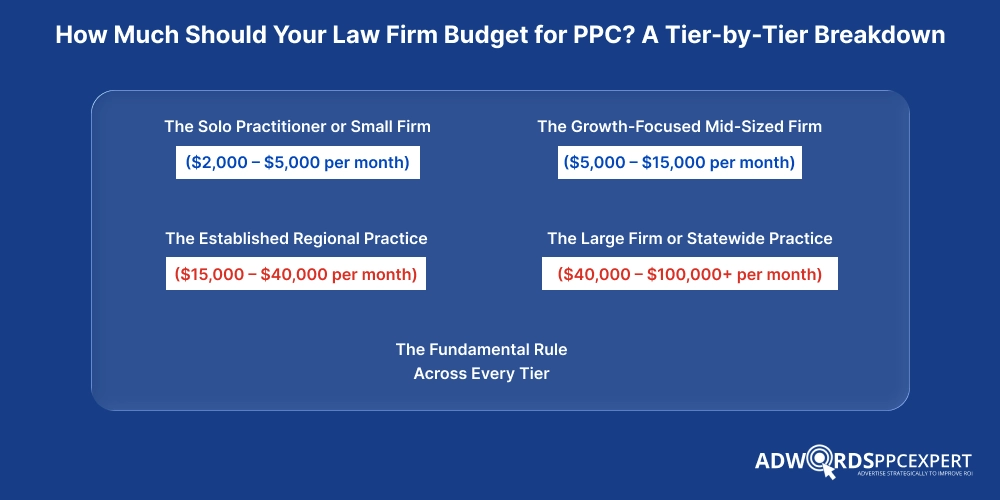
The Solo Practitioner or Small Firm ($2,000 – $5,000 per month)
At this investment level, a focused single-practice-area campaign in a non-major metro market is viable. This budget works best when the strategy is narrow and deliberate, meaning, one practice area, one geography, one conversion goal, one well-built landing page. Below $2,000 per month in a competitive legal market, Google’s machine learning algorithm lacks enough conversion data to optimize meaningfully, and CPLs tend to remain stubbornly high. At $3,000 to $5,000 per month in a mid-sized market with solid landing pages and a structured intake process, a realistic expectation is 8 to 18 leads per month. Closing even one case every six weeks from those leads, at an average family law retainer of $4,000 that generates a positive return at this investment level.
The Growth-Focused Mid-Sized Firm ($5,000 – $15,000 per month)
This is the budget range where legal paid advertising begins to develop real momentum. At $5,000 to $15,000 per month, firms can run concurrent campaigns across multiple practice areas or geographies, invest meaningfully in high-value keywords, begin building retargeting audiences, and generate enough conversion data for smart bidding algorithms to operate effectively. In a competitive mid-market, this level of investment should produce 20 to 50 leads per month depending on practice area CPLs. A personal injury firm spending $10,000 per month in this tier, with a structured intake team and optimized landing pages, can realistically sign four to eight new cases per month, producing revenue that far exceeds the advertising cost.
The Established Regional Practice ($15,000 – $40,000 per month)
At this level, firms can pursue a comprehensive multi-campaign architecture: separate campaigns by case type, geo-targeted campaigns for multiple office locations, dedicated remarketing campaigns to re-engage prior visitors, and seasonal budget adjustments to capitalize on high-conversion periods. Lead volumes in this tier range from 50 to 150 or more per month, and campaign management complexity increases accordingly. At this scale, the sophistication of your campaign structure, negative keyword depth, bid strategy calibration, landing page testing cadence, becomes as important as budget size in determining your CPL.
The Large Firm or Statewide Practice ($40,000 – $100,000+ per month)
Large regional and national firms with multiple practice areas and high-volume intake teams operate at this level, often running dozens of simultaneous campaigns across multiple states and geographies. These campaigns require dedicated PPC management, advanced audience segmentation, and integration with CRM and intake systems to handle the lead volume effectively. At the upper range of this tier, monthly lead volumes can exceed 300, and the primary constraint shifts from generating leads to having enough qualified attorneys and intake staff to handle them.
The Fundamental Rule Across Every Tier
Never invest in more leads than your intake infrastructure can actually handle. A $20,000 per month campaign that generates 80 leads a month is worthless if your intake team contacts 30 of them. Setting your budget requires honest assessment of both the volume you can generate and the volume you can actually work.
The Hidden Costs That Most Law Firms Forget to Budget For
Your Google Ads spend is the most visible line item, but it is not the only cost in a properly run legal PPC program. Accurate ROI calculation requires accounting for everything.
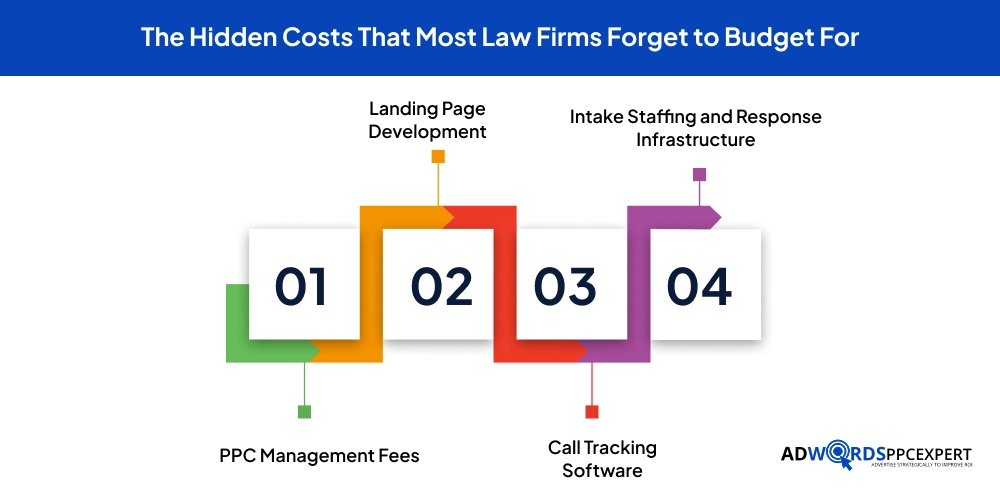
PPC Management Fees
Unless you are managing campaigns yourself, which requires significant technical expertise, ongoing time investment, and continuous education about platform changes, you will be working with an agency or specialist. Legal PPC management fees typically run between 15 and 25 percent of monthly ad spend on a percentage model, or $1,500 to $8,000 per month on a flat retainer depending on campaign complexity. On a $10,000 monthly campaign, management fees typically add $1,500 to $2,500. These fees are justified when a skilled manager reduces your CPL by 30 to 50 percent through continuous optimization, the math almost always supports professional management at any meaningful budget level, but you should be demanding of results in return.
Landing Page Development
A purpose-built, conversion-optimized landing page for each distinct campaign is non-negotiable for serious legal paid advertising. Sending paid traffic to your general firm website homepage, a page designed to educate and inform, not to convert urgent inquiries, typically produces conversion rates of 1 to 3 percent. Dedicated legal landing pages built for conversion achieve 8 to 14 percent. That gap in conversion rate translates directly into CPL, and the CPL difference between a 2% and a 10% converting page more than covers the cost of the page itself within the first month of operation. Professional legal landing page development runs $2,000 to $8,000 per page. If you are targeting multiple practice areas or geographies, budget for multiple pages.
Call Tracking Software
Legal PPC generates phone calls as frequently as it generates form submissions, and you need to know exactly which keywords, which ads, and which campaigns are driving those calls. Call tracking software assigns unique phone numbers to your various campaigns, records calls, and integrates attribution data back into your analytics and Google Ads account. Without call tracking, you are making optimization decisions based on incomplete data. Quality legal call tracking platforms run $150 to $500 per month depending on call volume.
Intake Staffing and Response Infrastructure
This is the cost that most firms never factor into their PPC budget, and it’s often the most consequential one. Research specific to the legal intake process consistently shows that response time within five minutes of a new inquiry produces dramatically higher consultation booking rates than responses after thirty minutes or longer. A lead generated at 7 PM on a Tuesday that does not receive a callback until 9 AM Wednesday has likely already hired someone else. After-hours legal intake answering services run $300 to $1,000 per month depending on call volume. Intake training and CRM software add additional costs. But these investments directly determine your intake conversion rate, which is the multiplier between your CPL and your cost per signed case. Skipping them while spending $10,000 a month on ads is like filling a bucket with a hole in the bottom.
The Mistakes Law Firms Make with PPC Advertising
Understanding where money gets wasted is as valuable as knowing where to invest it. These are the mistakes that drain ROI fastest in legal paid advertising campaigns.
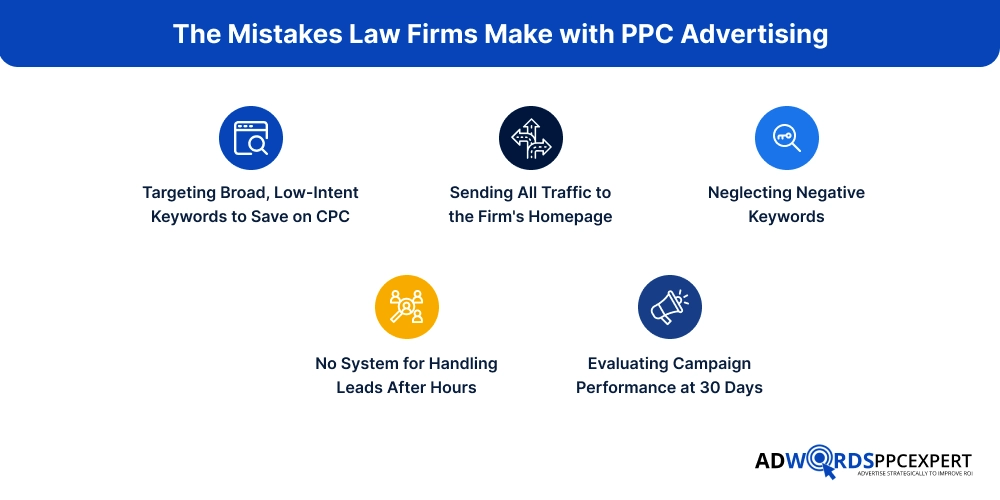
Targeting Broad, Low-Intent Keywords to Save on CPC
It seems logical, cheaper clicks mean more clicks for the same budget. In practice, broad keywords attract researchers, law students, people looking for legal aid, and casual browsers who have no intention of hiring a private attorney. The “cheap” $10 click that never converts into a lead costs more per case than the $90 click from someone who searched “car accident attorney free consultation Houston.” CPC is not the metric to minimize. CPL and cost per signed case are.
Sending All Traffic to the Firm's Homepage
This is the single most common and most costly mistake in legal PPC. Your homepage was designed to give an overview of your firm, list your practice areas, introduce your attorneys, and provide general information. It was not designed to convert an urgent inquiry from someone who just got hurt and needs help immediately. Traffic sent to a homepage from a PPC campaign converts at 1 to 3 percent. Traffic sent to a dedicated, focused landing page converts at 8 to 14 percent. That difference is the difference between a profitable campaign and one that exhausts your budget without producing results.
Neglecting Negative Keywords
Legal campaigns without robust negative keyword lists bleed money through irrelevant clicks. Searches for “free lawyer,” “pro bono attorney,” “legal aid near me,” “law school,” “lawyer salary,” “attorney jobs,” “legal definition,” and dozens of similar terms will trigger your ads if you haven’t explicitly excluded them. Building a comprehensive negative keyword list before launch and updating it every week based on the actual search terms that triggered your ads is one of the most reliable and cost-free ways to improve campaign efficiency.
Evaluating Campaign Performance at 30 Days
New legal PPC campaigns run in a learning phase for the first four to eight weeks. During this period, Google’s algorithm is gathering conversion data, building Quality Scores, and identifying patterns in who converts for your account. CPCs are typically higher and conversion rates lower during this phase than they will be at campaign maturity. Firms that evaluate a new campaign after one month of data and conclude that PPC “doesn’t work” are almost always abandoning a campaign right before the compounding returns begin. A minimum 90-day evaluation window is appropriate for any new legal paid advertising program.
No System for Handling Leads After Hours
A substantial portion of legal searches happen outside of business hours, evenings and weekends are peak times for accident and arrest-related searches, and stress-driven family law and employment inquiries happen at all hours. A campaign that generates leads at 8 PM and does not respond until 9 AM the next morning is not running a paid search campaign. It is running a very expensive research project for competing firms that pick up the phone at night. The after-hours response infrastructure is not optional for law firms investing seriously in paid advertising.
Eight Proven Strategies to Reduce Your Legal PPC Costs Without Sacrificing Case Volume
Rising CPCs are a structural reality in legal advertising. But higher costs don’t have to mean lower ROI. These strategies are what the highest-performing law firm campaigns are doing in 2026 to drive efficiency without cutting the pipeline.
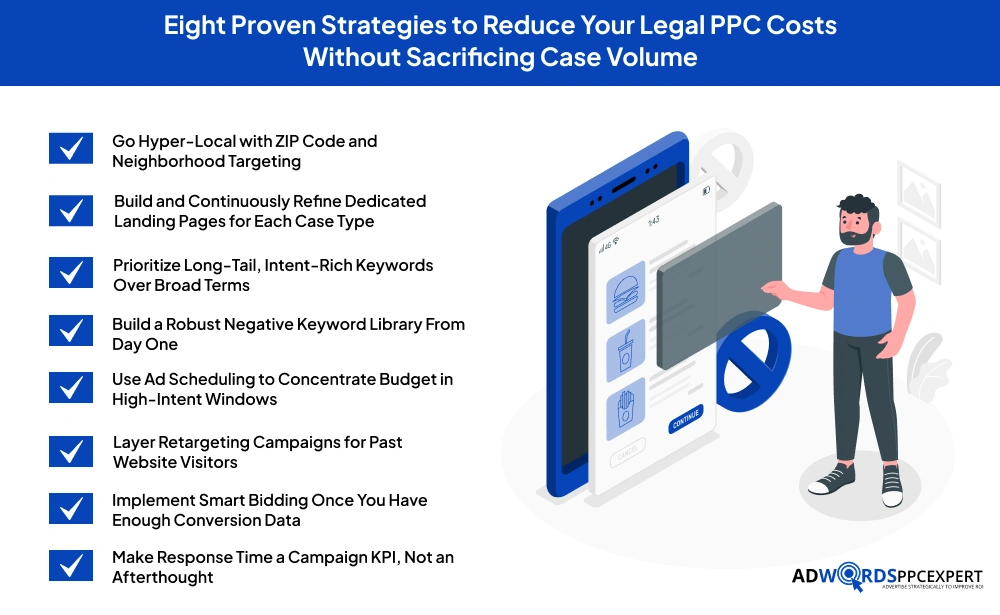
Go Hyper-Local with ZIP Code and Neighborhood Targeting
Instead of bidding on city-wide or metro-wide keywords, narrow your targeting to specific ZIP codes, neighborhoods, or custom radius areas around your office. This reduces your competition pool to only the firms bidding on that specific micro-geography, makes your ads more relevant to the searcher’s context, and almost always produces lower CPCs and higher conversion rates. Firms that shift from metro-wide targeting to hyper-local campaigns regularly report CPL reductions of 25 to 40 percent without any decrease in lead quality.
Build and Continuously Refine Dedicated Landing Pages for Each Case Type
Every major campaign should drive traffic to a landing page built specifically for that case type, with messaging, trust signals, and a contact form calibrated to that specific audience. An auto accident landing page should feature accident-relevant imagery, case results from vehicle accident cases, and copy that speaks directly to someone who was just in a collision. A criminal defense landing page should emphasize immediate availability, experience in local courts, and discretion. Generic pages kill conversion rates. Specificity drives them up.
Prioritize Long-Tail, Intent-Rich Keywords Over Broad Terms
Searching “attorney” gets you generic, expensive traffic. Searching “motorcycle accident attorney free consultation Detroit” gets you someone who has already identified their legal need, their location, and their preference for how to engage. Long-tail keywords face less competition, carry more intent, and convert at substantially higher rates. Building campaigns around specificity rather than volume almost always produces better economics even when the per-click costs appear similar.
Build a Robust Negative Keyword Library From Day One
Before you spend your first dollar, invest time building a comprehensive exclusion list. In legal campaigns, this means excluding searches for legal aid, pro bono services, legal jobs and careers, law school and education queries, specific statute or case law searches, and general informational legal content. Update this list weekly from your search term reports. Every irrelevant click you prevent is a CPL reduction that compounds over the lifetime of your campaign.
Use Ad Scheduling to Concentrate Budget in High-Intent Windows
In criminal defense, the highest-intent searches happen in the evening and overnight hours when arrests occur. In personal injury, post-accident searches spike on weekday mornings and early afternoons after commute-hour collisions. In family law, searches often peak on Sunday evenings and Monday mornings when couples have processed a difficult weekend. Identifying your practice area’s peak intent windows and weighting your budget toward those hours, while reducing spend during historically low-conversion periods, extracts more cases from the same monthly investment.
Layer Retargeting Campaigns for Past Website Visitors
The majority of people who click a legal ad and visit your landing page do not convert on the first visit. They may need to think about it, compare a few firms, or come back when the moment feels right. Retargeting campaigns on Google Display Network and Meta allow you to serve follow-up ads specifically to these prior visitors, people who have already demonstrated interest in your firm, at a fraction of the cost of acquiring a new cold click. In legal marketing, where trust takes time to build and the decision to hire an attorney carries real weight, retargeting is one of the most efficient uses of supplemental budget available.
Implement Smart Bidding Once You Have Enough Conversion Data
Google’s automated bidding strategies, that is Target CPA, Target ROAS, and Maximize Conversions, optimize your bids in real time using machine learning signals about conversion probability. These strategies work powerfully once a campaign has accumulated enough conversion history, typically 30 to 50 conversions over a recent 30-day period. For campaigns with this level of data, smart bidding consistently outperforms manual bidding over time. For campaigns that don’t yet have that data, manual bidding with controlled budgets is the appropriate strategy while the data builds.
Make Response Time a Campaign KPI, Not an Afterthought
The single most impactful improvement many law firms can make to their PPC ROI does not happen inside Google Ads at all. It happens in the intake process. Implementing a five-minute response protocol for new digital inquiries, whether through live intake staff, an answering service, or a structured callback system, can improve intake conversion rates by 20 to 40 percentage points. At a $400 CPL, a 10% improvement in intake conversion rate reduces your cost per signed case by more than $1,000. That improvement happens not in the campaign, but in the phone system and the staffing process. Both are part of the same investment.
What the Top Law Firm PPC Campaigns Do Differently To Outperform
After studying legal paid advertising campaigns across dozens of markets and practice areas, one thing becomes clear very quickly, the firms generating exceptional returns are not necessarily spending more than everyone else. They are simply doing things that most firms are not, consistently, deliberately, and without cutting corners. Here is exactly what separates them.
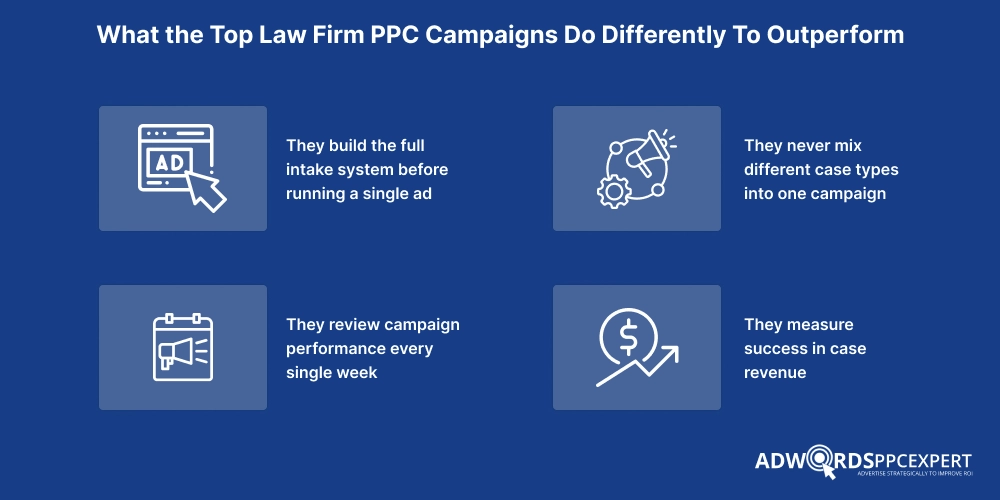
They build the full intake system before running a single ad
- Their dedicated landing page is live, tested, and converting before the campaign ever goes live
- Call tracking is already configured, every incoming call is tied back to the exact keyword that generated it
- Their CRM is set up to capture every lead automatically and route it to the right person instantly
- The intake team has a practiced, documented response protocol, who handles a new inquiry, how fast they respond, and what happens next
- They treat advertising as the final switch they flip on a system that is already ready, not the starting point for figuring things out
The firms that get this right understand one simple truth, the ad gets someone to raise their hand. Everything between that click and a signed retainer agreement is what actually wins the case.
They never mix different case types into one campaign
- Auto accidents run in their own campaign, with their own keywords, ad copy, landing page, and budget
- Truck accidents run separately, that is different case value, different search intent, different message entirely
- Slip and fall, medical malpractice, and workers' comp each get their own dedicated campaign structure
- Even geography is separated, that is a firm with multiple offices never lumps all locations into one campaign
When everything runs together, the data blurs and hides exactly what is working and what is quietly draining the budget. Clean separation means clean data, and clean data is what makes real optimization possible.
They review campaign performance every single week
- Search term reports are pulled and reviewed weekly to catch irrelevant queries before they burn through budget
- Keywords generating clicks but zero consultations are paused immediately, not left running out of inertia
- Ad headlines are tested regularly with a clear hypothesis, not changed randomly on a whim
- Hour-by-hour and day-by-day data is analyzed to find the windows where leads are most likely to convert
- Budget adjustments are made proactively, before performance slips, not after
The paid search landscape shifts constantly. A campaign that isn’t actively managed every week is quietly getting worse even when the monthly spend stays exactly the same.
They measure success in case revenue
- Clicks, impressions, and even lead volume are tracked but never celebrated as measures of success
- The only question that drives every optimization decision is - how much did this campaign generate in attorney fees this month?
- The only question that drives every optimization decision is - how much did this campaign generate in attorney fees this month?
- A campaign producing 100 leads at $200 each but signing only two cases is recognized immediately as a failure, regardless of how the numbers look on the surface
- A campaign producing 20 leads at $600 each but converting eight of them into retained clients is understood to be the stronger performer by a wide margin
The top firms have internalized one thing above all else: the metric that matters is money in the door. Every other number is just a stepping stone toward that outcome, or a distraction from it.
Final Thoughts
Lawyer PPC advertising in 2026 is expensive. There is no version of this guide that ends with a different conclusion. The cost of a single competitive click, the management fees, the landing page investment, the intake infrastructure,it all adds up to a real, meaningful commitment that should not be entered into casually or without understanding the mechanics.
But here is what the cost numbers cannot tell you on their own, they cannot tell you that somewhere in your city right now, someone is in the middle of a crisis that requires legal representation. They are on Google. They are typing right now. And the attorney who shows up at the top of their search, with a message that speaks directly to their situation, a landing page that builds trust in thirty seconds, and an intake team that answers the phone with genuine urgency, that attorney gets the case.
The firms winning with paid advertising in 2026 are not the biggest spenders. They are the most systematic operators. They have built campaigns with precision, landing pages with purpose, and intake processes with accountability. They have connected the dots between a $100 click and a $30,000 case fee, and they know exactly what happens in between.
If your firm is ready to build that system, the return is there. It is measurable, it is attributable, and for the right practice areas with the right execution, it is among the highest-ROI investments in legal business development.
Ready to Find Out What a Properly Built Legal PPC Campaign Could Generate for Your Firm?
At AdWordsPPCExpert, we specialize in building performance-driven Google Ads campaigns for law firms that want predictable, sustainable case growth from paid search. From practice-area-level keyword strategy and Quality Score optimization to conversion-focused landing pages and intake alignment, our team builds the complete system, not just the ads.
Frequently Asked Questions
How much should a law firm budget for PPC in 2026?
There is no universal number, but $3,000 to $5,000 per month is a realistic starting point for smaller firms in mid-sized markets. Competitive practice areas like personal injury in major metros require $10,000 to $20,000 or more monthly to generate a meaningful case pipeline. Below $2,000 per month in any competitive market, you will struggle to gather enough data for the campaign to optimize effectively.
Is PPC better than SEO for law firms?
They serve different purposes. SEO builds long-term organic visibility but takes six to twelve months to produce consistent results. PPC delivers immediate placement at the top of search results from day one. Most successful law firms run both, PPC fills the pipeline now while SEO reduces dependence on paid traffic over time. If you need cases this quarter, PPC is the faster path.
Why are legal keywords so expensive compared to other industries?
Because the case values justify it. When a single personal injury settlement generates $30,000 to $100,000 in attorney fees, firms are rationally willing to pay $100 or more per click. That tolerance for high acquisition costs across the entire legal industry drives up auction prices for everyone, including firms in lower-value practice areas competing in the same geographic markets.
How many leads can a law firm realistically expect from PPC each month?
It depends on budget, market, and campaign quality. A $5,000 per month campaign in a mid-sized market with a well-built landing page should realistically generate 12 to 25 leads per month. A $15,000 campaign in a competitive metro with optimized targeting can produce 30 to 60 leads. Lead volume without a strong intake process, however, does not translate to signed cases.

Ami Singh is a highly skilled AdWords PPC Specialist, known for creating profitable Google Ads strategies that elevate brands. With deep expertise in Google Search, Display, Shopping, YouTube Ads, and advanced bidding techniques, Ami consistently converts data into performance-driven results.
With a sharp analytical mind and a strong understanding of online consumer behavior, Ami designs campaigns that maximize ROI, boost quality scores, and reduce acquisition costs. His approach blends technical expertise with strategic thinking—making him a go-to expert for businesses aiming to dominate Google Ads.
Ami doesn’t just adapt to the fast-changing PPC industry, but he also stays ahead of the curve by testing new features, adopting automation smartly, and refining what works. Clients trust him for his transparency, insights, and ability to scale campaigns sustainably.
Looking to take your Google AdWords performance to the next level? Connect with Ami Singh at Softtrix and discover how he can help you get the maximum growth through powerful PPC strategies.