
Key Takeaways
- There is no fixed PPC budget for franchises. Set your budget based on each location's market, competition, and lead goals.
- Calculate your budget using a simple formula: Monthly PPC Budget = Desired Leads × Target CPA.
- Key factors that influence your budget include number of locations, local search demand, CPC, industry competition, and customer lifetime value (LTV).
- Typical monthly budgets: New franchises $1,500–$3,500, growing franchises $3,500–$8,000, and established multi-location franchises $8,000–$30,000+.
- Allocate most of your budget (60–70%) to local search campaigns, with the remainder for brand protection, remarketing, and testing.
- Review performance regularly and adjust your budget based on CPA, lead quality, and ROI, not industry averages.
Wondering if PPC advertising works the same way for every franchise?
The short answer is no.
Running PPC campaigns for a franchise is very different from managing paid ads for a single-location business.
You’re not advertising one business. You’re managing multiple markets, different levels of competition, brand guidelines, and the individual goals of each franchise location.
As a result, a budget that generates a steady flow of leads in one city may struggle to deliver the same results in another.
That’s why there isn’t a one-size-fits-all PPC budget for franchises.
Instead of asking, “How much should we spend?”, the better question is:
“How much does each location need to invest to generate profitable leads?”
The answer depends on several factors, including local competition, search demand, cost per click (CPC), customer value, and your lead generation goals.
In this guide, we’ll explain how experienced PPC specialists build franchise advertising budgets, where your investment delivers the greatest impact, and how to avoid wasting money on campaigns that fail to generate qualified leads.
Why Franchise PPC budgeting is more complex than traditional PPC
Simply put, setting a PPC budget for a single business is usually much simpler than setting one for a franchise with multiple locations. When you’re running campaigns for just one location and one service, the process is relatively straightforward. Once you identify a profitable cost per lead, it’s much easier to scale the budget.
On the other hand, franchise businesses don’t have that advantage. Every location operates in a different market, which means advertising costs and lead opportunities can vary significantly. Factors like local competition, search demand, population size, seasonality, and even customer behaviour all affect how much budget a particular location actually needs.
Single Business |
Franchise Business |
|---|---|
| One service area | Multiple locations serving different markets |
| One PPC campaign or account structure | Multiple campaigns tailored to individual territories |
| Competes against one local competitor landscape | Each location competes with a unique set of local competitors |
| Managed with a single advertising budget | Separate budgets can be allocated for each franchise location |
Here’s simple example
Let’s say there’s a personal injury law firm with one office in Chicago and another in Des Moines. Both offices offer the same legal services, but the advertising landscape is completely different.
In Chicago, keywords like “personal injury lawyer” or “car accident attorney” are highly competitive. Many law firms bid aggressively on these terms, which pushes the cost per click much higher. In Des Moines, there are fewer firms competing for the same searches, so the average CPC is much lower.
If both locations receive the same monthly PPC budget of $8,000, the Chicago office could spend its budget well before the month ends, causing ads to stop showing while potential clients are still searching. Meanwhile, the Des Moines office may have budget left over because it doesn’t need to spend as much to generate qualified leads.
This is where an experienced PPC agency makes a real difference. Instead of splitting the budget equally, they analyse the competition, search demand, historical conversion data, and cost per lead for each location. Based on those insights, they allocate more budget to competitive markets that need it, while avoiding unnecessary spend in locations where leads can be generated at a lower cost.
The goal isn’t to give every location the same budget. It’s to give every location the budget it needs to generate the best possible return.
The Two Budget Layers Every Franchise Needs
Most successful franchise PPC programs run on two coordinated budget layers:
National/Brand Budget
Owned and managed by corporate
Focused on brand awareness, brand-term protection (bidding on your own name so competitors can’t steal clicks), and top-of-funnel demand generation
Usually a flat percentage of overall marketing revenue, set annually.
Local/Co-op Budget
Funded by individual franchisees, often matched or supplemented by a co-op fund from corporate
Focused on location-specific keywords, local service pages, and geo-targeted campaigns
Tied directly to store-level performance metrics (calls, bookings, walk-ins, online orders)
Get this split wrong, and you’ll see one of two failure patterns: corporate overspending on brand terms while stores get no local traffic, or franchisees fighting each other in the same ad auctions because there’s no coordination.
What actually determines your franchise PPC Budget?
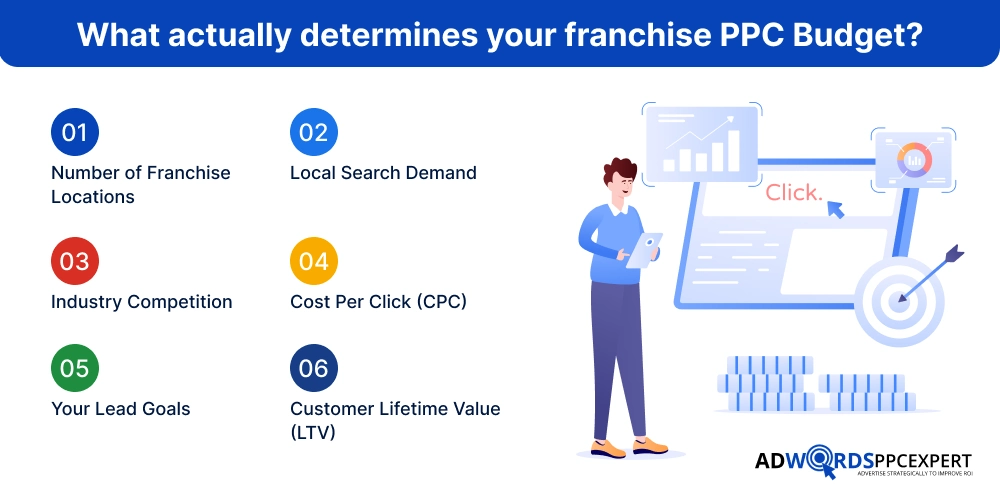
A successful PPC budget isn’t based on assumptions. It requires experience and the right strategy. Before recommending how much a franchise should invest, experienced PPC specialists analyse several key data points. Here are the factors that have the biggest impact.
1. Number of Franchise Locations
The number of franchise locations is one of the biggest factors that affects your PPC budget. Every location has its own audience, competitors, search demand, and cost per click. As you expand into more cities, your budget shouldn’t just increase; it needs to be planned separately for each market.
Example
Suppose you’re running a home cleaning franchise.
1 location: Around $2000/month may be enough to generate consistent leads.
5 Locations: You’ll likely need $9000 – $12000/month, not simply $1000 split evenly.
Why?
One location may need only $1500 because search demand is low, while another busy city could require $3,000 to remain competitive.
The budget should follow each location’s market opportunity, not be divided equally.
2. Local Search Demand
People don’t search for the same services at the same rate in every city. Some locations generate thousands of relevant searches every month, while others have only a fraction of that demand. If you ignore this difference, you’ll either overspend in smaller markets or limit growth in high-demand areas.
Before setting a budget, look at:
Monthly search volume
Population size
Seasonal demand
Local buying behaviour
Example:
A roofing franchise has two locations.
Target City |
Estimated Monthly Search Volume |
Recommended Monthly PPC Budget |
|---|---|---|
| Dallas | 5,800 searches | $4,500/month |
| Boise | 1,600 searches | $1,800/month |
Although both locations sell the same service, Dallas has much higher search demand. Investing only $1,800 there would cause the campaign to miss a large number of potential customers.
3. Industry Competition
Some franchise industries are naturally more competitive than others, which directly affects how much you need to invest in PPC.
When more businesses bid on the same keywords, the cost per click increases. As a result, franchises in highly competitive industries often need a larger budget to generate enough traffic, collect meaningful data, and maintain consistent ad visibility.
This is why there’s no fixed PPC budget that works for every franchise. A budget that works well for one industry may not be enough for another. Before setting a budget, it’s important to evaluate your industry’s average CPC, competition level, and expected cost per lead.
4. Cost Per Click (CPC)
Your average CPC has a direct impact on how many visitors your budget can buy. Here’s a simple comparison.
Industry |
Average Cost Per Click (CPC) |
Estimated Clicks from a $3,000 Budget |
|---|---|---|
| Cleaning Franchise | $5 | ~600 clicks |
| Plumbing Franchise | $18 | ~167 clicks |
| Personal Injury Franchise | $60 | ~50 clicks |
This is why two franchises with the same monthly budget can generate completely different volumes of traffic.
5. Your Lead Goals
Don’t start by choosing a budget. Start by deciding how many qualified leads each franchise location actually needs. Your PPC budget should support your business goals, not the other way around.
For example, if one location needs 20 new customers each month while another needs 60, giving both locations the same budget rarely makes sense. Their lead targets are different, so their investment should be too.
Example:
A pest control franchise wants 60 qualified leads each month.
Campaign data shows:
Average CPC: $8
Landing page conversion rate: 10%
To generate 60 leads, you’ll need approximately 600 clicks.
600 clicks × $8 = $4,800/month
This approach gives you a realistic budget based on your business goals instead of selecting a random number.
6. Customer Lifetime Value (LTV)
The more revenue a customer generates over time, the more you can afford to invest in acquiring them.
Example:
A cleaning franchise earns around $400 from an average customer.
Spending $250 to acquire that customer leaves very little profit.
Now compare that with an HVAC franchise, where the average customer spends around $8,000 over several years through installations, repairs, and maintenance plans.
Even if the HVAC franchise pays $600 to acquire a new customer, the return can still be highly profitable.
That’s why high-value franchise businesses often invest much larger PPC budgets—they know a single customer can cover the acquisition cost many times over.
A Simple Formula to Calculate Your PPC Budget
A practical budgeting formula is:
Monthly Budget = Desired Leads × Target CPA
Example:
- Lead goal: 80
- Target CPA: $65
Monthly Budget:
80 × $65 = $5,200
If you don’t yet know your CPA, estimate it using industry benchmarks, then refine it after collecting campaign data.
How Much Should a Franchise Spend on PPC?
There isn’t a universal number. Instead, consider your business stage.
Franchise Stage |
Suggested Monthly PPC Budget |
|---|---|
| New Franchise | $1,500–$3,500 |
| Growing Franchise | $3,500–$8,000 |
| Established Multi-Location Franchise | $8,000–$30,000+ |
These ranges assume you’re advertising on Google Search with professionally managed campaigns. Highly competitive industries may require significantly larger budgets.
Where the Budget Should Actually Go
Once the budget is set, here’s a reasonable breakdown for how it should be spent:
60–70% – Local search campaigns (Google Search, Local Services Ads, location-targeted Performance Max)
10–15% – Brand protection (bidding on your own brand + location name so competitors and aggregators don’t intercept your traffic)
10–15% – Retargeting/remarketing for people who visited a location page or started a booking/order and didn’t convert
5–10% – Testing budget for new campaign types, new geographies, or new offers before rolling them out system-wide
What Are the Signs of a Low PPC Budget?
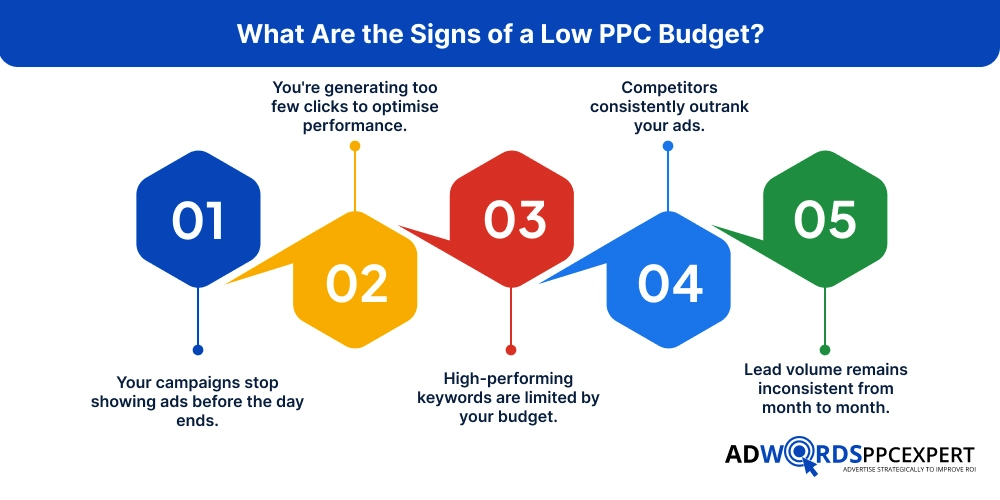
Below are the key signs that indicate your PPC budget may be too low for your campaigns. Keep in mind that a small budget doesn’t always save money. In many cases, it limits your campaign’s ability to perform and generate consistent results.
Common warning signs you shouldn't ignore:
- Your campaigns stop showing ads before the day ends.
- You're generating too few clicks to optimise performance.
- High-performing keywords are limited by your budget.
- Competitors consistently outrank your ads.
- Lead volume remains inconsistent from month to month.
If you’re experiencing any of these issues, increasing your budget strategically may improve campaign performance rather than simply increasing your ad spend.
What are The Biggest Mistake Franchise Businesses Make
Letting every franchisee run their own uncoordinated campaigns – this causes internal bidding wars and inconsistent brand messaging
Ignoring negative keyword sharing across locations – if one location learns a keyword doesn’t convert, every location should benefit from that insight
Underfunding new location launches – new stores need a visibility push, not the same steady-state budget as an established location
Not adjusting budget seasonally by market – a location in a tourist-heavy area has very different seasonal demand than one in a suburban market
No shared reporting standard — if every location tracks performance differently, corporate can’t make system-wide budget decisions with confidence
Final Says!
A franchise PPC budget should never be based solely on industry averages. Instead, allocate your budget based on your growth objectives, the markets you serve, your customer lifetime value (LTV), and the cost of acquiring profitable leads.
Start with the number of leads you need, calculate a realistic cost per acquisition, and build your budget from there. As campaign data accumulates, adjust your investment based on measurable performance rather than assumptions.
When every pound or dollar is tied to a clear objective, PPC becomes a predictable growth channel rather than a marketing expense.

Ami Singh is a highly skilled AdWords PPC Specialist, known for creating profitable Google Ads strategies that elevate brands. With deep expertise in Google Search, Display, Shopping, YouTube Ads, and advanced bidding techniques, Ami consistently converts data into performance-driven results.
With a sharp analytical mind and a strong understanding of online consumer behavior, Ami designs campaigns that maximize ROI, boost quality scores, and reduce acquisition costs. His approach blends technical expertise with strategic thinking—making him a go-to expert for businesses aiming to dominate Google Ads.
Ami doesn’t just adapt to the fast-changing PPC industry, but he also stays ahead of the curve by testing new features, adopting automation smartly, and refining what works. Clients trust him for his transparency, insights, and ability to scale campaigns sustainably.
Looking to take your Google AdWords performance to the next level? Connect with Ami Singh at Softtrix and discover how he can help you get the maximum growth through powerful PPC strategies.