
Advertising on Facebook continues to be a powerful growth channel for businesses of all sizes in 2026. With billions of active users across Facebook, Instagram ads, and Meta’s broader network, combined with AI-driven targeting and delivery, the platform still offers an unmatched ability to reach the right people at the right time.
That said, running Facebook ads today is not as simple as setting a budget and hitting publish. Competition is higher, the platform is smarter, and costs can vary widely depending on how campaigns are built. This naturally leads to the question nearly every advertiser asks before investing – how much does it actually cost to advertise on Facebook in 2026?
In this guide, we will walk through the real factors that influence Facebook advertising costs, share current cost benchmarks, explain how pricing changes based on campaign goals and industries, and show you how to budget more strategically. You will also learn practical ways to control ad spend, improve efficiency, and maximize return on ad spend (ROAS), without relying on guesswork.
By the end, you will have a clear, realistic understanding of Facebook ad costs in 2026 and the confidence to plan campaigns that are built for performance, not just visibility.
Understanding How Facebook Advertising Pricing Works in 2026
To understand how much it costs to advertise on Facebook in 2026, it’s important to first understand how Facebook actually prices ads. Unlike traditional advertising channels, where you pay a fixed fee for placement or impressions, Facebook advertising operates on a real-time, auction-based system that runs continuously in the background.
Every time someone opens Facebook, Instagram, or Messenger, Facebook instantly evaluates thousands of ads competing for that user’s attention. Within milliseconds, the platform decides which ad to show, in which placement, and at what cost. This decision is not based on budget alone. Instead, Facebook calculates what it calls total ad value, which is determined by three key factors:
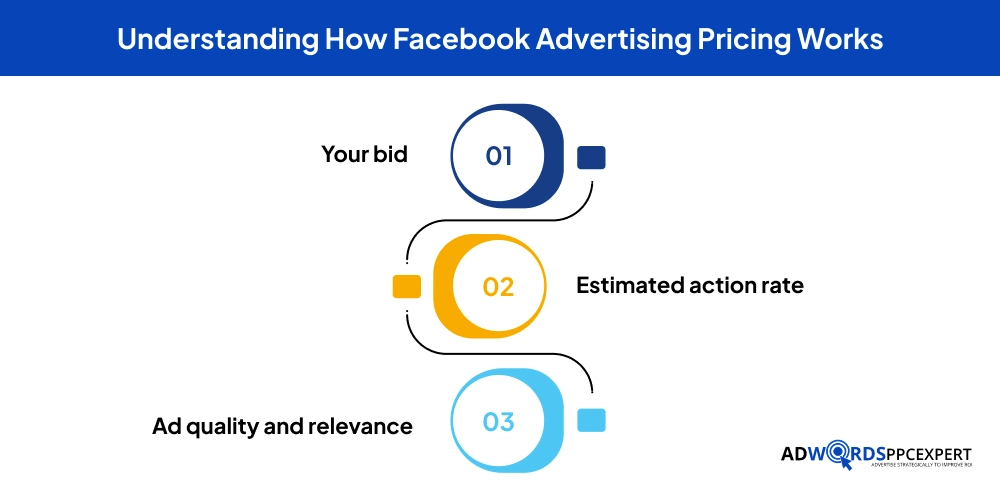
Your bid
This is the maximum amount you are willing to pay for a desired action, such as a click, impression, or conversion. While higher bids can increase competitiveness, they do not guarantee better placement on their own.
Estimated action rate
Facebook predicts how likely a user is to take the action you are optimizing for based on past behavior, engagement signals, and historical performance. Ads that are more likely to generate clicks, leads, or purchases are favored because they improve the user experience.
Ad quality and relevance
Facebook evaluates how valuable your ad is to users. This includes feedback, engagement levels, creative quality, messaging clarity, and how well the ad matches user intent. Ads perceived as helpful or relevant often win auctions at lower costs.
Because of this system, two advertisers targeting the same audience can see dramatically different costs. A brand with strong creative, clear messaging, and high engagement may win auctions at a lower price than a competitor with a larger budget but weaker ad quality.
In 2026, Facebook’s AI-driven optimization has become even more sophisticated. The platform now places greater emphasis on relevance, user behavior patterns, and predictive performance, making strategy, creative testing, and campaign structure far more important than budget size alone. Advertisers who understand and work with this system are far more likely to control costs and achieve consistent results.
Average Facebook Advertising Costs in 2026
When businesses ask how much it costs to advertise on Facebook in 2026, they are usually looking for concrete numbers they can use for planning and budgeting. While Facebook does not offer fixed pricing, and results vary widely, industry data, agency experience, and platform benchmarks provide realistic cost ranges that help set expectations.
These benchmarks should be used as reference points, not guarantees. Actual costs depend heavily on industry competition, audience targeting, campaign goals, and how well ads are executed.
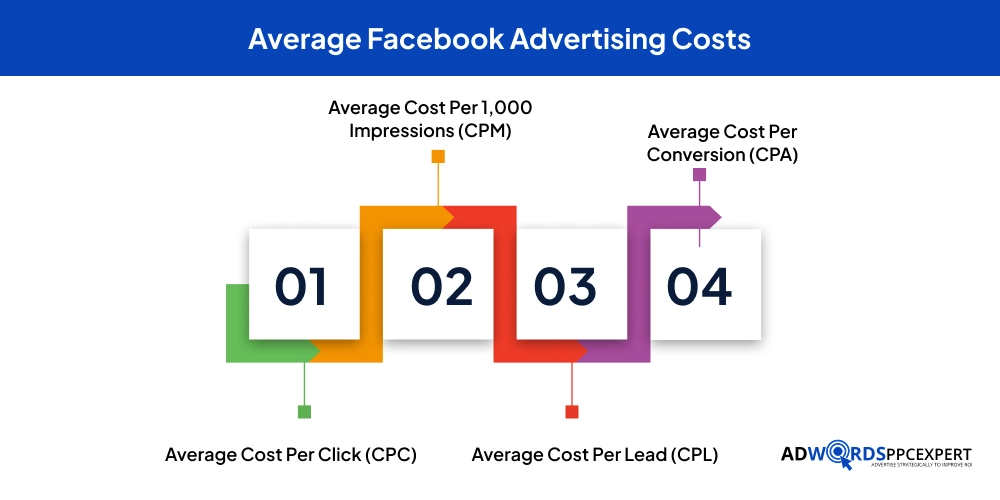
Average Cost Per Click (CPC)
In 2026, most advertisers see average CPCs ranging between $0.80 and $3.50. This metric reflects how competitive your audience is and how engaging your ads are.
Industries such as legal services, financial products, insurance, and high-ticket B2B often experience CPCs above $5 per click due to intense competition and high customer lifetime value. On the other hand, local service providers, niche ecommerce brands, and well-defined audiences can often maintain CPCs under $2 when ads are highly relevant.
CPCs are also influenced by creative performance. Ads with strong visuals, clear messaging, and high engagement frequently achieve lower CPCs even in competitive markets.
Average Cost Per 1,000 Impressions (CPM)
CPMs in 2026 typically fall between $7 and $18, representing the cost to show your ad 1,000 times. This metric is most affected by audience demand and seasonality.
During high-competition periods, such as holidays, product launches, or major sales events, CPMs often rise as more advertisers compete for the same users. Broader audiences and lower competition usually result in lower CPMs, while narrow or premium audiences drive higher costs.
CPM is an important early indicator of market competitiveness, but it does not measure performance on its own.
Average Cost Per Lead (CPL)
For lead generation campaigns, CPLs commonly range between $15 and $120. This wide range reflects differences in industry value and conversion difficulty.
CPL is influenced by several critical factors, including the strength of your offer, how competitive your industry is, the clarity of your landing page, and the effectiveness of your follow-up process. A well-structured lead funnel with clear messaging and trust signals can significantly lower CPL, even with higher traffic costs.
Higher CPLs are not necessarily a problem if lead quality and close rates justify the spend.
Average Cost Per Conversion (CPA)
For ecommerce and service-based businesses, average CPAs in 2026 often fall between $25 and $250 or more, depending on product pricing, sales cycle length, and funnel complexity.
Lower-priced products typically require higher conversion volume and more optimized funnels to remain profitable, while higher-ticket offers can tolerate higher CPAs if margins support it. Upsells, recurring revenue, and customer lifetime value all play a role in determining whether a CPA is sustainable.
Industry Benchmarks
Although global figures provide context, advertising costs on Facebook fluctuate by industry:
Industry | Avg. CPC | Avg. CPM | Avg. CPA |
|---|---|---|---|
| Retail / E-commerce | ~$0.50 | ~$7.30 | ~$12.00 |
| Financial Services | ~$2.50 | ~$12.00 | ~$30.00 |
| Healthcare | ~$1.20 | ~$10.00 | ~$18.00 |
| Travel & Hospitality | ~$0.90 | ~$9.50 | ~$20.00 |
| Education & Training | ~$0.60 | ~$6.80 | ~$14.00 |
These figures are averages, your business’s results may vary based on campaign strategy, targeting, and ad creative quality.
Why Benchmarks Are Not Performance Goals
These cost ranges are meant to provide context, not targets. A low CPC or CPA does not automatically mean success, just as a higher cost does not always indicate poor performance. The real goal of Facebook advertising in 2026 is profitable and scalable results, not simply cheaper clicks or impressions.
Comparing Facebook Ad Costs with Other Platforms
Understanding the cost to advertise on Facebook in 2026 also benefits from comparing it with other platforms:
- Instagram: Often integrated within Meta ads, metrics are similar but can lean slightly higher for visual placement.
- Google Ads: Search intent is stronger but CPC often costs more than Facebook.
- LinkedIn: LinkedIn advertising generally carries higher CPCs and CPMs, especially for B2B audiences.
- TikTok: TikTok’s dynamic format may yield higher CPMs for broad awareness but lower CPCs when well-targeted.
Facebook remains a balanced platform, offering competitive reach and impressions at relatively lower costs compared to some alternatives, especially for broad branding and conversion goals.
What Has Changed About Facebook Advertising Costs in 2026?
Facebook advertising in 2026 is shaped by multiple structural, technological, and behavioral shifts. Costs today are influenced less by simple bidding and more by how well advertisers understand the platform’s evolving ecosystem. Below are the most important changes that directly affect Facebook ad costs, explained in practical terms.
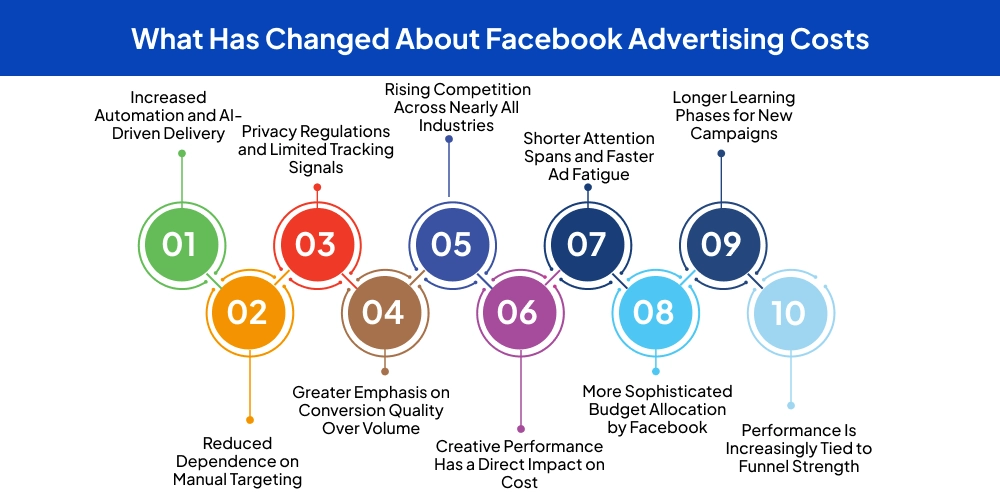
1. Increased Automation and AI-Driven Delivery
Facebook now relies heavily on artificial intelligence to control how ads are delivered, optimized, and scaled. Machine learning systems automatically manage audience expansion, bid adjustments, creative rotation, and budget allocation based on predicted performance. This shift means advertisers who design campaigns with clear objectives, sufficient conversion data, and flexible structures tend to see more stable costs. Those who resist automation or restrict learning signals often experience higher CPCs and inconsistent results, as the system lacks enough data to optimize efficiently.
2. Reduced Dependence on Manual Targeting
In earlier years, advertisers relied heavily on detailed interest targeting to control costs. In 2026, Facebook prioritizes behavioral signals and performance data over narrow manual selections. Overly restrictive targeting can limit delivery and increase costs, while broader targeting combined with strong creative allows Facebook’s AI to find high-intent users more efficiently. This change has shifted cost control away from targeting tactics and toward creative quality and campaign structure.
3. Privacy Regulations and Limited Tracking Signals
Privacy changes have reduced the amount of user-level data available for tracking and attribution. As a result, Facebook now optimizes based on aggregated signals and modeled conversions rather than precise individual tracking. Advertisers who rely on weak tracking setups or incomplete conversion data often see inflated costs due to poor optimization feedback. In contrast, businesses with strong first-party data, properly configured pixels, and verified events are better positioned to maintain cost efficiency.
4. Greater Emphasis on Conversion Quality Over Volume
Facebook’s algorithms in 2026 focus more on the quality of conversions rather than sheer quantity. Campaigns that generate low-intent leads, poor engagement, or quick drop-offs often see rising costs over time. Meanwhile, advertisers who optimize for meaningful actions, such as qualified leads, purchases, or high-value events, tend to benefit from more efficient delivery. This shift means advertisers must align their optimization events closely with real business outcomes to avoid wasted spend.
5. Rising Competition Across Nearly All Industries
As organic reach continues to decline on social platforms, more businesses are turning to paid Facebook advertising to remain visible. This increase in advertisers naturally drives up auction competition, especially in saturated industries like ecommerce, finance, SaaS, and professional services. Higher competition leads to increased CPCs and CPMs, making differentiation more important than budget alone. Strong positioning and clear messaging now play a direct role in cost control.
6. Creative Performance Has a Direct Impact on Cost
Creative quality now plays a larger role in determining Facebook ad costs than ever before. Ads that capture attention quickly, communicate value clearly, and align with user intent are rewarded with lower costs and better reach. Weak creatives lead to lower engagement, higher CPCs, and faster audience fatigue. In 2026, consistent creative testing and variation are essential for maintaining cost efficiency over time.
7. Shorter Attention Spans and Faster Ad Fatigue
User behavior says a lot about cost trends. Audiences in 2026 scroll faster, engage less with repetitive content, and ignore ads that feel generic or overly promotional. This results in faster creative fatigue, which increases costs if ads are not refreshed regularly. Advertisers must plan for ongoing creative updates to maintain performance and prevent rising CPCs and CPMs.
8. More Sophisticated Budget Allocation by Facebook
Facebook now dynamically redistributes budget across ad sets and creatives based on performance signals. Campaigns with limited data or poor structure may see budget wasted on underperforming segments. Advertisers who consolidate campaigns and provide sufficient learning data typically see more efficient spend. This change rewards strategic simplicity over overly complex account setups.
9. Longer Learning Phases for New Campaigns
Due to increased reliance on modeled data and AI prediction, new campaigns often require longer learning periods before stabilizing. During this phase, costs may appear higher or fluctuate. Advertisers who panic and make frequent changes often reset the learning process, increasing costs further. Patience and controlled optimization are now essential for long-term cost efficiency.
10. Performance Is Increasingly Tied to Funnel Strength
Facebook advertising costs in 2026 are closely linked to what happens after the click. Weak landing pages, slow load times, unclear messaging, or poor follow-up systems lead to lower conversion quality, which raises costs over time. Advertisers who invest in strong funnels, fast experiences, and clear value propositions are rewarded with better performance and more predictable costs.
Setting a Daily and Monthly Facebook Ad Budget in 2026
Many advertisers struggle to estimate how much they should allocate when planning their social media marketing strategy. While the cost to advertise on Facebook varies, Meta provides flexibility in budgeting.
Minimum Budgets
Facebook does not have a strict minimum spend requirement, but best practices suggest:
- Brand awareness campaigns: As little as $1–$5 per day can start driving impressions.
- Traffic or engagement campaigns: Often perform better with daily budgets of $5–$20+.
- Conversion campaigns: Recommended budgets start from $40–$50 per day to allow Meta’s algorithm enough data to optimize delivery.
These are not strict rules but provide guidance for realistic delivery and optimization.
Monthly Budget Planning
As a rule of thumb, many small and medium businesses start with:
- $300–$1,000 per month - testing phase and learning
- $1,000–$5,000+ per month - sustained growth and optimization
- $10,000+ per month - scaling and broad audience reach
Your goals, industry competition, and conversion rates ultimately determine how much you need to invest.
How Much Should You Expect to Pay for Popular Campaign Types?
Here is a quick breakdown of typical costs for common objectives in 2026:
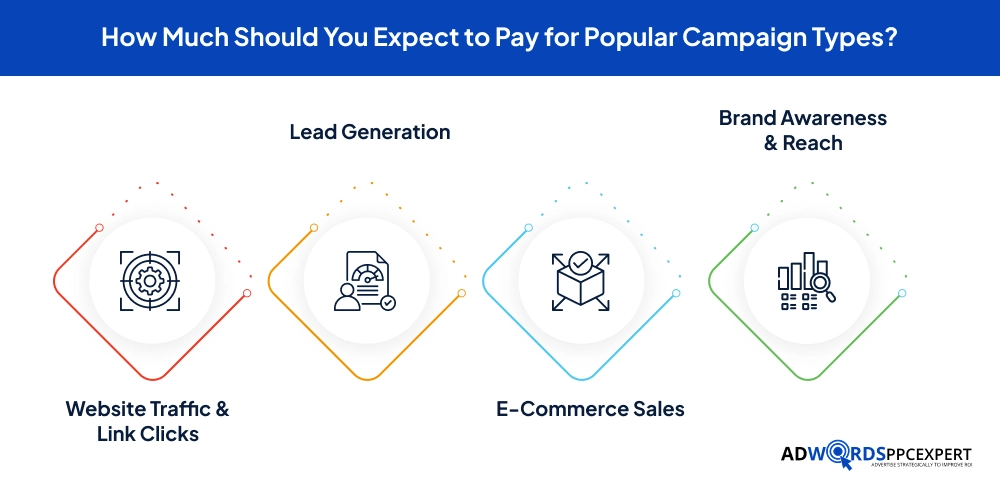
Website Traffic & Link Clicks
- CPC: $0.40–$1.20
- CPM: $6–$15
Traffic campaigns are usually more affordable than conversion campaigns because they optimize for clicks rather than actions.
Lead Generation
- CPL: $8–$30+, depending on industry competitiveness and audience quality.
Lead generation campaigns cost more due to targeted conversions requiring user commitment.
E-Commerce Sales
- CPA: $10–$40+ for purchases, depending on price point and industry demand.
Conversion optimization often incurs higher costs because Meta focuses on driving purchasing behaviors.
Brand Awareness & Reach
- CPM: $6–$15 (sometimes higher during peak seasons)
These figures provide a realistic reference point, but actual costs will always vary based on strategy, audience, and execution. The key is choosing campaign types that align with your goals and measuring success by return, not just cost.
What Are The Factors That Influence Facebook Advertising Costs in 2026
Facebook advertising costs are not random. They are shaped by a combination of strategic choices, market conditions, and how well your ads resonate with users. Understanding these factors helps you predict costs more accurately and make smarter budget decisions.
1. Campaign Objective
Your campaign objective plays a major role in determining cost. Objectives such as awareness and traffic typically cost less because they require lighter user actions, while conversion-focused objectives like purchases or leads are more expensive due to higher competition and stricter optimization requirements. Choosing an objective that aligns with your actual business goal is essential, as mismatched objectives often result in higher costs with poor performance.
2. Budget and Spend Consistency
Budget influences how quickly Facebook’s system can learn and optimize your campaign. Extremely low or inconsistent budgets limit data flow, making optimization less effective and increasing costs. On the other hand, a stable and realistic budget allows Facebook’s AI to identify patterns and deliver ads more efficiently over time. Scaling spend gradually rather than aggressively also helps control cost volatility.
3. Bid Strategy
Facebook’s bid strategy determines how aggressively the platform competes in auctions on your behalf. Automatic bidding generally delivers more stable costs by allowing Facebook to optimize for results, while manual bidding offers more control but requires experience. Poorly set bid caps can restrict delivery and inflate costs, while well-aligned bidding strategies help balance efficiency and volume.
4. Audience Size and Competition
Audience targeting has a direct impact on cost. Smaller, highly competitive audiences typically cost more due to limited inventory and higher demand. Broader audiences often result in lower CPMs and better optimization when paired with strong creatives. In 2026, Facebook favors scalable audiences supported by AI-driven delivery over overly narrow targeting.
5. Industry Competitiveness
Some industries naturally face higher advertising costs due to demand and customer value. Sectors such as finance, legal services, SaaS, and ecommerce often experience higher CPCs and CPAs. Less saturated niches and local services tend to have lower costs. Understanding your industry benchmarks helps set realistic expectations rather than chasing artificially low numbers.
6. Seasonality and Market Demand
Facebook advertising costs fluctuate throughout the year. High-demand periods such as holidays, product launches, or sales seasons drive competition and raise CPMs and CPCs. Conversely, off-peak periods often present opportunities for lower-cost testing and audience building. Planning campaigns around seasonal trends can significantly impact efficiency.
7. Ad Creative Quality
Creative performance is one of the strongest cost drivers in 2026. Ads that capture attention quickly, communicate value clearly, and encourage engagement are rewarded with lower costs. Poor visuals, generic messaging, or repetitive creatives lead to higher CPCs and faster fatigue. Ongoing creative testing is essential for maintaining cost efficiency.
8. Ad Quality and Relevance Signals
Facebook evaluates ads based on user feedback, engagement, and relevance. Ads that receive positive interactions and minimal negative feedback are prioritized in auctions, reducing costs. Low-quality experiences increase costs over time. Maintaining relevance through clear messaging and user-focused offers directly improves efficiency.
9. Campaign Duration and Stability
Short-term campaigns often cost more due to limited optimization time. Longer-running campaigns give Facebook more data to improve delivery and reduce costs. Frequent changes reset the learning phase, increasing volatility. Stability allows performance to improve incrementally.
10. Placement and Ad Format Selection
Where and how your ads appear also influences cost. Some placements are more competitive than others, and certain formats require higher production quality. Allowing automatic placements often reduces costs by giving Facebook flexibility to find cheaper inventory across its network.
11. Landing Page and Funnel Experience
Costs are influenced by what happens after the click. Slow load times, unclear messaging, or poor user experience reduce conversion rates and increase CPAs. Strong landing pages and clear calls to action help Facebook identify quality conversions and deliver ads more efficiently.
How Campaign Structure Affects Facebook Advertising Costs
Many advertisers overspend simply because their campaign structure is inefficient.
Poorly organized ad accounts cause:
Budget cannibalization
Inconsistent learning phases
Higher CPAs
A well-structured account separates:
Prospecting and retargeting
Cold, warm, and hot audiences
Testing and scaling campaigns
This structure allows Facebook’s algorithm to optimize properly, reducing wasted spend.
How to Lower Facebook Advertising Costs in 2026
Lowering Facebook advertising costs is less about cutting spend and more about helping the platform deliver better results efficiently. In 2026, Facebook’s auction rewards advertisers who align strategy, structure, and creative with how the system optimizes performance. The following approaches focus on reducing wasted spend while improving overall efficiency.
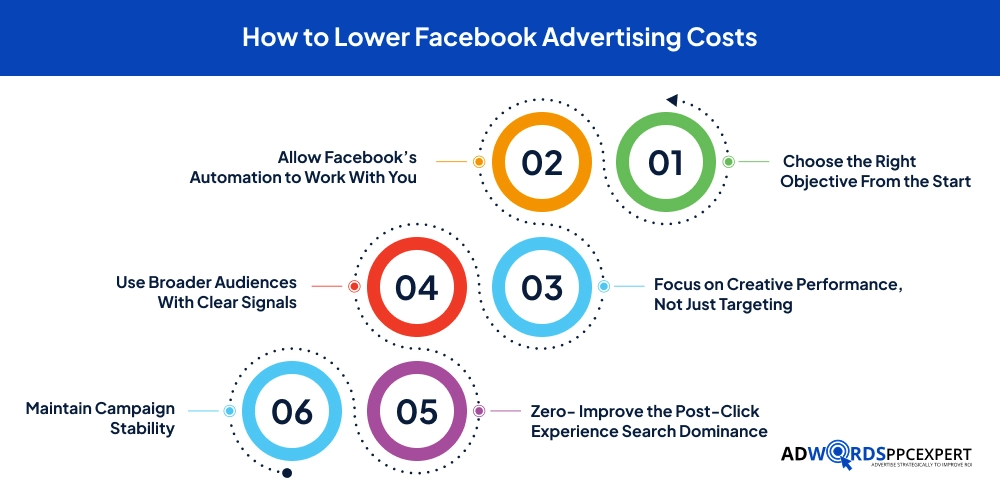
1. Choose the Right Objective From the Start
Selecting an objective that truly matches your business goal is one of the most effective ways to control costs. Optimizing for traffic when you need conversions or leads often results in cheap clicks but poor outcomes, which increases cost over time. When objectives align with real outcomes, Facebook can optimize delivery more accurately and reduce inefficiencies.
2. Allow Facebook’s Automation to Work With You
Over-managing bids, placements, or audiences often restricts delivery and raises costs. Using automated bidding and placement strategies gives Facebook flexibility to find lower-cost opportunities across its network. In 2026, campaigns that provide room for optimization consistently outperform tightly controlled setups.
3. Focus on Creative Performance, Not Just Targeting
Strong creatives reduce costs by improving engagement and relevance signals. Ads that clearly communicate value, match user intent, and capture attention early are rewarded with lower CPCs and CPMs. Regular creative testing and variation prevent fatigue and keep costs stable over time.
4. Use Broader Audiences With Clear Signals
Highly narrow targeting can increase costs by limiting reach and increasing competition. Broader audiences combined with strong messaging allow Facebook’s AI to identify high-intent users more efficiently. Clear conversion signals guide delivery better than restrictive audience rules.
5. Improve the Post-Click Experience
What happens after the click directly affects your advertising costs. Fast-loading pages, consistent messaging, and clear calls to action increase conversion rates, which helps Facebook identify quality traffic and deliver ads more efficiently. Weak landing experiences raise costs even if ads perform well.
6. Maintain Campaign Stability
Frequent edits reset the learning phase and increase volatility. Allowing campaigns enough time and data to optimize leads to lower costs over time. Making incremental changes instead of constant adjustments helps maintain performance efficiency.
Common Facebook Advertising Cost Mistakes to Avoid
Many advertisers end up overspending on Facebook, not because the platform is ineffective, but because of strategic mistakes that quietly increase costs over time. Understanding these common errors can help you protect your budget and improve long-term performance.
Chasing Cheap Clicks Instead of Real Outcomes
Optimizing campaigns solely for low CPCs often leads to traffic that does not convert. Cheap clicks may look good on reports, but if users do not take meaningful actions, costs increase elsewhere in the funnel. Successful advertisers focus on value-driven actions such as qualified leads or purchases, even if individual clicks cost more.
Ignoring Creative Performance Signals
Creative fatigue is one of the fastest ways costs rise. Ads that stop resonating with audiences receive lower engagement, which drives CPCs and CPMs higher. Failing to monitor creative performance or refresh ads regularly leads to declining efficiency, even with strong targeting.
Over-Restricting Targeting
Narrowing audiences too aggressively limits delivery and increases auction competition. This often causes higher costs and unstable performance. Broader audiences paired with strong creatives give Facebook’s AI more flexibility to find efficient conversions.
Making Constant Campaign Changes
Frequent edits reset Facebook’s learning phase, preventing campaigns from stabilizing. Many advertisers increase costs by reacting too quickly to short-term fluctuations. Allowing campaigns enough time to optimize leads to more predictable performance and lower costs.
Treating Facebook Ads as Set-and-Forget
Facebook advertising requires ongoing monitoring and refinement. Leaving campaigns untouched for long periods allows inefficiencies to compound. Regular review of performance data, creative quality, and conversion signals is essential to controlling spend.
How Professional Management Impacts Facebook Ad Costs
Managing Facebook ads goes far beyond launching campaigns and setting a budget. While many businesses start by handling ads in-house, professional management often reduces advertising costs over time by improving efficiency, accuracy, and scalability across the entire account.
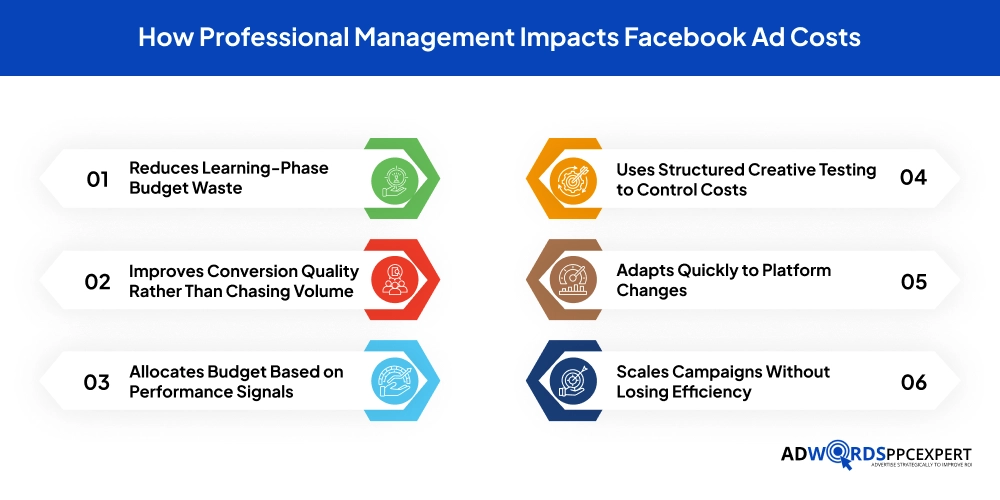
Reduces Learning-Phase Budget Waste
Every Facebook campaign enters a learning phase where the platform tests delivery and audience signals. Inexperienced setups often reset this phase repeatedly due to frequent changes, which leads to unstable performance and wasted spend. Professional managers structure campaigns correctly from the beginning, allowing Facebook’s algorithm to stabilize faster and distribute budget more efficiently.
Improves Conversion Quality Rather Than Chasing Volume
Lower costs do not come from cheap clicks alone. They come from sending stronger conversion signals back to Facebook. Experienced advertisers focus on high-intent audiences, clean tracking setups, and optimized conversion events so the algorithm prioritizes users more likely to take meaningful actions. Over time, this naturally lowers cost per result.
Allocates Budget Based on Performance Signals
Professional management ensures budgets are assigned based on real performance data, not assumptions. Campaigns that deliver results receive more investment, while underperforming ones are refined or paused. This disciplined approach prevents overspending and keeps overall costs under control.
Uses Structured Creative Testing to Control Costs
AI video ad maker plays a major role in auction pricing. Professionals follow a structured testing process to identify which formats, messages, and visuals drive engagement and conversions. By refreshing creatives before fatigue sets in, they maintain relevance and keep costs from rising unnecessarily.
Adapts Quickly to Platform Changes
Facebook’s advertising environment evolves constantly. Professional managers stay current with updates to bidding systems, attribution models, and performance signals. This helps avoid costly mistakes that occur when campaigns rely on outdated practices or incorrect assumptions.
Scales Campaigns Without Losing Efficiency
Scaling is where many advertisers see costs increase sharply. Professionals expand campaigns gradually by adjusting budgets, audiences, and creatives in a controlled way. This preserves efficiency while increasing volume, rather than forcing growth that harms performance.
This is why many businesses eventually work with experienced professionals, such as AdwordsPPCExpert, who understand how Facebook’s auction system, conversion signals, and creative performance interact. That experience helps reduce wasted spend, improve long-term efficiency, and maintain predictable results in competitive advertising environments.
Final Thoughts
Facebook advertising costs in 2026 are shaped less by fixed pricing and more by how well campaigns are planned, structured, and executed. While benchmarks provide helpful guidance, actual performance depends on aligning objectives, creatives, targeting, and post-click experience with how Meta’s platform now optimizes delivery. Businesses that focus on strategy, conversion quality, and long-term efficiency tend to see more predictable costs and stronger returns, while those chasing cheap clicks often overspend without results. With the right approach by specialized experts, as executed by AdwordsPPCExpert, Facebook remains a scalable and cost-effective channel, not because it is cheap, but because it rewards relevance, clarity, and smart execution.
Frequently Asked Questions (FAQs)
1. What is the average cost to advertise on Facebook in 2026?
In 2026, Facebook advertising costs vary depending on your industry, audience, and campaign objective. On average, CPC ranges from $0.80–$3.50, CPM from $7–$18, and CPA or CPL depends on conversion complexity and product pricing. These are industry benchmarks, not fixed costs.
2. Which factors have the biggest impact on Facebook ad costs today?
Ad costs are influenced by audience size and competition, campaign objective, ad creative quality, relevance, conversion funnel strength, and seasonality. Optimizing these factors efficiently can reduce cost per result while improving performance.
3. What Facebook ad objective has the lowest cost?
Brand awareness and reach campaigns typically have the lowest cost per result because they optimize for impressions rather than actions. However, lower cost does not always mean higher value. Conversion and lead objectives cost more but usually drive stronger business outcomes.
4. How can I reduce my Facebook advertising costs in 2026?
You can reduce Facebook advertising costs by choosing the right campaign objective, using broader audiences with strong creative, improving landing page performance, allowing campaigns time to optimize, and focusing on high-quality conversion signals instead of cheap clicks. Cost efficiency improves when strategy and execution work together.
5. How long does it take for Facebook ad costs to stabilize?
Most campaigns require a learning phase before costs stabilize. This typically takes several days to a few weeks, depending on budget and conversion volume. Making frequent changes during this period can increase costs, while stability allows Facebook’s system to optimize delivery more efficiently.

Ami Singh is a highly skilled AdWords PPC Specialist, known for creating profitable Google Ads strategies that elevate brands. With deep expertise in Google Search, Display, Shopping, YouTube Ads, and advanced bidding techniques, Ami consistently converts data into performance-driven results.
With a sharp analytical mind and a strong understanding of online consumer behavior, Ami designs campaigns that maximize ROI, boost quality scores, and reduce acquisition costs. His approach blends technical expertise with strategic thinking—making him a go-to expert for businesses aiming to dominate Google Ads.
Ami doesn’t just adapt to the fast-changing PPC industry, but he also stays ahead of the curve by testing new features, adopting automation smartly, and refining what works. Clients trust him for his transparency, insights, and ability to scale campaigns sustainably.
Looking to take your Google AdWords performance to the next level? Connect with Ami Singh at Softtrix and discover how he can help you get the maximum growth through powerful PPC strategies.