
Have you ever sat there, ready to launch a Google Ads campaign, and stopped yourself with a simple thought, “Is this money going to bring real customers… or am I about to waste it?”
If you have felt that pause, you are not alone. Almost every business owner reaches this point, and it usually comes down to one big question that does not have a clear answer online – how much does Google Ads actually cost? Not rough averages, not confusing charts, and not the usual “it depends” response. What you really want to know is what those costs look like for your business, your industry, and your goals.
The truth is, understanding Google Ads pricing is not about finding one fixed number. It is about understanding how Google decides what you pay, why some clicks cost more than others, and how your choices affect your budget.
That is exactly what this guide is here to walk you through. Instead of throwing random numbers at you, this guide breaks down how Google Ads pricing actually works in the real world. You will see what affects the cost, why some clicks are cheap while others are expensive, and how your industry, goals, and setup play a role in what you end up paying. By the time you finish reading, you will not just have an idea of Google Ads cost, but you will understand where the money goes, what is worth paying for, and how to make smarter decisions before you spend a single dollar.
What Is Google Ads?
Google Ads is Google’s online advertising platform that lets you show your business in front of people exactly when they are searching for products or services like yours. Instead of waiting for customers to find you on their own, Google Ads allows you to appear at the top of search results, on YouTube, and across other Google partner websites. The key thing to understand is that you do not pay just to show your ad, you usually pay only when someone clicks on it.
What makes Google Ads different from traditional advertising is control. You decide how much you want to spend, which keywords you want to show up for, where your ads appear, and when they run. Whether your goal is getting phone calls, website visits, leads, or sales, Google Ads lets you align your budget with your business goals instead of guessing.
This is also where cost becomes a big question. Because Google Ads works on a bidding system, what you pay is not fixed. Your cost depends on how competitive your industry is, what keywords you target, and how well your ads are set up. This is why understanding how PPC pricing works is just as important as running the ads themselves.
Why Google Ads Cost Is Never a Fixed Number
You keep seeing different answers to the question “how much does Google Ads cost” because the platform is built to be flexible, not fixed. Google does not charge a standard price to run ads. Instead, you set how much a click, impression, or action is worth to your business, and Google compares that value with other advertisers trying to reach the same audience.
Behind the scenes, Google uses a real-time pricing system to decide how ads are shown. This system evaluates your bid, the relevance of your ad, and how useful your landing page is for the user. Based on this evaluation, Google determines three things:
- Whether your ad appears
- Where your ad appears
- How much you pay when someone clicks
- Empower Your Campaign Game With AdWords PPC Experts
Because these factors change constantly, your Google Ads cost is always situational. It depends on the competition at that moment, how strong your ad setup is, and how well your campaign aligns with what users are searching for.
How the Pay-Per-Click Pricing Model Works in Google Ads
Most Google Ads campaigns follow a pay-per-click (PPC) pricing model. This simply means you do not pay for showing your ad, you only pay when someone actually clicks on it. If your ad appears 1,000 times but no one clicks, you are not charged anything.
The amount you pay for each click is not fixed. It depends on how competitive the keyword is and how relevant your ad and landing page are to the search. Keywords tied to high-value services usually cost more because businesses are willing to pay more for those potential customers.
For example, a company offering enterprise cybersecurity software may pay $25 or more per click because a single client can be worth thousands of dollars. On the other hand, a local car wash advertising “car wash open today” may pay just a few dollars per click because the service value is much lower.
This difference is exactly why there is no single answer to the question of Google Ads cost. What you pay is directly linked to what a click is worth to your business, not someone else’s.
What Are the Key Factors That Determine Google Ads Pricing?
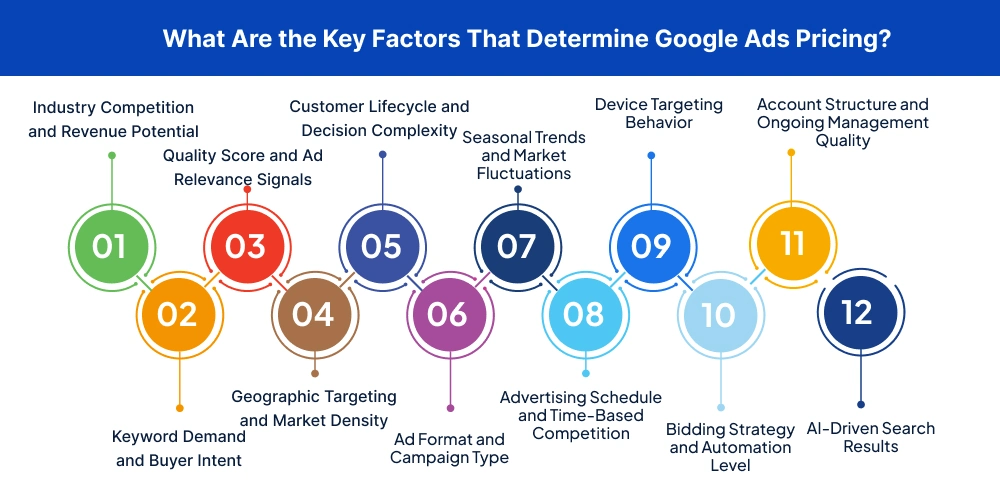
1. Industry Competition and Revenue Potential
Industry is one of the strongest drivers of Google Ads pricing. Highly competitive industries such as legal services, insurance, finance, real estate, and B2B professional services typically experience higher costs per click and higher costs per lead. The reason is simple: one converted lead in these industries can be worth thousands of dollars in revenue over time, which justifies higher advertising spend.
For example, in business services, a single new client may generate $1,000–$10,000 or more in lifetime value. In that context, paying $10–$20 per click is commercially reasonable. On the other hand, industries like arts, entertainment, or low-margin retail often see lower CPCs but must rely on higher volume to achieve the same revenue outcomes.
In short, the more revenue a customer can generate, the higher Google Ads pricing tends to be within that industry.
2. Keyword Demand and Buyer Intent
Not every keyword costs the same because not every search shows the same level of buying intent. Keywords that signal someone is ready to take action attract more advertisers, which increases competition and raises Google Ads pricing.
For example, a gym advertising on “personal trainer near me” will usually pay more per click than a gym targeting “gym workout tips”, because the first search shows intent to join or book. Similarly, a bakery bidding on “custom birthday cake order” may pay more than one targeting “cake decorating ideas”, since the customer is closer to making a purchase.
This difference is why keyword selection directly affects your ad spend. High-intent keywords can bring faster results but at a higher cost, while lower-intent keywords are cheaper and better suited for awareness or early-stage interest.
3. Quality Score and Ad Relevance Signals
Google Ads pricing is not purely bid-driven. Google actively rewards advertisers who deliver relevant, useful experiences to users. This is measured through Quality Score, which evaluates:
- How closely your ad matches the keyword intent
- How likely users are to click your ad
- How relevant and usable your landing page is
A higher Quality Score allows your ads to compete more effectively without increasing bids. In practical terms, this means two advertisers bidding the same amount can pay very different costs per click based on ad relevance and landing page quality.
This is why businesses that invest in strong ad copy, clear messaging, and optimized landing pages often see lower Google Ads pricing over time.
4. Geographic Targeting and Market Density
Location targeting has a direct impact on pricing. Advertising in high-population or high-competition regions typically costs more than advertising in smaller or less competitive markets.
For example, targeting ads across the entire United States is generally more expensive than focusing on a specific state, city, or local radius. Local targeting often reduces competition and allows smaller businesses to stretch their budgets further while still reaching qualified audiences.
Geographic precision is one of the most effective levers for controlling Google Ads pricing, especially for service-based businesses.
5. Customer Lifecycle and Decision Complexity
Some products and services require longer decision cycles. High-ticket offerings rarely convert on the first interaction. Instead, users may visit multiple times, consume content, compare providers, and only convert after weeks or months.
In these cases, Google Ads pricing reflects the need for repeated visibility. You may pay for multiple interactions before a conversion occurs, which increases apparent cost but supports long-term acquisition. This is common in B2B services, enterprise software, and professional consulting.
Understanding your customer lifecycle is essential for interpreting cost accurately, rather than judging campaigns solely on immediate conversions.
6. Ad Format and Campaign Type
Different ad formats operate under different pricing dynamics:
- Search Ads generally carry moderate to high costs due to strong intent
- Display Ads typically have lower costs but lower direct conversion rates
- Shopping Ads are competitive and price-sensitive, influenced by product margins
- YouTube Ads are priced per view and are often used for awareness and remarketing
Choosing the right format depends on whether your objective is direct response, brand exposure, or long-term nurturing. Misalignment between goal and format often leads to inefficient Google Ads pricing.
7. Seasonal Trends and Market Fluctuations
Google Ads pricing is not static throughout the year. Seasonal demand can cause sharp increases or decreases in cost.
For example, industries like HVAC, roofing, and tax services experience predictable spikes during peak seasons. During these periods, increased advertiser demand drives higher CPCs. Conversely, off-season periods often present cost-efficient opportunities for visibility.
External factors such as economic shifts, consumer behavior changes, or major events can also temporarily impact pricing across entire industries.
8. Advertising Schedule and Time-Based Competition
When your ads run can be just as important as where they run. Peak hours often see higher competition, especially in industries where many advertisers target the same business hours.
Running ads during less competitive time windows can sometimes reduce costs, provided user intent remains strong. Effective scheduling relies on performance data rather than assumptions and can materially influence overall Google Ads pricing efficiency.
9. Device Targeting Behavior
Cost can vary depending on whether ads are shown on mobile, desktop, or tablet devices. In many B2C industries, mobile clicks tend to be more expensive due to higher engagement and immediacy. In B2B industries, desktop traffic often carries higher value and higher costs.
Device performance should be evaluated based on conversion behavior, not just click volume, to avoid misinterpreting pricing data.
10. Bidding Strategy and Automation Level
Your bidding strategy plays a major role in how Google Ads pricing behaves.
Automated strategies use machine learning to adjust bids in real time based on the likelihood of achieving a goal, such as conversions or return on ad spend. Some strategies prioritize volume, which can increase CPC, while others focus on cost control and efficiency.
Manual and semi-automated strategies offer more control but require active management. Poorly configured bidding strategies are one of the most common reasons advertisers experience inflated costs.
11. Account Structure and Ongoing Management Quality
Finally, how well your Google Ads account is structured and maintained directly affects pricing outcomes. Well-organized campaigns, tightly grouped keywords, regular performance reviews, and ongoing optimization help prevent wasted spend.
Advertisers who actively manage negative keywords, refine targeting, and optimize ads typically achieve better performance at lower effective costs. Those who “set and forget” campaigns often see rising Google Ads pricing without proportional returns.
12. AI-Driven Search Results
Google’s introduction of AI-generated search results has changed how users interact with search pages. While some informational queries now get answered directly through AI overviews, Google has reported higher engagement on commercial and transactional searches where paid ads still play a critical role.
For advertisers like you, this means two things. First, purely informational keywords may see reduced value over time. Second, commercial keywords with clear buying intent may experience increased competition, which can place upward pressure on Google Ads pricing. Businesses that focus on high-intent searches and strong ad relevance are better positioned to benefit from these changes rather than be negatively impacted.
What Makes Up Your Google Ads Costs
Cost Per Click (CPC)
This is the most common Google Ads cost. You pay only when someone clicks on your ad. CPC varies based on competition, keyword demand, and ad relevance.
Cost Per Thousand Impressions (CPM)
With CPM, you pay for every 1,000 times your ad is shown, not for clicks. This model is mainly used for brand awareness campaigns on the Display Network or YouTube.
Cost Per Acquisition (CPA)
CPA focuses on results rather than traffic. It shows how much you spend to get a lead, sale, or signup. This metric is especially important for eCommerce, subscription-based, and lead-generation businesses.
Cost Per Conversion (By Industry)
The cost to generate a conversion can differ widely depending on the industry. For example, retail businesses may see lower conversion costs, while technology or finance companies often pay significantly more due to higher customer value. This gives a clearer picture of how much it can cost to run Google Ads in different sectors.
Google Shopping Ads Cost
Shopping Ads are commonly used by online stores. Costs depend on product category and competition. Popular items like electronics usually cost more, while niche or specialized products tend to be more affordable.
Google Ads Certification Cost
If you plan to manage ads yourself, Google Ads certification is available at no cost. You only spend money when you actively run campaigns.
Google Ads Management or Service Cost
If you hire an agency or specialist, there is an additional service fee. This is typically charged as a monthly flat fee or a percentage of your ad spend, depending on the provider.
How Does Google Ads Determine Your Cost Per Click?
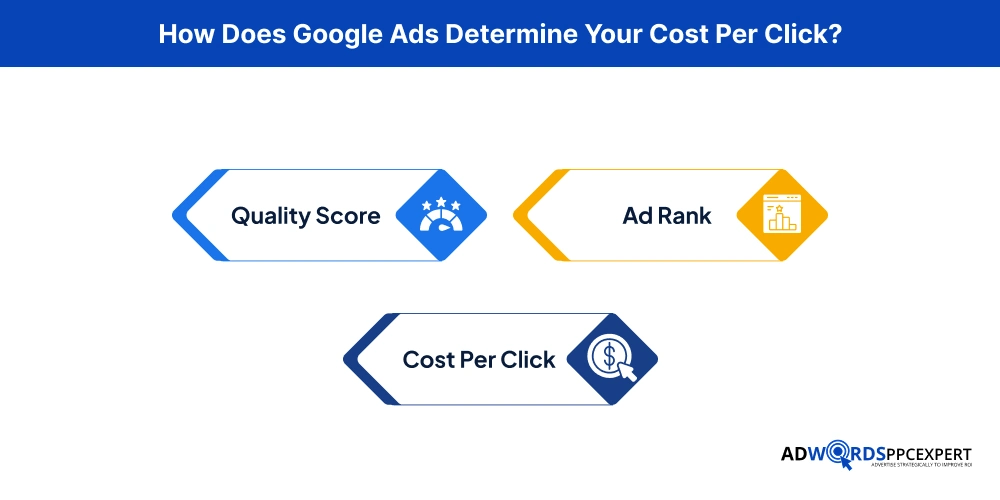
Google Ads uses an auction system, but ad positions are not awarded to the highest bidder alone. You also don’t automatically pay your maximum bid. Instead, Google prioritizes relevance and user experience, which means advertisers with smarter campaigns can outperform competitors with larger budgets. Here is how Google decides who wins the auction and how much each click costs.
Quality Score
Google assigns each ad a Quality Score, rated from 1 to 10. This score is based on how relevant your ad and landing page are to the keyword, your expected click-through rate, and the overall landing page experience. Higher Quality Scores often lead to better placements and lower costs.
Ad Rank
Google then calculates Ad Rank to determine if your ad appears and where it shows in the paid search results. Ad Rank is influenced by your Quality Score and your maximum bid, the highest amount you are willing to pay per click. Ads with higher Ad Rank earn more prominent positions.
Cost Per Click
If your ad is shown, you are charged only when someone clicks on it, and usually less than your maximum bid. Your actual cost per click is calculated by dividing the Ad Rank of the advertiser below you by your Quality Score, then adding one cent. This allows advertisers with stronger Quality Scores to pay less per click while ranking higher.
Additional Variables in Your Google Ads Costs
While Quality Score and maximum bid are the most important factors, several other elements also influence your Ad Rank and overall ad spend:
- Landing page relevance and experience
- Auction-time quality
- The device, location, and context of users’ searches
- Alternative bidding methods
- Alternative ad formats
How Much Do Google Ads Cost Per Month?
Google Ads does not come with a fixed monthly price, and that is what makes it powerful. Instead of paying a set fee, you invest what makes sense for your business goals, your market, and the results you want to achieve.
Most businesses don’t fail with Google Ads because they spend too little or too much. They fail because they do not spend strategically. When budgets are aligned with clear objectives and smart targeting, even modest ad spend can drive measurable growth.
In real-world campaigns, monthly investment typically looks like this:
$800–$2,000 per month for small businesses or first-time advertisers testing demand
$5,000–$30,000 per month for companies focused on consistent lead generation or scaling sales
$50,000+ per month for brands that rely heavily on paid search to drive revenue
What matters most is not the number, but its momentum. Many high-performing advertisers dedicate a meaningful share of their marketing budget to Google Ads, giving campaigns enough data to optimize, improve quality scores, and reduce wasted spend over time.
The biggest advantage of Google Ads is control. You set the budget, pause or adjust it anytime, and can start small, even at $10 a day, then increase spend as performance proves profitable. With the right strategy, Google Ads becomes less of a cost and more of a predictable growth engine.
How to Reduce Google Ads CPC Without Losing Conversions?
High cost-per-click does not mean Google Ads is not working, it usually means the campaign needs smarter optimization. Google consistently rewards relevance, intent, and user experience. When those improve, CPC naturally comes down without hurting performance.
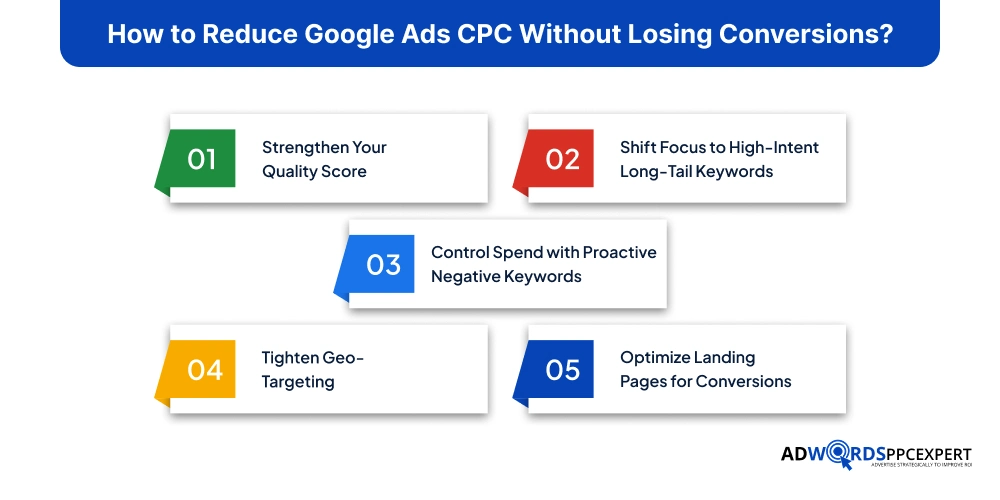
Strengthen Your Quality Score
Quality Score has the biggest impact on CPC. Ads that closely match search intent, deliver strong engagement, and send users to relevant landing pages are rewarded with lower costs and better visibility.
Shift Focus to High-Intent Long-Tail Keywords
Broad keywords drive competition and inflate costs. Long-tail keywords face less bidding pressure and attract users closer to conversion, resulting in cheaper clicks and better ROI.
Control Spend with Proactive Negative Keywords
Unfiltered traffic is expensive traffic. Building and maintaining a strong negative keyword list prevents irrelevant searches, reduces wasted clicks, and protects your budget.
Tighten Geo-Targeting
CPC varies widely by location. Focusing spend on high-converting regions, and excluding underperforming areas helps reduce costs while improving lead quality.
Optimize Landing Pages for Conversions
Lower CPC is not just about ads. Faster load times, clear messaging, and strong calls to action improve conversion rates, allowing you to get more value from every click.
What Makes Google Ads Worth the Cost for Your Business?
Google Ads may seem complex at first, and the question of cost can feel overwhelming. But the true value lies in how you use it. When campaigns are set up strategically, with the right keywords, targeting, ad relevance, and optimized landing pages every click has the potential to bring in real customers, not just traffic.
The key is understanding that Google Ads is not about spending the most money, it is about making every dollar count. By aligning your budget with your goals, monitoring performance, and continuously refining your campaigns, you can turn your ad spend into measurable growth.
Ultimately, Google Ads becomes worth the cost when it drives meaningful results for your business. And with expert guidance, by AdwordsPPCExpert, you can maximize ROI, reduce wasted spend, and ensure every campaign delivers real value.
Frequently Added Questions On Google Ads Pricing
1. How much does Google Ads cost for small businesses?
Google Ads costs vary depending on your goals, industry, and keyword competition. Small businesses often spend between $800–$2,000 per month to test campaigns and gather performance data. Starting with a modest budget allows you to optimize ads, track results, and scale efficiently.
2. What determines the cost of Google Ads?
Your Google Ads cost depends on multiple factors including keyword competition, Quality Score, ad relevance, landing page experience, geographic targeting, device type, and bidding strategy. Ads that are highly relevant and well-targeted typically cost less per click while driving better results.
3. How can I lower my Google Ads cost-per-click (CPC) effectively?
To reduce CPC without sacrificing results, focus on improving your Quality Score, targeting long-tail keywords, adding negative keywords, optimizing landing pages for conversions, and concentrating on high-performing regions or devices. These strategies ensure every click delivers maximum value.
4. Are high CPCs always a bad sign?
Not necessarily. High CPCs often occur in competitive industries where a single conversion can be extremely valuable, like legal services, finance, or B2B software. The key is to compare CPC to the potential revenue per customer, ensuring your ad spend is profitable.
5. How do Quality Score and ad relevance affect Google Ads costs?
Quality Score measures how relevant your ad and landing page are to the keyword and user intent. Ads with higher Quality Scores can rank higher and pay less per click. Optimizing ad copy, targeting, and landing page experience is essential for lowering costs and improving campaign efficiency.

Ami Singh is a highly skilled AdWords PPC Specialist, known for creating profitable Google Ads strategies that elevate brands. With deep expertise in Google Search, Display, Shopping, YouTube Ads, and advanced bidding techniques, Ami consistently converts data into performance-driven results.
With a sharp analytical mind and a strong understanding of online consumer behavior, Ami designs campaigns that maximize ROI, boost quality scores, and reduce acquisition costs. His approach blends technical expertise with strategic thinking—making him a go-to expert for businesses aiming to dominate Google Ads.
Ami doesn’t just adapt to the fast-changing PPC industry, but he also stays ahead of the curve by testing new features, adopting automation smartly, and refining what works. Clients trust him for his transparency, insights, and ability to scale campaigns sustainably.
Looking to take your Google AdWords performance to the next level? Connect with Ami Singh at Softtrix and discover how he can help you get the maximum growth through powerful PPC strategies.