
Consider a weekly scenario playing out in countless boardrooms within the B2B technology and professional service spaces: A scaling SaaS company spends $10,000 per month on paid media. The Director of Demand Generation wishes to allocate the entire $10,000 on Google Ads to target buyers who are searching for the solution. The Sales Director emphatically declares that money must be spent on LinkedIn Ads because that is where our decision-makers live.’ The Founder highlights that Microsoft Ads delivers a 30% reduction in Cost Per Click (CPC) and asks why all their dollars aren’t spent there.
In each instance, everyone is partly right but failing to consider how these different advertising platforms are anything but substitutes in B2B marketing. And, the biggest question that B2B advertisers should ask is not: ‘Which platform is better?’ or ‘Which platform is cheaper?’
But which platform has the capacity to reach the right buyer, with the right message, at their particular point in the purchase process?
Google Ads vs Microsoft Ads vs LinkedIn Ads: The Short Answer
Should you need a quick and easy strategic starting point, the core difference between all three of these B2B advertising media can be summed up by intention versus identity:
- Google Ads: Identifies existing search intent. It is best used when your potential customer is actively searching for your software/service category.
- Microsoft Ads: Delivers additional reach of search intent at a reduced average CPC, coupled with distinct Microsoft ecosystem signals and LinkedIn profile attribute layering.
- LinkedIn Ads: Builds demand among targeted professional buyer personas through job function, experience, company size, industry, and even account-based lists long before any active search takes place.
Google Ads for B2B: Capturing High-Intent Search Demand
Google Search is the clear engine that drives active B2B demand generation. The minute a business user faces an operational pain point, comes up against security requirements, or gets budget allocation to replace software, the first thing they do is always a search. Google Ads gives B2B companies the chance to engage with these prospects right at the very moment they start doing research.
Commercial Intent & Commercial Queries
Google Ads works best when the keyword displays intent to make a purchase. Searches where terms like ‘enterprise cybersecurity software,’ ‘B2B ERP for manufacturing,’ or ‘[Competitor] alternatives’ appear clearly show that the user is making progress on their buying journey. Informational searches (‘cloud security meaning’) will not have as high a conversion rate and need to be nurtured separately.
Campaign Segmentation: Branded, Non-Branded & Competitor
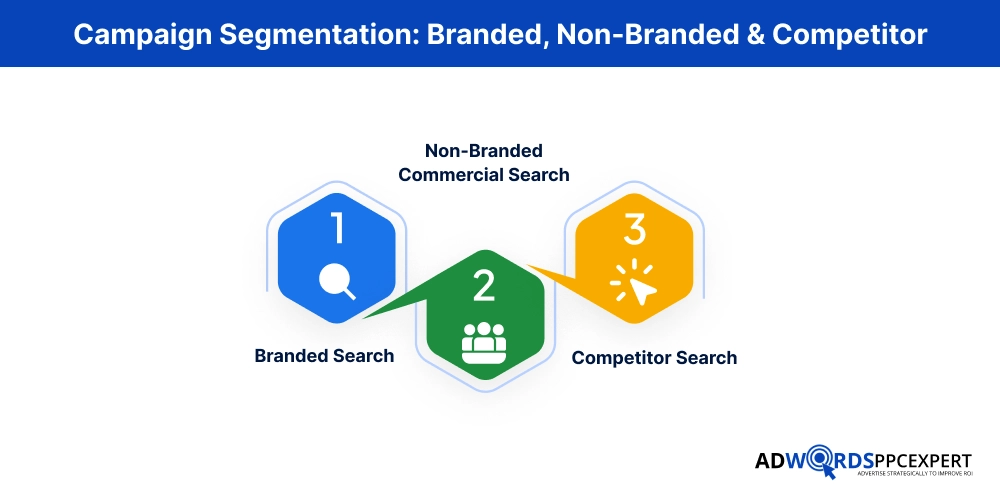
- Branded Search: Defends your market share against competitive bidders on your brand name. Such campaigns generate your most efficient CPLs and conversions.
- Non-Branded Commercial Search: Acquires non-branded active searchers. It is the engine of growth in search marketing, distinguished by its high CPC but direct access to brand-new category demand.
- Competitor Search: Reaches potential customers looking for alternative suppliers. Highly focused campaigns of this kind typically have low Quality Scores and high CPC because of the low relevancy of ads to landing pages.
Modern Google Ads Mechanics: Broad Match, Responsive Search Ads & Smart Bidding
Google Ads’ official best practice states that today’s search algorithm is based on three things: Broad Match keywords, Responsive Search Ads (RSAs), and Smart Bidding (either Target CPA or Target ROAS). At auction time, Google’s AI system analyzes billions of signals, including device type, location, search history context, and user signals, to set bids for each impression.
Nevertheless, B2B marketers need to see Google’s suggestions from an educated point of view. The combination of Broad Match with Smart Bidding can help in finding commercial long-tail queries that cannot be found by using Exact Match. But without proper implementation of offline first-party conversion tracking (by sending SQL status of contacts to Google via Enhanced Conversions or Zapier/HubSpot integration), Smart Bidding will optimize for bad form fills.
Limitations of Relying Exclusively on Google Search
The main drawback of Google Search is that it does not create demand; it merely captures existing demand. If you are in a nascent product category where the consumer doesn’t even know the name of the category, there won’t be much of a search volume. Moreover, the professional demographic capabilities of Google Ads are quite poor since a student searching for something results in the same $30 ad click as the Enterprise Vice President.
Microsoft Ads for B2B: Incremental Reach & Audience Layering
Microsoft Ads (formerly known as Bing Ads) is often overlooked by B2B marketers, but it is arguably one of the most economical platforms when it comes to generating B2B leads. With 1 billion unique monthly users on Bing, Yahoo, AOL, MSN, and Microsoft Audience Network, Microsoft Ads offers access to a different professional audience.
The Enterprise Desktop Advantage
The search engine network of Microsoft enjoys a much larger desktop market share than mobile. On corporate machines, Microsoft’s Windows remains the default OS, Edge being the browser, and Bing the default search engine. As enterprise purchasers conduct their research sitting at corporate computers at their desks during office hours, a vast number of enterprise decision-makers are reached through Microsoft Ads.
Microsoft's Native LinkedIn Profile Targeting vs. LinkedIn Ads
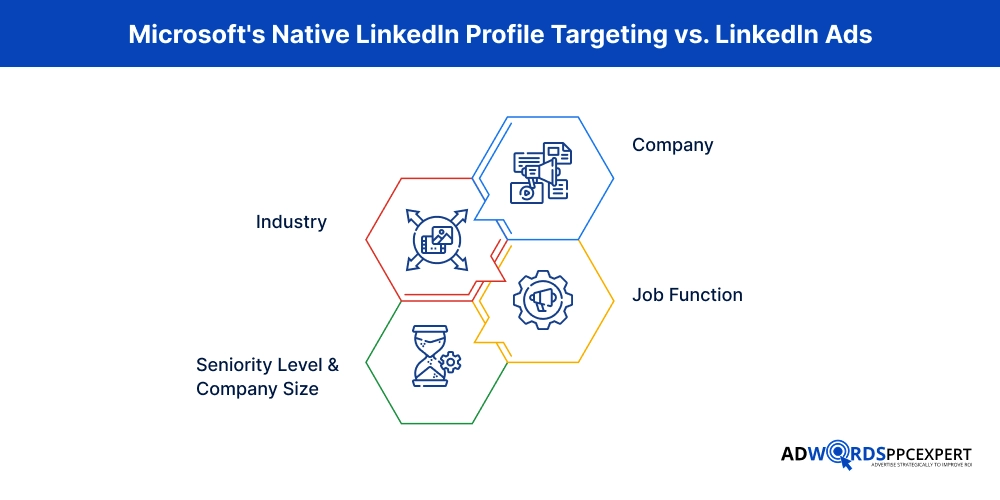
One of the key features of Microsoft Advertising is that it combines data from LinkedIn natively (acquired by Microsoft in 2016). This means that advertisers can add LinkedIn Profile targeting directly into their Search and Audience campaigns via Microsoft Ads.
- Company: Target companies (up to 1,000 per campaign).
- Industry: Segment traffic based on industry verticals (such as Financial Services, Healthcare).
- Job Function: Define roles (such as Information Technology, Finance, Legal).
- Seniority Level & Company Size: Apply filters for Executive, VP, Director, or Manager level jobs within some chosen accounts.
Economics: Incremental Volume & Lower CPCs
For B2B marketing campaigns, Microsoft’s search advertising is known to be 20% to 45% cheaper on Cost Per Click compared to Google Search. Due to the fact that corporate employees generally earn higher average income than regular employees, Microsoft Ads is an ideal way to convert leads into opportunities cheaply.
LinkedIn Ads for B2B: Professional Audience & Account-Based Demand Generation
LinkedIn Marketing Solutions is the premier global platform for professional audience targeting. With over 1 billion members globally—including more than 180 million senior-level executives and 10 million C-level decision-makers—LinkedIn provides an environment where users engage specifically in a professional mindset.
Unrivaled First-Party Professional Data
Unlike consumer networks that rely on inferred interest data, LinkedIn’s targeting is powered by self-reported, real-time professional identity data. B2B marketers can target prospects with surgical precision using:
- Demographics: Job Function, Seniority, Member Skills, and exact Job Titles.
- Firmographics: Exact Company Names (Account-Based Marketing), Industry, Company Size, and Growth Rate.
- Education & Interests: Groups, Degrees, and Field of Study.
- First-Party Data: Match CRM contact/account lists via Matched Audiences, build Lookalikes, or retarget website visitors via the LinkedIn Insight Tag.
Creating and Influencing Demand Across Long Sales Cycles
For business-to-business (B2B) sales cycles lasting 3 to 12 months, only 5% of the targeted audience is actually purchasing anything (95/5 rule coined by the Ehrenberg-Bass Institute and LinkedIn B2B Institute). Focusing on search-based ads alone means ignoring the other 95% of the purchasers who are not yet in the search phase.
The LinkedIn platform is especially strong for ABM and demand generation marketing. The Thought Leadership Content, Document Ads, Video Ads, and Native Lead Gen Forms help B2B brands to gain category trust, create awareness about the problems faced, and set up criteria for purchase well before the actual procurement starts.
Format Versatility & Lead Generation
LinkedIn features ad formats that are created with B2B buyer journeys in mind:
- Image & Video Ads: Native in-feed ads that are created for thought leadership, ungated case studies, and the brand story.
- Native Lead Gen Forms: Enables the prospect to download whitepapers, research papers or e-books with just two clicks, pre-populating their profiles in order to generate high form fill rates.
- Document Ads: Native display of gated PDFs or slideshows within the feed for the prospect to see what insights they have before sharing their information.
- InMail / Conversation Ads: Personalized messaging sent directly to their inbox.
Head-to-Head Platform Comparison
To evaluate channel capabilities objectively, the following comparison table details core operational criteria across Google Ads, Microsoft Ads, and LinkedIn Ads:
Evaluation Factor |
Google Ads |
Microsoft Ads |
LinkedIn Ads |
|---|---|---|---|
| Primary Strength | Captures active commercial search intent at scale | Expands search reach with lower CPCs and strong desktop enterprise reach | Provides precise account and professional demographic targeting |
| Core Intent Level | High (active search query) | High (active search query) | Low-to-Medium (passive browsing and mindset exposure) |
| Targeting Method | Keywords, search query context, and in-market audiences | Keywords plus professional profile attributes such as company, industry, and function | Profile data including job title, seniority, company, and ABM lists |
| Best Funnel Stage | Bottom-of-Funnel (BOFU) and Middle-of-Funnel (MOFU) | Bottom-of-Funnel (BOFU) and Middle-of-Funnel (MOFU) | Top-of-Funnel (TOFU) and Middle-of-Funnel (MOFU) demand generation |
| Typical B2B Use Case | Capturing buyers actively comparing solutions or software categories | Scaling search coverage cost-effectively and filtering B2B audiences | Building account awareness, distributing thought leadership, and ABM |
| Average CPC Range | High to Very High ($5.00–$50.00+) | Moderate ($2.50–$25.00) | Very High ($6.00–$20.00+) |
| Average CPL Range | Moderate to High ($80–$300+) | Low to Moderate ($50–$200+) | High ($100–$400+) |
| Main Limitation | High CPC competition and limited job-title targeting | Lower total search query volume compared with Google | High CPC/CPM and lower immediate bottom-funnel intent |
| Key Measurement | Offline Conversion Tracking (OCT), ROAS, and qualified lead rate | Offline Conversion Tracking (OCT) and incremental search CPA | Pipeline influence, account engagement, and cost per opportunity |
| Minimum Budget Fit | $2,000–$5,000+/month for focused niche campaigns | $1,000–$3,000+/month as a search complement | $3,000–$5,000+/month for meaningful audience reach |
Which Channel Should You Choose? Scenario-Based Decision Framework
Instead of using your own preference, B2B growth leaders need to choose channels of advertisement through the use of concrete operational parameters. The following decision matrix can help you:
Google Ads For:
This is the most common structure.
- The category of your product or service has search volume and commercial intent keywords (e.g., "B2B accounting software for enterprise").
- The buyer is aware that he or she has a problem and needs a comparison with vendors.
- The sales cycle is short (less than 90 days), and the first goal is capturing the ready-to-buy prospect.
- You have strong CRM integration for feeding offline pipeline stages back to Google Smart Bidding.
Microsoft Ads For:
- Your Google Ads search campaigns are successful, but CPC rates limit your budget scalability.
- Your Ideal Customer exists in an enterprise desktop corporate environment (such as Banking, Government, Healthcare, Fortune 500).
- Your goal is to combine general search terms with LinkedIn filters based on companies or industries to exclude unqualified user clicks.
- You want affordable increments of search traffic to reduce the total blended Cost-Per-Acquisition.
LinkedIn Ads For:
- Defining an entirely new category of software or finding a solution for something that is not searched for.
- Your Ideal Customer Profile (ICP) is narrowly defined through certain job titles and seniority, or a list of accounts targeted via Account-Based Marketing.
- You have a high Average Contract Value (ACV) between $20,000 and $100,000+ per year to justify a high Cost-Per-Click and CPL rate.
- The buying decision process involves several people in different groups (IT, Legal, Finance, and Operations).
Practical B2B Budget Allocation Strategies ($5K, $10K, $25K/Month)
Budget fragmentation is a top cause of B2B campaign underperformance. Spreading a modest budget across too many platforms dilutes data collection, preventing algorithmic bidding optimization.
Framework 1: $5,000 / Month Starting Budget
- Recommended Split: Allocation: 80% Google Search ($4,000/mo) | 20% Microsoft Search ($1,000/mo)
- Strategic Rationale: Focus 100% of capital on demand capture. Allocate $4,000 to Google Ads focused strictly on high-intent exact and phrase match non-branded commercial keywords and branded search. Allocate $1,000 to Microsoft Ads to import the Google campaign structure, capturing identical search intent at lower CPCs.
- Avoid: Do not split a $5,000 budget with LinkedIn Ads unless ACV exceeds $50,000 and search volume is zero. A $1,500/month LinkedIn budget usually generates insufficient click volume to achieve statistical significance.
Framework 2: $10,000 / Month Growth Budget
- Recommended Split: Allocation: 50% Google Search ($5,000/mo) | 15% Microsoft Search ($1,500/mo) | 35% LinkedIn Ads ($3,500/mo)
- Strategic Rationale: Maintain $6,500 across Search channels to fully capture existing active market demand. Introduce $3,500/month on LinkedIn Ads targeting exact ICP personas with high-value thought leadership, ungated case studies, or native Lead Gen Forms to seed demand among top target accounts.
Framework 3: $25,000 / Month Scale Budget
- Recommended Split: Allocation: 40% Google Search ($10,000/mo) | 10% Microsoft Search ($2,500/mo) | 40% LinkedIn Ads ($10,000/mo) | 10% Multi-Channel Retargeting ($2,500/mo)
- Strategic Rationale: Deploy a balanced full-funnel acquisition engine. LinkedIn ($10k) drives targeted ABM awareness and video engagement across target accounts. Google ($10k) and Microsoft ($2.5k) capture intent as nurtured buyers search for solutions. Dedicated retargeting ($2.5k across LinkedIn and Google Display/RLSA) maintains continuous touchpoints with engaged website visitors.
The Full-Funnel Multi-Channel Strategy
When executed in isolation, channels often deliver suboptimal efficiency. However, when integrated into a unified multi-channel architecture, performance scales exponentially.
The Integrated B2B Buyer Journey Flow
- Stage 1 (Awareness / Demand Creation): Target key accounts with Thought Leadership Video Ads and ungated Industry Reports on LinkedIn to build problem awareness.
- Stage 2 (Intent / Demand Capture): When decision-makers search for vendors, capture them via high-intent Search campaigns on Google Ads and Microsoft Ads.
- Stage 3 (Consideration / Retargeting): Retarget non-converting landing page traffic across LinkedIn and Microsoft Audience Network with customer social proof, ROI calculators, and product demo case studies.
- Stage 4 (Closed-Loop Attribution): Pass lead data into CRM (HubSpot, Salesforce), track pipeline progression to SQL/Opportunity, and feed conversion value back to Google/Microsoft Smart Bidding.
Assessment of channels based on last click attribution results in extreme misallocation. Within a multi-channel setup, LinkedIn is usually used as the channel that initiates brand recognition, followed by a final click on Google Search, which occurs weeks later. Excluding LinkedIn from the equation through last click CPL assessment leads to reduced search query volume and pipeline generation.
Why Cost Per Lead (CPL) Alone Is a Flawed Metric for B2B PPC
The metric most commonly misused by B2B marketing teams is raw Cost-Per-Lead (CPL). A low CPL often indicates weak audience targeting, low-friction form fills (e.g., spam personal email addresses), or unvetted traffic.
Consider the following comparative scenario between Channel A (Low CPL / Low Quality) and Channel B (High CPL / High Quality):
Performance Metric |
Channel A (Broad Search / Low Gating) |
Channel B (LinkedIn ABM / Strict ICP) |
|---|---|---|
| Monthly Spend | $10,000 | $10,000 |
| Raw Form-Fill Leads | 200 Leads | 50 Leads |
| Cost Per Lead (CPL) | $50 | $200 |
| MQL Conversion Rate | 20% (40 MQLs) | 70% (35 MQLs) |
| SQL Conversion Rate | 10% of MQLs (4 SQLs) | 40% of MQLs (14 SQLs) |
| Qualified Opportunities | 2 Opportunities | 8 Opportunities |
| Closed Deals (25% Win Rate) | 0.5 Deals (1 Deal every 2 months) | 2 Closed Deals |
| Average Deal Value (ACV) | $40,000 | $40,000 |
| New ARR Generated / CAC | $20,000 ARR | CAC = $20,000 | $80,000 ARR | CAC = $5,000 |
In this case, Channel A is seen to be four times as effective when considering only CPL ($50 compared to $200). However, Channel B makes 4x more pipeline revenue with a CAC of $5,000 compared to $20,000 by Channel A. For B2B marketing, marketers need to focus on CPQO and CAC, and not only on front-end leads cost.
What the Data Says: Benchmarks, Audience Reality & Platform Economics
When evaluating published B2B PPC benchmark studies (such as data from WordStream, First Page Sage, or platform-reported metrics), advertisers must understand that benchmarks reflect aggregate multi-industry averages. Costs vary dramatically based on industry vertical, country, brand authority, and conversion action type.
Platform |
Avg B2B CPC Range |
Avg B2B CTR Range |
Primary B2B Conversion Action |
Source / Dataset Basis |
|---|---|---|---|---|
| Google Ads (Search) | $4.50–$25.00+ | 3.1%–6.5% | High-Intent Demo / Contact Form Fill | Platform Data & Industry Benchmarks (2025/2026) |
| Microsoft Ads (Search) | $2.50–$15.00 | 2.8%–5.2% | Demo Request / Content Download | Microsoft Advertising Insights (2025/2026) |
| LinkedIn Ads (Sponsored Content) | $6.00–$18.00+ | 0.45%–0.95% | Native Lead Form / Content Download | LinkedIn Marketing Solutions Documentation (2025/2026) |
| LinkedIn Ads (InMail / Message) | $0.80–$2.20 / Send | 40%–55% Open Rate | Event Sign-up / Direct Demo Request | LinkedIn Marketing Benchmarks (2025/2026) |
| Google Display Network (GDN) | $0.50–$2.50 | 0.35%–0.80% | Retargeting Site Visit / Micro-conversion | Google Ads Network Benchmarks (2025/2026) |
Frequently Asked Questions (FAQ)
Q: Which is better for B2B lead generation, Google Ads or LinkedIn Ads?
Neither platform can be described as ‘better’ across all situations because both platforms address different business needs. Google Ads is better at targeting active searches when buyers are looking for specific business solutions. LinkedIn Ads is better at targeting specific professional profiles (based on job title, company size, or industry) to create active searches.
Q: Is Microsoft Ads really worth using for B2B companies?
Yes, because Microsoft Ads gives search traffic coming from desktop users on the corporate side and with higher purchasing capacity at a cost per click that is 20% to 40% less compared to Google Ads. Also, there are options for filtering search traffic by industry, company, and job function.
Q: Why are LinkedIn Ads more expensive than Google Ads?
LinkedIn Ads pricing model comes with premium CPMs and CPCs due to the presence of verified, self-declared professional first-party data on the site. Unlike Google, which targets keyword searches, LinkedIn targets specific job titles, senior positions, and company lists.
Q: How much budget do I need to start advertising on LinkedIn for B2B?
The minimum budget one should start with when using LinkedIn Ads should be a budget of at least $3,000 to $5,000 per month. This budget enables campaigns to attain enough impressions from target companies and hence statistical significance.
Q: Can Microsoft Ads replace LinkedIn Ads for professional targeting?
No. On Microsoft Ads, LinkedIn targeting acts as a filter applied to search queries or native network placements. It does not allow you to run sponsored content posts inside the LinkedIn newsfeed or target exact job titles.
Q: How should B2B companies measure PPC success beyond CPL?
B2B companies should track metrics tied directly to revenue: Cost Per Qualified Lead (CPQL), Cost Per Opportunity, Pipeline Generated ($), Customer Acquisition Cost (CAC), and Return on Ad Spend (ROAS) based on closed-won deal value.
Conclusion
None of the ad networks acts alone as the silver bullet for B2B growth. Each platform, be it the high-intent demand acquisition via Google Ads, efficient enterprise reach through Microsoft Ads, or highly targeted account-based demand generation on LinkedIn Ads, plays an indispensable role in its unique way.
Instead of focusing on individual platforms and measuring success by the mere front-end Cost Per Lead (CPL), the B2B marketers have to align platform investment based on deal size, sales cycle length, and down-funnel pipeline speed. Through capturing existing intent, then layering enterprise reach and scaling LinkedIn for brand influence, the companies build a robust full-funnel acquisition machine designed for measurable revenue ROI.
For a customized paid media strategy, budget modeling, or the implementation of campaigns on Google Ads, Microsoft Ads, and LinkedIn Ads, please contact the paid search and performance marketing team at AdWordsPPCExpert to accelerate your B2B pipeline.

Ami Singh is a highly skilled AdWords PPC Specialist, known for creating profitable Google Ads strategies that elevate brands. With deep expertise in Google Search, Display, Shopping, YouTube Ads, and advanced bidding techniques, Ami consistently converts data into performance-driven results.
With a sharp analytical mind and a strong understanding of online consumer behavior, Ami designs campaigns that maximize ROI, boost quality scores, and reduce acquisition costs. His approach blends technical expertise with strategic thinking—making him a go-to expert for businesses aiming to dominate Google Ads.
Ami doesn’t just adapt to the fast-changing PPC industry, but he also stays ahead of the curve by testing new features, adopting automation smartly, and refining what works. Clients trust him for his transparency, insights, and ability to scale campaigns sustainably.
Looking to take your Google AdWords performance to the next level? Connect with Ami Singh at Softtrix and discover how he can help you get the maximum growth through powerful PPC strategies.