
Google Ads can help businesses generate leads and sales quickly. But getting your ads in front of potential customers does not automatically mean your budget is being spent efficiently.
Google Ads is a paid marketing channel, so every click can cost you money. If your keywords, ad copy, landing page, conversion tracking, or bidding strategy are not set up properly, you can spend your budget without getting the results you expected.
Google estimates that advertisers receive about $2–$2.30 in value for every $1 spent on Google Ads. However, the actual return varies widely by business, campaign, industry, and how the account is managed.
For a successful Google Ads campaign, you need the right keywords, relevant ad copy, a strong landing page, accurate conversion tracking, and a bidding strategy that matches your goal.
One reason bidding matters is that Google does not treat every search opportunity the same way.
For example, someone searching “emergency plumber near me” is likely showing a different level of intent from someone searching “how to fix a leaking tap.”
Depending on your campaign goal, Google’s automated bidding systems can use signals available at auction time to estimate which opportunities are more likely to produce the desired result.
In simple terms, your bidding strategy tells Google what result you want and helps it decide how to compete for each advertising opportunity.
In this guide, we’ll explain Google Ads bidding strategies from scratch, so you can understand what each strategy does, when to use it, and how to choose the right one for your campaign.
What is a bidding strategy in Google Ads?
Every time someone searches on Google, advertisers compete in an auction for the opportunity to show an ad. Your bidding strategy tells Google what you want to achieve and how it should optimize your bids toward that goal.
For example:
When a person searches for a local service like “emergency roof repair near me,” that search may be far more valuable to a roofing company than someone searching “roof repair cost.”
Google’s automated bidding systems can use signals available at the time of each auction, such as device, location, time of day, and other contextual signals, to adjust bids based on the likelihood of achieving your campaign goal. Smart Bidding makes these bid adjustments at the individual auction level.
That is the important distinction:
The keyword tells Google what the search is about. The bidding strategy tells Google what outcome you want from that search.
The Main Google Ads Bidding Strategies
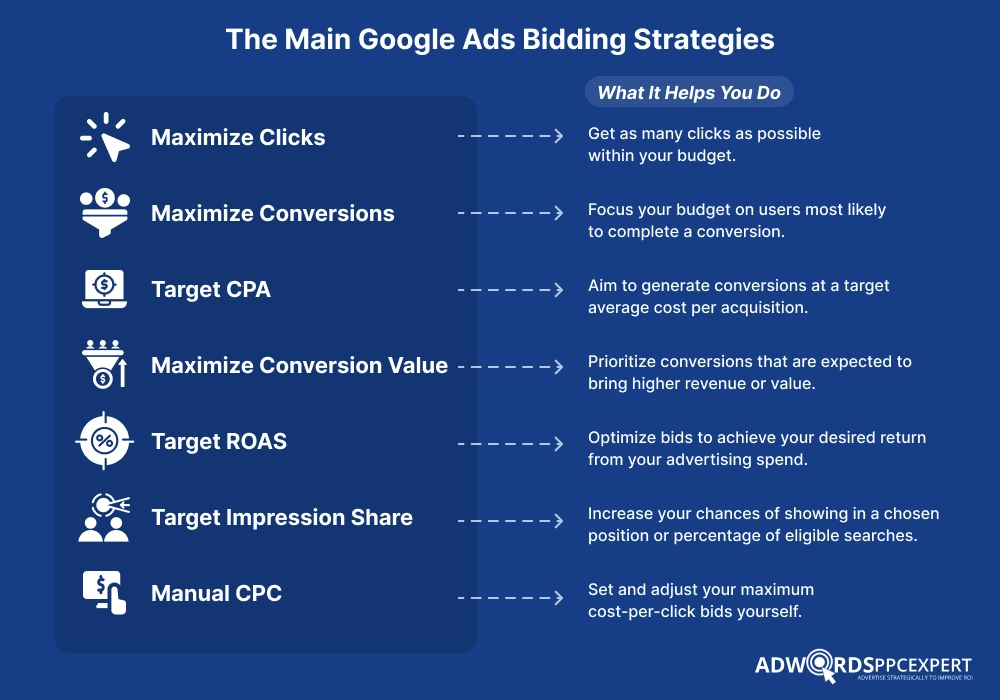
Google Ads currently gives advertisers several ways to control bidding. The major strategies fall into four practical groups:
Your Goal |
Suitable Bidding Strategy |
What It Helps You Do |
|---|---|---|
| Get More Website Visits | Maximize Clicks | Get as many clicks as possible within your budget. |
| Generate as Many Leads as Possible | Maximize Conversions | Focus your budget on users most likely to complete a conversion. |
| Generate Leads Around a Desired Cost | Target CPA | Aim to generate conversions at a target average cost per acquisition. |
| Generate as Much Sales Value as Possible | Maximize Conversion Value | Prioritize conversions expected to bring higher revenue or value. |
| Maintain a Specific Return on Ad Spend | Target ROAS | Optimize bids to achieve your desired return from advertising spend. |
| Control Visibility on the Search Results Page | Target Impression Share | Increase your chances of showing in a chosen position or percentage of eligible searches. |
| Maintain More Manual Control | Manual CPC | Set and adjust your maximum cost-per-click bids yourself. |
Google classifies Maximize Conversions, Target CPA, Maximize Conversion Value, and Target ROAS as Smart Bidding strategies, meaning they use auction-time bidding to optimize toward conversions or conversion value.
But knowing this list is not enough.
The real question is:
Which one should you use for your campaign?
1. Manual CPC: When You Want More Control Over Your Bids
Manual CPC is the traditional approach. You decide how much you are willing to bid per click, rather than letting Google’s automated system determine the bid.
You may initially want tighter control over spending while you collect search-term and conversion data.
You could assign different maximum CPC bids based on your assessment of the keywords.
For example:
Keyword |
Example Max CPC |
|---|---|
| “emergency locksmith near me” | $8.00 |
| “car locksmith near me” | $6.50 |
| “lock replacement” | $4.50 |
| “locksmith services” | $5.00 |
Note: These are illustrative bids, not recommended market rates.
The important point is that you are controlling the bids yourself.
When does Manual CPC make sense?
It can be useful when:
- You need tight manual control.
- The campaign has little or no conversion data.
- You are conducting an initial keyword test.
- You have a very specific bidding approach.
- You want to understand the campaign before handing more control to automation.
But there is a limitation.
You are making decisions at the keyword level. Google can use far more auction-level information than you can manually manage.
That is why Manual CPC is usually not the end goal for a mature conversion-focused campaign.
2. Maximize Clicks: Get More Traffic Within Your Budget
Maximize Clicks does exactly what its name suggests.
You give Google a budget and ask it to generate as many clicks as possible within that budget. In fact, Google automatically adjusts bids to pursue more visits. This can be useful when your immediate goal is traffic rather than leads or revenue.
Instead of immediately forcing the campaign toward a CPA target, the advertiser might use Maximize Clicks to gather search-term, keyword, and landing-page data.
A click is not a business result. You can generate 1,000 clicks and still receive very few appointment requests.
So don’t judge this strategy by clicks alone.
Look at:
- Search terms
- Engagement
- Landing-page behavior
- Calls
- Form submissions
- Appointment bookings
- Actual qualified leads
- When I would use it
Use Maximize Clicks when traffic itself has value, or when you are deliberately collecting data before moving toward a conversion-focused strategy.
3. Maximize Conversions: Tell Google You Want Leads or Sales
Now we move into conversion-focused bidding. Maximize Conversions tells Google to use your budget to generate as many conversions as possible.
Google’s system predicts the likelihood of conversion for each auction and adjusts bids accordingly.
This is where conversion tracking becomes extremely important.
Consider a locksmith campaign
The client does not actually want:
- 5,000 impressions
- 1,000 clicks
- cheap visitors
They want:
phone calls from people who need a locksmith.
The campaign may target:
1. “emergency locksmith near me”
2. “24 hour locksmith”
3. “car key replacement”
4. “lockout service”
5. “commercial locksmith”
Suppose the campaign has:
$3,000 monthly budget
The advertiser could use Maximize Conversions and allow Google to find auction opportunities that are more likely to result in tracked conversions.
But there is a deeper issue.
What counts as a conversion?
If the account treats all of these as conversions:
- Contact-page visit
- 10-second phone call
- Form submission
- Actual booked job
Google can optimize toward the wrong outcome.
For a locksmith, a qualified phone call lasting several minutes may be much more valuable than someone who accidentally clicks the contact button.
So before changing the bidding strategy, fix the conversion setup.
Bad conversion data + sophisticated bidding = sophisticated optimization toward the wrong goal.
4. Target CPA: When You Know What a Lead Is Worth
Target CPA becomes useful when the business has a clear understanding of what it can afford to pay for a conversion.
CPA means Cost Per Acquisition or, depending on the conversion, cost per action.
Suppose a plumbing company knows that it can comfortably acquire a qualified lead for around $50.
The campaign is generating enough reliable conversion data.
Instead of simply saying:
“Get me as many conversions as possible.”
The advertiser can say:
“Get me conversions while aiming for an average CPA around $50.”
Google then adjusts bids at auction time to work toward that target. Individual conversions can cost more or less than the target; the target is an average goal rather than a fixed price for every conversion.
5. Maximize Conversion Value: Not Every Conversion Is Equal
This is where more advanced Google Ads management begins.
Imagine an ecommerce business sells:
Product A – $40
Product B – $150
Product C – $600
If all three purchases are counted simply as “one conversion,” Maximize Conversions sees them as equal conversions.
But the business does not see them as equal.
A $600 purchase has a very different commercial value from a $40 purchase.
Maximize Conversion Value allows Google to optimize toward the value you send with your conversion data rather than simply counting conversions. Google recommends value-based bidding when conversions have different values.
Example
Suppose an online furniture store sells:
Dining chairs: $120
Dining tables: $600
Bedroom sets: $1,800
The business wants to increase revenue rather than simply increase the number of orders.
Its conversion tracking passes the actual transaction values into Google Ads.
Now Google has a better signal.
Instead of:
“Find me more buyers.”
The campaign is effectively optimizing toward:
“Find me opportunities likely to produce valuable purchases.”
That is a much more useful objective for many ecommerce businesses.
The advanced lesson
If your business has different customer values, don’t flatten them into one conversion whenever you can avoid it.
The quality of the data you feed into Google affects the quality of the decisions its bidding system can make.
6. Target ROAS: When Revenue and Profitability Matter
Target ROAS is used when you want Google to pursue conversion value while working toward a particular return on ad spend.
ROAS is:
Conversion Value ÷ Ad Spend × 100
For example:
Suppose an online electronics store spends $10,000 per month on Google Ads.
It generates $50,000 in tracked sales.
That gives it:
$50,000 ÷ $10,000 = 5
So the campaign produced a 5x ROAS.
If the business’s economics support a 5x return, Target ROAS may be appropriate.
But here’s where experienced campaign management matters.
ROAS is not profit.
Suppose:
Revenue = $100,000
Ad spend = $20,000
ROAS = 5x
That sounds excellent.
But if product costs, shipping, refunds, salaries, and other operating costs consume most of the remaining $80,000, a 5x ROAS may not be as attractive as it looks.
For some businesses, a 3x ROAS can be more profitable than a 5x ROAS if the products have different margins.
This is why advanced advertisers should think beyond revenue.
7. Target Impression Share: When Visibility Is the Objective
Not every campaign is trying to generate the maximum number of conversions.
Sometimes the goal is visibility.
Target Impression Share allows advertisers to target a percentage of eligible impressions and choose where they want the ad to appear, such as the top of the page or absolute top, subject to Google’s auction and eligibility constraints.
Example
A law firm wants strong visibility for its own brand searches:
- “Smith & Partners”
- “Smith & Partners law firm”
- “Smith & Partners reviews”
The objective isn’t necessarily to discover hundreds of new leads.
The firm wants to make sure competitors have less opportunity to occupy prominent positions when people search specifically for its brand.
Target Impression Share may make sense for that type of campaign.
But don’t use it everywhere
If your real objective is qualified leads, a campaign that proudly reports 95% impression share may still be a poor campaign.
Visibility is not the same thing as revenue.
An Advanced Example: Choosing the Strategy for a Real Business
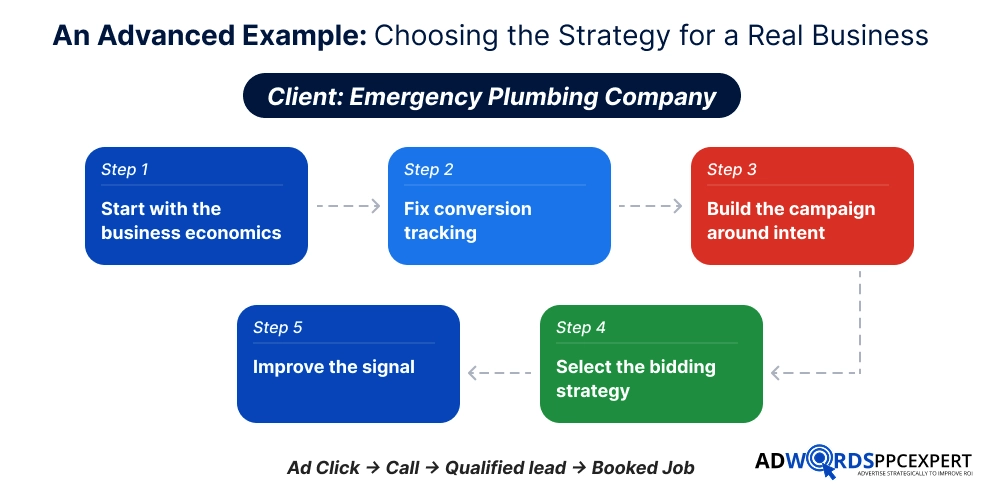
Let’s take a fictional but realistic example.
Client: Emergency Plumbing Company
The company serves:
- Seattle
- Bellevue
- Redmond
- Kirkland
Its high-intent keywords include:
- “emergency plumber Seattle”
- “plumber near me”
- “water heater repair Seattle”
- “burst pipe plumber”
- “24 hour plumber”
- “emergency drain cleaning”
The client doesn’t care about getting cheap clicks.
The business wants qualified calls that turn into booked plumbing jobs.
Step 1: Start with the business economics
The company determines:
- Average job value: $450
- Average profit contribution per job: $180
- Lead-to-job rate: 40%
- Maximum acceptable lead cost: approximately $70
Now the bidding decision has context.
Step 2: Fix conversion tracking
The campaign should distinguish meaningful actions from weak ones.
Potential primary conversion:
Qualified phone call
Potential secondary actions:
- Contact form submission
- Quote request
- Directions
- General engagement
You don’t necessarily want every interaction treated as an equally valuable primary conversion.
Step 3: Build the campaign around intent
High-intent searches might be separated from informational searches.
For example:
Emergency campaign
- “emergency plumber Seattle”
- “24 hour plumber Seattle”
- “burst pipe plumber”
- “emergency plumbing service”
Water heater campaign
- “water heater repair Seattle”
- “water heater replacement”
- “water heater service near me”
This gives the bidding system cleaner signals.
Step 4: Select the bidding strategy
If the campaign has sufficient reliable conversion data and the business’s priority is lead volume:
Maximize Conversions
If the business needs to keep acquisition costs around a defined level:
Target CPA
Step 5: Improve the signal
Suppose the account generates 100 phone calls, but only 35 become genuine sales opportunities.
Optimizing for all calls may teach Google to find people who call—not necessarily people who become customers.
An advanced setup can import qualified lead or offline conversion data back into Google Ads.
Now the optimization signal becomes closer to:
Ad click → call → qualified lead → booked job
That is much more valuable than optimizing around a shallow action.
Advanced Google Ads Bidding Strategies That Actually Matter
This is where many basic guides stop. In a real account, the bidding strategy itself is only one part of the system.
1. Don’t optimize toward the cheapest conversion. Optimize toward the right conversion.
2. Separate campaigns when the economics are genuinely different
3. Use value-based bidding when lead quality varies
4. Broad Match + Smart Bidding Requires Discipline
5. Don’t Change Your Target CPA Every Few Days
6. Don’t Set an Aggressive Target Just to Make the Dashboard Look Good
7. Your Budget and Bidding Strategy Work Together
8. Don’t Judge a Bidding Strategy by CPC Alone
A Practical Google Ads Bidding Framework
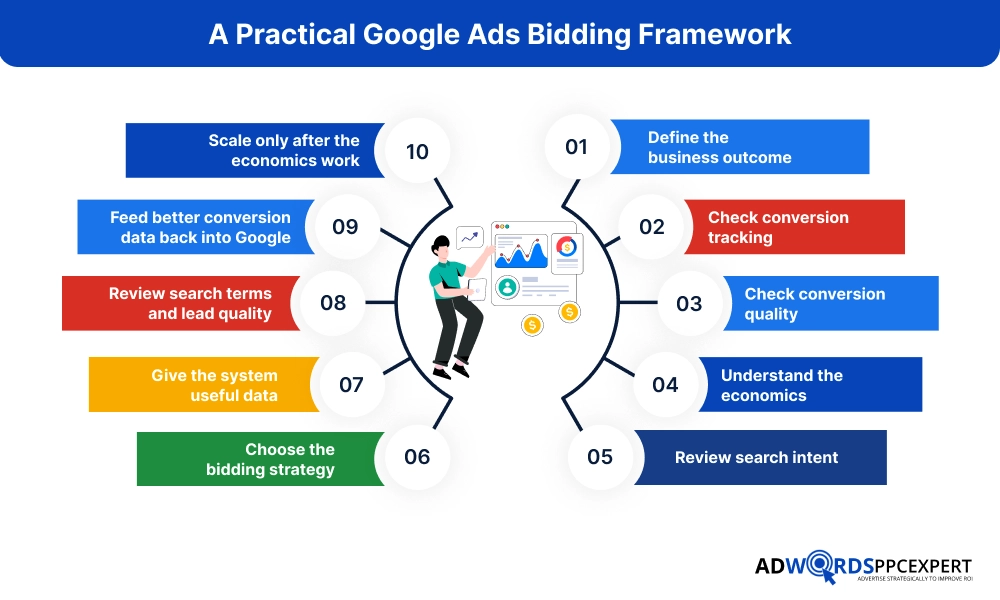
If I were reviewing a new account, I would not begin by changing the bid strategy.
I would work through this order:
1. Define the business outcome: What does the client actually consider a successful conversion?
2. Check conversion tracking: Is Google receiving the right signals?
3. Check conversion quality: Are the tracked conversions actually valuable?
4. Understand the economics: What is an acceptable CPA? What is a customer worth? What margin does the business make?
5. Review search intent: Are we bidding on searches that indicate someone is ready to buy?
6. Choose the bidding strategy: Match the strategy to the business objective.
7. Give the system useful data: Don’t keep changing targets before the campaign has a chance to respond.
8. Review search terms and lead quality: Automation does not remove the need for human campaign management.
9. Feed better conversion data back into Google: Especially for lead-generation businesses where a form submission does not equal a customer.
10. Scale only after the economics work: More traffic is not the goal. A more profitable business is.
Final Takeaway
Google Ads bidding is no longer simply about deciding whether a keyword should have a $5 or $10 bid.
The stronger approach is to connect keywords -> search intent -> conversion data → business value → bidding strategy.
A locksmith may need to optimize around qualified emergency calls. An ecommerce store may need to distinguish a $50 order from a $1,000 order. A B2B company may need to tell Google which leads actually become opportunities.
That is why there is no universally “best” Google Ads bidding strategy.
The best strategy is the one that gives Google the right objective, the right data, and a realistic business target.
And that is also why changing from Manual CPC to Target CPA, or from Maximize Conversions to Target ROAS, should never be treated as a magic optimization. The bidding strategy can only work with the signals and economics behind the campaign.

Ami Singh is a highly skilled AdWords PPC Specialist, known for creating profitable Google Ads strategies that elevate brands. With deep expertise in Google Search, Display, Shopping, YouTube Ads, and advanced bidding techniques, Ami consistently converts data into performance-driven results.
With a sharp analytical mind and a strong understanding of online consumer behavior, Ami designs campaigns that maximize ROI, boost quality scores, and reduce acquisition costs. His approach blends technical expertise with strategic thinking—making him a go-to expert for businesses aiming to dominate Google Ads.
Ami doesn’t just adapt to the fast-changing PPC industry, but he also stays ahead of the curve by testing new features, adopting automation smartly, and refining what works. Clients trust him for his transparency, insights, and ability to scale campaigns sustainably.
Looking to take your Google AdWords performance to the next level? Connect with Ami Singh at Softtrix and discover how he can help you get the maximum growth through powerful PPC strategies.