
PPC helps startups generate leads quickly, making it a valuable channel for early growth.
Startups can allocate 15% to 40% of their total marketing budget to PPC, depending on their goals and growth stage.
The ideal PPC budget also depends on your market size, industry competition, and customer acquisition costs.
As a startup founder, one of the biggest questions you’ll have before launching PPC is: How much should you spend?
If your budget is too little, your campaigns might not gather enough data, or if you spend too much, the chances are you’ll burn your marketing budget before seeing a return.
Ultimately, it happens more often than most founders expect.
According to WordStream, businesses waste an average of $1,100 every month on Google Ads because of poor campaign planning and budget management.
In a nutshell, most startups don’t fail because PPC doesn’t work. They fail because they start without a budget plan. They pick a number that feels right, target too many keywords, or expect sales within the first few days. Before they know it, the budget is gone, and so is their confidence in PPC.
The good news is that it doesn’t have to be that way. With the right budget strategy, PPC becomes a growth channel instead of an expensive experiment.
In this guide, you’ll learn how to plan a startup PPC budget that gives your campaigns room to perform without putting unnecessary pressure on your cash flow.
Why PPC Budget Planning Matters for Startups
Paid advertising gives startups something SEO cannot always deliver immediately: visibility from day one. The problem is that visibility alone doesn’t generate revenue.
Without a clear budget strategy, startups often:
Spend too much on broad keywords
Target the wrong audience
Run campaigns without conversion tracking
Increase budgets before campaigns become profitable
Pause campaigns because they believe PPC “doesn’t work”
In reality, poor planning is usually the issue—not PPC itself. Budget planning ensures every pound has a job. Instead of simply buying clicks, you’re investing in qualified traffic that has a realistic chance of becoming customers.
Don't Set a Budget Until You Answer These Three Questions
When you are about to launch a PPC campaign dashboard, hold on a few seconds and answer these three questions.
How much is a new customer worth to your business? Knowing your customer lifetime value (LTV) helps you understand how much you can realistically invest to acquire one.
How much can you spend to get a new customer and still make a profit? This is your target cost per acquisition (CPA). Without it, it’s easy to overspend.
How much of your monthly budget can you comfortably invest in marketing? Your PPC budget should support your growth, not put pressure on your cash flow.
Many startups skip this step because they want to get their ads live as quickly as possible. That’s where things start to go wrong. If you don’t know these numbers, you’re not planning your PPC budget; instead, you’re simply making a guess. And guessing is one of the fastest ways to waste your advertising budget.
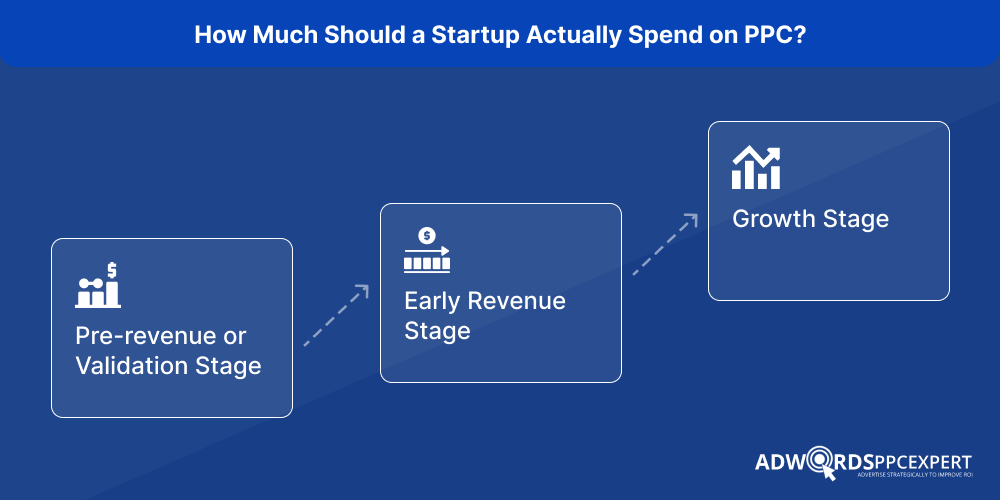
How Much Should a Startup Actually Spend on PPC?
No fixed PPC budget works for every startup. Anyone who gives you a single number without understanding your business is simply guessing.
The right budget depends on your goals, your industry, how competitive your keywords are, and how much you can comfortably invest each month. For most startups, PPC usually takes 15% to 40% of the overall marketing budget, but the exact amount varies based on the stage of the business and how quickly you want to grow.
For example: A startup investing $3,000 a month in marketing might allocate $450–$1,200 to PPC, depending on its goals and competition.
Here’s a simple way to think about it.
Pre-revenue or Validation Stage
If you’re still validating your product or service, keep your PPC budget small. At this stage, the goal isn’t to make a huge profit. It’s to learn what works.
Here you have a big opportunity to use your budget to test different keywords, ad copy, audiences, and landing pages. The insights give you early learning so you avoid big mistakes later.
Early Revenue Stage
Once your business starts generating consistent sales or leads, you can gradually increase your budget. By now, you should know how much it costs to acquire a customer and whether your campaigns are bringing in profitable results.
Note: Don’t increase your budget just because your ads are getting more clicks. Increase it because you’re seeing more qualified leads or sales at a cost your business can afford.
Growth Stage
When your PPC services and campaigns consistently deliver profitable results, PPC becomes a growth channel instead of an experiment.
This is the right time to expand into new keywords, target additional locations, and increase your daily budget. Scale gradually and keep a close eye on your cost per acquisition and return on ad spend. If performance starts to decline, adjust your campaigns before increasing your budget again.
One final rule is worth remembering. If a slow month of PPC could affect your payroll, cash flow, or day-to-day operations, you’re spending more than your business can comfortably handle. A good PPC budget should help your startup grow, not create unnecessary financial pressure.
Crucial Factors that Should Impact the Startup PPC Budget
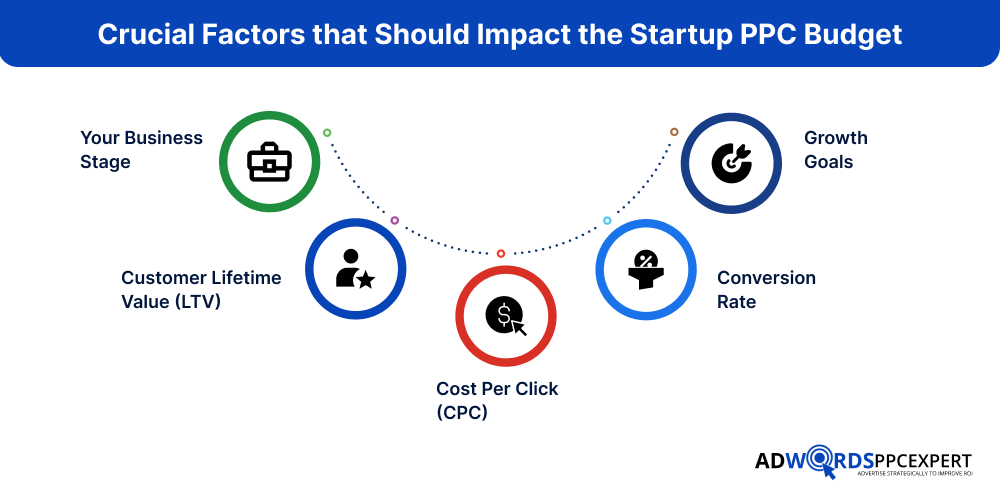
Every startup has different goals and challenges. Understanding these factors will help you set a realistic PPC budget and spend more effectively.
1. Your Business Stage
A newly launched startup needs to validate demand before aggressively scaling. Yn this case, early-stage businesses should focus on:
- Testing keywords
- Understanding customer behaviour
- Finding profitable audiences
- Measuring conversion rates
When your business starts growing and your revenue is increasing, this is the time you can increase budgets.
2. Customer Lifetime Value (LTV)
Your LTV plays a major role in determining how much you can afford to spend acquiring a new customer.
For example:
If one customer generates only $50 in profit, spending $100 to acquire them isn’t sustainable.
If one customer is worth $10,000 over their lifetime, spending $500 to acquire that customer may be a smart investment.
The higher your customer lifetime value, the more flexibility you have with your PPC budget. Businesses with strong profit margins can often afford higher cost per click and more competitive bids because each new customer generates significantly more long-term revenue.
The key isn’t finding the lowest acquisition cost; it’s finding a customer acquisition cost (CAC) that remains profitable based on the lifetime value of each customer.
3. Cost Per Click (CPC)
Undeniably, every industry has different advertising costs. Some local service keywords cost only a few dollars. Others, especially in legal, finance, software, or insurance, can cost $50–$100+ per click. Knowing your average CPC helps estimate how much traffic your budget can realistically generate.
For example:
$500 budget
Average CPC: $5
You’ll receive roughly 100 clicks. If your average CPC is $25, the same $500 budget will generate only 20 clicks. Understanding this helps you set realistic expectations before launching your campaigns.
4. Conversion Rate
Traffic alone doesn’t generate revenue. What matters is how many visitors become customers. Let’s compare two startups spending the same PPC budget.
Metric | Startup A | Startup B |
|---|---|---|
| Monthly PPC Budget | $2,000 | $2,000 |
| Average CPC | $5 | $5 |
| Total Clicks | 400 | 400 |
| Conversion Rate | 2% | 8% |
| Leads Generated | 8 | 32 |
| Cost Per Lead | $250 | $62.50 |
Both startups spend $2,000 and receive the same 400 clicks. The only difference is their conversion rate.
Startup B generates 4x more leads simply because its landing page, offer, and user experience convert visitors more effectively.
5. Growth Goals
Your objectives should influence your budget. Different goals require different levels of investment.
For example:
Goal | Budget Strategy |
|---|---|
| Validate a New Product | Start with a small testing budget to measure demand and campaign performance. |
| Generate Local Leads | Allocate a moderate monthly budget focused on high-intent local audiences. |
| National Expansion | Increase investment gradually with a structured scaling plan across multiple regions. |
| Rapid Customer Acquisition | Invest a larger budget backed by proven conversion data and scalable campaigns. |
In PPC, budget should follow strategy, rather than guesswork.
A Simple Formula to Estimate Your PPC Budget
Rather than choosing a random monthly figure, work backwards from your goals.
For example:
- Target leads per month: 50
- Website conversion rate: 5%
- Required clicks: 1,000
- Average CPC: $4
Estimated monthly budget:
1,000 × $4 = $4,000
This approach aligns your budget with measurable business objectives instead of assumptions.
Common PPC Budget Mistakes Startups Make
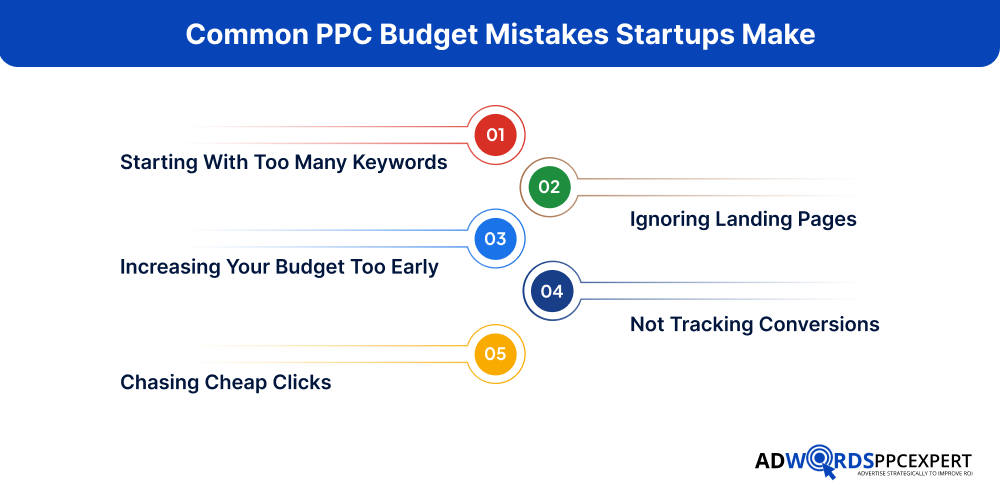
As a startup owner, here are a few key factors to consider to avoid costly mistakes and prevent wasting your PPC budget.
Starting With Too Many Keywords: Trying to target every keyword from the beginning spreads your budget too thin. Start with high-intent keywords that are most likely to drive qualified leads and conversions.
Ignoring Landing Pages: Even the best PPC ads won’t generate results if your landing page fails to convert visitors. Ensure your landing page matches the ad, loads quickly, and has a clear call to action.
Increasing Your Budget Too Early: Increasing your budget doesn’t automatically improve results. First, optimise your keywords, ads, and landing pages. Once your campaigns consistently deliver profitable results, you can scale your budget with confidence.
Not Tracking Conversions: Without conversion tracking, you’re measuring clicks instead of business results. Every startup should know:
- Cost per lead
- Cost per acquisition
- Return on ad spend
- Conversion rate
These metrics determine whether your investment is generating profit.
Chasing Cheap Clicks: Low CPC isn’t always good. A keyword costing £15 that consistently generates customers is often far more valuable than a £1 keyword that never converts. Focus on profitability rather than traffic volume.
How to Make Every Dollar Work Harder
A well-managed PPC budget isn’t about spending less. It’s about spending more efficiently. Some practical ways to improve efficiency include:
- Target high-intent search terms instead of broad keywords.
- Use negative keywords to filter irrelevant traffic.
- Optimise landing pages before increasing ad spend.
- Focus budgets on your highest-performing campaigns.
- Review search term reports regularly.
- Test ad copy continuously to improve click-through rates.
- Use remarketing to re-engage visitors who didn't convert the first time.
Small improvements across these areas often reduce your cost per acquisition without increasing your overall budget.
When Should You Increase Your PPC Budget?
Increasing your budget makes sense when:
1. Campaigns consistently meet your target cost per acquisition.
2. Your landing pages convert at a healthy rate.
3. You’re losing impressions due to budget limits rather than poor ad quality.
4. Additional spending continues to generate profitable customers.
5. Your business has the operational capacity to handle more leads or sales.
If these conditions aren’t in place, increasing your budget is unlikely to improve results.
Final Thoughts!
Startup PPC budgeting isn’t about choosing a number that feels comfortable. It’s about making informed decisions based on your business goals, customer value, competition, and performance data.
Start with a budget that allows you to gather meaningful insights. Measure every important metric. Optimise before you scale. As your campaigns become more efficient, increase your investment with confidence rather than guesswork.
The startups that achieve the strongest long-term results aren’t necessarily those with the biggest budgets. They’re the ones that treat PPC as an ongoing investment, continuously refining their campaigns to make every pound deliver measurable business growth.

Ami Singh is a highly skilled AdWords PPC Specialist, known for creating profitable Google Ads strategies that elevate brands. With deep expertise in Google Search, Display, Shopping, YouTube Ads, and advanced bidding techniques, Ami consistently converts data into performance-driven results.
With a sharp analytical mind and a strong understanding of online consumer behavior, Ami designs campaigns that maximize ROI, boost quality scores, and reduce acquisition costs. His approach blends technical expertise with strategic thinking—making him a go-to expert for businesses aiming to dominate Google Ads.
Ami doesn’t just adapt to the fast-changing PPC industry, but he also stays ahead of the curve by testing new features, adopting automation smartly, and refining what works. Clients trust him for his transparency, insights, and ability to scale campaigns sustainably.
Looking to take your Google AdWords performance to the next level? Connect with Ami Singh at Softtrix and discover how he can help you get the maximum growth through powerful PPC strategies.