
Using pay-per-click ad campaigns to increase your sales is a common marketing tactic. Small to midsized businesses often spend $100 to $10000 every month to leverage this profit-pulling marketing channel.
Yet nearly 73% of small businesses and 80-90% of ecommerce businesses struggle with failed PPC campaigns. That’s because the rule for success is not to spend more but to spend smartly.
PPC is, indeed, a way to achieve quick results, but only if implemented the right way. And that’s why choosing the right ppc agency matters.
The agency you choose to work with will influence where your budget goes, how well it is used, how your campaigns are managed, and whether your investment generates real business growth or just impressive-looking reports.
The sad part is that many businesses fall into the trap of flashy presentations and claims like “Guaranteed #1 Rankings” and “10X ROAS”. Months later, they are left wondering where the budget vanished.
Hiring a ppc agency isn’t actually difficult. Hiring the right one is. That’s because every other pay-per-click company today is a premier Google Partner, promising lower CPCs, higher ROAS, and quality leads. It’s easy to get overwhelmed.
So, how do you find the best match? The wrong choice can drain your budget with no profitable results, while the right one can become a long-term growth partner.
Does that mean you’ll keep experimenting and losing your money until you find that “right long-term growth partner?”
No! You just need to be proactive when hiring a ppc partner. A little due diligence during your research and signing the contract can save you from costly mistakes. A few smart questions can help you separate genuine partners from agencies that just make big promises.
That’s exactly what this blog will help you do!
Key Takeaways
- Most ad campaigns fail because businesses partner with agencies that don’t align with their needs and goals.
- Businesses should practice a proactive approach when it comes to hiring a PPC agency.
- Do not look for agencies to achieve faster results; hire them to achieve long-term, measurable results.
- Good PPC agencies operate with transparency and authority, maintaining clear communication.
- Before signing the contract, ask the agency about their strategy, platforms, case studies, references, action plan for campaign failure, success metrics, and optimization frequency.
- Hiring an agency based on its size or pricing isn’t the right way. Instead, look for expertise, track records, and what they will offer at a specific price.
- The right PPC partner will be honest about challenges, explain their decision-making process, keep you informed with meaningful reports, and take responsibility for campaign performance.
Let’s get into the details.
What Every Business Should Know Before Hiring a PPC Agency?
Before evaluating PPC agencies, you need to understand what you are actually hiring them to do. In a majority of cases, businesses look for agencies that can help them achieve quick results – more leads and sales.
That’s a good reason but not enough. The job of a PPC agency is not just to create ads and watch clicks roll in.
A capable agency:
- Conducts deep research to identify your target audience
- Identified keywords that get you profit
- Develops compelling copies that trigger actions
- Build landing page strategies
- Manages bidding for efficient budgeting
- Monitors conversion data to track progress
- Test continuously and optimize campaigns based on performance.
In other words, they are responsible for turning your ad spend into measurable business outcomes.
Here’s what you need to know before you even begin your search for an ideal PPC partner.
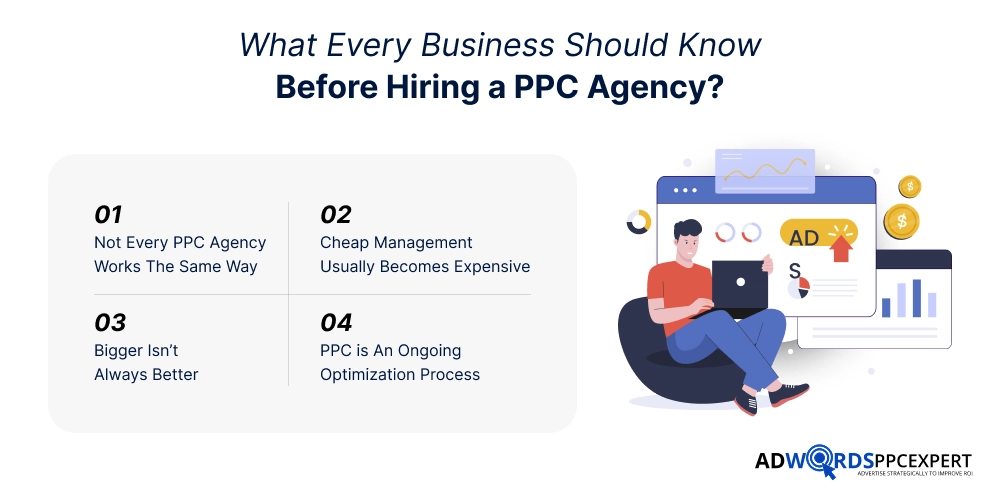
1. Not Every PPC Agency Works The Same Way
This is where many companies get caught off guard. They assume every PPC agency offers the same expertise, but in reality, their experience, approach, and areas of specialization can vary significantly. Hence, they can deliver different results.
Some agencies can be great at lead generation for SaaS businesses; others can specialize in dealing with ecommerce. Some focus on local campaigns, while others excel at managing international advertising across multiple platforms.
But here’s one thing: An agency that delivers outstanding results for a fashion store can struggle to deliver the same for a B2B SaaS company.
Why? Because every industry has different customer behavior, search intent, competition, and conversion goals.
That is why you should never judge the experience of a business only by years – relevance is an important consideration. Industry knowledge often shortens the learning curve and helps campaigns perform faster.
2. Cheap Management Usually Becomes Expensive
Are you also among those businesses that believe choosing the agency with the lowest monthly fee saves money? If yes, you are not alone!
Well, in reality, poor campaign management can waste thousands in advertising spend. Imagine you pay $200 per month to an agency only to find they mismanaged a $10,000 monthly ad budget. Even if they have charged you low, your overall cost is much higher because your campaigns aren’t generating the best possible return.
As marketing expert Seth Godin famously said: The cost of being wrong is less than the cost of doing nothing.
However, in ppc, making the wrong hiring decision can mean paying twice; once for running ineffective campaigns and again to fix them.
3. Bigger Isn’t Always Better
Businesses often get into a deal with larger agencies, assuming they will automatically deliver great results.
That’s not necessarily true!
Many large agencies have extensive resources, but your account may be handled by junior account managers. On the other hand, smaller boutique agencies may offer direct access to experienced PPC specialists and more personalized attention.
So, instead of focusing on the agency size, you should evaluate:
- Who will actually manage your campaigns?
- How experienced and efficient are they?
- How many accounts will they handle simultaneously?
The answers to these questions matter more than the employee count of the agency.
4. PPC is An Ongoing Optimization Process
Launching a campaign is only the beginning. To increase the chances of the success of a campaign, it requires constant testing of keywords, bids, audiences, ad creatives, landing pages, and conversion paths.
As it’s said, “Most marketing isn’t about getting it right the first time. It’s about learning faster than your competition”.
The best PPC agencies embrace this mindset. They don’t assume they already know what will work; they test, measure, learn, and improve continuously.
That’s exactly the type of partner you should be looking for.
12 Crucial Questions To Ask Before Signing a Contract
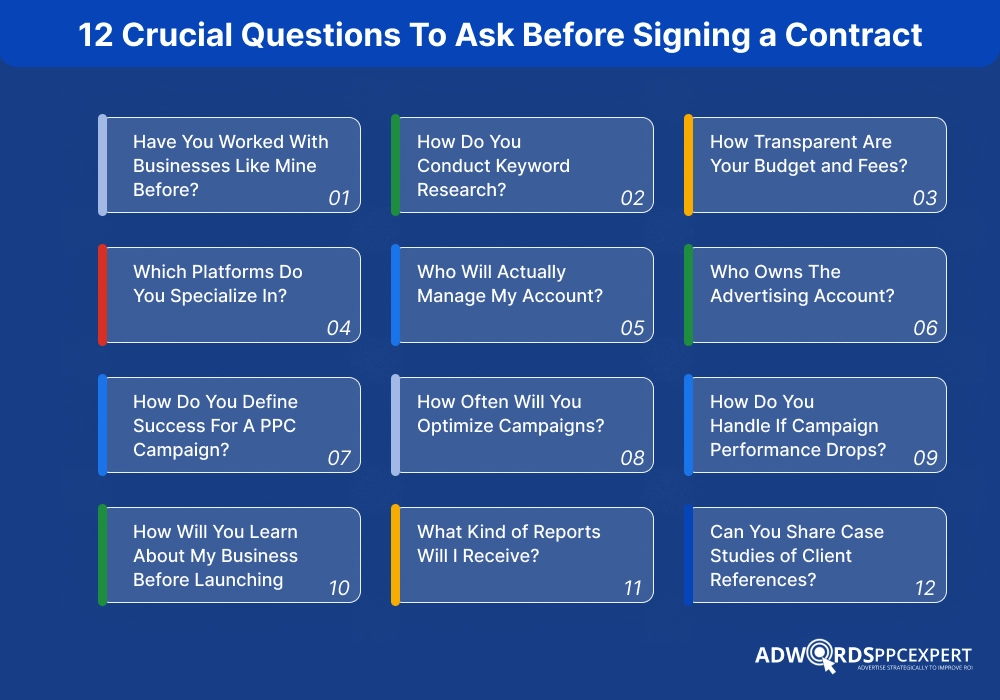
Once you have an understanding of what to expect from a PPC agency, now comes the time to evaluate your options. These questions will help you separate impressive results from sales pitches. Answers to these questions will help you understand if their strategies, processes, and expertise align with your niche, goals, and business model
1. Have You Worked With Businesses Like Mine Before?
As mentioned earlier, industry experience doesn’t guarantee success, but it can reduce costly trial and error. An agency that understands who your audience is, their buying journey, and the competition around can make better decisions from day one.
Ask the agency for examples similar to yours. This doesn’t mean competitors, but companies with similar goals, audiences, or sales processes. If the agency hasn’t worked with a business like you, ask how they will research your market before launching the campaigns.
A good agency will explain:
- Challenges they faced
- Strategies they used
- Measurable outcomes they achieved
- Lessons they learned
Red Flag: They claim they can market “any business” but provide no relevant examples.
Green Flag: They discuss industry-specific insights rather than generic answers or examples.
2. Which Platforms Do You Specialize In?
You should not advertise your business everywhere. Different ad platforms serve different purposes.
The right agency will recommend platforms based on what’s popular. They will recommend them based on your goals, where your ideal customers spend time, and how they make buying decisions.
For example, someone actively searching for “best CRM software” on Google is already looking for a solution. This makes Google Ads an ideal fit. But if you are launching a fitness brand, Meta Ads might be more effective for creating awareness and generating interest. Similarly, LinkedIn Ads are suited for B2B decision-makers, while Amazon Ads are ideal for businesses that sell directly on Amazon.
An experienced agency understands these differences and chooses channels strategically.
A good agency will explain why a particular platform aligns with your business and its goals, audience, and budget. Their recommendations should feel customized and not like a one-size-fits-all solution.
Red Flag: If the agency insists on advertising everywhere without a clear strategy or justification,
Green Flag: They recommend platforms based on your objectives and explain the reasons behind every recommendation.
3. How Do You Define Success For A PPC Campaign?
Every business has a different goal when it comes to running ads. A local clinic may want appointment bookings, while an ecommerce brand using ecommerce PPC focuses on improving ROAS. If the ppc agency measures the success of campaigns only by clicks or impressions, it is focusing on activity and not the impact.
Ask the agency:
- Which KPIs will you track?
- How do they align with my business goals?
The right agency will consider conversions, CPA, ROAS, or even revenue, and not vanity metrics like clicks, traffic, or impressions.
Red Flag: If they mainly talk about clicks, traffic, or impressions.
Green Flag: They align KPIs to your business goals.
4. How Will You Learn About My Business Before Launching Campaigns?
A PPC campaign can deliver outstanding results only if it is planned well. As good the strategy is, better outcomes it delivers. If an agency rushes to launch ads without discussing your business with you is more likely to waste budget. They should first learn about what you do, your products or services, target audience and location, what goals you want to achieve, your competitors, and sales process.
Ask the agency:
- What does your onboarding process include?
- How do you research our business and competitors?
A reliable agency will have a comprehensive onboarding process starting with discovery sessions, market research, and competitor analysis. Based on the insights from these stages, they will create a proper strategy before designing the ad campaign.
Red Flag: If they rush with campaign creation just after the contract is signed.
Green Flag: They ask questions thoughtfully before making recommendations.
5. How Do You Conduct Keyword Research?
Keywords are an important aspect of marketing, whether it’s pay-per-click or search engine optimization. A good PPC agency knows this well and prioritizes comprehensive keyword research.
Good keyword research is about finding the right customers. It’s not about exploring the most searched terms.
A keyword with low search volume but strong buying intent often generates better ROI than a broad, high-volume keyword.
Ask the agency:
- How do you select keywords?
- How do you identify negative keywords?
An agency that values search intent, competition, commercial value, and refines keyword lists regularly is worth considering.
Red Flag: Choosing keywords based only on search volume.
Green Flag: They work following a structured keyword research process.
6. Who Will Actually Manage My Account?
A common challenge that businesses come across when partnering with a ppc agency is account handling. Many times, businesses don’t even know who is actually handling or managing their accounts.
It’s often a lack of transparency that leaves clients unsure of who’s making decisions and how their budget is being spent.
The person selling you the service isn’t always the one managing your campaigns. When you know who will handle your account helps you understand the level of expertise and attention your business will receive.
Ask the Agency:
- Who will be my account manager?
- What is their PPC experience?
So, what does a good agency look like? You will work with a dedicated specialist backed by experienced strategists.
Red Flag: They can’t tell you clearly who will manage your ad account.
Green Flag: Clear ownership with experienced professionals.
7. How Often Will You Optimize Campaigns?
PPC never works if you set it up and let it work in auto mode. Competitors adjust bids, search trends change, and ads lose effectiveness over time. Regular optimization helps improve performance while reducing wasted ad spend.
Ask the Agency:
- How frequently do you optimize campaigns?
- What elements do you regularly review?
A good agency will keep track of campaigns consistently and optimize bids, keywords, audiences, and creatives.
Red Flag: Changes are made only when performance drops.
Green Flag: They optimize regularly and continuously.
8. What Kind of Reports Will I Receive?
A report should tell you more than what happened; it should explain why it happened and what’s being done next. Otherwise, you’re just looking at numbers without understanding their impact.
Ask the agency:
- What metrics are included in your reports?
- How often will we review performance together?
You can ask for sample reports from the agency and see if they include insights, recommendations, and the next steps.
Red Flag: Reports that contain raw data and are filled with jargon but not much explanation.
Green Flag: Reporting is simple, transparent, and actionable.
9. How Transparent Are Your Budget and Fees?
Some agencies advertise low management fees but add setup charges, software costs, or hidden commissions later. It is important to understand where your money goes, as it helps avoid unpleasant surprises.
Ask the agency:
- What’s included in your management fee?
- Are there any additional charges?
Red Flag: Agencies that give vague answers or unexpected extra cots.
Green Flag: If they keep complete pricing transparency.
10. Who Owns The Advertising Account?
Do you own a Google Ads account? If yes, you may lose years of campaign data if you ever decide to switch.
Your advertising account is a business asset. Therefore, it should always remain under your ownership.
Ask the Agency:
- Will we own the ad account?
- Will we have a full administrative account?
The right agency will not take away your ownership or create an account under your ownership from day one.
Red Flag: The agency transfers ownership to itself and doesn’t even give you admin access.
Green Flag: You retain complete ownership and control.
11. How Do You Handle If Campaign Performance Drops?
There’s a lot of uncertainty when it comes to paid ads’ performance. Even the best-performing campaigns can experience dips due to reasons like increased competition, changes in customer behavior, sudden algorithm changes, or seasonal trends.
What matters isn’t performance drops; it’s how quickly the agency identifies the cause and responds. A proactive agency should have a clear optimization and recovery process, and instead of simply increasing your budget.
Ask the agency:
- How do you identify the reason behind a performance drop?
- What is your strategy to improve the campaign performance?
Red Flag: If they talk about increasing ad spend as the only solution to improve performance or wait for it to get better on its own.
Green Flag: Their strategy should include identifying the reasons for the performance drop, testing solutions, and communicating their action plan clearly.
12. Can You Share Case Studies of Client References?
It’s quite natural for you to enquire about the agency’s past projects and track record. Any agency can claim it’s delivered outstanding results, but proof builds credibility. Case studies and client references show how they have solved real challenges, the strategies they used, and the outcomes they achieved.
While agencies may not disclose confidential data, they should be able to demonstrate their expertise with relevant examples.
Ask the Agency:
- Can you share case studies relevant to my industry?
- Can I speak with a current or past client?
Red Flag: If they provide generic testimonials or avoid sharing any evidence of their work.
Green Flag: They readily provide transparent case studies and client references.
Evaluating the Answers And Making The Right Choice
Now, you know the right questions to ask, but asking them is only half the process. The real value lies in evaluating how the agency responds.
You should always look beyond polished presentations and confident sales pitches. A trustworthy PPC agency will answer your questions with clarity, support their claims with real examples, and explain their strategy in a way that makes sense to you. They won’t dodge difficult questions, overpromise unrealistic results, or pressure you into making a quick decision.
Further, as you compare agencies, pay attention to four things: transparency, expertise, communication, and accountability.
The right partner will be honest about challenges, explain their decision-making process, keep you informed with meaningful reports, and take responsibility for campaign performance.
Remember, you are not hiring an agency to run your ads. Instead, you’re choosing a long-term growth partner who will manage your advertising budget and help your business grow. Choose wisely, and your PPC investment is far more likely to deliver lasting results.
Frequently Asked Questions
1. How do I know if a PPC agency is right for my business?
A good agency will take time and sit with you to understand your business – operations, offerings, challenges, and goals. They will connect with you with complete transparency and accountability.
Whether you ask them about their expertise, past projects, references, or pricing, they will readily answer you with honest answers. They will also explain the strategy they may use and show relevant examples of successful projects. Lastly, they would focus on achieving real results like ROI and leads rather than just clicks and impressions.
2. What questions should I ask before hiring a PPC agency?
Some of the most important questions you should ask a PPC agency before hiring are:
- Have you worked with businesses like mine?
- How do you measure campaign success?
- Who will own and manage my ad account?
- How will you handle it if performance drops?
- Can you share case studies and references?
- How often will you optimize campaigns?
Answers to these questions will help you assess their expertise, transparency, accountability, and efficiency.
3. How much should a PPC agency charge?
There’s no standard or fixed pricing because the fee depends on factors like your advertising budget, campaign complexity, and the services included. Some agencies charge a flat monthly fee, while others take a percentage of your ad spend. Instead of choosing the cheapest option, focus on transparency, the value they provide, and their ability to generate a positive return on investment.
4. Should my business own the Google Ads account?
Yes. Your business should always own the Google Ads account and have full administration access. This ensures you retain your campaign history, performance data, and account settings if you decide to switch agencies in the future. Agencies should manage the account, not own it.
5. How long does it take for a PPC agency to deliver results?
While you may start seeing traffic and leads within the first few weeks, meaningful optimization takes time. Most PPC campaigns require 2-3 months of testing, data collection, and continuous optimization before delivering consistent and scalable results. The exact timeline depends on your industry, competition, budget, and campaign objectives.

Ami Singh is a highly skilled AdWords PPC Specialist, known for creating profitable Google Ads strategies that elevate brands. With deep expertise in Google Search, Display, Shopping, YouTube Ads, and advanced bidding techniques, Ami consistently converts data into performance-driven results.
With a sharp analytical mind and a strong understanding of online consumer behavior, Ami designs campaigns that maximize ROI, boost quality scores, and reduce acquisition costs. His approach blends technical expertise with strategic thinking—making him a go-to expert for businesses aiming to dominate Google Ads.
Ami doesn’t just adapt to the fast-changing PPC industry, but he also stays ahead of the curve by testing new features, adopting automation smartly, and refining what works. Clients trust him for his transparency, insights, and ability to scale campaigns sustainably.
Looking to take your Google AdWords performance to the next level? Connect with Ami Singh at Softtrix and discover how he can help you get the maximum growth through powerful PPC strategies.
In 2026, digital advertising has become faster, smarter, and more competitive than ever. Google Ads auctions no longer require advertisers to constantly monitor past performance and manually adjust their bids. With Google processing millions of searches every day, every search triggers a fresh, unique auction with its own context and competition.
This is where Smart Bidding comes in. It is Google’s AI-powered bidding system that automatically sets bids in real time using machine learning to predict which clicks are likely to convert. Instead of relying on manual bid adjustment or one static bid for the day, it analysis hundred of signals in milliseconds and makes a smarter bidding decision on your behalf.
Understanding how Smart Bidding works can help you make better campaign decisions, improve your campaigns’ performance, and make the most out of your Google Ads budget. In this article, we will break down what Smart Bidding is, how it works, discuss different bidding strategies, and best practices to help you get the maximum out of your campaigns.
In 2026, digital advertising has become faster, smarter, and more competitive than ever. Google Ads auctions no longer require advertisers to constantly monitor past performance and manually adjust their bids. With Google processing millions of searches every day, every search triggers a fresh, unique auction with its own context and competition.
This is where Smart Bidding comes in. It is Google’s AI-powered bidding system that automatically sets bids in real time using machine learning to predict which clicks are likely to convert. Instead of relying on manual bid adjustment or one static bid for the day, it analysis hundred of signals in milliseconds and makes a smarter bidding decision on your behalf.
Understanding how Smart Bidding works can help you make better campaign decisions, improve your campaigns’ performance, and make the most out of your Google Ads budget. In this article, we will break down what Smart Bidding is, how it works, discuss different bidding strategies, and best practices to help you get the maximum out of your campaigns.