
You are running a PPC campaign with great copy, smart targeting, and a strong bidding strategy, yet the conversion rate is low. It’s not because of your ad, it’s because of the weak landing page. PPC can only be an invitation. It brought you customers, but if the traffic is sent to a slow, generic, mismatched page, your budget is most likely to get wasted, and the ad will not generate any leads.
Your landing page doesn’t resonate with your ad copy, lacks trust signals, and has no mobile optimization; the potential customer is most likely to leave without conversion. A well-optimized landing page changes it all. It can get you more customers and leads within the same budget and improve the conversion rate.
In the guide, you will learn why optimizing the landing page is crucial for a high-converting PPC campaign, the most important elements for optimization, and the common mistakes to avoid.
Let’s get started!
Key Takeaways
- An effectively targeted ad with a strong bidding strategy can attract lots of clicks, but the real factor that decides conversion is the landing page.
- If the landing page mismatches with ad copy, lacks a trust signal, and isn’t mobile-friendly, the user is most likely to bounce.
- Landing page optimization is one of the most effective ways to generate more leads with the same ad budget.
- Landing page optimization improves conversion rates, reduces cost per lead, enhances user experience, improves Google Ads Quality Score, and maximizes return on investment.
- High-quality landing pages are built on five core principles: relevance, simplicity, speed, trust signals, and mobile optimization.
- Key elements to optimize landing pages for efficient lead generation performance include: headline, hero section, value proposition, forms, visual elements, CTA, page layout, and copy.
- PPC landing page optimization is a continuous process. Regular A/B testing, heatmap analysis, and tracking user behavior can help identify optimization opportunities.
- Key metrics to measure landing page performance include conversion rate, CPL, bounce rate, form completion rate, and time on page.
Why Landing Page Optimization Matters for PPC Lead Generation
The landing page is the bridge between your paid ad and a converted lead. You may increase your ad budget, refine your keyword and ad copy, but if the page where customers land is not optimized, nothing else matters. A weak landing page simply burns your PPC budget.
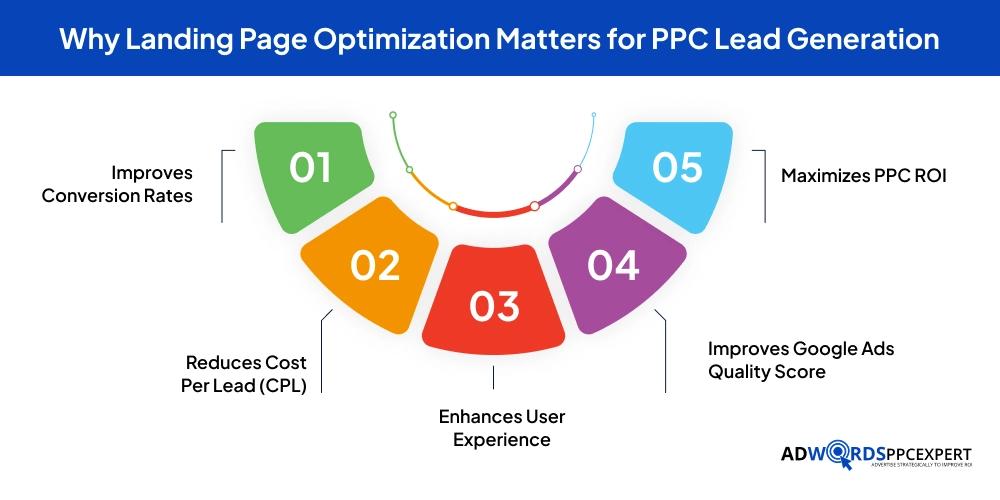
Improves Conversion Rates
A well-optimized landing page contributes to high conversion. A clear message that removes any confusion, a convincing call to action, and compelling offers keep users attracted towards the page and urge them to fill the form.
Reduces Cost Per Lead (CPL)
An optimized landing page attracts more customers with the most apt headline resonating with the ad copy, and a strong CTA pushes them to share details. Your campaign attracts more leads without expanding the budget and reduces the cost per lead.
Enhances User Experience
A user who clicks on your ad has a specific intent and expectation. Faster load time, mobile-friendly design, and clear navigation provide a smooth user experience and increase the likelihood of conversion.
Improves Google Ads Quality Score
Google evaluates your landing page experience as a part of its quality score calculation. Evaluation includes elements like page speed and relevant content. A good score helps you get visibility at a lower Cost Per Click (CPC) and better ad placement.
Maximizes PPC ROI
With landing page optimization, the ad is most likely to convert and get more leads. Businesses investing in PPC services can improve campaign performance significantly and get the most out of the campaign with lower cost per lead (CPL) and increased Return on Ad Spend (ROAS).
What Makes a PPC Landing Page Convert?
A PPC campaign can bring in customers and clicks, but what happens after the click matters the most. Not every landing page attracts consistent leads. A few of them bring steady leads, while others get traffic with low conversion. What sets high-converting landing pages apart are five core principles that influence how users perceive and interact with the page. They create a foundation for a positive user experience and a high-converting landing page.
Let’s break them down:
Relevance & Message Match
- One of the most important conversion principles in PPC is message match.
- The landing page headline, offer, and messaging should closely match the ad copy that brought visitors to the page.
- Avoid using any generic services pitch that doesn’t directly address the user's search intent.
- A perfectly matched message builds trust and reduces bounce rate.
Here is a quick example for your reference:
Level |
What to Match |
Example |
|---|---|---|
| Keyword Match | Landing page headline reflects the search term | Ad targets "PPC agency New York" → Headline: "Top PPC Agency in New York" |
| Ad Copy Match | Offer and CTA on the page should match the ad | The ad says "Free Audit" → Page headline says "Claim Your Free PPC Audit" |
| Visual Match | Page design and tone feel consistent with the ad creative | Same color palette, imagery style, and brand voice |
Clarity & Simplicity
- Your landing page should be free of distractions, and the focus should be on one goal (lead generation).
- Keep it simple while removing unnecessary sidebars, navigation, cluttered layout, or excessive information. Avoid multiple CTAs that may create confusion.
- Let visitors immediately understand what is being offered and what actions they are supposed to take.
Speed
- Page speed directly affects user experience and conversion rates.
- It is crucial to keep a user engaged and reduce bounce rates.
- A page that takes more than 3 seconds to load mostly loses the user’s interest and decreases engagement.
Trust Signals
- Visitors coming to the landing page don’t know your business. You need to win their trust to ensure engagement and conversion.
- Testimonials, security badges, case studies, industry certifications, and online review ratings are the most common trust signals.
- These trust signals are social proof that reassures visitors that your business is trustworthy and credible.
- No matter how compelling your offer is, without these signals, it is most likely to get ignored and will not convert.
Mobile Optimization
- With most PPC traffic coming from mobile, mobile-responsive design is non‑negotiable.
- Ensure your page has easy-to-tap touch-friendly buttons, a fast loading speed, and a clear CTA at the top of the page.
Here’s a quick overview of the 5 core principles for your reference:
Principle |
What It Means |
Key Action |
|---|---|---|
| Relevance & Message Match | Page matches the ad exactly | Align headline, offer & message |
| Clarity & Simplicity | One goal, no distractions | Remove navigation, one CTA |
| Speed | Load <3 seconds | Compress images, optimize scripts |
| Trust Signals | Show proof you're legitimate | Add testimonials, badges, & case studies |
| Mobile Optimization | Works perfectly on mobile | Responsive design, touch-friendly buttons |
Before optimization:
Visitor clicks ad → lands on homepage → confused → leaves
After optimization:
Visitor clicks ad → sees exact offer → sees CTA → fills form
Which Landing Page Elements Should You Optimize for Maximum Conversions?
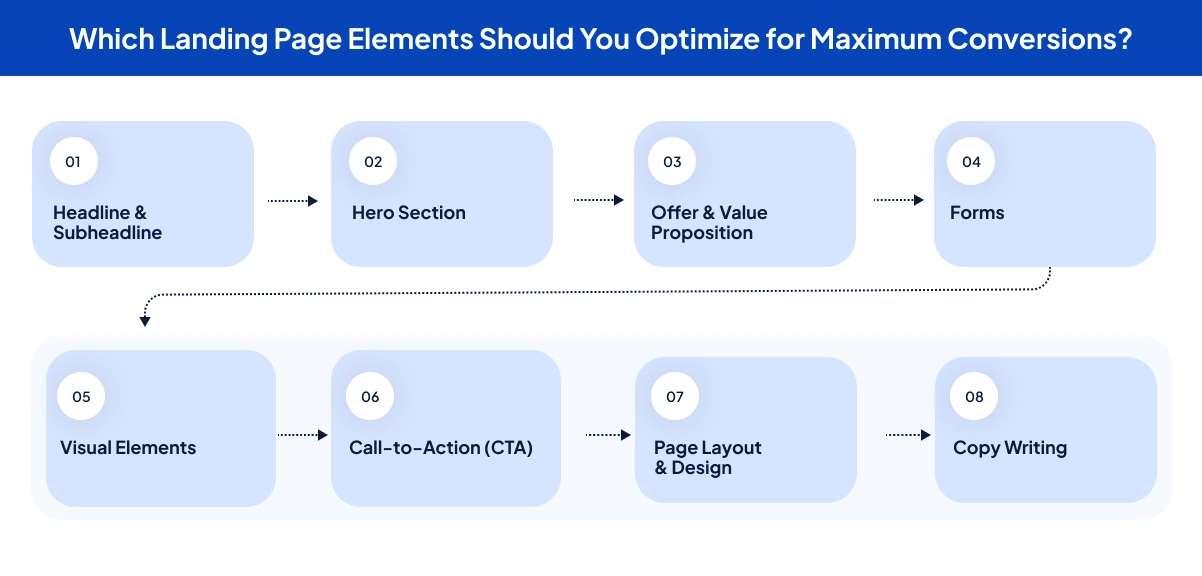
Your landing page acts like the first impression of your business. If your landing page greets visitors with a slow load time, an irrelevant headline, and a form asking too much, they feel the page is not worthy enough to hand over their details. Every element of your landing page has an impact on user behavior. They should be optimized to build trust and confidence. Here’s how you can optimize each one of them:
Headline & Subheadline
The headline is the first thing that catches users’ attention. It makes or breaks the user’s interest. It is the deciding factor if the user will proceed further or bounce back. Following are the ways to optimize a headline:
- Match it exactly with the ad copy.
- Keep the main headline short (under 10 to 12 words).
- Use a subheading to expand the benefit or provide further explanation.
- Focus on benefits, not features.
Hero Section
The hero section is the second most important spot that attracts users’ attention and guides them towards action. Here’s how it can be optimized:
- The hero section should clearly communicate your offer with the most relevant call-to-action.
- It should incorporate a short video or image that matches your offers and not a generic one.
- Keep it clean. Free it from the navigation menu or unnecessary visuals.
- Ensure it loads in quickly and doesn’t slow down the entire page.
Offer & Value Proposition
Your offer is your lead magnet. Make it strong and irresistible to users. It should clearly explain the deliverable and how it is valuable to users. Examples include:
- Free consultations
- Free audits
- Cost estimates
- Product demonstrations
- Downloadable guides or resources
Forms
Form is often the final step before the conversion happens. It determines whether the user is willing to share information or skip. Here’s how to optimize it:
- Keep it short. Asking too much information may lose the customer’s interest.
- Use clear field labels.
- Consider a multi-step form for complex lead generation.
- Enable autofills, use smart defaults, and mobile-friendly designs.
- Add a microcopy to reassure privacy (for example, we hate spam too, your email is safe with us).
Visual Elements
High-quality visuals help viewers understand the page more quickly and connect more with it emotionally. Best practices include:
- Use relevant images instead of generic images, such as real customer images, before and after screenshots.
- Use visuals and icons to break text monotony and guide the user.
- Include explainer videos.
- Use high-quality hero images.
Call-to-Action (CTA)
Your call to action should trigger the user towards action. It should act like the final push. Instead of being generic like submit, it should be benefit-driven and create urgency and interest wherever possible. Examples include:
- Get My Free Quote
- Schedule My Consultation
- Start My Free Trial
- Download the Guide
Page Layout & Design
Layout determines how a visitor moves through your page, which section appears first, and what they would be reading next. An intuitive layout can provide the user with excellent navigation. Following are some best practices:
- Maintain a clear visual hierarchy: Hero → Benefits → Visuals → Social Proof → Form → CTA.
- Use ample white space. Don’t make it look like a mess or too wordy.
- Keep important content above the fold.
- Ensure consistency between mobile and desktop experiences.
- Use A/B testing to verify which layout works the best for your users.
Copy Writing
A compelling copy doesn’t sound like marketing copy. It sounds like written by someone who deeply understands visitors’ problems and can provide a plausible solution. It focuses on communicating benefits rather than just talking about features. A good copy should:
- Speak directly to the target audience
- Highlight benefits rather than features
- Address common concerns
- Use concise, easy-to-read language
- Reinforce trust and credibility
Quick PPC Landing Page Audit Checklist
Element |
Best Practice |
Common Mistake |
Impact on Conversions |
|---|---|---|---|
| Headline | Benefit-driven: “Get Free Roof Inspection in 24 Hours” | Feature-driven: “We Offer Roofing Services” | ↓ 40% conversions |
| CTA Button | Action + urgency: “Get Your Free Quote Now” | Generic: “Submit” | ↓ 35% click rate |
| Form Length | Short: 3–4 fields (name, email, phone) | Long: 7+ fields | ↓ 50% completion |
| Page Load Speed | <3 seconds (critical for mobile) | >5 seconds | ↑ 70% bounce rate |
| Navigation | Remove distractions, focus on one goal | Keep menus, sidebars | ↓ 25% conversions |
| Visual Elements | High-quality images & videos | Generic images & videos | ↑ 30% conversions |
| Mobile Design | Responsive, touch-friendly buttons | Desktop-only layout | ↓ 60% mobile conversions |
PPC Landing Page Testing and Optimization Process
Landing page optimization is not a set-and-forget process. It needs continuous optimization, testing, and refinement to ensure the landing page performs at its best. With audience behavior and market needs consistently changing over time, continuous optimization becomes essential to maintain high-quality landing pages.
Conduct A/B Testing
A/B testing, or split testing, is the process of running two variants of landing pages simultaneously, with one element changed to verify which version works the best. By focusing on one element, testing every time may help accurately identify which element works. Following are the elements to experiment with and their impacts:
Element to Test |
Impact |
|---|---|
| Headline | Highest influence on whether visitor stays or bounces |
| CTA Button Copy | Second most visible element — directly drives action |
| Form Length | Directly affects completion rate |
| Hero Image or Visual | Strong influence on trust and relevance |
| Offer Framing | How the lead magnet is described affects perceived value |
| Social Proof Placement | Position of testimonials affects trust at decision point |
| Page Length | Long-form vs. short-form for different traffic temperatures |
| CTA Button Color | Lower impact — test after structural elements |
Analyze Heatmaps and Session Recordings
Heatmaps show how visitors interact with your landing page. It reveals where users click, how far they scrolled, and where they move on your page. Session recordings show individual customer journeys, how they interacted with your page, and their real behavior in action. Together, these tools help you discover:
- Which content do users ignore
- Where users stop scrolling before reaching the CTA
- Which sections cause visitors to leave the page
- Which non-clickable elements do users mistakenly try to click
Track User Behavior
Heatmaps help you know where customers are struggling. Tracking user behavior via analytics, you will get to know how many of them are struggling and at which stage of the page. By tracking users’ behavior, you can monitor where they are dropping off in the conversion process. Following are the key areas to analyze:
- Bounce rate
- Scroll depth
- Time on page
- Form abandonment rate
- CTA click-through rate
Implement Changes Incrementally
- Avoid making multiple changes at once. Make small changes and test one by one.
- With too many changes implemented at once, it is difficult to verify which change influenced growth the most.
- Small and controlled adjustments make measurement easy and provide more accurate results.
Monitor Results and Repeat
A landing page is not a one-time project. It involves continuous performance monitoring and optimization. Repeat the cycle to ensure optimal performance. Monitor the following metrics to evaluate performance:
- Conversion rate
- Cost per lead (CPL)
- Bounce rate
- Form completion rate
- Return on ad spend (ROAS)
Key Metrics to Measure Landing Page Performance
You can’t optimize anything you don’t measure. Without effective measurement, you are only firing arrows in a dark room. You have no clue what is actually working. Key metrics help you know actual users’ behavior, how they interact with your page, and where they get stuck.
These key metrics help you frame a data-driven, strategic landing page optimization plan as per your requirements. The following key metrics will help you verify if your landing page is working efficiently and if your updates are giving you better ROI:
Metric |
Why It Matters |
Benchmarks / Targets |
|---|---|---|
| Conversion Rate | Shows how effectively clicks turn into leads/customers | Aim for 10%+ (varies by industry) |
| Cost Per Lead (CPL) | Measures the efficiency of ad spend | Lower CPL implies higher ROI |
| Bounce Rate | Indicates relevance and engagement | Keep under 40–50% |
| Form Completion Rate | Tracks how many users finish lead forms | Optimize for 60–80% completion |
| Time on Page | Reflects engagement and content quality | Healthy range: 1–2 minutes+ |
Final Words
It’s not the number of clicks that makes a PPC campaign successful; it is the conversion that ultimately determines its success. Effective targeting with strategic bidding can help drive qualified traffic to your website, but the real conversion happens later when the user reaches your landing page.
By focusing on core principles of landing pages, such as relevance, trust, and mobile-friendly design, you can build a strong foundation for conversion. Key elements to optimization are the headline, forms, visual elements, CTAs, and trust signals. Effective optimization can ensure more user engagement and more conversions.
Also, landing page optimization is a long-term process in PPC services. It requires consistent testing and regular monitoring of key metrics to ensure optimal performance. Get the most out of your PPC budget with effective strategies and attract more conversions.
Frequently Asked Questions on Landing page optimization for PPC leads
1. What is landing page optimization for PPC?
It is the process of improving your landing page so you get more customers or leads from the same paid advertisement. It involves improving and refining every element of the page, from the headline and form to the CTA. An optimized landing page resonates well with the ad, delivering the same message and offering trust signals to ensure maximum conversion.
2. Why is a landing page important for PPC campaigns?
An optimized landing page is crucial for conversion. A well-targeted campaign with strategic bidding may attract a lot of clicks, but these clicks alone can’t contribute to conversion. An effective landing page determines whether the click will convert and become a lead or not. A well-optimized landing page encourages users to fill out the form and request a quote.
3. Does my landing page affect my Google Ads Quality Score?
Yes. Landing Page Experience is one of the three components Google uses to calculate Quality Score, alongside Expected CTR and Ad Relevance. It directly affects Google Ads Quality Score. A poor landing page can drop your score and negatively affect your ranking.
4. How can I reduce my PPC cost per lead (CPL)?
There are many ways to reduce PPC Cost per Lead (CPL). These include effective targeting, improving ad relevance, and optimizing the landing pages. Optimizing landing pages includes shortening forms, strengthening calls-to-action, improving page speed, and ensuring a strong message match between your ads and landing pages.
5. What elements have the biggest impact on landing page conversions?
There are several elements affecting the landing page conversion. These include headline, hero section, value proposition, form length, fields, visual elements, trust signals, call-to-action (CTA), page layout, and copy.
6. How often should I optimize my PPC landing pages?
Landing page optimization is an ongoing process. Regular review of performance data and A/B testing helps maximize conversions over time.

Ami Singh is a highly skilled AdWords PPC Specialist, known for creating profitable Google Ads strategies that elevate brands. With deep expertise in Google Search, Display, Shopping, YouTube Ads, and advanced bidding techniques, Ami consistently converts data into performance-driven results.
With a sharp analytical mind and a strong understanding of online consumer behavior, Ami designs campaigns that maximize ROI, boost quality scores, and reduce acquisition costs. His approach blends technical expertise with strategic thinking—making him a go-to expert for businesses aiming to dominate Google Ads.
Ami doesn’t just adapt to the fast-changing PPC industry, but he also stays ahead of the curve by testing new features, adopting automation smartly, and refining what works. Clients trust him for his transparency, insights, and ability to scale campaigns sustainably.
Looking to take your Google AdWords performance to the next level? Connect with Ami Singh at Softtrix and discover how he can help you get the maximum growth through powerful PPC strategies.