

Key Takeaways
- Not every click is valuable. Irrelevant traffic can waste a large portion of your PPC budget.
- Poor ad relevance and low Quality Scores often lead to higher costs and lower visibility.
- Tracking conversions is essential if you want to understand where your revenue is coming from.
- A strong landing page can turn the same amount of traffic into significantly more leads.
- Small PPC mistakes can become expensive over time, which is why regular optimization is important.
Investing your hard-earned money in a PPC campaign while hoping to get instant traffic and leads. But in reality, it doesn’t always happen. In fact, you may not get the return you are expecting. Instead, you end up paying for clicks that never convert into paying customers.
Obviously, PPC is a powerful marketing tool, but only if it is working the way it should. Today, most audiences spend a significant amount of time online, making it easier for businesses to reach potential customers through paid advertising.
The global PPC market size is projected to reach $218.3 billion by 2026. In fact, more than 65% of small and medium-sized businesses invest in PPC, making it a cornerstone of lead generation and eCommerce growth.
However, simply running ads is not enough. You need the right campaign strategy to reach the right audience and turn clicks into leads and sales.
In this blog, we’ll discuss where your PPC campaigns may be falling short and the solutions to fix those issues. This will help you avoid spending money on ads that don’t deliver results. Here are some of the most common red flags indicating budget leakage and what you can do to stop them.
Most Visible Signs Your PPC Campaign Money is Being Wasted
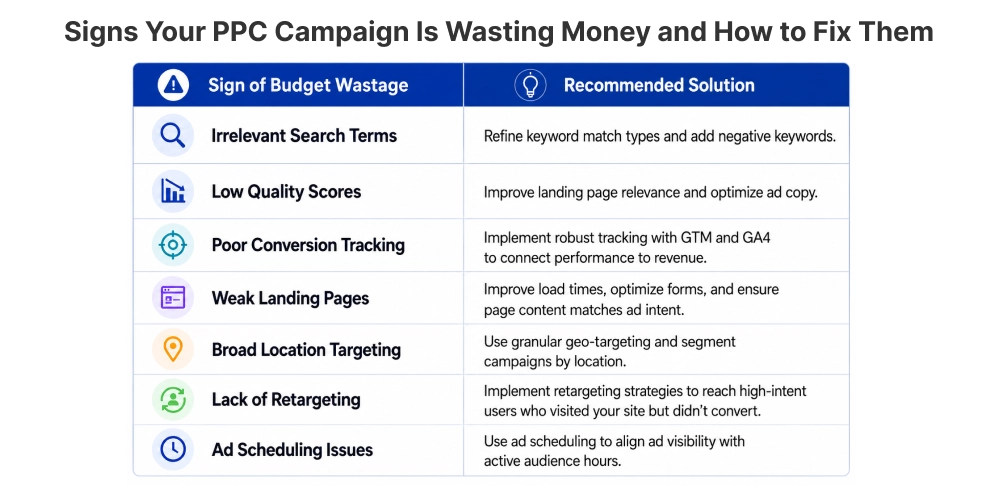
Irrelevant clicks, poor targeting, and non-strategic campaign management can directly waste 30% to 60% of your PPC budget. For small and medium-sized businesses, every dollar matters. That’s why it’s important to identify the warning signs before they drain your advertising spend. Here are some common red flags that indicate budget leakages and what you can do to fix them.
1. Not Showing Up on Relevant Search Terms
Problem:
One of the most common PPC problems businesses face is appearing for search terms that are not relevant to their products or services. This usually happens when campaigns rely heavily on broad match keywords without proper controls.
As a result, your ads are shown to users who have no intention of buying from you. You end up paying for clicks that never convert, which wastes your budget and reduces overall campaign performance.
Example:
Suppose you sell premium office furniture and bid on the broad keyword “office desk.”
Your ad may appear for searches like “DIY office desk plans” or “used office desks for sale.”
Out of 100 clicks, only 10 users may actually be interested in buying your products.
If your average CPC is $2, you could waste $180 on irrelevant traffic alone.
Solution:
- Review the Search Terms Report regularly.
- Add negative keywords to block irrelevant searches.
- Use Phrase Match and Exact Match keywords where appropriate.
- Group keywords by intent and create highly targeted ad groups.
- Continuously refine keyword targeting based on conversion data.
2. Low Quality Scores
Problem:
Google assigns each keyword a Quality Score ranging from 1 to 10. A score of 1 indicates a poor user experience and low relevance, while a score of 10 means your ads, keywords, and landing pages closely match the user’s search intent.
Google primarily evaluates Quality Score based on Expected CTR, Ad Relevance, and Landing Page Experience. When your Quality Score is low, Google Ads charges a higher cost per click (CPC), reduces your ad visibility, and can lower your ad rank.
This usually happens when your ad copy is not relevant to the target keywords or when the landing page fails to deliver what the ad promises.
Solution:
- Align ad copy closely with target keywords.
- Include primary keywords in headlines and descriptions.
- Improve landing page relevance and user experience.
- Ensure the landing page delivers exactly what the ad promises.
- Test multiple ad variations to improve click-through rates (CTR).
- Use Google PageSpeed Insights to test your landing page speed and ensure it loads in less than 3 seconds.
3. Poor Conversion Tracking
Problem:
When it comes to PPC, many business owners only focus on clicks and impressions without accurately measuring conversions. As a result, they know how much traffic their ads are generating, but not how many leads, calls, bookings, or sales are coming from that traffic.
Without proper tracking, it becomes difficult to identify which campaigns, keywords, and ads are generating actual revenue. This often leads to the budget being allocated to underperforming campaigns while high-performing opportunities are overlooked.
Solution:
- Set up conversion tracking in Google Ads.
- Implement Google Tag Manager (GTM) for accurate event tracking.
- Connect Google Analytics 4 (GA4) with Google Ads.
- Track key actions such as form submissions, calls, purchases, and bookings.
- Assign conversion values to understand which campaigns generate the highest return.
- Create conversion-based reports instead of relying solely on traffic metrics.
- Regularly perform PPC audit tracking to ensure data accuracy and avoid reporting gaps.
4. Sending Clicks to Weak Landing Pages
Problem:
Even if your ads generate clicks, a poorly optimized landing page can prevent visitors from converting. Slow-loading pages, confusing layouts, weak calls-to-action, and content that doesn’t match the ad message often result in high bounce rates and lost opportunities.
Example:
Let’s say you spend $1,000 on PPC and generate 500 clicks.
- If only 5 visitors convert, your conversion rate is 1%.
- However, after improving your landing page, 25 visitors convert from the same 500 clicks.
- Your conversion rate increases to 5% without increasing your ad budget.
In this case, you’re getting 5x more leads from the same advertising spend.
Solution:
- Improve page load speed and mobile responsiveness.
- Match landing page content with ad messaging and keywords.
- Use clear and compelling calls-to-action (CTAs).
- Simplify forms by reducing unnecessary fields.
- Add trust signals such as reviews, testimonials, and certifications.
- Conduct A/B testing to identify the highest-converting page elements.
5. Broad Location Targeting
Problem:
Targeting a large geographic area without proper segmentation can quickly drain your PPC budget. For example, imagine you’re a personal injury lawyer based in Chicago and only accept clients within a 30-mile radius.
However, your campaign is targeting the entire state of Illinois. Your ads may receive clicks from users in Springfield, Peoria, or Rockford who are unlikely to hire you because of the distance.
Even though these clicks increase traffic, they don’t generate qualified leads, causing your budget to be spent on people outside your actual service area.
Similarly, a local HVAC company, dentist, or roofing contractor may be paying for clicks from locations they don’t serve simply because their targeting settings are too broad.
Solution:
- Use granular geo-targeting to focus on high-value locations.
- Exclude regions that do not generate leads or sales.
- Create separate campaigns for different cities or service areas.
- Adjust bids based on location performance.
- Analyze geographic reports regularly to identify profitable regions.
6. Ad Scheduling Issues
Problem:
Many businesses believe that running ads 24/7 will generate more leads. However, ads shown during low-performing hours can waste a significant portion of the budget.
For example, if you’re a personal injury lawyer and most inquiries come between 8 AM and 8 PM, but your ads run throughout the night, you may pay for clicks from users who don’t convert.
If a potential client contacts you at 2 AM and doesn’t hear back until the afternoon, there’s a high chance they’ve already contacted another law firm.
Solution:
- Review hourly performance reports.
- Schedule ads during peak conversion periods.
- Reduce bids during low-performing hours.
- Align ad schedules with business operating hours.
7. Lack of Retargeting Campaigns
Problem:
Most visitors do not convert on their first visit. In fact, many users visit a website, explore a few pages, and leave without taking any action. However, without retargeting campaigns in place, these potential customers may never return.
For example, if 100 people visit your service page and only 3 become leads, the remaining 97 visitors represent missed opportunities. Since they have already shown interest in your business, failing to re-engage them can result in lost leads and wasted ad spend.
Solution:
- Create remarketing audiences in Google Ads and GA4.
- Run display, search, and video retargeting campaigns.
- Segment audiences based on behavior and intent.
- Use personalized ad messaging for returning visitors.
8. Over-Reliance on Automated Bidding
Problem:
Automated bidding can be highly effective, but many businesses rely on it too early. If conversion tracking is inaccurate or the campaign doesn’t have enough conversion data, Google may optimize for the wrong actions.
As a result, bids can increase for keywords that generate clicks but not actual leads or sales, leading to wasted ad spend.
Example:
Let’s say your campaign generated only 3 conversions last month, but you’re using a Smart Bidding strategy like Target CPA.
Since Google has very little data to learn from, it may make inaccurate bidding decisions. Your average CPC could increase from $2 to $5 without a noticeable increase in conversions.
As a result, you spend more budget while generating the same number of leads. In this situation, automation is making decisions, but it doesn’t have enough data to make the right ones.
Solution:
- Verify conversion tracking accuracy before enabling automated bidding.
- Monitor bid strategy performance regularly.
- Start with enough conversion data before using Smart Bidding.
- Review CPC, CPA, and conversion trends frequently.
- Test automated bidding against manual bidding to compare performance.
- Allow sufficient learning time, but intervene if costs increase without results.
How to Extract More Profit From Your PPC Budget
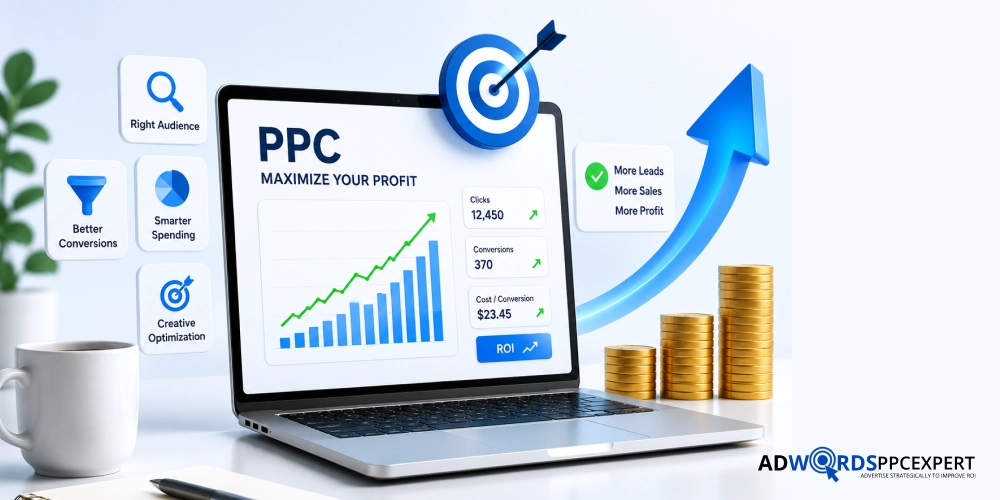
Fixing common PPC mistakes is only the first step. The real difference between an average campaign and a highly profitable one often comes down to how the campaign is managed. From keyword selection and audience targeting to ad creation, bid management, and ongoing optimization, every decision impacts your return on investment.
Many businesses assume that simply running ads will generate results. In reality, PPC success depends on having the right strategy behind the campaigns. A well-managed account continuously adapts to performance data, market PPC trends, competitor activity, and changing customer behavior.
An experienced PPC agency can help maximize every advertising dollar by:
- Making sure your ads are shown to people who are actually looking for your products or services.
- Preventing your budget from being spent on clicks that have little chance of converting.
- Finding opportunities to generate more leads without increasing your ad spend.
- Improving ad performance so you get better results from the same budget.
- Turning more website visitors into inquiries, bookings, or sales.
- Identifying what's working and cutting out what's not.
- Bringing back potential customers who visited your website but left without taking action.
- Tracking where your leads and sales are coming from so every dollar is spent wisely.
The difference between breaking even and generating consistent profit often lies in the expertise behind the campaign. With strategic management, continuous optimization, and a focus on measurable business outcomes, PPC can become a scalable source of leads, sales, and long-term growth.
People Also Ask
1. Why Is My PPC Campaign Getting Clicks But No Conversions?
If your ads are generating clicks but not leads or sales, the problem may be your landing page, targeting, offer, or conversion tracking. A campaign should be measured by conversions, not just traffic.
2. How Much Budget Is Typically Wasted in Poorly Managed PPC Campaigns?
The amount varies, but many businesses lose a significant portion of their budget through irrelevant clicks, poor keyword targeting, weak landing pages, and inaccurate tracking. Regular optimization helps reduce this waste.
3. What Is the Biggest Mistake Businesses Make With PPC?
One of the biggest mistakes is focusing on clicks instead of conversions. Without proper tracking and optimization, businesses often spend money on traffic that never generates revenue.
4. Can a PPC Agency Help Reduce Wasted Ad Spend?
Yes. A PPC agency continuously monitors campaign performance, identifies budget leaks, improves targeting, and optimizes ads to ensure more of your budget is spent on generating qualified leads and sales.
5. How Often Should a PPC Campaign Be Optimized?
PPC campaigns should be reviewed regularly. Search trends, competition, and user behavior change over time, so continuous optimization is necessary to maintain performance and control costs.
6. Is PPC Worth It for Small Businesses?
Yes. When managed correctly, PPC can generate targeted traffic, qualified leads, and measurable results. The key is ensuring your budget is focused on high-intent keywords and audiences.
7. How Long Does It Take to See Results From PPC?
Unlike SEO, PPC can start generating traffic immediately after launch. However, it typically takes a few weeks of optimization and data collection to achieve consistent and profitable results.
Want a PPC Expert? Run Campaigns That Generate More Conversions and Reduce Wasted Spend
In the above section, we discussed some of the common reasons PPC campaigns fail to generate revenue and shared solutions to fix them. However, finding these issues and optimizing campaigns requires experience and continuous monitoring.
A dedicated pay per click agency helps identify where your advertising dollars are being wasted. Whether it’s irrelevant clicks, poor targeting, weak ad copy, or inefficient bidding, even small mistakes can cost hundreds or thousands of dollars every month.
By continuously optimizing campaigns, PPC experts help reduce wasted spend and redirect more of your budget toward keywords and audiences that generate leads and sales.
The result? More conversions, better ROI, and more value from every dollar you invest in PPC advertising.

Ami Singh is a highly skilled AdWords PPC Specialist, known for creating profitable Google Ads strategies that elevate brands. With deep expertise in Google Search, Display, Shopping, YouTube Ads, and advanced bidding techniques, Ami consistently converts data into performance-driven results.
With a sharp analytical mind and a strong understanding of online consumer behavior, Ami designs campaigns that maximize ROI, boost quality scores, and reduce acquisition costs. His approach blends technical expertise with strategic thinking—making him a go-to expert for businesses aiming to dominate Google Ads.
Ami doesn’t just adapt to the fast-changing PPC industry, but he also stays ahead of the curve by testing new features, adopting automation smartly, and refining what works. Clients trust him for his transparency, insights, and ability to scale campaigns sustainably.
Looking to take your Google AdWords performance to the next level? Connect with Ami Singh at Softtrix and discover how he can help you get the maximum growth through powerful PPC strategies.