

Your product is catching up, your website is closing sales, and you need to grow using paid marketing channels. As you start engaging PPC firms and consultants, you will soon realize that not all firms have the same pricing structure.
One PPC firm asks for a fixed hourly rate. Another wants to bill on a monthly retainer basis as a percentage of your ad budget. A third offers you an exciting “performance-based” service where they only get paid when you generate sales!
But how do you separate the marketing hype from reality? Picking the wrong PPC fee structure is not just an inefficient use of management dollars; it could cause a major misalignment between your best interests and the financial well-being of your vendor.
As an experienced PPC management agency with years of experience running millions of dollars’ worth of digital marketing campaigns, we’ve worked with all types of fee structures.
In this guide, we are going to look at three main PPC fee structures: the hourly rate, the monthly retainer (with a focus on ad budget percentage retainers), and performance-based pricing.
Key Takeaways
- PPC retainer fees and percentage of advertising cost are the two most common PPC pricing models in use today by small to medium-sized companies.
- PPC hourly pricing is more suitable for auditing, consulting work, and account analysis.
- Performance-based PPC pricing models have a lot going for them, but may pose certain difficulties in attribution.
- Pricing structures used by PPC agencies typically range from 10% to 20% of monthly advertising costs, with additional management fees in some cases.
- Bigger PPC budgets require additional strategy development and careful planning, such as audience targeting, attribution modeling, and conversion tracking.
- The ideal PPC pricing model will be the one yielding maximum return on investment.
Most Common PPC Pricing Models
In many cases, companies use monthly management fees together with a percentage of advertising expenses for financing their PPC campaigns. Such a financing model allows the agency to estimate its staff needs depending on the level of difficulty of the campaign you want, which means constant management for you.
PPC firms normally offer monthly management fees between 10% and 20% of total monthly advertising expenses. If you spend approximately $10,000 on Google advertising each month, then you will be required to pay an additional $1,000-$2,000 in management fees.
The choice of the right payment scheme depends on what your expectations are.
Average PPC Management Costs in 2026
While pricing varies based on industry competition, account complexity, and campaign size, most businesses can expect PPC management fees to fall within the following ranges:
Service Type |
Typical Monthly Cost |
|---|---|
| PPC Freelancer | $500 – $2,000 |
| Small PPC Agency | $1,500 – $5,000 |
| Mid-Size Agency | $3,000 – $10,000 |
| Enterprise PPC Agency | $10,000+ |
| Percentage of Ad Spend | 10% – 20% |
Businesses should evaluate pricing alongside experience, reporting quality, tracking capabilities, and strategic support rather than focusing solely on management fees.
The Core DNA of PPC Management Costs
It’s important to first consider what you’re buying into when you decide to bring in some help. PPC management is not a passive process that just sets itself into motion once it has been set up. It involves a meeting point of data analysis, copywriting, tracking, and business strategy.
When an expert PPC advertising firm conducts its account evaluation for you, the pricing model takes into consideration several key areas of focus:
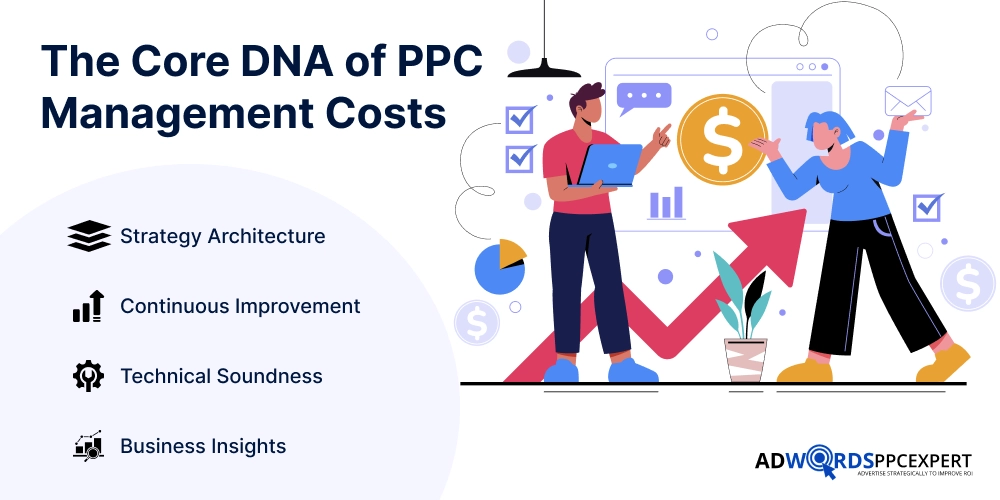
- Strategy Architecture: Competitor analysis, keyword targeting, and campaign building.
- Continuous Improvement: Negative keyword filtering, bidding optimization, and A/B testing of ads.
- Technical Soundness: Creating a server-side tracking mechanism, GTM variables, and attributions.
- Business Insights: Turning raw traffic numbers into key business KPIs such as ROAS and CAC.
The Hourly Rate Model: Pay by the Hour
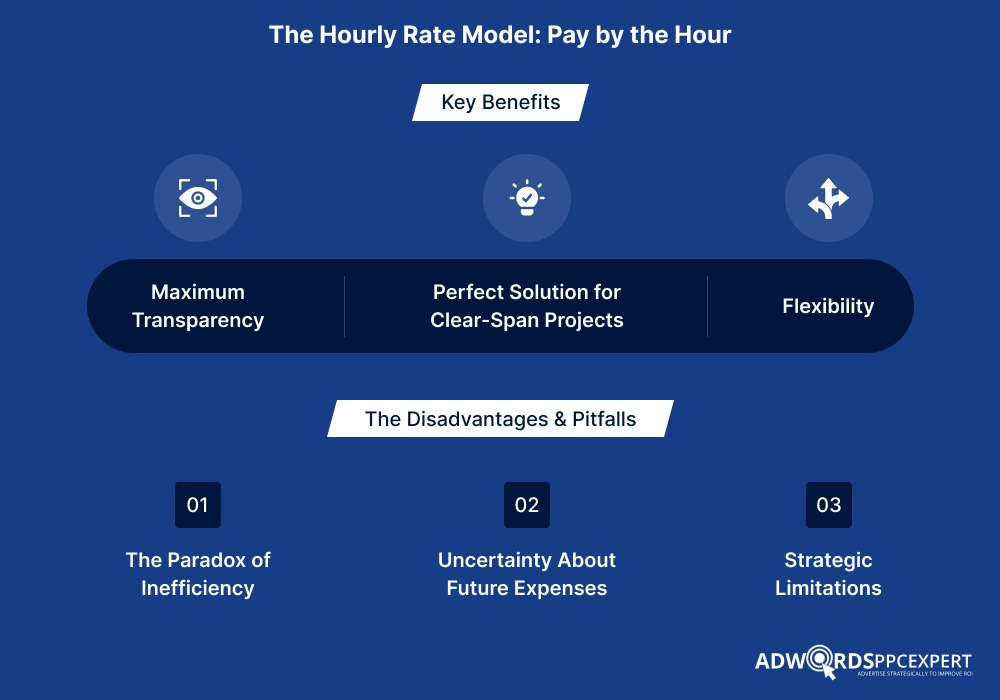
In the hourly model, you pay an agreed rate for every hour of work the professional puts into your account. The rates depend on the consultant’s expertise and vary from $75 to $250+ per hour.
When an expert PPC advertising firm conducts its account evaluation for you, the pricing model takes into consideration several key areas of focus:
Real-Life Example of How it Works
Assuming a rate of $150 per hour and 10 hours per month spent on auditing, building, and optimizing your account, your total fee will be $1,500. In case of any technical challenges, requiring additional time equal to 4 hours, you end up paying $2,100
Key Benefits
- Maximum Transparency: All expenditures are crystal clear. You can always ask for detailed time logs to get information about what has been done within that time.
- Perfect Solution for Clear-Span Projects: If you do not require constant management but would love to hire a professional for a high-level account analysis or creating an efficient campaign architecture, this pricing strategy is perfect.
- Flexibility: You can reduce the number of hours when the budget is low and increase them when needed.
The Disadvantages & Pitfalls
The Paradox of Inefficiency
A top-notch strategist may spend 15 minutes on fixing a critical issue or finding a profitable keyword due to his or her wealth of experience. But a less skilled marketer will probably need 4 hours. Thus, the client will pay more for the latter’s services under an hourly billing model.
Uncertainty About Future Expenses
The necessity to make quick adjustments in case of an unforeseen situation, like a flood of spam clicks or problems with a conversion tag after redesigning the site, will affect your monthly bill negatively.
Strategic Limitations
When all consultations, emails, or exploration efforts lead to additional payments, communication between the business owner and the PPC specialist becomes less effective, limiting strategic opportunities.
Monthly Retainer Plan (and Percentage of Ad Spend)
The monthly retainer plan is undoubtedly the heavyweight champ in the agency world. This plan has two main versions: either a flat monthly fee or a percentage of ad spend (usually between 10-20%), sometimes supplemented with a minimum base monthly fee.
Version A: The Flat Monthly Retainer Plan
This entails paying a monthly retainer amount (such as $2,500 per month) to handle a certain amount of work per month, regardless of the time involved or fluctuations in your budget.
- Advantages: You'll have predictable overhead on your cash flow. The agency will be motivated to maximize performance without constantly looking at the clock.
- Disadvantages: In case your business experiences a lean quarter and cuts its ad spend, you will still be responsible for the full retainer amount, which could quickly distort your cost per acquisition numbers.
Version B: Percentage of Advertising Spend
It is the standard measure across the board for medium to large-sized accounts. The fee you pay varies based on your spending through various channels, and let’s say you spent $20,000 in Google Ads, while the agency fee is 15%. Your management fee will be $3,000.
- Advantages: Truly scalable. When you have successful campaigns, you automatically want to allocate more money to them. The bigger your budget, the more data you will collect, test different versions of your ads, and manage your bids. The percentage model scales the payment for the job along with its complexity.
- Disadvantages: “Spend More To Make More”. Business owners are generally skeptical about whether the agency will make them invest more to make profits themselves without sufficient data to back it up.
Performance-Based Pricing Structure: High-Risk/High Reward
Paying purely for performance is completely opposite to the traditional agency model. Here, you pay for nothing else but outcomes. Typically, this will be measured by the number of leads per cost or as a percentage of the revenue generated by campaigns that are tracked from the advertising account. Alternatively, bonuses may be paid based on reaching certain ROAS levels.
How It Works in Practice
For example, an e-commerce company agrees to pay a PPC advertising agency 5% of its total revenue coming from Google Shopping campaigns run by the latter. Should these campaigns generate $100,000 worth of sales, the agency receives $5,000; however, if the campaigns fail and produce zero revenue, the agency gets zero as well, despite spending 80+ hours working on your Google account.
Benefits of This Approach
- Perfect Synergy of Interests: The success of an agency here depends entirely on your success. There is always something at stake, which means that the agency treats your budget as if it were their money.
- Low Financial Barrier to Entry: Ideal for startup founders who lack funds or are afraid of being scammed.
Potential Drawbacks
Attribution Controversies: Pricing that depends on performance is highly dependent on tracking. Issues may occur during the process of determining which sales/leads to attribute to the PPC campaign.
A Focus on Quick Results: Agencies working with performance-based contracts may neglect the potential benefits of long-term branding and other upper funnel marketing strategies.
High Cost Despite Lower Risk: Even though the cost appears lower due to the risk factor being low, a company will end up paying more than it would for retainer services.
Head-to-Head Comparison Matrix
To help visualize how these models function across core business metrics, let’s look at them side-by-side:
Evaluation Metric |
Hourly Pricing |
Monthly Retainer / % of Spend |
Performance-Based Fees |
|---|---|---|---|
| Predictability of Cost | Low (Spikes with tech issues) | High (Fixed or tied to budget) | Low (Varies widely with sales volume) |
| Agency's Core Incentive | Deliver expertise within billable hours | Optimize efficiently; scale profitable channels | Maximize short-term conversions at all costs |
| Best Suited For | Cleanups, technical audits, and brief training | Growth-stage companies, established brands | High-margin e-commerce, tight sales funnels |
| Onboarding Cost | Low to Moderate | Moderate (Requires setup fee) | High (Often requires heavy tech setup) |
| Communication Flow | Restrained (Clock is ticking) | Open and fluid | Highly collaborative but combative on tracking |
Simulator Tool for the Dynamic PPC Models
To have an idea of how these models will work in terms of financial implications, you may use this calculator to generate scenarios depending on your budget goals, hours expected to be worked, and revenue targets.
Note: For an accurate pricing estimate, kindly get in touch with our PPC experts.
Common Pricing Mistakes Businesses Often Make
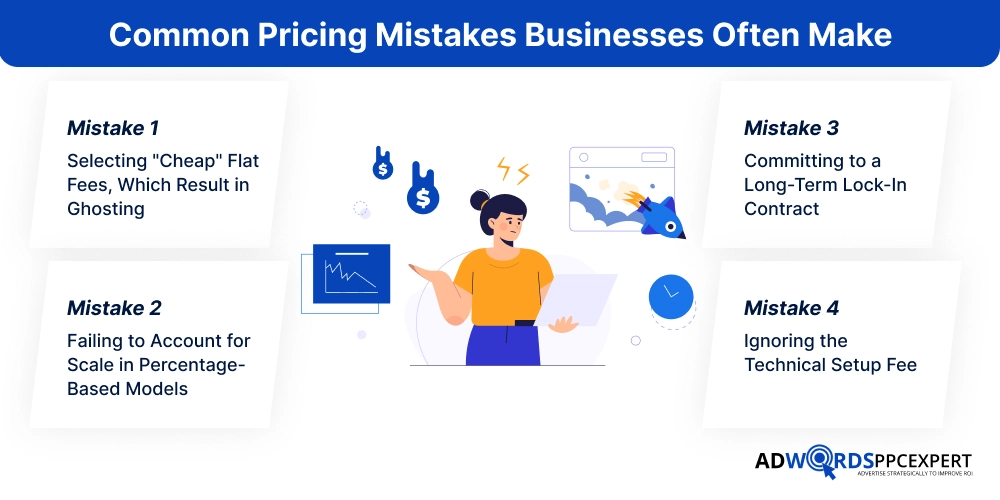
While many advertisers select their vendor solely based on the cheapest bid, they are surprised later when they find themselves in an unsuccessful business relationship. The four most common errors are:
Mistake 1: Selecting "Cheap" Flat Fees, Which Result in Ghosting
In case an agency promises to take care of your complicated AdWords campaign using the $300 flat rate fee, you should be extremely careful. Consider these numbers: for an agency to survive, a single account manager should serve 30-40 customers per month. It means that the account manager cannot spend more than two hours with each campaign monthly.
The result of such a policy is ghosting because your manager spends time on login, looks at the dashboard, does nothing important, and logs off again.
Mistake 2: Failing to Account for Scale in Percentage-Based Models
If your budget grows from $10,000 to $100,000 a month, a flat 15% fee means your management cost jumps from $1,500 to $15,000. While a larger budget does require significantly more work (managing complex cross-channel campaigns, scaling negative keyword lists, and deeper cohort analysis), the workload does not scale 10x linearly.
Solution: Always ensure your contract includes a tiered percentage model. For instance: 15% on the first $20,000 of spend, 12% on the next $30,000, and 10% on anything over $50,000.
Mistake 3: Committing to a Long-Term Lock-In Contract
Don’t make yourself commit to any ironclad 12-month PPC agreement from day one. Data is moving so fast in the paid search space, and you want to test if an agency can handle the pressure of communicating and operating effectively at first. Find the agencies that offer a pure 90-day trial period with transition to a monthly rolling contract going forward.
Mistake 4: Ignoring the Technical Setup Fee
To build a highly converting PPC machine, a lot of work has to be done initially. The tracking system needs to be validated, previous trackers to be removed, landing page templates rolled out, and a customized reporting dashboard installed through Looker Studio integration. If an agency does not charge an upfront technical setup fee, chances are that they are skipping the whole thing.
Strategic Decision Guide: Which Marketing Consultant Model Fits You Best?
How do you make all of this information result in a strategic business decision? Here is the bucket you should match against your own personal business situation:
Scenario A: The "Lean Startup" & Early-Stage Venture Business
Your Situation: You currently have a new website, no baseline conversions yet, a monthly budget of less than $3,000, and you are in the early stages of product validation.
Recommended Approach: Seek out an experienced consultant with an hourly rate or a smaller agency with a relatively cheap monthly retainer package. Don’t choose any performance marketing option because no experienced marketing performance consultant would spend their time working on such an undeveloped checkout funnel.
Scenario B: The Lead Generation or SaaS & B2B Enterprise Company
Your Situation: You need high-quality inbound phone calls, demos for enterprise companies, or qualified leads added to your CRM database. Your budget stays relatively consistent at $5,000 to $25,000 per month.
Recommended Approach: Monthly Retainer with baseline + Tiered Percentage of Spend. This will encourage the agency to scale up its lead generation and provide it with enough budget to constantly build unique custom landing pages and run performance optimizations.
Scenario C: The Rapid-Growth E-Commerce Brand
Your Company’s Characteristics: You have positive unit economics, strong gross margins (50%+), great checkout processes, and solid tracking systems that credit all revenues accurately to each ad interaction.
The Way Forward: Go with a Hybrid Approach. Offer a basic monthly retain rate to ensure the agency has its operational costs covered and has allocated resources efficiently, in addition to giving a performance bonus to incentivize your partner to grow rapidly and without skimping on good leads and building brand equity.
PPC Pricing Model Comparison At a Glance
Pricing Model |
Best For |
Cost Predictability |
Scalability |
|---|---|---|---|
| Hourly | Audits, consulting, short-term projects | Low | Limited |
| Flat Monthly Retainer | Stable businesses | High | Moderate |
| Percentage of Ad Spend | Growing advertisers | Moderate | High |
| Performance-Based | Mature ecommerce businesses | Low | High |
There is no universally perfect PPC pricing model. The best option depends on your budget, business goals, internal marketing resources, and growth objectives.
Frequently Asked Questions
1. What is a reasonable fee for setting up a new PPC campaign?
Depending on the sophistication of your product portfolio and current tracking systems, typical setup fees will be between $1,000 and $3,500.
2. Why can't all agencies run on a strictly performance-based structure?
A good agency understands that it only has half the puzzle when it comes to online marketing — the click. It can bring the right type of users to your site at a perfect cost-per-click rate.
3. Does "Percentage of Ad Spend" also cover the payments made to Google?
Not at all! The payment for ads is made directly by you to the platform (i.e., Google, Microsoft, Meta) through your company’s credit card. The management fee, on the other hand, is the payment you make for the strategic work done by the agency.
4. How frequently should I have my PPC expert optimize my account?
Beware of any PPC agency making hundreds of changes to your account every day. In this era of intelligent bidding algorithms, there’s no need to make frequent changes.
Conclusion: The Net ROI Is More Important Than the Fee Structure
Ultimately, paying too much attention to the technicalities of the pricing system may cause you to overlook an important metric – Net Return on Investment.
An hourly consultant who charges $1,000 a month while leaving all your marketing campaigns in cruise control will be a lot more costly than an advanced agency offering a monthly retainer fee of $4,000 to help you double your revenue by increasing the size of your pipeline and market share.
While seeking a new marketing partner, try to find an effective fee structure that offers cost predictability, makes the process of strategic communication more efficient, and allows the provider to treat the money spent on ads as carefully as they would treat their own finances.
We at Adwords PPC Expert value transparency above all; our frameworks allow keeping all the incentives aligned and focused on sustainable development. Do you want to learn how to maximize the ROI of your pay-per-click efforts? Contact us to get a free strategic account audit.

Ami Singh is a highly skilled AdWords PPC Specialist, known for creating profitable Google Ads strategies that elevate brands. With deep expertise in Google Search, Display, Shopping, YouTube Ads, and advanced bidding techniques, Ami consistently converts data into performance-driven results.
With a sharp analytical mind and a strong understanding of online consumer behavior, Ami designs campaigns that maximize ROI, boost quality scores, and reduce acquisition costs. His approach blends technical expertise with strategic thinking—making him a go-to expert for businesses aiming to dominate Google Ads.
Ami doesn’t just adapt to the fast-changing PPC industry, but he also stays ahead of the curve by testing new features, adopting automation smartly, and refining what works. Clients trust him for his transparency, insights, and ability to scale campaigns sustainably.
Looking to take your Google AdWords performance to the next level? Connect with Ami Singh at Softtrix and discover how he can help you get the maximum growth through powerful PPC strategies.