
Businesses do not have the luxury to wait for six months before knowing if their campaigns are yielding any results or not. They require quick results that show that there is some activity going on from their marketing efforts.
The success of a PPC campaign depends upon numerous things, such as competitiveness, PPC campaign strategy, landing page, target audience, and budgeting.
Companies often receive their traffic and inquiries in as little as days, and with proper optimization, they begin to convert more leads at less cost.
This is what makes PPC Marketing the most successful marketing channel in recent times. Let’s discover more about PPC and PPC agencies.
Key Takeaways
- PPC campaigns can produce high-quality leads in as little as one week from inception.
- Good PPC management consists of keyword research, targeting, tracking, testing, and optimization.
- The quality of the landing pages and targeted demographics greatly affect PPC conversions and lead generation.
- While artificial intelligence and automation make PPC marketing easier, a human strategy is still vital.
- Organizations that continually optimize their PPC strategies generally obtain better cost savings and return on investment.
- By avoiding some of the mistakes made by PPC marketing campaigns, organizations create sustainable leads faster and more profitably.
What Does a PPC Company Actually Do?
However, most organizations assume that PPC management can only be viewed as the creation of Google Ads campaigns alongside selecting relevant keywords. Indeed, there is much more to PPC than just that.
Among other things, a PPC management service typically involves:
Keywords Research and User Intention Analysis
Keywords research is aimed at finding out the search phrases that target users utilize when searching for certain goods or services. As opposed to amateurs, professional PPC managers always go for keywords that have the highest potential to convert.
Research of Competing Organizations
The study of competing organizations is needed for companies to understand how their competitors operate in the market. It is possible to analyze the competitors’ keywords and ads, as well as the bid strategies and landing page structure used by these competitors.
Campaign Structure Management
The right campaign structure increases ad relevancy and enhances its optimization. Besides, it facilitates spending money on PPC campaigns wisely.
Ad Copy Writing
When considering the ability of PPC campaigns to attract clicks and leads, effective ad copy is a must. It should highlight all benefits associated with your service/product, offer solutions for possible problems, and include calls-to-action. In this case, professionally developed ads may become an excellent method of improving CTR and overall campaign effectiveness.
Conversion Tracking
Conversion tracking refers to the measurement of specific actions made by users after clicking on ads. Such actions may include making a phone call, filling out forms, buying certain products, or scheduling a service. The absence of a good tracking system will make it impossible to know whether a PPC campaign is successful. Having appropriate data, a PPC company will be able to make the necessary changes in the campaign structure.
Landing Page Optimization
Landing page optimization is concerned with improving the speed and usability through calls to action. When implemented, such measures help boost the level of conversions, which, in turn, enables companies to optimize their revenue from PPC traffic.
Targeting The Audience
The segmentation of audiences allows advertisers to be able to segment their audience based on their age groups, preferences, and even how they behave. and also search intents. Personalization and targeting become possible with campaigns in advertisements.
PPC Bidding
The use of bidding management enables PPC companies to avoid paying too much for each click or conversion on ads. PPC companies will adjust their bids depending on competition, objectives, and conversion rates.
Targeting Based On Geographic Locations
This refers to the use of geographic targeting, whereby PPC campaigns are directed at certain locations such as cities, certain regions, or even specific service areas. Businesses can be able to save costs as they advertise to potential local customers. This is important, especially for service providers.
Testing Various Versions
With the use of A/B testing in PPC companies, they will be able to know which version of the advertisement performs best. Optimization will be carried out on various elements of the PPC campaigns.
Continuous Performance Optimization
As mentioned above, continuous performance optimization is vital for PPC because any changes in the market environment will require optimization to minimize the costs of acquisition. There are several reasons why companies prefer to use PPC services.
However, it should be remembered that traffic alone cannot make one successful – the quality of leads matters too.
How Fast Could an Experienced Agency Generate Leads Through PPC Marketing Campaigns?
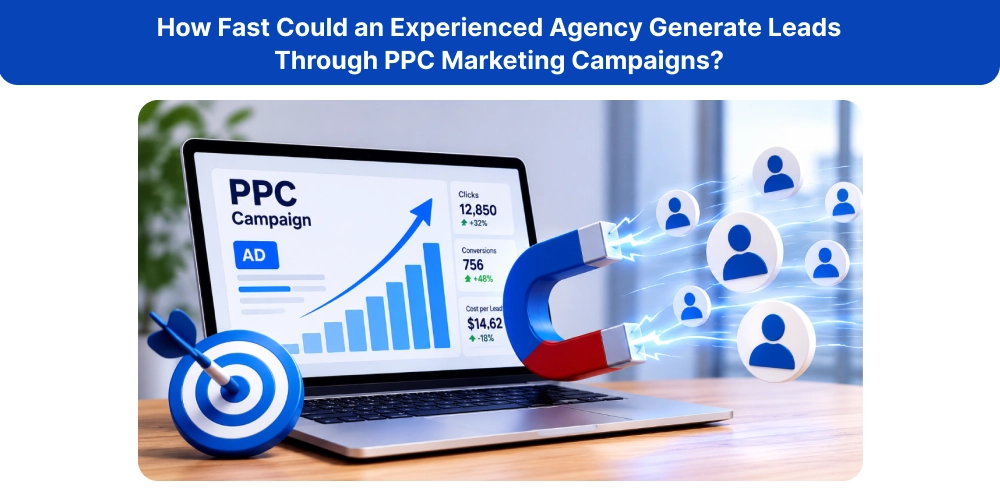
In only three days from starting your PPC campaign, you could already start generating your leads, especially if you target high-intent audiences. However, there is no denying that PPC campaigns require some time before they become profitable in lead generation.
Phase 1: Setting Up the PPC Campaign (Days 1-3) CPA vs Profitability Relationship
The first phase entails preparing everything needed to get started with the PPC campaign.
This includes:
Setup Activity | Purpose |
|---|---|
| Keyword Research | Identify high-intent search terms |
| Competitor Analysis | Understand bidding landscape |
| Conversion Tracking | Measure calls, forms, and purchases |
| Landing Page Review | Improve conversion potential |
| Ad Creation | Develop compelling PPC ads |
| Geographic Targeting | Focus on relevant audiences |
Once campaigns are approved by advertising platforms, ads can begin appearing within hours.
At this stage, businesses often start receiving:
- Website traffic
- Phone calls
- Contact form submissions
- Quote requests
- Product inquiries
For local service businesses with strong search demand, leads may begin arriving within the first 48–72 hours.
Phase 2: Early Optimization (Week 1–2)
The first two weeks are heavily focused on data collection.
The PPC company monitors:
- Click-through rates
- Conversion rates
- Cost per click
- Search term quality
- Bounce rates
- User engagement
- Device performance
- Geographic performance
At this stage, campaigns are refined based on real user behavior.
Common Optimizations Include:
- Removing irrelevant keywords
- Adjusting bidding strategies
- Refining ad copy
- Improving landing page messaging
- Adding negative keywords
- Improving mobile performance
- Narrowing audience targeting
This step is crucial as it helps to improve the quality of leads and minimize any unnecessary costs spent on advertising.
Phase 3: Scalable Lead Generation (Month 1-3) Recommended Budget Allocation Model
Once there is enough conversion data, PPC becomes much more efficient.
This is where businesses usually experience:
- Lower cost per lead
- Better conversion rates
- Higher-quality inquiries
- Increased return on ad spend
- Predictable lead flow
A professional PPC service will start expanding on their successful campaigns while at the same time reducing their unsuccessful ones.
Time Frame of PPC Results
This is the estimated timeline that a business should expect in terms of PPC results.
Time Period | Typical PPC Results |
|---|---|
| First 3 Days | Initial traffic and impressions |
| First Week | Clicks, data collection, possible early leads |
| First 2 Weeks | Campaign optimization begins |
| First Month | Consistent lead generation improves |
| 2–3 Months | Stable performance and scalable ROI |
| 3–6 Months | Advanced optimization and reduced CPA |
Why PPC Leads Generation is Faster Than SEO
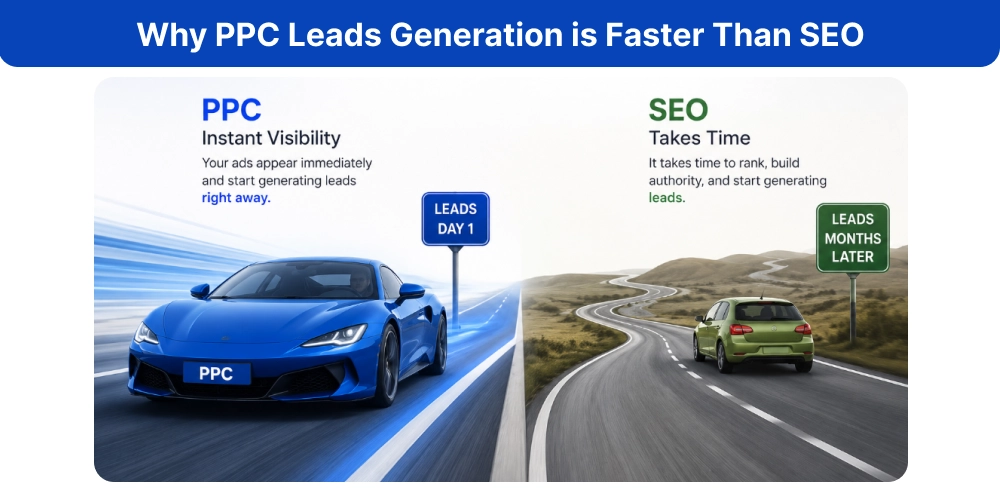
SEO is a great investment but requires time to generate rankings, build authority, acquire backlinks, and build trust factors.
On the other hand, the PPC leads generation process works differently. It allows businesses to get instantly ranked on SERPs.
PPC vs SEO Lead Generation Timeline
Marketing Channel | Time to Initial Results | Long-Term Growth |
|---|---|---|
| PPC Advertising | Days to Weeks | Fast scaling |
| SEO | Months | Strong long-term authority |
| Social Media Organic | Slow | Brand awareness focused |
| Traditional Advertising | Variable | Harder to measure |
This explains why a number of companies choose to implement both techniques. PPC provides instant leads, while SEO creates sustainable organic results.
Real-Life PPC Lead Generation Examples
Various firms use PPC techniques to generate quality leads for their respective businesses. The following examples demonstrate how different companies have made use of Pay-Per-Click lead generation.
Case Study 1: Local Plumbing Business
Business Situation
A local plumbing company struggled to generate emergency service calls consistently. Their website existed, but they relied heavily on referrals.
PPC Strategy Implemented
The PPC company launched:
- Emergency plumbing search campaigns
- Mobile call-only ads
- Geographic targeting within service areas
- High-intent keywords such as “emergency plumber near me.”
- Optimized landing pages with click-to-call buttons
Results
Metric | Before PPC | After 60 Days |
|---|---|---|
| Monthly Leads | 18 | 96 |
| Cost Per Lead | N/A | $34 |
| Conversion Rate | 2.1% | 11.8% |
| Monthly Revenue | Moderate | Increased significantly |
Case Study 2: B2B Software Company
Business Situation
A SaaS company wanted to generate demo bookings for its project management platform.
PPC Strategy Implemented
The PPC company focused on:
- Long-tail commercial keywords
- Competitor targeting campaigns
- LinkedIn retargeting
- Conversion-focused landing pages
- Demo booking optimization
Results After 90 Days
Metric | Month 1 | Month 3 |
|---|---|---|
| Demo Requests | 21 | 94 |
| Cost Per Acquisition | $148 | $71 |
| Conversion Rate | 3.4% | 8.7% |
| Qualified Leads | Moderate | High |
Case Study 3: eCommerce Fashion Brand
Business Situation
An online fashion store wanted faster sales growth during seasonal launches.
PPC Strategy Implemented
The campaign included:
- Google Shopping Ads
- Search campaigns
- Dynamic remarketing
- Seasonal promotions
- Mobile-first ad creatives
Results Within 45 Days
Metric | Before PPC | After PPC |
|---|---|---|
| Website Traffic | Low | 4X Increase |
| Conversion Rate | 1.3% | 4.6% |
| ROAS | Minimal | 5.1X |
| Cart Abandonment | High | Reduced |
Factors that Determine Lead Generation Speed of PPC
Several factors determine how quickly PPC will be able to generate leads. Optimized campaigns generally have a quicker time to produce leads since they can attract many potential customers who are highly targeted and intent to act on their purchases. Some factors include:
Industry Competitiveness
Very competitive industries like law, insurance, and financial services will need more budget allocation in terms of click-throughs and higher ad placement. Firms operating in less competitive industries might generate more leads with a cheaper advertising cost.
Quality of Landing Pages
An effective landing page has a significant influence on PPC campaigns as well. Good headlines, faster load times, mobile responsiveness, and call-to-action buttons are just some features that boost PPC conversions. Otherwise, good ads would not even matter at all when there are poorly designed landing pages.
Budget Allocation
Having large budgets helps PPC campaigns collect data and traffic quickly. Strategy often weighs more than just budget allocation since effective campaigns, even with a moderate budget, could consistently generate profitable leads.
Targeting Audience
Businesses should target audiences with high intentions by using PPC platforms. Such tools provide businesses with ways to filter audiences by geographic, demographic, device, and consumer behaviors.
The Role of Data and Optimization in PPC Success
Many businesses mistakenly expect PPC campaigns to become perfectly profitable immediately.
In reality, the strongest PPC performance comes from continuous optimization.
Professional PPC management relies heavily on data analysis.
Key Metrics PPC Companies Track
Metric | Why It Matters |
|---|---|
| Click-Through Rate (CTR) | Measures ad engagement |
| Cost Per Click (CPC) | Controls advertising efficiency |
| Conversion Rate | Measures lead generation effectiveness |
| Cost Per Acquisition (CPA) | Tracks profitability |
| Return on Ad Spend (ROAS) | Measures campaign revenue efficiency |
| Bounce Rate | Indicates landing page relevance |
Such optimization with respect to metrics will ensure continuous growth of the campaign from month to month.
How AI and Automation Are Revolutionizing PPC Lead Generation
The modern approach to PPC marketing involves using automation and machine learning techniques to optimize marketing campaigns and increase lead generation efficiency. For example, currently, Google employs sophisticated AI algorithms for processing huge amounts of data collected during PPC campaigns and optimizing them.
Identification of Prospective Users Using AI Technology
It is easy to find out about prospective customers using artificial intelligence since the latter allows analyzing certain parameters such as browsing behavior, intention to buy, and demographic characteristics of prospective users.
Optimization of Bidding Process
By employing complex algorithms, automated bidding systems will be able to adjust your bids according to multiple parameters that may include the following: device used, location, competition, user intent, and other parameters.
Prediction of User Behavior
It is possible to make accurate predictions about the actions of prospective users when it comes to conversion. In addition, such knowledge can be used for optimizing PPC campaigns.
Improving Ad Positioning and Search Intent Identification
With the assistance of AI, marketers can easily place ads to reach their target audience at the right time and at the right location when they are conducting searches. Also, the ability to predict search intents and preferences of consumers becomes more effective.
Need for Human Guidance
Though significant success has been witnessed from the use of AI in PPC marketing, the professional help of human beings cannot be underestimated. This is because experts know how to make the best use of the technologies to enhance efficiency.
Common PPC Mistakes Making Companies Fail to Gain Leads
The primary cause behind failure to gain PPC leads within the shortest time possible is poor planning, inadequate targeting, and the wrong strategy. It would be an absolute waste of resources to implement inefficient campaigns and optimization processes.
Use of Irrelevant Keywords
Another mistake commonly made by businesses includes the use of irrelevant or too broad keywords, which leads to the targeting of the wrong clients, hence money is wasted due to low conversion rates. Effective use of PPC keywords helps businesses to target those people interested in making conversions.
Poor Quality of Landing Pages
The other issue involves the poor design of the landing pages. Slow loading time, poorly designed calls to action, and confusing layout can discourage people from converting even though they came through the ads. Businesses need to design pages in ways that encourage conversion.
No Means of Measuring Conversions
The process of optimizing a company’s ads becomes hard in case it has no means of determining the effectiveness of certain keywords or ads in driving conversions. That is why it is critical to measure conversion rates carefully.
Failure to Consider Negative Keywords
Negative keywords help in eliminating ads that may be displayed during search queries which cannot bring about any sales. Without the inclusion of negative keywords, firms might end up wasting money targeting users unlikely to make purchases.
Lack of Regular Optimization
It is essential to constantly monitor and optimize a PPC campaign for better results. This is because conditions in the market keep changing over time. Therefore, regular optimization is necessary.
What Businesses Should Expect From a Professional PPC Company
An experienced PPC management team should provide:
PPC Service Area | Expected Outcome |
|---|---|
| Campaign Setup | Proper targeting and structure |
| Keyword Research | High-intent traffic opportunities |
| Ad Optimization | Better click-through rates |
| Landing Page Advice | Improved conversion rates |
| Reporting | Transparent performance tracking |
| Ongoing Optimization | Lower acquisition costs over time |
Businesses that work with experienced professionals often achieve faster and more sustainable growth.
Companies looking for expert paid advertising management frequently partner with PPC campaign specialists to build scalable lead generation systems tailored to their industry and business goals.
Is PPC Worth It for Small Businesses?
Absolutely.
PPC is especially valuable for small businesses because it allows them to compete directly with larger brands in search results.
With proper targeting and optimization, small businesses can:
- Generate local leads quickly
- Control advertising budgets
- Track every conversion
- Improve brand visibility
- Scale campaigns based on performance
Many small businesses prefer PPC because it delivers measurable results much faster than traditional advertising channels.
Final Thoughts
PPC marketing services will begin to attract leads for your company within days after setting up a successful campaign, but it is by optimizing and scaling it continually that you get the best results.
Although early traffic might seem quick to achieve, profitability is only achieved through testing, refining the target audience, improving landing pages, and making better managing the campaigns better using data.
Some variables affect the quickness of PPC lead generation. These include competition, accuracy of targeting, budgeting, market demand, and website quality.
Those who want fast and measurable growth and effective lead generation need PPC because of its many benefits.
Unlike other methods of marketing, PPC marketing generates more than just clicks.
Frequently Asked Questions
1. How soon will PPC campaigns provide leads?
Most PPC campaigns can yield leads and traffic within a matter of days after launching. Yet, optimization during the first few weeks is essential to maximize lead quality and cost-effectiveness.
2. Which is faster, PPC or SEO?
PPC campaigns are faster to bear fruit since they are capable of delivering immediate traffic via ads displayed by the search engine. SEO requires months to take effect before producing any tangible results.
3. How much money is needed for a successful PPC campaign?
The answer to this question varies from one business to another and will depend on the specifics of the industry involved. Moderate investments, however, can yield excellent results with proper campaign management.
4. What kinds of businesses have the best PPC performance?
Among those that tend to perform exceptionally well with PPC campaigns are local service businesses, e-commerce stores, health care providers, financial services firms, law practices, SaaS businesses, and home services businesses.
5. Why is landing page optimization crucial for PPC?
The landing page determines whether a visitor will become a lead or not. Speed, effective messaging, and a compelling call to action increase the likelihood of conversion considerably.
6. Can a smaller company take advantage of PPC ads?
Certainly. The ability of PPC campaigns to target niche audiences and manage ad spend makes it possible for smaller companies to compete with their larger competitors.

Ami Singh is a highly skilled AdWords PPC Specialist, known for creating profitable Google Ads strategies that elevate brands. With deep expertise in Google Search, Display, Shopping, YouTube Ads, and advanced bidding techniques, Ami consistently converts data into performance-driven results.
With a sharp analytical mind and a strong understanding of online consumer behavior, Ami designs campaigns that maximize ROI, boost quality scores, and reduce acquisition costs. His approach blends technical expertise with strategic thinking—making him a go-to expert for businesses aiming to dominate Google Ads.
Ami doesn’t just adapt to the fast-changing PPC industry, but he also stays ahead of the curve by testing new features, adopting automation smartly, and refining what works. Clients trust him for his transparency, insights, and ability to scale campaigns sustainably.
Looking to take your Google AdWords performance to the next level? Connect with Ami Singh at Softtrix and discover how he can help you get the maximum growth through powerful PPC strategies.