
Running pay-per-click advertising without a well-thought-out budget is like pouring water into a cracked bucket. You might keep adding money, but you will never see the results you are after. In 2026, where ad costs across most industries have climbed anywhere from 15% to 30% compared to previous years, having a structured monthly PPC budget for businesses is not just smart, it’s essential. Without a clear budgeting structure, businesses often face two major problems:
- Overspending without measurable ROI
- Underfunding campaigns that could otherwise generate valuable leads
A structured PPC budget ensures that every dollar is allocated strategically across campaign execution, management, and performance optimization.
Whether you are a small local service provider just dipping your toes into Google Ads or a growing ecommerce brand managing campaigns across multiple platforms, understanding what your monthly PPC budget should include can be the difference between a campaign that drains your cash flow and one that consistently delivers measurable ROI.
This guide walks you through from the core components of a PPC budget to smart allocation strategies, key budgeting methods, recommended starting budgets, management best practices, and the tools that make managing it all a whole lot easier. By the time you finish reading, you will know exactly how to build a monthly ad spend plan that works for your business goals and your bottom line.
What Is a Monthly PPC Budget And Why Does It Go Beyond Ad Spend?
Most business owners hear “PPC budget” and immediately think about how much money they are handing over to Google or Meta each month. And while your direct ad spend is certainly the most visible part of the equation, it’s far from the complete picture.
A truly comprehensive monthly PPC budget for businesses accounts for every cost associated with running and maintaining a successful paid advertising program. That includes management fees, software subscriptions, creative development, and landing page costs, the elements that are often overlooked until they start quietly eating into your margins.
Businesses today rely on PPC budgets to achieve several key goals:
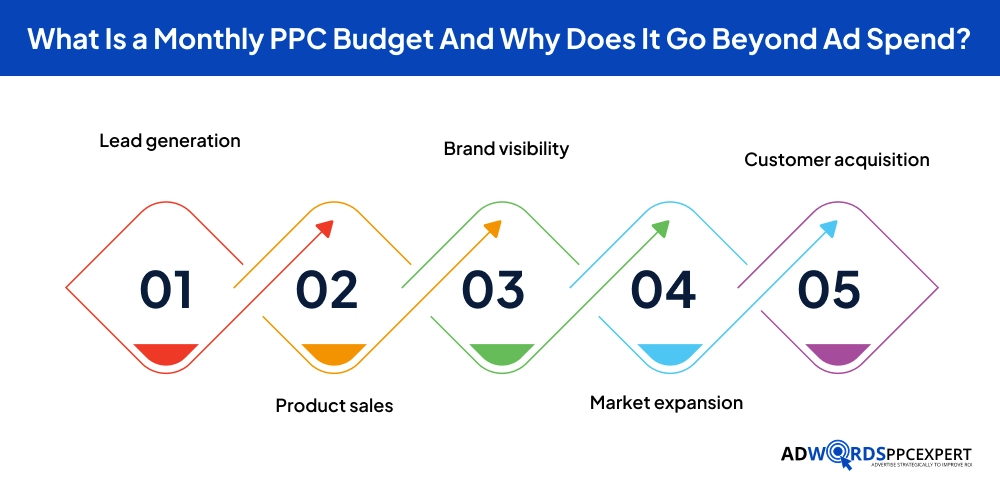
- Lead generation
- Product sales
- Brand visibility
- Market expansion
- Customer acquisition
Here is a practical way to think about it. Your PPC budget is not just a number you set and forget. It is a strategic financial plan that should directly reflect your business goals, your market competitiveness, and the resources it takes to run campaigns that actually convert.
Let’s break down what a complete monthly PPC budget should include, starting from the ground up.
Core Components Every Monthly PPC Budget Should Include
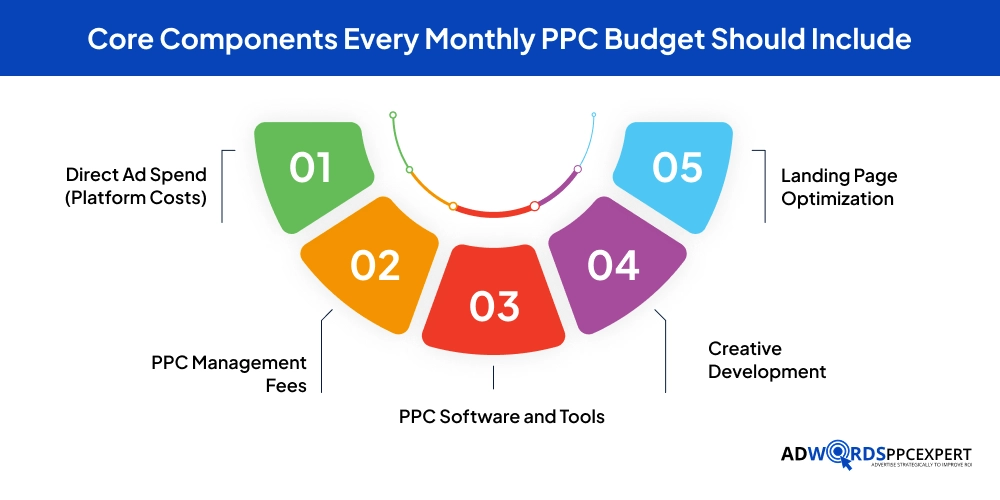
Direct Ad Spend (Platform Costs)
This is the money you pay directly to advertising platforms, that is, Google Ads, Microsoft Ads, Meta Ads, LinkedIn, and so on, every time a user interacts with your ad. The most common models include Cost-Per-Click (CPC), where you pay each time someone clicks your ad; Cost-Per-Mille (CPM), where you pay per 1,000 impressions, and Cost-Per-Acquisition (CPA), where you pay only when a specific action like a purchase or form fill is completed.
CPC is the dominant model in search engine advertising, and the one most businesses will encounter first. In competitive industries like legal, insurance, or SaaS, average CPCs can range from $5 to well over $50 per click. For most small to mid-sized businesses, a reasonable starting point for direct ad spend on Google Ads is somewhere between $1,000 and $5,000 per month, though this varies significantly by industry, geography, and the competitiveness of your target keywords.
PPC Management Fees
If you are working with a PPC agency or a freelance specialist, their fees are a significant and non-negotiable line item in your monthly PPC budget. There are a few common pricing structures you will encounter:
- Flat Monthly Retainer: Typically ranges from $500 to $5,000 or more per month depending on campaign scope. You pay a fixed fee regardless of your ad spend, making it predictable and straightforward.
- Percentage of Ad Spend: Usually 10% to 20% of your total monthly ad spend. If you're spending $5,000 on ads, expect to pay an additional $500 to $1,000 in management fees on top of that.
- Performance-Based: Fees tied to results — per lead, per sale, or a percentage of revenue. This model sounds appealing but requires robust conversion tracking to work effectively.
One important thing to always keep in mind, your management fee and your ad spend are two completely separate line items. If an agency quotes you $1,500 per month, that number typically doesn’t include what Google or Meta charges for clicks. Make sure you know which number is which before signing anything.
PPC Software and Tools
Effective PPC campaign management requires more than the native ad platform dashboards. Most serious advertisers and agencies rely on a stack of third-party tools for keyword research, competitive analysis, bid management, and reporting. These include platforms like SEMrush, Ahrefs, SpyFu, Optmyzr, and various analytics dashboards. Depending on the tools your team uses, this could add anywhere from $100 to $1,000 or more per month to your overall budget. These are not luxury expenses, they are what allow your team to make faster, smarter, data-driven decisions that keep your campaigns competitive.
Creative Development
Ad creative is often the most underestimated line item in a monthly PPC budget. Your ad copy, display banners, video ads, and responsive search ad variations all require time and resources to create, test, and refresh. Poor creative can tank even the best-targeted campaigns. At minimum, budget time and resources for regular creative testing, a discipline that directly impacts your click-through rate (CTR) and Quality Score on platforms like Google Ads. A strong Quality Score does not just improve ad rankings; it actively lowers the cost per click you pay, making creative investment one of the most financially leveraged activities in PPC management.
Landing Page Optimization
Every click you pay for lands on a page. If that page is not designed to convert, you are paying for traffic that bounces without taking any action. Landing page costs include design, development, A/B testing, and the tools used to manage it all, such as Unbounce or Instapage. A well-optimized landing page can dramatically lower your effective cost per acquisition by improving your conversion rate. It also directly improves your Quality Score on Google Ads, which reduces your cost per click. Investing in landing page optimization stretches every dollar of your ad spend further, and ignoring it is one of the most expensive mistakes a PPC advertiser can make.
Key Budgeting Methods to Calculate Your Monthly PPC Budget
There is no one-size-fits-all formula for setting a monthly PPC budget for businesses. The right approach depends on your industry, your business maturity, and your specific campaign goals. Here are the three most effective budgeting methods, each suited to a different stage of business growth and level of available data.
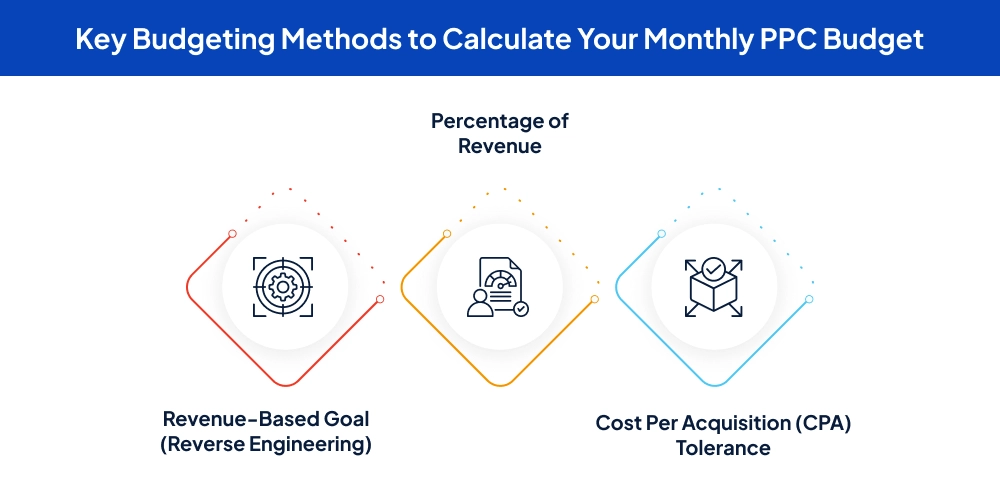
Revenue-Based Goal (Reverse Engineering)
This is the most strategic and results-driven method, and it’s the one we recommend for any business that has even a little conversion data to work with. Instead of picking a number and hoping it’s enough, you work backward from the revenue outcome you want to achieve.
The process works like this:
- Start by identifying your desired revenue for the month. For example, $50,000.
- Calculate the number of conversions (sales or leads) needed to reach that revenue target based on your average order value or deal size.
- Use your known website conversion rate (CVR) to determine how many clicks you need. If your CVR is 5%, and you need 100 conversions, you need 2,000 clicks.
- Multiply the required clicks by your average CPC. At $3.00 per click, your required monthly budget is $6,000.
This method directly connects every dollar of ad spend to a business outcome, making it far easier to justify budget increases when performance is strong and to diagnose exactly what needs to change when it isn’t.
Percentage of Revenue
A common and straightforward approach, especially for established businesses with predictable revenue streams. The general industry guideline is to allocate 7% to 10% of gross revenue to your total marketing budget, and then assign a specific portion of that marketing budget to PPC.
- For ecommerce businesses, PPC typically accounts for 20% to 30% of the total marketing budget, given the direct and measurable connection between paid traffic and sales.
- B2B companies may allocate a smaller percentage to PPC and more toward content, events, or account-based marketing.
- Service-based businesses often start by dedicating around 50% of their marketing budget to PPC, especially in the early growth phase when brand awareness is still being built.
The upside of this method is simplicity and natural scalability. As revenue grows, the ad budget grows proportionally. The downside is that it can disconnect spending from real market opportunity, particularly in highly competitive industries where you may need to outspend your percentage during a critical growth window.
Cost Per Acquisition (CPA) Tolerance
This method is built around profitability and unit economics. Rather than starting from revenue goals or a percentage of income, you start by calculating the maximum amount you can spend to acquire a single customer while still remaining profitable.
- Identify your average customer lifetime value (LTV) or average order value.
- Determine your target gross margin percentage.
- Calculate the maximum CPA your business can sustain without losing money. For example, if your LTV is $500 and your target margin is 50%, your maximum allowable CPA is $250.
- Use this CPA ceiling as your governing constraint when setting bids and total monthly budget.
This approach is especially valuable for businesses in competitive markets where CPCs are high, because it forces a discipline around profitable growth rather than just traffic volume. Once you know your CPA tolerance, you can reverse engineer a budget in the same way as the revenue-based method above.
Recommended Initial Monthly PPC Budgets by Business Type
One of the most practical questions any business owner asks is, how much monthly PPC budget should I allocate for my business? Here’s a straightforward breakdown by business type to anchor your thinking.
Local Businesses
For businesses serving a single city or local market, such as plumbers, dentists, law firms, contractors, or restaurants, a starting monthly PPC budget of $500 to $2,000 is typically workable for Google Search or Local Services Ads. This range provides enough daily budget to generate impressions and clicks in a geographically limited area without overcommitting before you have performance data. As campaigns prove their return, local businesses can scale confidently within this channel.
Small and Midsize Businesses
Small to mid-sized businesses with a regional or national footprint generally need a few thousand dollars per month to start seeing meaningful results. A starting range of $2,000 to $5,000 per month is the most common entry point. The key principle here is to begin with a budget that generates enough data to optimize, typically at least 30 to 50 clicks per day, and then scale systematically based on ROI. Starting too small means the learning period drags out, and optimization decisions are based on insufficient data.
Competitive Industries and B2B
For businesses operating in high-CPC verticals, such as legal, finance, insurance, SaaS, healthcare, or enterprise B2B, the initial monthly budgets need to reflect the reality of the market. A starting range of $5,000 to $15,000 per month is typical, and some enterprise B2B companies running multi-channel campaigns will budget $25,000 or more monthly from the outset. In these industries, underfunding your campaigns is particularly damaging because it limits your impression share in markets where appearing consistently is critical to building trust and capturing intent-driven searches.
Across all categories, the guiding principle is the same, start with a budget that’s adequate for your market, prove the ROI, and scale from there. A budget that is too small won’t generate the data you need to make good decisions.
Smart PPC Budget Allocation: Where Should Your Money Go?
Having a budget is step one. Knowing how to allocate it intelligently across campaigns, channels, and funnel stages is where the real strategy lives.
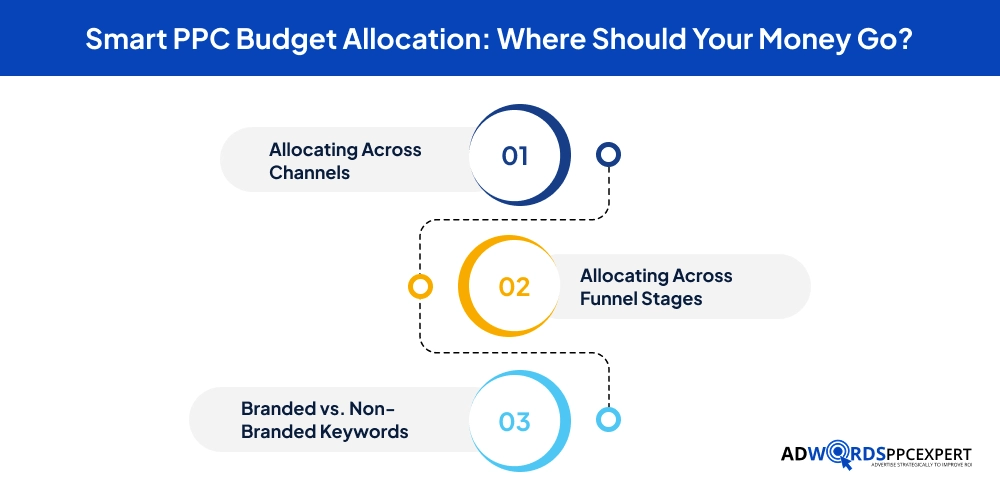
Allocating Across Channels
Not all platforms are created equal, and the right mix depends entirely on your audience, product type, and goals. Google Search Ads are best for capturing high-intent demand, people actively searching for your product or service, and typically get the largest share of budget, usually 50% to 70%. Google Display and Remarketing are great for brand awareness and re-engaging website visitors, usually accounting for 10% to 20% of total budget. Meta Ads across Facebook and Instagram are ideal for B2C brands, visual products, and audience building, complementing search well for full-funnel coverage. Microsoft Ads offer lower competition and CPCs than Google, worth testing if your Google campaigns are already at capacity. LinkedIn Ads carry high CPCs but offer unmatched targeting for B2B businesses, justified only when your average deal size is large enough to support the cost.
Allocating Across Funnel Stages
A smart monthly PPC budget for businesses doesn’t just focus on bottom-of-funnel conversions. It invests across the full customer journey. Top-of-funnel campaigns, display ads, YouTube pre-rolls, or social media campaigns targeting cold audiences, build the audience that converts later. Middle-of-funnel campaigns using remarketing and educational content ads nurture warm prospects who have already shown interest. Bottom-of-funnel campaigns using high-intent search ads and strong remarketing for cart abandoners are where the bulk of conversion budget should live.
For most small and mid-sized businesses, a 10/20/70 split across top, middle, and bottom funnel is a reasonable starting point. Adjust based on your actual performance data as campaigns mature.
Branded vs. Non-Branded Keywords
Don’t overlook branded keyword campaigns. Bidding on your own brand name protects you from competitors targeting your brand terms. These campaigns typically have very high Quality Scores, low CPCs, and strong conversion rates. Budget a small but consistent portion, usually 5% to 10% of your search spend to protect your branded traffic and ensure you’re always the first result when someone specifically searches for your business.
PPC Budget Planning: Making Your Budget Last the Full Month
Even with the right budget in place, poor pacing can sabotage your results. Budget pacing refers to how evenly your ad spend is distributed throughout the month. If your campaigns burn through budget in the first two weeks, you will have no visibility and no conversions for the rest of the month.
Understanding Daily Budgets
Google Ads and other platforms operate on daily budgets. Google may spend up to twice your daily budget on a single high-traffic day, but over the course of a billing month, it won’t charge you more than your monthly cap, your daily budget multiplied by 30.4. The simplest formula to convert a monthly target into a daily budget is to divide your monthly budget by 30.4.
Setting Up Alerts and Monitoring
Set up automated alerts within your ad platforms or via third-party tools to flag daily spend approaching your cap, unusual spikes in CPC, sudden drops in conversion rate, and impression share losses due to budget constraints. Weekly reviews of your campaign performance, paired with deeper monthly audits, give you the rhythm needed to stay ahead of pacing problems before they impact results.
Shared Budgets vs. Campaign-Level Budgets
Google Ads allows you to set shared budgets across multiple campaigns, which helps ensure total monthly spend stays within a hard cap without manually managing each campaign. However, shared budgets can create unintended allocation issues, one high-traffic campaign may consume budget meant for another. Use them carefully and review performance at the campaign level regularly to make sure spend is being distributed the way you intend.
Bidding Strategies and Their Impact on Your Monthly Budget
Your bidding strategy does not just determine how much you pay per click, it fundamentally shapes how your entire budget gets spent. In 2026, automated and AI-powered bidding strategies have matured significantly and are worth leaning into when you have sufficient conversion data.
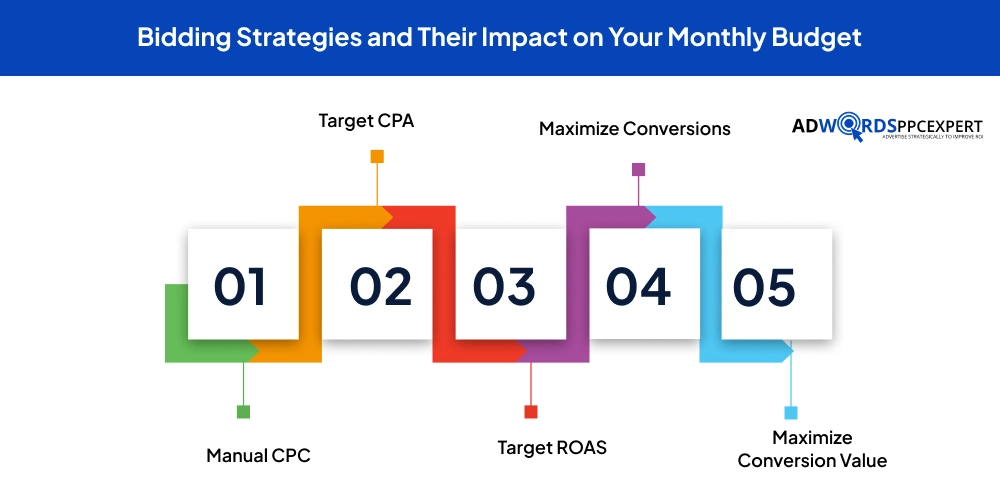
- Manual CPC gives you the most control over individual keyword bids. Best for early-stage campaigns where tight cost management is needed while gathering initial data. Time-intensive and difficult to scale.
- Target CPA is among the most popular smart bidding strategies for lead generation. You set your desired cost per conversion and Google's machine learning adjusts bids automatically. Works best with at least 30 to 50 conversions per month in a campaign.
- Target ROAS is best for e-commerce businesses with varying order values. You set a target revenue return, and the algorithm optimizes bids to maximize revenue at that target. Requires solid conversion value tracking to function properly.
- Maximize Conversions is a fully automated strategy that spends your daily budget to gain the highest number of leads or conversions possible. Especially useful for new campaigns where you want to gather conversion data quickly and efficiently before moving to Target CPA.
- Maximize Conversion Value works similarly but focuses on maximizing total revenue rather than conversion volume, making it better suited for businesses where order or deal values vary significantly.
One important note: avoid switching bidding strategies too frequently. Every change resets Google’s learning period, which typically takes two to four weeks, and can temporarily destabilize performance and distort your pacing during that window.
Keyword Strategy and Its Role in Budget Efficiency
The keywords you target have a direct and dramatic impact on how far your monthly budget goes. Broad, competitive keywords burn through budget fast. Long-tail keywords are typically cheaper and convert better because they reach people closer to a purchase decision.
Using Negative Keywords to Protect Your Budget
Negative keywords prevent your ads from showing up for irrelevant searches, meaning you stop paying for clicks that have no realistic chance of converting. A well-maintained negative keyword list can reduce wasted spend by 20% to 40% in most accounts. Review your Search Terms report at least weekly and add negatives proactively. Common examples for a B2B software company include terms like “free,” “tutorial,” and “DIY.” This one habit alone can meaningfully extend your monthly budget without spending a single additional dollar.
Match Types and Budget Impact
Keyword match types, such as broad, phrase, and exact, affect how aggressively Google matches your ads to search queries. Most well-structured campaigns use a tiered approach: phrase and exact match for core revenue-driving keywords, with broad match deployed selectively and paired with tight negative keyword coverage to prevent irrelevant traffic.
Management Best Practices for Your Monthly PPC Budget
Even a well-structured budget can underperform without disciplined ongoing management. These best practices apply regardless of your industry, campaign size, or the platforms you’re advertising on.
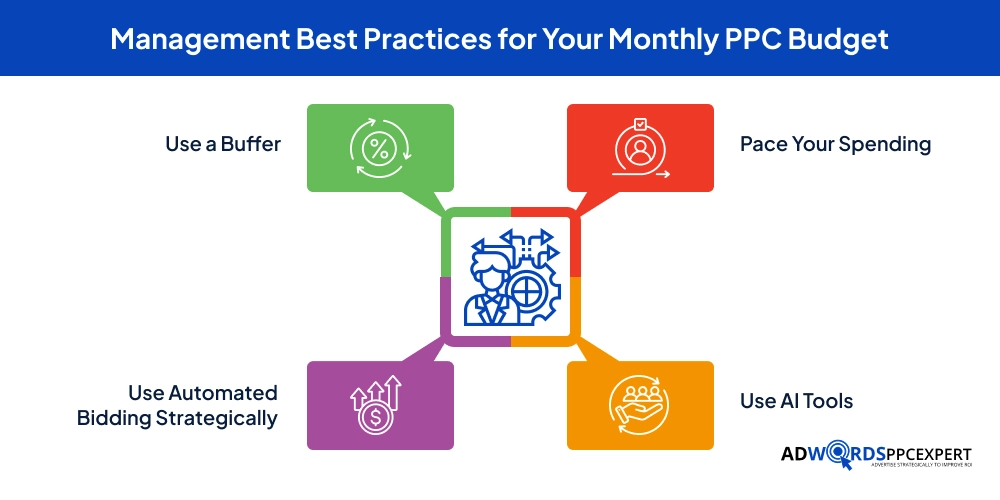
- Use a Buffer: Always add 15% to 20% on top of your calculated base budget to account for fluctuating CPCs. Ad auction prices are not static, they shift with competitor behavior, seasonality, and changes in search demand. A buffer ensures your campaigns don't go dark or underdeliver during unexpected cost spikes.
- Use Automated Bidding Strategically: Leverage smart bidding strategies like "Maximize Conversions" to let Google's algorithm spend your daily budget in a way that captures the highest number of leads or conversions. Once you have accumulated enough conversion data (30 to 50 per month at minimum), transitioning to Target CPA or Target ROAS allows the algorithm to optimize not just for volume but for profitability.
- Pace Your Spending: Always use daily budget limits to prevent your campaigns from exhausting your full monthly budget in the first week or two, particularly at the start of a new campaign when spend velocity can be unpredictable. Calculate your daily budget by dividing your monthly target by 30.4, and monitor pacing weekly to make sure spend is distributing evenly throughout the month.
- Use AI Tools: In 2026, AI-powered tools are no longer a nice-to-have, they are a competitive necessity. Utilize AI to analyze historical performance data, identify patterns in conversion activity, flag budget inefficiencies, and automatically adjust bids and budgets for better performance. Platforms like Optmyzr, Adalysis, and Google's own Performance Max campaigns use machine learning to do in seconds what would take a human analyst hours. Incorporating these tools into your management workflow frees up time for higher-level strategic decisions while improving day-to-day campaign efficiency.
Common PPC Budget Mistakes Businesses Make in 2026
Even experienced marketers fall into traps. Setting and forgetting is one of the most damaging habits in PPC management. The channel requires regular monitoring because markets shift, competitors adjust bids, and Quality Scores fluctuate constantly. Ignoring hidden costs like management fees, tools, and creative development leads to inaccurate ROI calculations and unpleasant budget surprises.
Spreading the budget too thin is another common mistake. Trying to run active campaigns on five platforms with a $2,000 monthly budget means no single platform gets enough spend to generate reliable data or meaningful results. It’s almost always better to dominate one channel before expanding. Underfunding in competitive markets is similarly damaging, a budget too small for your industry won’t compete, won’t generate optimization data, and won’t produce the results stakeholders expect.
Neglecting landing pages is expensive in ways that don’t always show up immediately. Paying for clicks that land on a generic homepage or a poorly designed page is one of the fastest ways to waste ad budget. Chasing clicks instead of conversions is another trap — high CTR without corresponding conversions is a vanity metric. And not using conversion tracking from day one makes every optimization decision a guess. Always set up conversion tracking before you spend a single dollar on ads.
Tools to Help You Plan and Manage Your Monthly PPC Budget
The right tools make budgeting smarter and faster. Google Ads Performance Planner is a free tool that lets you forecast campaign performance under different budget scenarios, particularly useful when planning for seasonal pushes or evaluating a budget increase. Google Keyword Planner is essential for keyword research and CPC estimation during the planning phase, giving you search volume data and average CPC ranges for virtually any keyword.
SEMrush and Ahrefs are powerful third-party platforms for keyword research, competitive intelligence, and ongoing campaign analysis. Optmyzr and Adalysis are dedicated PPC management and optimization platforms that help with bid management, budget pacing, and performance monitoring across large accounts. For businesses where CRM data matters, connecting Google Ads to a platform like HubSpot enables closed-loop reporting, tracking ad spend all the way through to closed revenue, giving you a far more accurate picture of true ROAS.
Adjusting Your Monthly PPC Budget for Seasonal Trends
One of the biggest advantages of PPC advertising is its flexibility, you can scale spend up or down relatively quickly in response to market conditions. Start by reviewing your historical performance data by month to identify your peak and off-peak periods. E-commerce PPC businesses typically spike in Q4. Tax preparation firms peak in early Q1. Landscaping companies see their best traffic in spring. Insurance businesses benefit from year-end enrollment periods.
Plan your annual budget allocation with these peaks in mind. Concentrate more of your budget during high-conversion periods and consider scaling back during naturally slow months. Use the slower months to optimize your account structure, refresh your creative assets, and test new keyword themes so you’re fully prepared to compete when traffic picks back up. This approach ensures you are not burning budget during low-demand periods while also ensuring you are never underfunded during your most critical revenue windows.
Measuring Whether Your Monthly PPC Budget Is Working
Spending money on pay-per-click advertising is only worthwhile if you can measure the results with confidence. Here are the key performance indicators every business should track:
- Click-Through Rate (CTR): How compelling your ads are. Target 2%–5% for Search; 0.5%–1% for Display.
- Cost Per Click (CPC): What you're paying per visit. Varies widely by industry and keyword competitiveness.
- Conversion Rate: The percentage of clicks completing a desired action. 2%–5% is average; 5%+ is strong.
- Cost Per Acquisition (CPA): What you're paying per lead or sale. Should always be evaluated against customer lifetime value.
- Return on Ad Spend (ROAS): Revenue generated per dollar of ad spend. 4:1 is a solid baseline; 8:1+ is excellent.
- Quality Score: Google's rating of ad relevance and landing page experience. Target 7–10 to lower CPCs.
- Impression Share: The percentage of eligible impressions you're winning. Aim for 60%+ on core campaigns.
Review these metrics weekly to catch issues early and monthly for deeper strategic evaluation. Never measure success by a single metric in isolation. Always trace performance back to business outcomes, the question isn’t just “is my CPC going down?” but “is my business growing as a result of this spend?”
Building a Monthly PPC Budget That Scales With Your Business
One of the most satisfying parts of well-managed PPC is that it’s inherently scalable. When you find a campaign configuration that consistently delivers strong ROAS, you can and should increase the budget. Unlike SEO, a profitable PPC campaign can be scaled relatively quickly by increasing ad spend and expanding keyword coverage.
The key to sustainable scaling is data-driven incrementalism. Increase budgets in 15% to 20% increments rather than doubling overnight. Large sudden increases can disrupt automated bidding algorithms that have been calibrated to historical spend patterns, causing temporary performance dips during the new learning period.
As you scale, expand your negative keyword lists to protect efficiency, refresh your creative regularly to prevent ad fatigue, and verify that your landing pages can handle the increased traffic volume while maintaining conversion rates. Scaling ad spend into a broken conversion funnel just means losing money faster. Before you increase budget, always make sure the full path from click to customer is functioning optimally.
Final Thoughts
There is a meaningful mental shift that happens when businesses stop treating their monthly PPC budget as a marketing expense and start treating it as a strategic business investment. Every dollar of ad spend should be accountable to a business outcome, that is, leads generated, revenue produced, and customers acquired.
In 2026, that accountability requires a complete budget that accounts for all costs, a calculation method grounded in your actual goals, smart allocation across channels and funnel stages, proactive pacing and monitoring, disciplined management best practices, and the willingness to adjust based on what the data tells you.
Whether you are managing your PPC campaigns in-house or working with an agency, the principles in this guide give you the foundation to build a monthly PPC budget for businesses that doesn’t just spend money, it earns it back.
If you are ready to take a more strategic approach to your paid advertising and want expert guidance on structuring your monthly PPC budget for maximum ROI, our team at AdWordsPPCExpert is here to help. From Google Ads management to full-funnel PPC strategy, we work with businesses of all sizes to turn ad spend into real, measurable results.
Frequently Asked Questions (FAQs)
How much should a small business spend on PPC per month?
Most small businesses should start with $1,000 to $3,000 per month. This provides enough daily spend to generate clicks, collect data, and let Google’s algorithm optimize. Businesses in competitive industries may need to start closer to $3,000 to $5,000 to see meaningful results.
What is a good ROAS for a PPC campaign?
A ROAS of 4:1 is a solid baseline, meaning $4 in revenue for every $1 spent on ads. Anything at 8:1 or above is considered excellent. Keep in mind that what’s “good” varies by industry and profit margins, so always evaluate ROAS in the context of your own business model.
Should PPC management fees be included in your monthly PPC budget?
Yes, always. Management fees are part of your total investment and directly affect your ROI. A campaign spending $3,000 in ads plus $1,000 in management fees has a real monthly cost of $4,000 and your returns should be measured against that full number, not just the ad spend.
How often should businesses review and adjust their PPC budget?
Weekly reviews for spend pacing and key metrics, and a deeper strategic review every month. Budget adjustments should happen proactively ahead of seasonal peaks, not reactively after performance has already dropped.

Ami Singh is a highly skilled AdWords PPC Specialist, known for creating profitable Google Ads strategies that elevate brands. With deep expertise in Google Search, Display, Shopping, YouTube Ads, and advanced bidding techniques, Ami consistently converts data into performance-driven results.
With a sharp analytical mind and a strong understanding of online consumer behavior, Ami designs campaigns that maximize ROI, boost quality scores, and reduce acquisition costs. His approach blends technical expertise with strategic thinking—making him a go-to expert for businesses aiming to dominate Google Ads.
Ami doesn’t just adapt to the fast-changing PPC industry, but he also stays ahead of the curve by testing new features, adopting automation smartly, and refining what works. Clients trust him for his transparency, insights, and ability to scale campaigns sustainably.
Looking to take your Google AdWords performance to the next level? Connect with Ami Singh at Softtrix and discover how he can help you get the maximum growth through powerful PPC strategies.