
You have Googled it. You have asked around. You have gotten quotes ranging from $300 to $5,000 a month, and you still have no idea what you are actually supposed to pay.
Sound familiar? If you are a business owner trying to figure out how much Google Ads management should cost, you are not confused because you are missing something obvious. You are confused because nobody in this industry gives you a straight answer. Agencies quote what they charge, not what is fair. Blog posts give vague ranges without explaining what actually drives the number. And every time you ask a direct question, you get a response that sounds a lot like “it depends.”
Here is the thing, it does depend. But that does not mean pricing should be a mystery. There are real, knowable reasons why one business should pay $800 a month and another should pay $3,500. There are clear differences between what a $500/month service delivers and what a $2,500/month service delivers. And there are specific warning signs that tell you when an agency is overcharging, underdelivering, or quietly burning your budget while you are not looking.
This guide lays all of it out, plainly and honestly. By the time you finish reading, you will know exactly what the different pricing models mean, what each investment level realistically buys you, which hidden costs inflate the real number, and what questions to ask any agency before you hand over a single dollar. No runaround. No “it depends.” Just the full picture, so you can make a confident, informed decision.
The Two Types Of Google Ads Management Cost
Before any pricing conversation makes sense, there is one foundational distinction that every business owner needs to lock in: when you advertise on Google, you are paying two completely separate entities, and confusing them is where most people go wrong from the very start.
The first is your ad spend. This is the money that flows directly to Google, every click, every impression, every view on a YouTube ad. It’s your fuel. Google charges you for it through your account, and your monthly ad spend is entirely set by your own budget. No agency touches this money; it goes straight to Google.
The second is your Google Ads management fee. This is what you pay the professional, an agency, a specialist, a freelancer to actually build, run, optimize, and report on your campaigns. Think of your ad spend as the gasoline and your management fee as what you pay the driver. More fuel does not get you anywhere meaningful if the driver does not know the roads.
This distinction matters for a simple reason: when you evaluate agency proposals, you will almost always be quoted a management fee. An agency telling you they charge “$750 a month” is not saying your total Google Ads cost is $750. It means $750 is what they charge to manage whatever ad budget you separately allocate to Google. Misread this and your entire budget planning falls apart.
There is also a ratio worth understanding here. As a general principle, your ad spend should be meaningfully larger than your management fee, typically three to eight times larger, depending on your industry. If your management fee equals or exceeds what you are actually spending on ads, the economics rarely produce meaningful ROI. A management fee of $1,000/month only makes financial sense if your ad spend is at least $2,500 to $3,000 per month minimum. Below that threshold, the math usually favors either increasing your ad budget or waiting until you can.
The Four Pricing Models
Agencies and specialists structure their fees in four primary ways. Each model creates different incentives, different risks, and different optimal conditions. Understanding them before you talk to anyone puts you in a measurably stronger negotiating position.
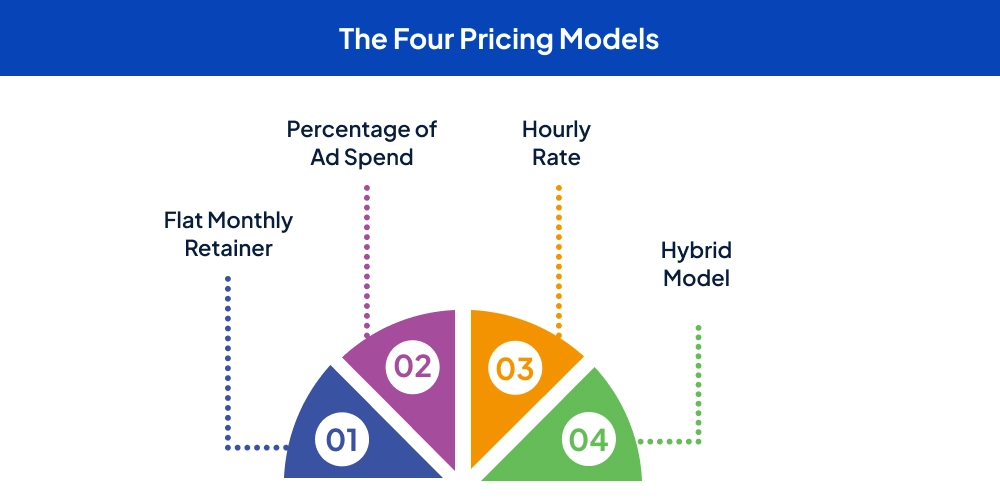
Flat Monthly Retainer
A fixed fee every month regardless of how much you spend on ads. You’ll typically see retainers ranging from $500 to $3,000/month for small-to-mid-sized accounts, with larger or more complex campaigns sitting above that.
The appeal is clarity: you know your cost, you can plan your budget, and the agency earns the same whether you spend $2,000 or $6,000 on ads. That creates a natural alignment of incentives — they have no financial reason to push your ad spend higher. Their job is simply to make your existing budget perform as well as possible.
The watch-out: if your campaigns scale dramatically and the workload grows, a flat fee can start to feel inadequate to the agency, which sometimes translates into reduced attention. Make sure your contract spells out what work is included and what triggers a renegotiation.
Percentage of Ad Spend
The dominant model at larger agencies. The standard range is 10% to 20% of your monthly ad spend, with most agencies setting a minimum floor of $500 to $1,000/month to protect their bottom line on smaller accounts.
At $5,000/month in ad spend and a 15% rate, you are paying $750 in management fees. Scale to $20,000/month and that fee jumps to $3,000, even if the actual work involved hasn’t tripled. This model is transparent and common, but it creates one structural tension worth watching: the agency’s revenue goes up when you spend more, regardless of whether increasing the budget is the right strategic move for your business at that moment.
“Ask your agency this question directly: Is this budget increase recommendation coming from what the data shows, or from what would increase your management fee?”
That said, percentage-of-spend pricing is not inherently wrong. For businesses scaling aggressively or managing complex campaigns at high spend levels, it’s a reasonable way to ensure the agency is compensated proportionally for genuine complexity. Just make sure performance benchmarks are written into the contract alongside the percentage rate.
Hourly Rate
Independent consultants and boutique specialists often charge by the hour: typically $75 to $200/hour in the US, with highly experienced senior consultants sometimes commanding $250 to $350/hour for specialized work.
Hourly billing makes sense for discrete, bounded projects: account audits, conversion tracking setup, one-time campaign builds, or training your in-house team. It works less cleanly for ongoing management because PPC optimization work doesn’t always fit into neat, predictable hourly blocks. If you engage someone on an hourly basis for ongoing work, always negotiate a monthly hour cap so you are not surprised by invoices.
Hybrid Model
A growing favorite among experienced, independent specialists: a lower base retainer plus a smaller performance percentage. Something like “$900/month base + 5% of ad spend” or “$1,200/month base + a bonus per qualified lead generated.”
Hybrid pricing threads an important needle. The base retainer keeps the agency financially stable and incentivized to do the foundational work well. The performance component creates a shared stake in your growth. For businesses in active scaling mode, this model often produces the healthiest long-term agency relationship because both sides have skin in the same game.
Pricing Model | Typical Range | Incentive Alignment | Best Fit |
|---|---|---|---|
| Flat Retainer | $500 – $3,000/mo | Strong — no spend inflation motive | Stable budgets, boutique specialists |
| % of Ad Spend | 10–20% + minimum | Moderate — watch for spend creep | High-spend, scaling brands |
| Hourly | $75 – $250/hr | Neutral — task-based | Audits, one-time projects |
| Hybrid | Base + small % | Strong — aligned on growth | Growth-stage businesses |
Tier by Tier: What Your Money Actually Buys
The difference between $500/month and $3,000/month in management fees is not just a bigger number, it is a categorically different service. Here is what each investment level actually delivers.
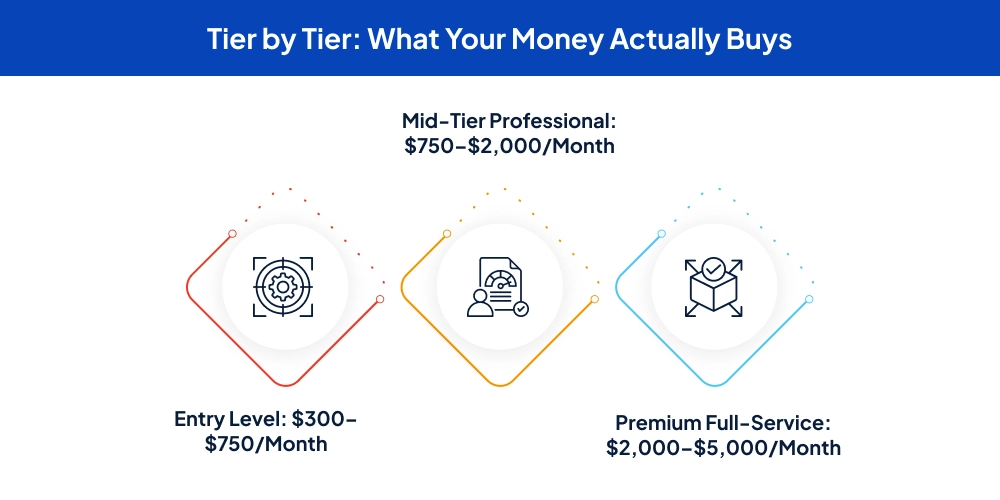
Entry Level: $300–$750/Month
At this tier, you are most commonly working with an offshore team, a digital marketing generalist handling many channels at once, or a very junior freelancer building their client base. The deliverables tend to be templated: a basic campaign build, standard keyword groupings borrowed from industry templates, and a monthly report that shows you clicks, impressions, and cost, but rarely connects any of it to actual leads or revenue.
Campaign optimization happens sparingly, perhaps once per month if you are lucky, and it’s typically reactive, adjusting what is obviously broken rather than proactively improving what is working. Your account manager likely handles 30 to 50 clients simultaneously. They don’t know your business. They probably don’t know your market. The ads running might technically be live, but without the strategic thinking, regular testing, and hands-on refinement that actually move performance forward, you are essentially paying to have someone press the “on” button and walk away.
The uncomfortable truth about this tier: the wasted ad spend from poor account management typically dwarfs whatever savings you captured on the management fee. Negative keyword lists go unupdated, irrelevant search terms drain your budget, quality scores stay low (which means higher CPCs), and conversion tracking is often incomplete or flat-out broken. You end up spending more in ad budget inefficiency than the difference between this tier and the next one would have cost you.
Mid-Tier Professional: $750–$2,000/Month
This is where real, strategic Google Ads management begins. At this level, your campaigns are custom-built around your specific business, your competitive landscape, and your conversion goals. Keyword research is thorough and ongoing. Negative keyword lists are actively managed. Ad copy gets tested regularly, not just written once and forgotten. Bidding strategies are adjusted based on actual performance data, not left on autopilot.
Your account manager at this tier is handling a sensible client load, typically 10 to 20 accounts, which means they have genuine bandwidth to understand your business and respond quickly when something changes. Conversion tracking is set up properly: form submissions, phone calls, and online transactions are all being measured and attributed correctly. Monthly reports tell you what matters, cost per lead, conversion rate, cost per acquisition, not just surface-level traffic numbers.
You also start getting proactive strategy at this level. Instead of waiting to be asked, a good mid-tier manager will flag opportunities: a competitor leaving a gap in a keyword cluster, a landing page underperforming versus a new variation they want to test, an automated bidding strategy that is ready to be unlocked based on your conversion volume. That forward-thinking management is what separates a caretaker from a growth partner.
For the large majority of US small and mid-sized businesses, local service companies, professional service firms, growing e-commerce PPC brands, this is the tier where investment and return find their best balance.
Premium Full-Service: $2,000–$5,000/Month
At this tier, Google Ads management becomes an integrated marketing partnership rather than a standalone service. You are not just getting campaigns managed, you are getting advanced audience segmentation, landing page optimization collaboration, deep attribution modeling, competitive intelligence, and tight integration with your CRM for closed-loop reporting that connects ad spend directly to signed contracts and revenue.
Account managers at this level handle small rosters, sometimes as few as five to eight clients, and they know your business deeply. They understand your sales cycle and average deal value. They know which of your competitors are bidding aggressively and when. They can tell you not just that your campaign generated 40 leads last month, but that 12 of those leads came from a specific keyword cluster and converted to sales at twice the rate of the rest.
Businesses that consistently get strong ROI at this level typically share some common characteristics: they are in high-value industries where a single client is worth thousands of dollars, they operate across multiple locations or markets, or they are running complex campaign portfolios including Search, Performance Max, and Shopping simultaneously.
Industry Benchmarks: Why Your Niche Changes Everything
The management fee discussion does not exist in a vacuum, it’s inseparable from the competitive reality of your specific industry. Cost-per-click (CPC) varies enormously across sectors, and high-CPC environments demand higher-caliber, more attentive management. Here is a realistic snapshot of average CPCs across major US industries:
Industry | Avg. CPC Range (US) | Management Complexity |
|---|---|---|
| Legal / Law Firms | $50 – $150+ | Very High |
| Insurance | $40 – $90 | Very High |
| Financial Services | $25 – $65 | High |
| Home Services (Roofing, HVAC, Plumbing) | $15 – $60 | High |
| Medical & Healthcare | $12 – $50 | High |
| B2B SaaS / Tech | $20 – $80 | High |
| E-Commerce (General) | $0.50 – $8 | Moderate–High |
| Education / Online Courses | $8 – $25 | Moderate |
| Restaurants / Local Food | $1.50 – $5 | Low–Moderate |
Why does this change the management fee conversation? Because high-CPC industries require considerably more skill. A PPC manager who handles restaurant accounts all day doesn’t possess the bid strategy nuance, quality score optimization expertise, or negative keyword discipline needed to manage a personal injury law firm’s campaigns at scale. The competitive stakes are different. One bad month in legal PPC can mean $10,000 in clicks that didn’t convert not $500. That kind of environment demands senior-level attention and deep industry familiarity, which costs more.
This is why comparing management fees across industries is almost meaningless without context. The same $1,500/month management fee might represent excellent value for a regional restaurant chain but be woefully insufficient for a multi-location roofing company competing against national franchise networks in a major metro market.
The Hidden Costs That Inflate Your Real Investment
The management fee headline number rarely tells the complete financial story. Business owners who don’t ask the right questions before signing often discover additional costs they did not budget for, sometimes significant ones. Here is what to watch for.
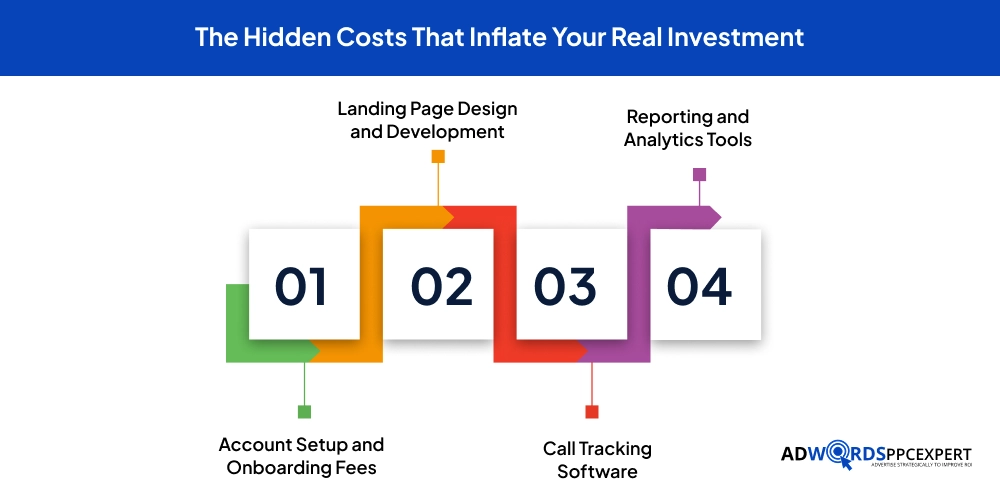
Account Setup and Onboarding Fees
Most agencies charge a one-time setup fee ranging from $500 to $2,500 to build your account from the ground up. This typically covers keyword research, competitive analysis, campaign architecture, ad copy development, and conversion tracking installation. Is this legitimate? Generally, yes proper account setup is intensive work and foundational to everything that follows. The red flag is when setup fees are premium but the delivered account looks templated and generic. Before paying any setup fee, ask for a clear list of every deliverable included and a timeline for when each will be completed.
Landing Page Design and Development
Any experienced PPC manager will eventually tell you correctly that your landing pages are as important as your ads. Sending paid traffic to a generic homepage is one of the most common and costly mistakes in Google Ads management. Purpose-built landing pages designed around specific services, audiences, or offers consistently outperform generic pages on conversion rate. Building them properly costs money: typically $500 to $2,000 per page for design and development.
Some agencies include landing page optimization within their monthly management scope. Others charge for every update. If you are a multi-service business, you may need three to five dedicated pages to run campaigns effectively, which can meaningfully change your total investment picture. Clarify this in the proposal phase, not after the campaigns are live.
Call Tracking Software
For any business where phone calls are a meaningful conversion event, home services, legal, medical, real estate, and most local service businesses, call tracking is not optional. Without it, you cannot attribute which campaigns, keywords, or ads are actually generating revenue-producing calls. The cost is typically $50 to $150/month for a platform like CallRail or CallTrackingMetrics. Some agencies include this; others don’t. Know which camp your potential partner falls into.
Reporting and Analytics Tools
Professional-grade reporting sometimes involves third-party platforms beyond Google Ads’ native dashboard for advanced attribution, cross-channel reporting, or competitive intelligence. These tools can add $100 to $400 per month. Again, some agencies bundle them into their retainer; others list them as separate line items. Ask explicitly what tools are used and who pays for them.
Should You Just Do It Yourself? An Honest Answer
This question deserves a straightforward answer rather than the predictable “hire an expert” response you would expect from an agency’s blog. So here is the honest version: self-managing Google Ads is possible, and in specific situations it’s the right call. But it comes with costs that don’t show up as line items.
The most significant is your time. Learning Google Ads well enough to manage campaigns competently takes serious hours, not a weekend, but months of consistent study, testing, and course-correcting. The platform evolves constantly: new campaign types, automation features, audience targeting options, and bidding algorithm updates roll out regularly. Staying current is a job in itself. If you are a business owner, that time carries opportunity cost. Ten to fifteen hours a month spent learning and running ads is ten to fifteen hours not spent on operations, sales, hiring, or client delivery.
There is also the cost of learning on your own dime. Every PPC manager has made expensive early errors, overly broad match types draining budget on irrelevant queries, bidding strategies launched before the account had enough conversion data, and ad copy that earned clicks but didn’t convert. Those are paid educational experiences when it’s your ad budget funding them.
Self-management makes sense when your monthly ad spend is under $500 (most agencies won’t engage at an economically sensible fee at that level), your market is genuinely low-competition, or you are willing to invest serious time in the learning curve. Beyond $2,000/month in ad spend, professional management almost always covers its own cost. Even a conservative 10% improvement in campaign efficiency on a $2,000 budget saves $200/month enough to start offsetting management fees. At $5,000/month, a skilled specialist routinely delivers efficiency gains worth three to five times their monthly fee.
How to Know If Your Management Fee Is Actually Worth It
The right question was never “how much does Google Ads management cost?” The right question has always been: “What return am I getting on every dollar I invest?” A $3,000/month management fee that generates $40,000 in revenue is an extraordinary investment. A $400/month fee that produces nothing is extraordinarily expensive.
Here is the framework that cuts through the noise:
First, know your conversion value.
What is a lead, call, or sale actually worth to your business? A home services company with a $600 average job ticket and a 35% close rate on inbound phone calls values each lead at roughly $210. A personal injury attorney, where one retained case generates $25,000 in fees, values each qualified lead far higher. This number is the anchor of every ROI calculation that follows.
Second, track everything.
This is non-negotiable. Without complete, verified conversion tracking capturing every form submission, every tracked phone call, every online transaction, you cannot evaluate performance honestly. Many accounts that appear to be underperforming are actually generating results that simply are not being measured. Insist on clean measurement before any campaign goes live.
Third, calculate your true cost per acquisition. Add your monthly ad spend and management fee together. Divide that total by the number of qualified conversions generated. If you are spending $3,500 in ads and $1,000 in management ($4,500 total) and generating 18 qualified leads, your CPA is $250. Is that profitable? Only your conversion value established in step one, tells you the answer.
ROI Formula
ROI = (Revenue from Ads − Total Costs) ÷ Total Costs × 100
If $4,500 in total monthly investment generates $18,000 in revenue, that is a 300% ROI, meaning every $1 invested returned $4. Strong by any standard.
Your management partner should be handing you this calculation every single month. If their reports show clicks and impressions but don’t connect to leads, revenue, or cost per acquisition, that’s not reporting, it’s decorating. Demand accountability or find someone who provides it.
Red Flags That Should End Any Conversation Immediately
Experience in this industry makes patterns very recognizable. There are specific behaviors and contract terms that reliably predict poor outcomes, and ignoring them in the excitement of a new vendor relationship is a mistake that costs real money. Here’s what to walk away from without hesitation.
They will no’t give you full ownership of your Google Ads account. This is the number one red flag in the entire industry. Your account should live under your own Google login with agency access granted through their manager account. Agencies that insist on owning the account, meaning you lose your entire campaign history, conversion data, audience lists, and optimization work if you ever leave, are building leverage over you rather than delivering value. Walk away immediately.
Guaranteed rankings, clicks, or leads. Google Ads is a real-time auction. Nobody, not Google itself, can guarantee specific positions, lead volumes, or click quantities. These promises are sales tactics dressed up as expertise. The second you hear a guarantee tied to a specific outcome, treat everything else the agency says with skepticism.
Long-term contracts with punishing exit clauses. A 12-month lock-in with a 60-day cancellation notice and a hefty early termination fee tells you one thing: this agency doesn’t trust their results to retain you voluntarily. Confident agencies offer flexible, month-to-month agreements because they know their performance will keep you.
Reports that show clicks but never conversions. If your monthly performance report is full of charts about impressions, CTR, and cost-per-click but does not tell you how many leads or sales the campaigns generated, you are being given optics instead of accountability. This is often intentional.
No conversion tracking discussion during onboarding. If an agency doesn’t bring up conversion tracking setup in the first conversation, they are not planning to measure results. This is a fundamental requirement of professional PPC management, its absence suggests the agency is not interested in accountability.
Management fees that exceed or nearly equal your ad spend. If you are paying $900/month to manage $1,000/month in ads, the economics are almost impossible to justify. Your management fee should represent a sensible fraction of your ad spend, not an equivalent or greater line item.
10 Questions Every Business Owner Should Ask Before Hiring
These questions work because they require specific, substantive answers. Vague responses reveal more than direct answers: an agency that can’t clearly explain its optimization process, its reporting methodology, or its account ownership policy is an agency that either doesn’t have strong answers, or hopes you won’t ask.
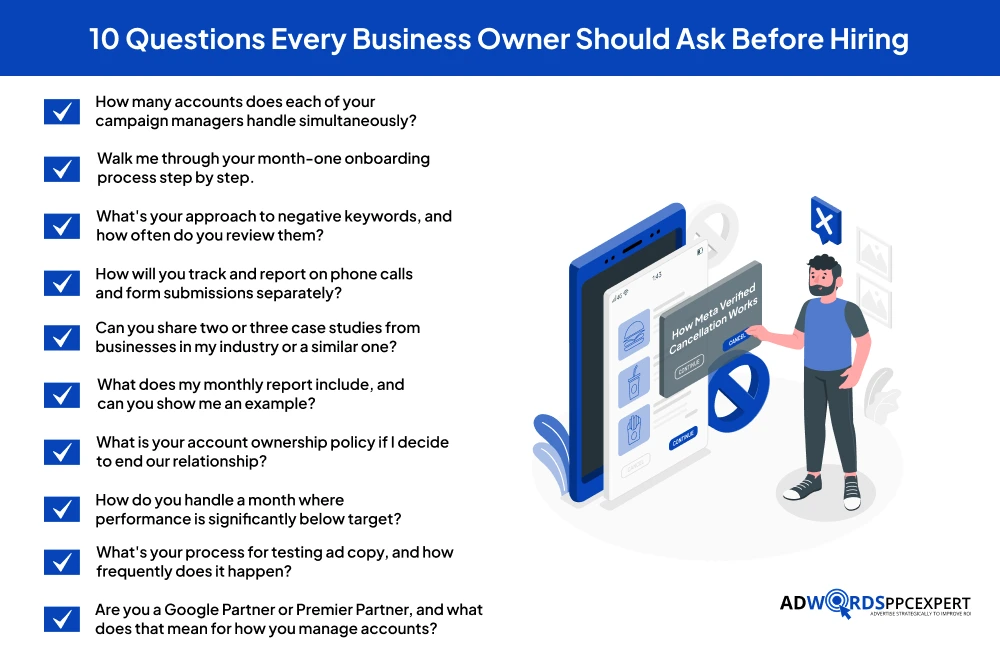
"How many accounts does each of your campaign managers handle simultaneously?"
A healthy number is 8 to 15. Above 25, your account is being managed reactively, not proactively. Above 40, you are barely getting attention.
"Walk me through your month-one onboarding process step by step."
Look for a specific sequence: competitor research, keyword strategy development, campaign build, conversion tracking verification, and a first-month review milestone. Generic answers signal generic processes.
"What's your approach to negative keywords, and how often do you review them?"
Negative keyword management is one of the highest-impact, most consistently neglected tasks in PPC management. It should happen at a minimum weekly on active accounts. An agency that’s vague on this is likely neglecting it.
"How will you track and report on phone calls and form submissions separately?"
You want to hear about specific call tracking integration, properly configured conversion goals in Google Analytics, and ideally CRM connectivity for revenue attribution.
"Can you share two or three case studies from businesses in my industry or a similar one?"
Relevant experience in your vertical, that is, legal, home services, e-commerce, and medical, which means they already understand the high-performing keywords, seasonal patterns, and competitive dynamics in your market. That institutional knowledge has real value.
"What does my monthly report include, and can you show me an example?"
A useful report shows you cost per lead or cost per acquisition, conversion volume, ROAS (for e-commerce), and what specific optimizations were made that month and what impact they had.
"What is your account ownership policy if I decide to end our relationship?"
The non-negotiable correct answer: everything stays with you. Your campaigns, your keywords, your conversion history, your audience lists, all of it is yours from day one.
"How do you handle a month where performance is significantly below target?"
Strong agencies have a clear process: root cause analysis, a documented corrective action plan, and proactive communication. Weak agencies get defensive or shift blame to external factors.
"What's your process for testing ad copy, and how frequently does it happen?"
Systematic A/B testing of ad headlines, descriptions, and calls to action should be a continuous part of management, not a quarterly afterthought. Ask for specifics on methodology and testing cadence.
"Are you a Google Partner or Premier Partner, and what does that mean for how you manage accounts?"
Google Partner certification indicates a minimum level of demonstrated expertise and account performance standards. Premier Partner status, held by the top tier of certified agencies, signals consistently strong client results and significant managed spend. It’s not a guarantee of quality, but it’s a meaningful baseline filter.
Final Thoughts
Google Ads management pricing is not a commodity decision. It’s an investment decision, and like all investments, what matters isn’t just the cost but what that cost returns. The business owner who pays $1,800/month for skilled, accountable PPC management and builds a $25,000/month revenue engine from it made one of the best decisions of their year. The one who saves $1,300/month on a budget agency and watches $8,000 in ad spend disappear without a trackable lead to show for it made a very costly “bargain.”
When you are evaluating options, stop comparing management fees in isolation. Compare the total investment, that is, the ad spend plus management fee plus ancillary costs, against your conversion value, your competitive environment, and your growth goals. That is the calculation that tells you whether any given proposal makes sense for your business.
Ask the hard questions before you sign anything. Insist on account ownership from day one. Demand reporting that connects campaign performance to actual business outcomes, not just clicks and impressions. And if an agency responds to those requests with discomfort rather than clarity, that discomfort is your answer.
The best Google Ads management relationships are built on transparency, accountability, and a shared stake in your results. When you find that combination at a price that makes economic sense for your business, you will know it, because the numbers will show up in your pipeline every single month.
Frequently Asked Questions
1. What is the average cost of Google Ads management for small businesses?
For most small businesses, Google Ads management typically costs between $500 and $2,000 per month, depending on the size of the ad budget and the complexity of the campaigns. Businesses running local campaigns with limited keywords may pay less, while companies targeting larger markets or multiple services usually require more advanced campaign management, which increases the cost.
2. Do Google Ads agencies charge a setup fee?
Yes, many agencies charge a one-time setup fee when launching a new Google Ads account. This fee usually covers tasks such as keyword research, campaign structure planning, ad copy creation, conversion tracking setup, and initial optimization. Setup fees typically range between $500 and $2,000, depending on the scope of the project and the number of campaigns being created.
3. How much should I spend on Google Ads each month?
There is no universal minimum budget for Google Ads, but many businesses start with $1,000 to $5,000 per month to gather meaningful performance data and generate consistent leads. The ideal budget depends on factors such as industry competition, cost-per-click for relevant keywords, and the overall marketing goals of the business.
4. Why do Google Ads management fees vary so much?
Google Ads management fees vary widely because every advertising account is different. Factors such as the size of the advertising budget, the number of campaigns, keyword competition, geographic targeting, and reporting requirements all influence the amount of work involved. More complex accounts require more time, strategic planning, and ongoing optimization, which leads to higher management costs.
5. How can I tell if my Google Ads management service is worth the cost?
The best way to evaluate Google Ads management is by measuring return on investment (ROI). If your campaigns generate high-quality leads or sales that exceed your advertising and management costs, the service is delivering value. Key metrics to monitor include cost per conversion, conversion rate, and overall revenue generated from paid advertising.

Ami Singh is a highly skilled AdWords PPC Specialist, known for creating profitable Google Ads strategies that elevate brands. With deep expertise in Google Search, Display, Shopping, YouTube Ads, and advanced bidding techniques, Ami consistently converts data into performance-driven results.
With a sharp analytical mind and a strong understanding of online consumer behavior, Ami designs campaigns that maximize ROI, boost quality scores, and reduce acquisition costs. His approach blends technical expertise with strategic thinking—making him a go-to expert for businesses aiming to dominate Google Ads.
Ami doesn’t just adapt to the fast-changing PPC industry, but he also stays ahead of the curve by testing new features, adopting automation smartly, and refining what works. Clients trust him for his transparency, insights, and ability to scale campaigns sustainably.
Looking to take your Google AdWords performance to the next level? Connect with Ami Singh at Softtrix and discover how he can help you get the maximum growth through powerful PPC strategies.