
Running paid ads today is no longer about who has the biggest budget. It is about who understands the market better. Every time you enter an ad auction, you are competing against brands that have already tested what works, what fails, and what converts. The difference between wasting ad spend and scaling profitably often comes down to one critical skill, that is PPC competitor analysis.
When done correctly, PPC competitor analysis removes guesswork from your advertising strategy. It shows you where competitors are investing, how they position their offers, which keywords actually matter, and where opportunities exist to win clicks at a lower cost. More importantly, it helps you make smarter decisions instead of reactive ones.
This in-depth guide breaks down how to perform PPC competitor analysis step by step, explains what to analyze, how to interpret the data, and how to turn insights into real performance gains, without copying competitors or violating ad platform policies.
Understanding PPC Competitor Analysis Beyond the Basics
At a surface level, PPC competitor analysis is about identifying who you are competing with in paid search. But in practice, it goes much deeper. It’s a structured process of studying competitors’ paid advertising behavior to uncover patterns, priorities, and performance signals.
A strong PPC competitor analysis answers questions like:
- Why are certain competitors dominating top ad positions?
- Which keywords are driving real commercial intent?
- What messaging consistently appears across high-performing ads?
- How are competitors structuring landing pages to convert traffic?
- Where are competitors overspending or underperforming?
Instead of reacting blindly to rising CPCs or declining conversions, competitor analysis gives you context. You are no longer guessing why costs are increasing or why certain keywords are not working, you are seeing the bigger picture.
Why PPC Competitor Analysis Is Essential for Modern Google Ads Campaigns
Paid search today operates in a very different environment than it did just a few years ago. Google Ads now relies heavily on automation, machine learning, and smart bidding strategies that respond to market signals in real time. While these advancements improve efficiency, they also raise the competitive baseline. Nearly every advertiser now has access to similar tools, bidding strategies, and targeting options. As a result, the margin for error has narrowed significantly.
Today, PPC competitor analysis is no longer optional. It provides the external context needed to make sense of rising costs, fluctuating performance, and shifting user behavior. Instead of relying solely on your own account data, competitor analysis allows you to understand how the broader market behaves and where opportunities exist to gain an edge.
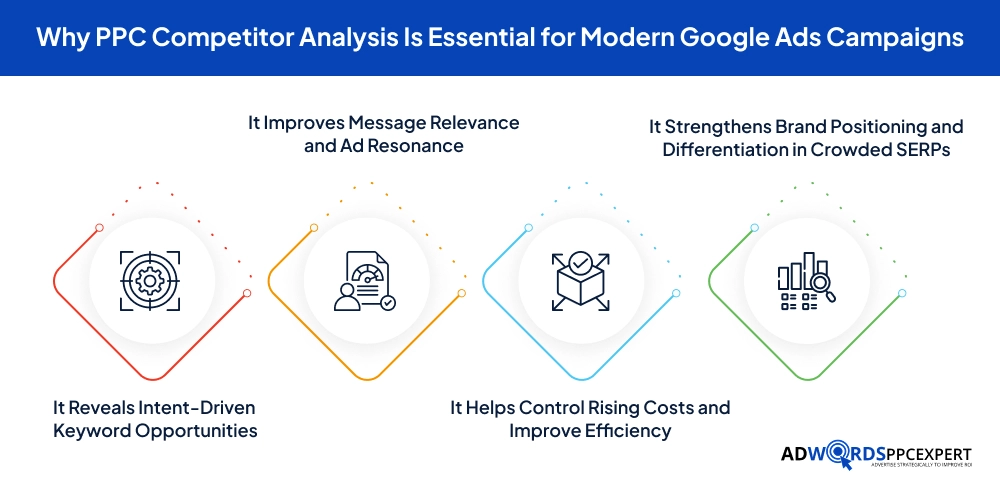
It Reveals Intent-Driven Keyword Opportunities
Most successful advertisers do not stumble upon profitable keywords by accident. They test extensively, refining keyword lists over time to focus on search terms that consistently produce leads or sales. By the time you see a competitor repeatedly bidding on the same keyword, it is often because that keyword has already proven its value.
Through PPC competitor analysis, you can identify these intent-driven keywords far earlier in the process. This helps you:
- Prioritize terms that indicate strong buying intent
- Avoid over-investing in keywords that generate traffic but not conversions
- Shorten the learning curve typically required to find profitable keyword segments
Rather than spending months experimenting with broad or low-quality keywords, you benefit from insights competitors have already validated through their spend and performance history.
It Improves Message Relevance and Ad Resonance
High-performing ads are rarely generic. They succeed because they reflect real user concerns, objections, and motivations at different stages of the buying journey. Competitor ads offer valuable clues into what resonates most with your shared audience.
When you analyze competitor ad copy, you begin to notice patterns:
- Which pain points are emphasized repeatedly
- What benefits are positioned as most valuable
- How urgency, trust, or credibility is communicated
This insight allows you to craft ads that speak more directly to user expectations. Instead of guessing which messages might work, you refine your copy based on what the market has already responded to, while still differentiating your brand’s voice and value.
It Helps Control Rising Costs and Improve Efficiency
One of the biggest challenges in Google Ads today is managing rising cost-per-click. Increased competition and automated bidding can quickly drive costs up, especially when advertisers chase the same keywords without a clear strategy.
PPC competitor analysis helps you understand where competitors are placing their bets. By identifying:
- Keywords with intense bidding pressure
- Areas where competition is lighter or inconsistent
- Seasonal or time-based shifts in bidding behavior
You can allocate the budget more strategically. This prevents unnecessary bidding wars on keywords that do not justify their cost and allows you to invest more confidently where competitors signal genuine value. Over time, this leads to better cost control and more efficient spending.
It Strengthens Brand Positioning and Differentiation in Crowded SERPs
In crowded ad auctions, many ads begin to look and sound the same. When multiple advertisers rely on similar language, offers, or promises, users struggle to see meaningful differences, which often drives decisions purely on price.
Competitor analysis highlights how other brands position themselves and where they focus their messaging. Some may emphasize affordability, others speed, reliability, expertise, or guarantees. Understanding these positioning choices allows you to make intentional decisions about how your brand shows up.
Instead of blending into generic messaging, you can:
- Highlight strengths competitors overlook
- Address objections competitors ignore
- Present a clearer, more compelling value proposition
This differentiation not only improves click-through rates but also attracts higher-quality users who are better aligned with your offering.
What Are the Key Benefits of PPC Competitor Analysis?
PPC advertising allows brands to appear at the top of search engine results instantly by bidding on keywords, rather than waiting for SEO efforts to mature. However, visibility alone does not guarantee performance. Competitor analysis ensures your investment is informed, efficient, and aligned with market realities.
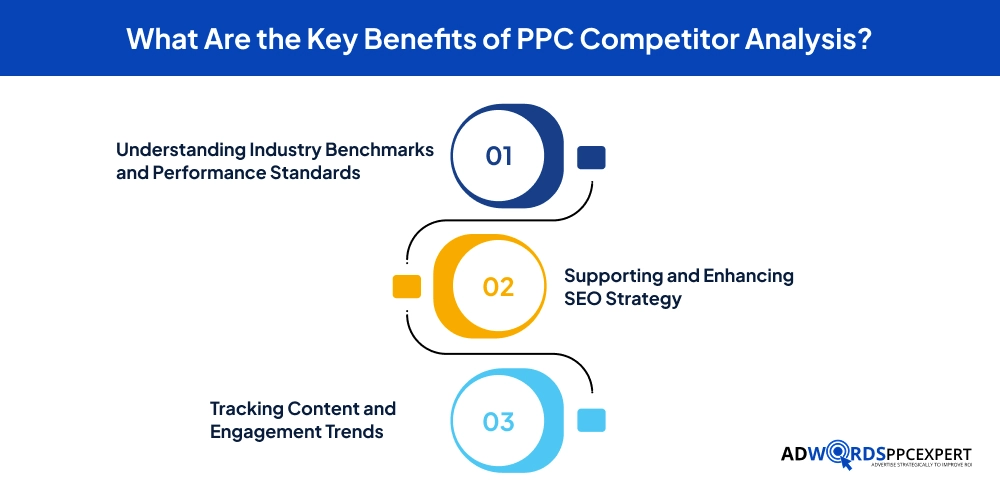
Understanding Industry Benchmarks and Performance Standards
Conducting competitor analysis across multiple advertisers gives you a clearer picture of industry benchmarks. You begin to understand typical ad formats, bidding behaviour, promotional offers, and engagement strategies already present in the market.
These insights help you set realistic campaign goals, forecast budgets accurately, and avoid unrealistic expectations. Instead of operating in isolation, your strategy aligns with how users are already interacting with similar ads.
Supporting and Enhancing SEO Strategy
PPC competitor insights often extend beyond paid ads. By analysing competitor landing pages, content structure, and keyword themes, you gain valuable information that can also support your ai SEO efforts.
You can identify which keywords drive engagement, what type of content users respond to, and how landing pages are structured for conversions. This allows better alignment between paid and organic strategies, improving overall search visibility.
Tracking Content and Engagement Trends
Competitor PPC campaigns often reveal broader content and engagement strategies. Reviewing how frequently competitors refresh ad copy, promote offers, or adjust messaging provides insight into what resonates with users over time.
These observations help you refine your own content approach, whether through stronger CTAs, clearer value propositions, or more user-focused landing page experiences.
What Can You Learn from Your Competitors’ PPC Strategies?
Competitor PPC campaigns are a practical learning resource. They offer real-time insight into how brands attract clicks, convert traffic, and allocate budget.
Landing Page Design and Conversion Practices
Clicks only matter if they convert. By analysing competitor landing pages, you can evaluate messaging clarity, page structure, CTA placement, trust signals, and offer presentation. While not every tactic will suit your brand, identifying proven conversion elements helps reduce experimentation risks.
Estimating Ad Spend and Budget Priorities
Although exact budgets are not publicly available, competitor analysis tools provide useful estimates of ad spend, keyword investment, and campaign scale. This helps you understand how aggressively competitors are investing and where they are focusing their budgets.
These insights allow you to benchmark your own spend and determine whether to compete directly, niche down, or pursue alternative keyword strategies.
Discovering Growth and Differentiation Opportunities
Perhaps the biggest advantage of PPC competitor analysis is uncovering opportunities for differentiation. By identifying what competitors emphasise and what they ignore, you can adjust your messaging, offers, or keyword targeting to stand out.
This may include targeting underserved keywords, highlighting unique features, or positioning your brand around specific customer pain points that competitors fail to address.
How to Perform PPC Competitor Analysis Step by Step to Improve ROI
PPC competitor analysis only improves ROI when it goes beyond surface-level observation. The goal is not to see who is advertising, but to understand why their ads work, where they spend money efficiently, and where they waste budget, so you can outperform them with fewer clicks and better conversions.
Below is a step-by-step framework designed to help you extract real, actionable insights and turn them into measurable performance gains.
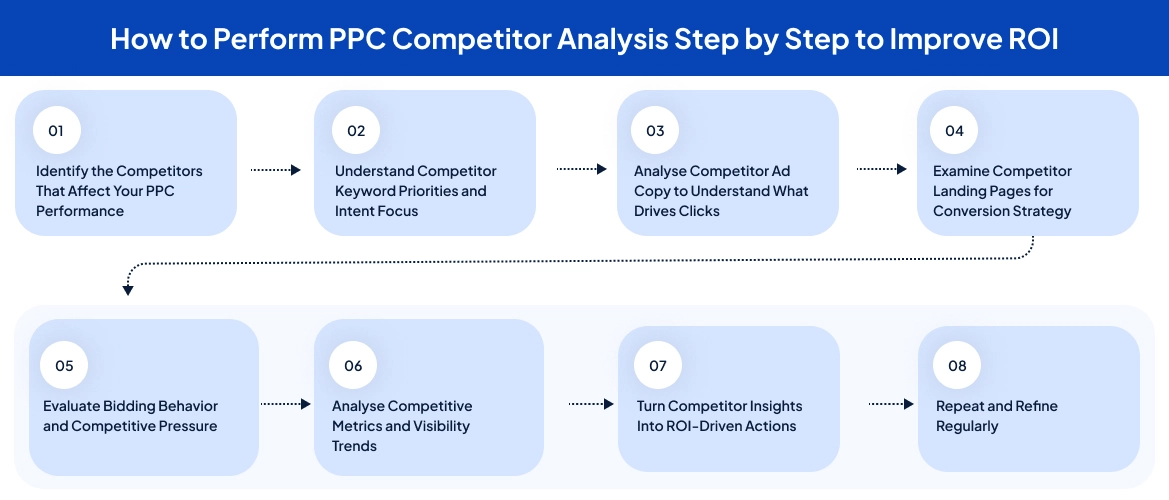
Step 1: Identify the Competitors That Affect Your PPC Performance
The first and most critical step is identifying true PPC competitors, not just brands you recognize in your industry. Many advertisers lose ROI by analysing companies that never actually compete with them in Google Ads auctions.
Your PPC competitors fall into two groups:
Direct PPC competitors are businesses offering similar products or services and targeting the same buying intent. These advertisers consistently appear for your high-intent keywords and directly influence your costs and impression share.
Indirect PPC competitors may offer alternative solutions or related services, but still compete for the same search intent. Even if their offering is different, they can increase CPCs and reduce visibility for your ads.
To identify them accurately, search your core transactional keywords and note which advertisers appear repeatedly. Use Google Ads Auction Insights to uncover overlapping bidders and review which competitors consistently outrank or appear alongside you. This step ensures every insight you gather is grounded in real auction dynamics.
Step 2: Understand Competitor Keyword Priorities and Intent Focus
Once competitors are identified, the next step is analysing how they structure their keyword strategy. Keywords reveal where competitors believe revenue comes from.
Rather than focusing on keyword volume alone, analyse intent. High-ROI competitors prioritise keywords that indicate readiness to act, terms related to pricing, comparisons, services, locations, or urgency. These keywords often convert better even if their search volume is lower.
Look for patterns such as:
- Keywords competitors bid on consistently over long periods
- Search terms tied to decision-making stages
- Keyword themes aligned with specific offers or services
This step helps you avoid months of trial and error by learning which keywords already demonstrate commercial value. It also helps uncover keyword gaps that are valuable queries competitors are ignoring or underbidding on, which often offer lower CPCs and higher ROI potential.
Step 3: Analyse Competitor Ad Copy to Understand What Drives Clicks
Ad copy analysis is about understanding what motivates users to choose one ad over another. Ads that consistently appear are rarely accidental, they are usually optimised based on performance data.
Study competitor ad messaging to identify:
- The problems or pain points they highlight
- The benefits they emphasise most strongly
- The emotional or rational triggers they use
Pay close attention to headlines and calls-to-action. Strong CTAs usually match the user’s stage in the buying journey, whether it’s learning, comparing, or ready to convert. Also, analyse how competitors structure urgency, credibility, or guarantees within limited character space.
Additionally, review their use of ad extensions. Sitelinks, callouts, and structured snippets often reveal which services, differentiators, or trust elements competitors believe improve click-through rates.
This step allows you to create ads that feel more relevant, differentiated, and conversion-focused, rather than generic or reactive.
Step 4: Examine Competitor Landing Pages for Conversion Strategy
Clicks only create ROI when landing pages convert. That is why landing page analysis is one of the most valuable parts of PPC competitor analysis.
Evaluate competitor landing pages from a user’s perspective. Ask whether the page immediately reinforces the promise made in the ad, removes uncertainty, and guides visitors toward a clear action.
Focus on:
- Message consistency between ads and landing pages
- Clarity of the primary offer and call-to-action
- Use of trust signals such as testimonials, reviews, or certifications
- Page structure, readability, and mobile usability
High-performing landing pages reduce friction by answering objections early and making next steps obvious. If competitors appear to test multiple layouts or messaging variations, it often indicates an active optimisation strategy aimed at improving conversion rates.
These insights can help you improve your own pages so each click produces more value, without increasing spend.
Step 5: Evaluate Bidding Behavior and Competitive Pressure
Understanding how aggressively competitors bid helps you avoid unnecessary budget waste. While you cannot see exact bids, bidding patterns provide strong signals.
Competitors who maintain a consistent top-of-page presence usually invest heavily in those keywords. Others may bid selectively during peak hours, specific locations, or high-intent searches.
Analyse:
- Keywords with intense competition and rising CPCs
- Areas where competitors reduce visibility or disappear
- Seasonal or promotional bidding trends
This allows you to shift budget toward opportunities with stronger ROI rather than entering expensive bidding wars where margins shrink quickly.
Step 6: Analyse Competitive Metrics and Visibility Trends
Performance metrics provide context for how well competitors execute their strategies. While exact data is unavailable, visibility trends reveal a lot.
Using Auction Insights and competitive monitoring tools, review:
- Impression share and overlap rate
- Position-above rate
- Changes in competitor presence over time
These trends help you understand whether performance shifts are caused by internal campaign issues or broader competitive pressure. Over time, this insight allows you to anticipate market changes instead of reacting after performance declines.
Step 7: Turn Competitor Insights Into ROI-Driven Actions
The final and most important step is execution. PPC competitor analysis only improves ROI when insights are applied strategically.
Use your findings to:
- Prioritise high-intent, high-efficiency keywords
- Refine ad messaging to better match user intent
- Improve landing page clarity and conversion flow
- Allocate budget toward opportunities competitors overlook
This transforms competitor analysis from passive observation into a performance-driven optimisation process.
Step 8: Repeat and Refine Regularly
Competitor behaviour changes constantly. New advertisers enter auctions, budgets shift, and messaging evolves. To maintain ROI, competitor analysis must be ongoing.
High-competition accounts benefit from monthly reviews, while fast-moving industries may require weekly monitoring. Regular analysis ensures your campaigns stay aligned with market realities rather than outdated assumptions.
Common PPC Competitor Analysis Mistakes
Even experienced advertisers make mistakes when analysing competitors. These missteps often lead to higher costs, poor performance, and strategies that look good on paper but fail to deliver ROI. Understanding what not to do is just as important as knowing the right steps.
Below are the most common PPC competitor analysis mistakes, and why they hurt performance.
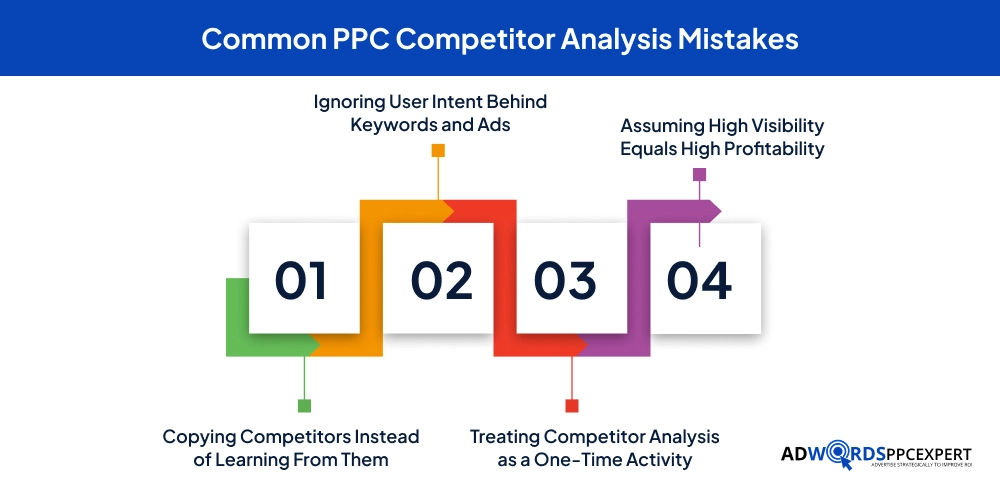
Mistake 1: Copying Competitors Instead of Learning From Them
One of the biggest mistakes advertisers make is treating competitor analysis as a blueprint to copy. Replicating competitor ads, keywords, or landing pages removes differentiation and weakens brand positioning.
Competitors operate with different budgets, audiences, and value propositions. What works for them may not work for you, and in some cases, copying can even lead to policy issues or compliance risks.
The real purpose of PPC competitor analysis is to understand patterns, not duplicate execution. Insights should inform smarter decisions, inspire better messaging, and help you identify gaps where you can stand out. ROI improves when you adapt insights to your strengths rather than mirror someone else’s strategy.
Mistake 2: Ignoring User Intent Behind Keywords and Ads
Another common mistake is analysing keywords and ads without understanding why users search for them. Keywords with similar wording can represent completely different intent stages, from research to comparison to purchase.
Focusing only on volume or visibility can lead to incorrect assumptions about what drives conversions. Competitor ads may perform well not because of the keyword itself, but because the messaging aligns perfectly with user expectations at that stage of the journey.
Without intent analysis, campaigns often attract clicks that don’t convert, increasing costs without improving results. Effective competitor analysis connects keywords, ad copy, and landing pages to intent-driven outcomes, not just impressions
Mistake 3: Treating Competitor Analysis as a One-Time Activity
Many advertisers conduct PPC competitor analysis once and never revisit it. This approach quickly becomes outdated.
Competitor strategies evolve constantly. Budgets change, messaging shifts, new keywords emerge, and automation introduces frequent adjustments. A one-time analysis reflects a moment in time, not an ongoing competitive landscape.
When analysis is not updated regularly, campaigns become reactive instead of proactive. Continuous monitoring allows you to identify trends early, respond to new threats, and capitalise on opportunities competitors have not fully explored. Ongoing analysis is what keeps PPC strategies aligned with real market conditions.
Mistake 4: Assuming High Visibility Equals High Profitability
Seeing competitors dominate the top of search results can be misleading. High impression share or top-of-page presence does not automatically mean a campaign is profitable.
Some advertisers prioritise visibility over efficiency, overspending to maintain dominance even when margins are thin. Others may run brand awareness campaigns that are not designed for immediate ROI.
Effective PPC competitor analysis looks beyond visibility and focuses on conversion signals, ad relevance, landing page alignment, messaging clarity, and intent matching. True competitive advantage comes from converting traffic efficiently, not simply appearing everywhere.
Why Avoiding These Mistakes Matters
Each of these mistakes leads to wasted spend, poor targeting, and missed opportunities. By avoiding them, PPC competitor analysis becomes a strategic advantage rather than a surface-level exercise.
When done correctly, competitor analysis helps you:
- Spend more efficiently
- Target higher-intent users
- Build stronger differentiation
- Improve conversion performance
That is what turns competitive insights into real ROI growth.
Top Tools for Effective PPC Competitor Analysis
PPC competitor analysis becomes significantly more accurate and efficient when supported by the right tools. While no tool provides perfect data, combining insights from multiple platforms helps uncover patterns related to keywords, ad messaging, visibility, and competitive pressure.
Below are the most widely used and reliable tools professionals use to conduct PPC competitor analysis that drives better ROI.
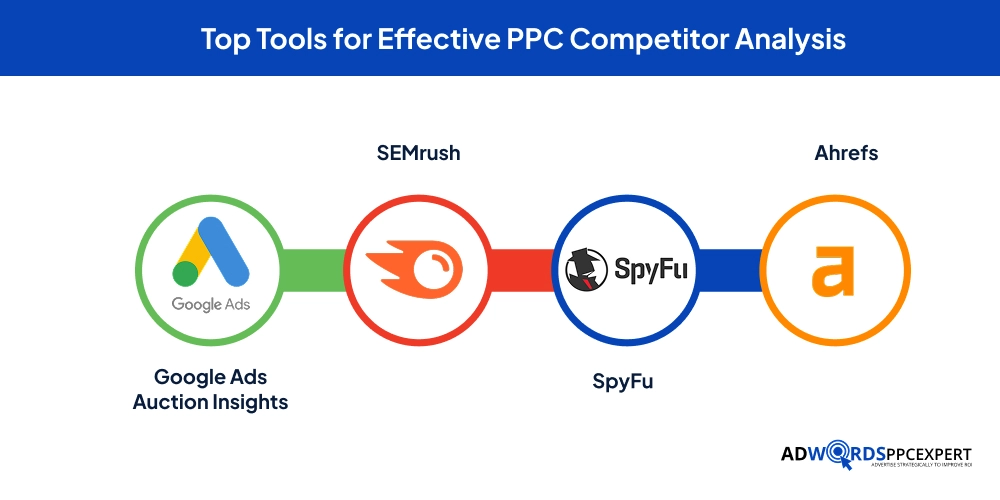
Google Ads Auction Insights
Google Ads Auction Insights is the most direct and trustworthy source for understanding PPC competition because it uses first-party auction data.
This tool shows which advertisers are competing with you for the same keywords and how often they appear relative to your ads. Metrics such as impression share, overlap rate, position-above rate, and top-of-page rate help you understand competitive intensity and bidding behaviour.
Auction Insights is especially useful for identifying:
- Who consistently outranks you
- Where competition increases or decreases over time
- Whether performance changes are due to competitors or internal factors
Because it reflects real auction activity, this tool should be the foundation of any PPC competitor analysis.
SEMrush
SEMrush is a powerful platform for analysing competitors’ paid keyword strategies at scale. It provides visibility into the keywords competitors bid on, estimated traffic, ad copy variations, and historical trends.
One of its biggest strengths is identifying keyword overlap and keyword gaps, helping you discover search terms competitors prioritise, or overlook entirely. SEMrush also allows you to review how long competitors have been bidding on specific keywords, which often indicates profitability.
This tool is ideal for understanding:
- High-intent keyword targeting
- Competitive keyword saturation
- Long-term PPC strategy patterns
SpyFu
SpyFu is particularly useful for tracking competitor ad history. It allows you to see which ads competitors have run repeatedly and which keywords they have invested in over time.
Ads that run for extended periods usually signal strong performance. By reviewing historical data, you can avoid short-term trends and focus on strategies that consistently deliver results.
SpyFu also provides estimated spend and CPC data, making it useful for benchmarking and budget planning. It’s especially effective for identifying which competitors are scaling versus testing.
Ahrefs
Although primarily known for SEO, Ahrefs also offers valuable insights for PPC competitor analysis. It helps identify keyword overlaps between paid and organic strategies and reveals how competitors align their content with paid traffic.
Ahrefs is particularly helpful for understanding:
- Keyword intent alignment
- Landing page relevance
- Content themes competitors support with paid ads
This tool works best when PPC and SEO strategies are integrated, allowing advertisers to improve both paid efficiency and long-term visibility.
Heatmap and User Behavior Tools
Tools like heatmaps and session recordings help analyse how competitor landing pages guide user behavior. While you can’t access competitor analytics directly, observing page structure, CTA placement, and content hierarchy provides insight into conversion strategy.
These tools are particularly helpful for improving post-click performance by identifying friction points and usability patterns that impact ROI.
How to Use Tools Without Over-Relying on Them
Tools support PPC competitor analysis, but they do not replace strategic thinking. Data should always be interpreted through the lens of intent, business goals, and conversion outcomes.
The most effective approach is combining:
- Auction-level insights for accuracy
- Keyword and ad intelligence for scale
- Landing page analysis for conversion optimisation
When used correctly, these tools turn competitor data into actionable decisions rather than overwhelming reports.
Final Thoughts
PPC competitor analysis delivers real value only when it leads to better decisions, not just better data. By understanding how competitors approach keywords, messaging, landing pages, and budget allocation, advertisers can reduce wasted spend and focus on strategies that drive meaningful conversions. When treated as an ongoing process, it helps campaigns stay aligned with user intent, market shifts, and competitive pressure. In crowded Google Ads environments, success depends on clarity, relevance, and execution, not simply higher budgets. A structured, insight-driven approach to PPC competitor analysis enables sustainable growth and stronger ROI, which is exactly the type of performance-focused strategy practiced at Adwordsppcexpert.
Frequently Asked Questions (FAQs)
1. How do you perform PPC competitor analysis?
PPC competitor analysis is performed by identifying advertisers competing for the same keywords, analysing their keyword targeting, ad copy, bidding behavior, landing pages, and visibility trends. The goal is to understand what drives their performance and apply those insights to improve your own campaign efficiency and ROI.
2. What tools are best for PPC competitor analysis?
The most effective tools for PPC competitor analysis include Google Ads Auction Insights for auction-level data, SEMrush and SpyFu for keyword and ad intelligence, Ahrefs for intent and content alignment, and ad intelligence platforms for broader market insights. Combining multiple tools provides more accurate and actionable data.
3. What metrics should you track in PPC competitor analysis?
Key metrics to track include impression share, overlap rate, position-above rate, estimated CPC, keyword coverage, ad messaging consistency, and landing page alignment. These metrics help determine competitive pressure and identify opportunities to improve performance.
4. How does PPC competitor analysis help lower cost per click?
PPC competitor analysis helps lower cost per click by identifying keywords competitors overbid on, uncovering lower-competition alternatives, and improving ad relevance. Higher relevance improves Quality Score, which reduces CPC and increases visibility without increasing spend.
5. What is the difference between PPC competitor analysis and keyword research?
Keyword research focuses on identifying search terms to target, while PPC competitor analysis evaluates how other advertisers use those keywords, structure ads, and allocate budget. Competitor analysis provides a strategic context that helps refine keyword selection and bidding decisions.

Ami Singh is a highly skilled AdWords PPC Specialist, known for creating profitable Google Ads strategies that elevate brands. With deep expertise in Google Search, Display, Shopping, YouTube Ads, and advanced bidding techniques, Ami consistently converts data into performance-driven results.
With a sharp analytical mind and a strong understanding of online consumer behavior, Ami designs campaigns that maximize ROI, boost quality scores, and reduce acquisition costs. His approach blends technical expertise with strategic thinking—making him a go-to expert for businesses aiming to dominate Google Ads.
Ami doesn’t just adapt to the fast-changing PPC industry, but he also stays ahead of the curve by testing new features, adopting automation smartly, and refining what works. Clients trust him for his transparency, insights, and ability to scale campaigns sustainably.
Looking to take your Google AdWords performance to the next level? Connect with Ami Singh at Softtrix and discover how he can help you get the maximum growth through powerful PPC strategies.